
Frequently Asked Questions
E-mail: [email protected]
This is the sixth monthly column in which I try to give you the best possible answers to the questions you write in or e-mail. I expect to make this introduction in a few more columns, until you get comfortable with the routine.
Each question has a sequential number for identification purposes. Because publication space is limited, spillover material will be posted on the AMA Web site at http://modelaircraft.org/mag/FAQ/index.asp. Actually, all questions and answers will be posted on the AMA Web site.
Let's start!
Q45
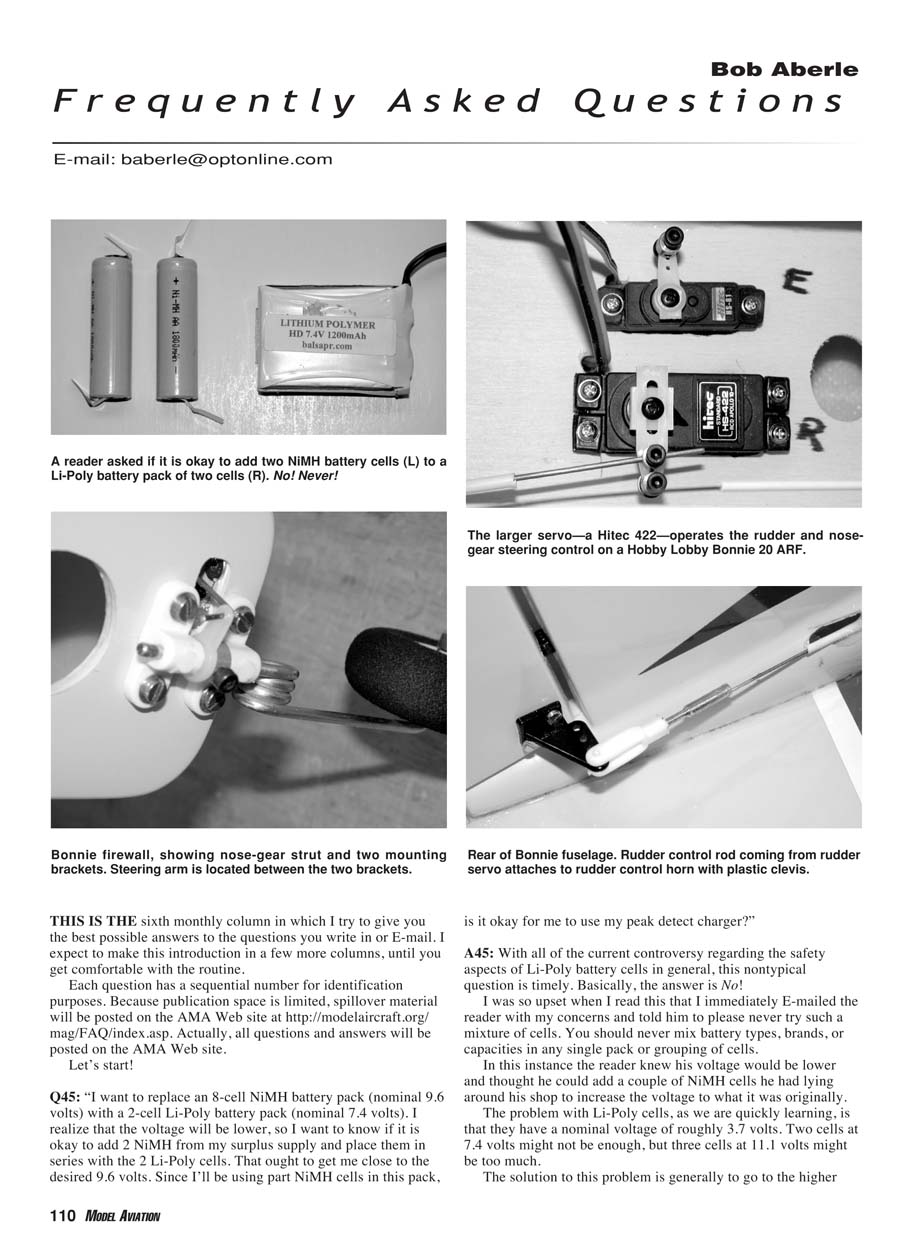
"I want to replace an 8-cell NiMH battery pack (nominal 9.6 volts) with a 2-cell Li-Poly battery pack (nominal 7.4 volts). I realize that the voltage will be lower, so I want to know if it is okay to add 2 NiMH from my surplus supply and place them in series with the 2 Li-Poly cells. That ought to get me close to the desired 9.6 volts. Since I'll be using part NiMH cells in this pack, is it okay for me to use my peak detect charger?"
A45: With all of the current controversy regarding the safety aspects of Li-Poly battery cells in general, this nontypical question is timely. Basically, the answer is No.
You should never mix battery types, brands, or capacities in any single pack or grouping of cells. In this instance the reader knew his voltage would be lower and thought he could add a couple of NiMH cells he had lying around his shop to increase the voltage to what it was originally. The problem with Li-Poly cells, as we are quickly learning, is that they have a nominal voltage of roughly 3.7 volts. Two cells at 7.4 volts might not be enough, but three cells at 11.1 volts might be too much.
The usual solution is to accept the higher voltage (use three cells) and then select a propeller that draws less current or, using a gear drive, change the reduction ratio to reduce the current. But never add other types of battery cells to Li-Poly packs. Likewise, do not attempt to charge a mixed pack with a peak-detect charger: you would quickly exceed the 4.2 volts maximum per Li-Poly cell and the Li-Poly cells would be damaged. While Li-Poly packs don't typically explode, a cell can swell and, in worst cases, catch fire.
Again: never mix battery chemistries in one pack, and never attempt to charge Li-Poly cells with anything except a dedicated Li-Poly charger.
Q46
"I just bought my first model aircraft with a steerable nose gear. I'm not sure how I should hook this up so that I can steer the model while on the ground."
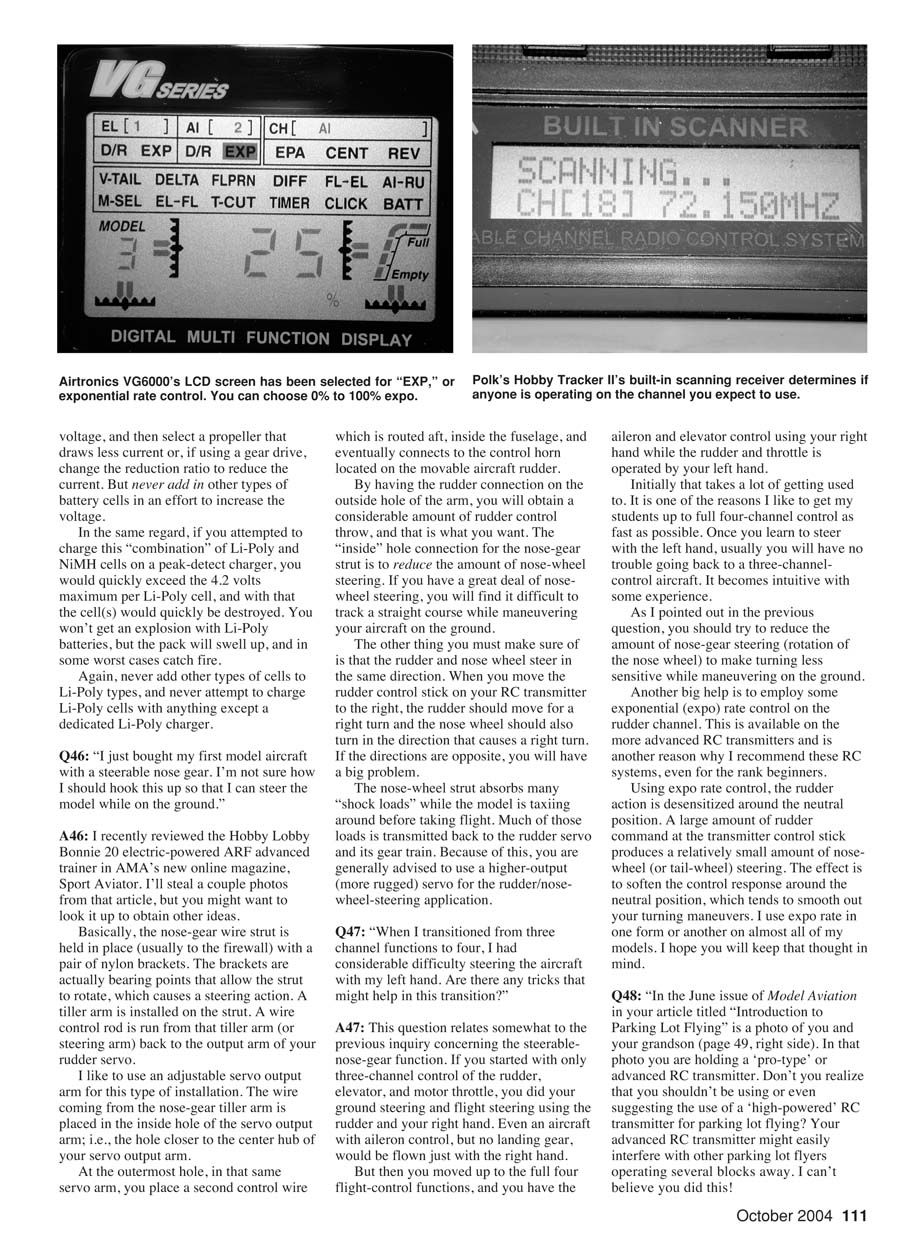
A46: The nose-gear wire strut is usually held in place (to the firewall) with a pair of nylon brackets that act as bearing points, allowing the strut to rotate for steering. A tiller arm is installed on the strut, and a wire control rod runs from that tiller arm back to the output arm of your rudder servo. I like to use an adjustable servo output arm for this type of installation.
- Place the wire from the nose-gear tiller arm in the inside hole of the servo output arm (the hole closer to the center hub) to reduce the amount of nose-wheel steering.
- At the outermost hole of the same servo arm, place a second control wire routed aft, inside the fuselage, to the control horn on the movable rudder. This outer hole gives a greater rudder throw for flight control.
Make sure the rudder and nose wheel steer in the same direction: when you move the rudder stick to the right, the rudder and the nose wheel should both respond to produce a right turn. If they work opposite one another, you'll have significant control problems.
Because the nose-wheel strut absorbs many shock loads while taxiing, much of that load is transmitted back to the rudder servo and its gear train. Use a higher-output (more rugged) servo for the rudder/nose-wheel-steering application.
Q47
"When I transitioned from three channel functions to four, I had considerable difficulty steering the aircraft with my left hand. Are there any tricks that might help in this transition?"
A47: This transition is common. With three-channel control (rudder, elevator, throttle) you used your right hand for ground steering and flight steering with the rudder. Moving to four-channel control typically places aileron and elevator on the right-hand sticks and rudder and throttle on the left hand, which takes getting used to.
Tips:
- Practice to develop the left-hand coordination; with experience it becomes intuitive.
- Reduce the amount of nose-gear steering (as described in Q46) to make ground turning less sensitive.
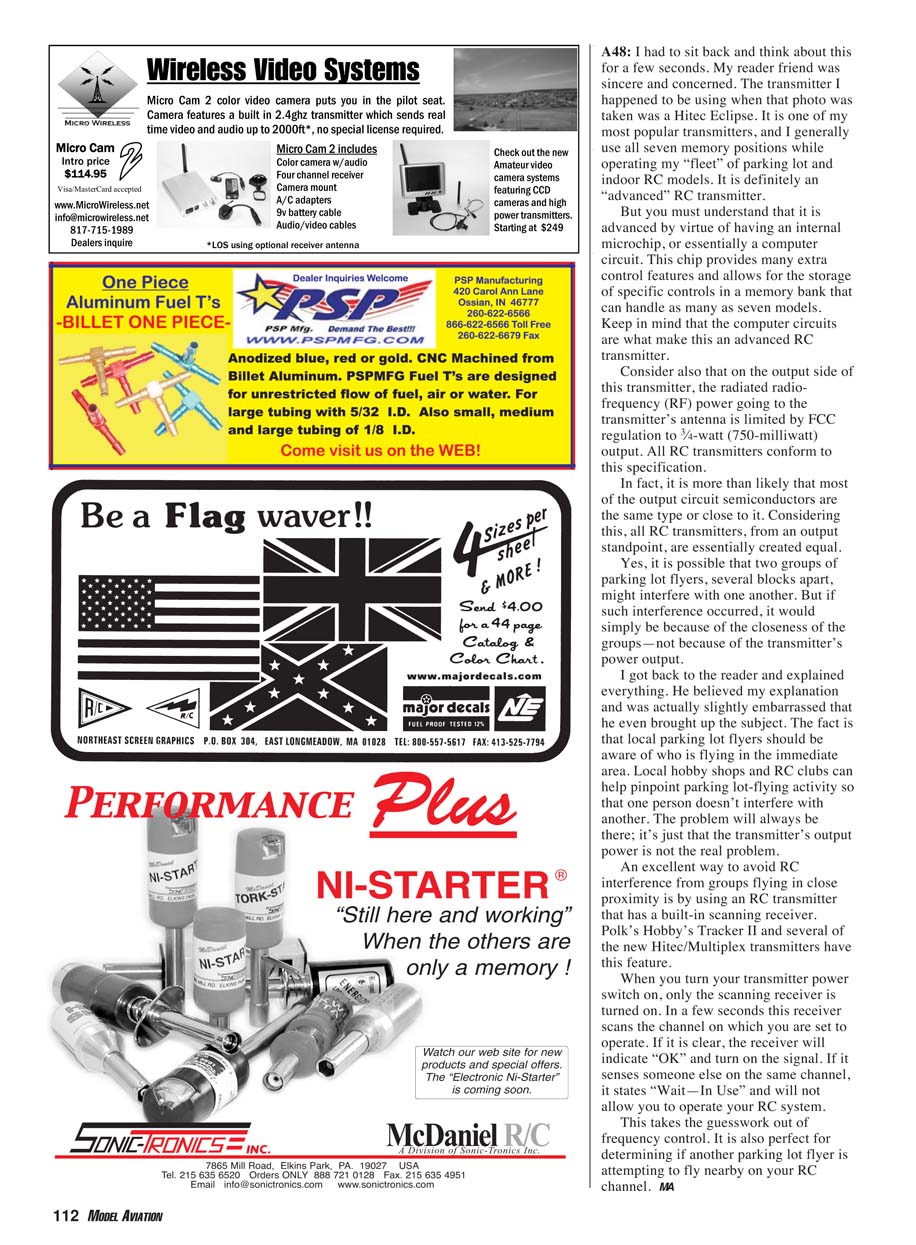
- Use exponential (expo) rate control on the rudder channel if your transmitter supports it. Expo desensitizes rudder response around neutral, smoothing turning maneuvers and preventing overly sensitive nose-wheel steering. I use some form of expo on almost all my models.
Q48
"In the June issue of Model Aviation in your article titled 'Introduction to Parking Lot Flying' is a photo of you and your grandson (page 49, right side). In that photo you are holding a 'pro-type' or advanced RC transmitter. Don't you realize that you shouldn't be using or even suggesting the use of a 'high-powered' RC transmitter for parking lot flying? Your advanced RC transmitter might easily interfere with other parking lot flyers operating several blocks away. I can't believe you did this!"
A48: The transmitter was in the "scan" mode. The Hobby Tracker II transmitter will scan the band to locate a clear channel and then lock onto the first clear channel. In that photo the scanner had located channel 187 at 72.150 MHz, so the transmitter was not radiating an RF signal in the picture.
Most modern transmitters are frequency-agile and will pick a clear channel. When flying in a parking-lot environment you should always check that the channel is clear and that no one else is operating on or near your chosen channel.
A few clarifications:
- The Hitec Eclipse (the transmitter I happened to be using) is considered "advanced" because it contains an internal microchip that provides extra control features and memory for multiple models. That computer circuitry does not imply greater RF output.
- FCC regulations limit output power to 3/4 watt (750 milliwatts) for these transmitters, so from an output standpoint most transmitters are essentially equal.
- If groups of parking lot flyers several blocks apart interfere with one another, it's due to proximity and channel use, not the inherent power of any particular transmitter.
Local hobby shops and RC clubs can help coordinate parking lot flying to avoid interference. An excellent way to avoid RC interference in close-proximity flying is to use a transmitter with a built-in scanning receiver (for example, Polk's Hobby Tracker II and several newer Hitec/Multiplex transmitters). When you turn on such a transmitter, the scanning receiver checks whether the channel is clear; if clear, it enables the main transmitter, and if the channel is in use it prevents you from operating on that channel. This removes much of the guesswork from frequency control and helps prevent interference.
MA
Transcribed from original scans by AI. Minor OCR errors may remain.

