
Frequently Asked Questions - 2005/02
Bob Aberle E-mail: [email protected]
THIS IS THE 11th monthly column in which you write in or E-mail your questions, and I try to give you the best possible answers. Each question is given a sequential number for identification purposes. Because publication space is limited, part of each month’s installment will appear here, and the columns in their entirety are posted on the AMA Web site at www.modelaircraft.org/mag/faq/index.asp.
Let’s get started!
Q89
“I’m beginning to realize that more and more magazines, the AMA, and even private individuals are making available archives of previously published model aircraft articles, plans, three-views, photos, etc. Searching for this type of data can present problems at times, depending on how the search program is organized.
Keeping all of this in mind, could you recommend a good starting point for me as I attempt to look up model aircraft designs of yesterday?”
A89: AMA has established a digital archive of articles published in MA from 1975 until 2000. (A notice concerning this service was published in the June 2004 issue on page 36.)
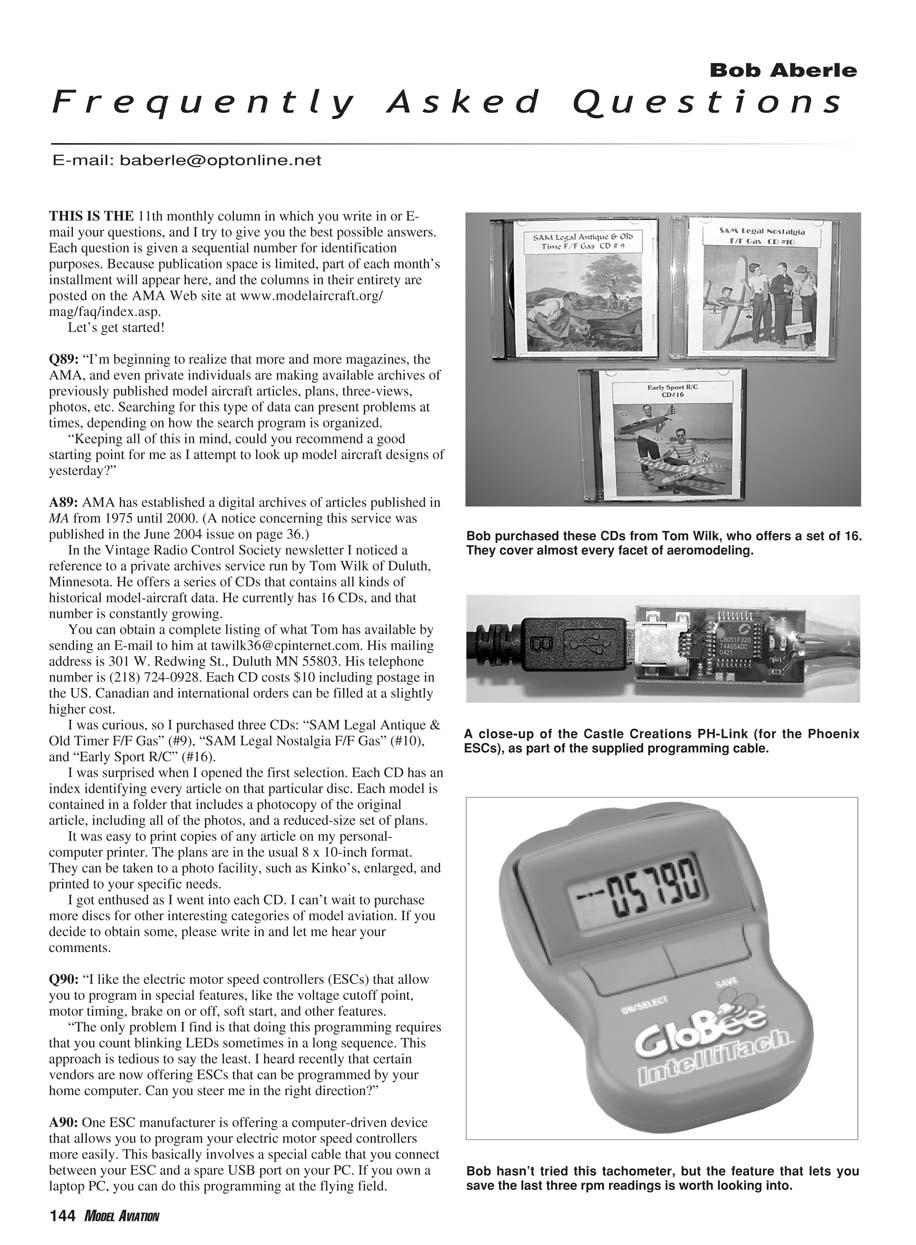
In the Vintage Radio Control Society newsletter I noticed a reference to a private archive service run by Tom Wilk of Duluth, Minnesota. He offers a series of CDs that contain all kinds of historical model-aircraft data. He currently has 16 CDs, and that number is constantly growing.
You can obtain a complete listing of what Tom has available by contacting him:
- E-mail: [email protected]
- Mail: Tom Wilk, 301 W. Redwing St., Duluth, MN 55803
- Phone: (218) 724-0928
Each CD costs $10 including postage in the U.S. Canadian and international orders can be filled at a slightly higher cost.
I purchased three CDs: “SAM Legal Antique & Old Timer F/F Gas” (#9), “SAM Legal Nostalgia F/F Gas” (#10), and “Early Sport R/C” (#16). Each CD has an index identifying every article on that disc. Each model is contained in a folder that includes a photocopy of the original article (with photos) and a reduced-size set of plans.
It was easy to print copies on my personal computer printer. The plans are in the usual 8 x 10-inch format and can be taken to a photo facility (such as Kinko’s) to be enlarged and printed to your specific needs.
I got enthused as I went through each CD and can’t wait to purchase more discs for other categories of model aviation. If you decide to obtain some, please write in and let me hear your comments.
Q90
“I like the electric motor speed controllers (ESCs) that allow you to program in special features, like the voltage cutoff point, motor timing, brake on or off, soft start, and other features.
The only problem I find is that doing this programming requires that you count blinking LEDs sometimes in a long sequence. This approach is tedious, to say the least. I heard recently that certain vendors are now offering ESCs that can be programmed by your home computer. Can you steer me in the right direction?”
A90: One ESC manufacturer offers a computer-driven device that allows you to program your ESCs more easily. This involves a special cable that you connect between your ESC and a spare USB port on your PC. If you own a laptop, you can do this programming at the flying field.
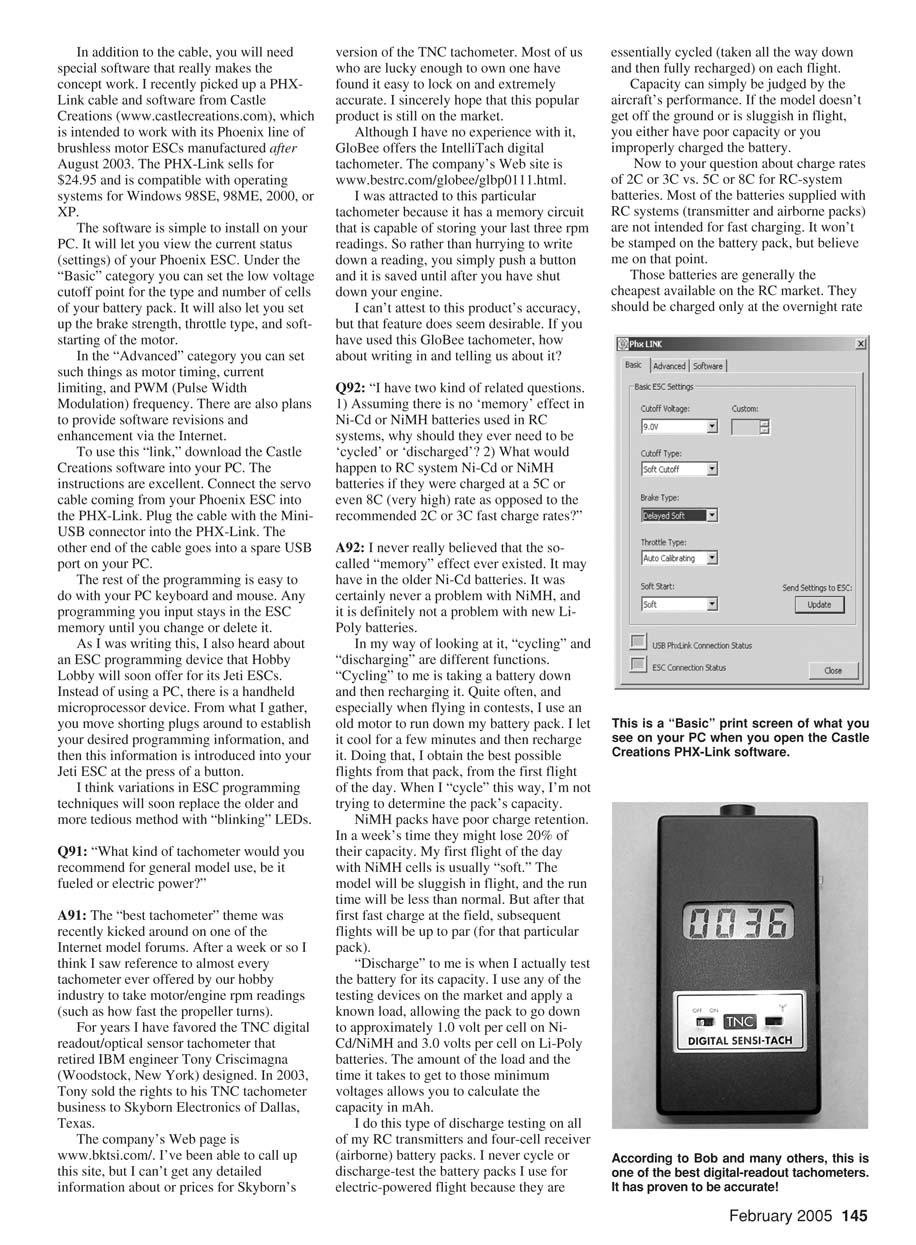
Castle Creations provides the PHX-Link cable and software, intended to work with its Phoenix line of brushless motor ESCs manufactured after August 2003. Details:
- Product: PHX-Link cable and software (Castle Creations)
- Price: $24.95
- Compatibility: Windows 98SE, 98ME, 2000, or XP
- Website: www.castlecreations.com
The software is simple to install and lets you view and change the current settings of a Phoenix ESC. In the "Basic" category you can set the low-voltage cutoff for the battery type/number of cells, brake strength, throttle type, and soft-start. In the "Advanced" category you can set motor timing, current limiting, and PWM frequency. Castle Creations plans to provide software revisions and enhancements via the Internet.
To use the PHX-Link:
- Download and install the Castle Creations software on your PC.
- Connect the servo cable from your Phoenix ESC to the PHX-Link.
- Plug the mini-USB connector into the PHX-Link and the other end into a spare USB port on your PC.
- Program settings using your keyboard and mouse; changes are stored in the ESC memory until changed again.
I also heard about a handheld programming device Hobby Lobby will soon offer for its Jeti ESCs. Instead of using a PC, it’s a microprocessor handheld where you move shorting plugs to select programming options and then transfer the settings to the ESC at the press of a button.
I think ESC programming techniques will soon replace the older, tedious blinking-LED method.
Q91
“What kind of tachometer would you recommend for general model use, be it fueled or electric power?”
A91: Discussion on Internet model forums covered almost every tachometer offered by the hobby industry. For years I have favored the TNC digital readout/optical sensor tachometer designed by Tony Criscimagna (Woodstock, New York). In 2003 Tony sold the rights to his TNC tachometer business to Skyborn Electronics of Dallas, Texas.
Skyborn’s web page is: www.bktsi.com/. I’ve been able to access the site but couldn’t find detailed product/pricing information there. Owners of the original TNC tachometer have found it easy to lock on and extremely accurate. I hope the product remains available.
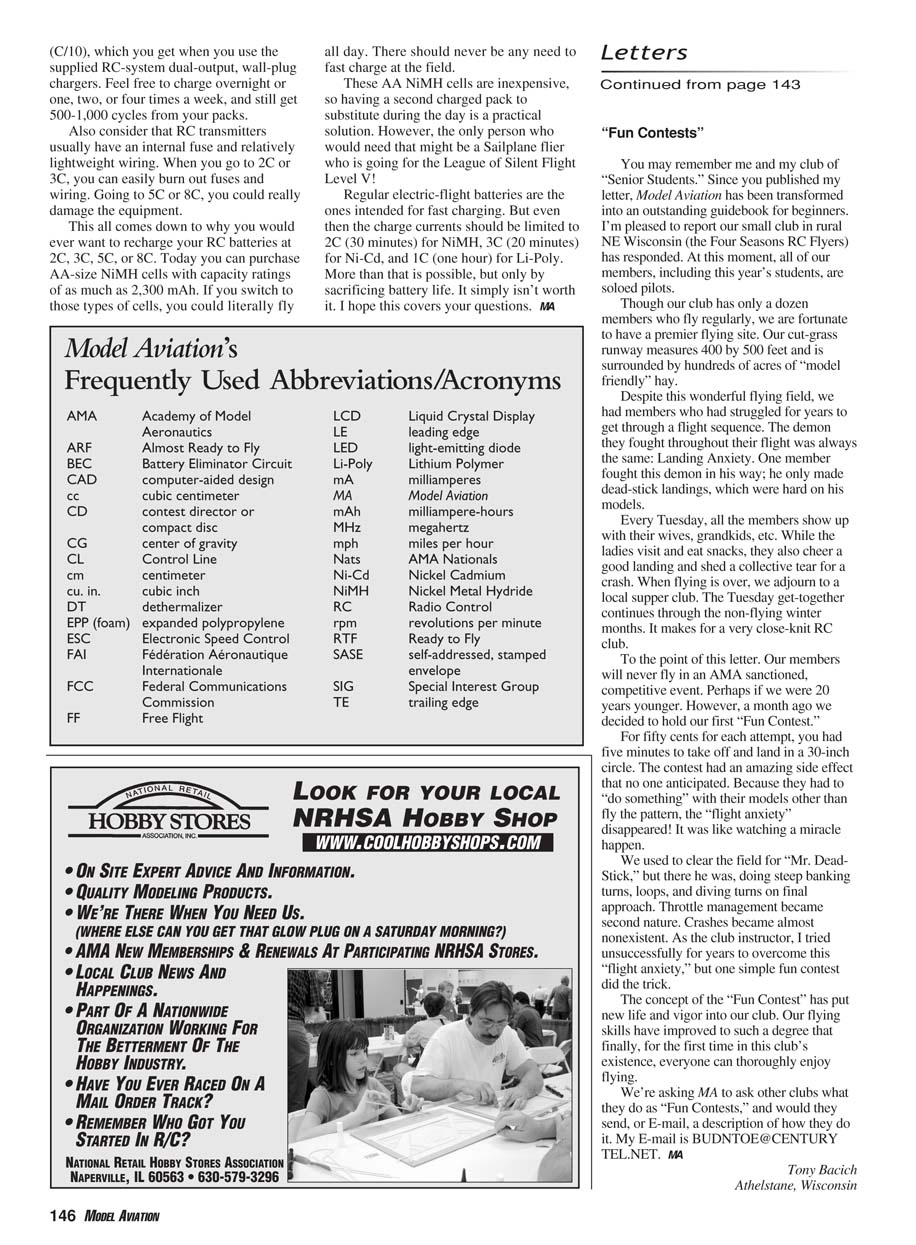
Another option is the GloBee IntelliTach digital tachometer (I have no personal experience with it). Website: www.bestcre.com/globee/gbp0111.html. I was attracted to the IntelliTach because it has a memory circuit capable of storing your last three rpm readings, so you can save a reading rather than rushing to write it down. I can’t attest to its accuracy; if you’ve used the GloBee tachometer, please write in and share your experience.
Q92
“I have two kind of related questions. 1) Assuming there is no 'memory' effect in Ni-Cd or NiMH batteries used in RC systems, why should they ever need to be 'cycled' or 'discharged'? 2) What would happen to RC system Ni-Cd or NiMH batteries if they were charged at a 5C or even 8C (very high) rate as opposed to the recommended 2C or 3C fast charge rates?”
A92: I never really believed the so-called "memory" effect ever existed; it may have been an issue with older Ni-Cd cells but it was never a problem with NiMH and is definitely not a problem with Li-Poly batteries.
In my view, "cycling" and "discharging" are different:
- "Cycling" means taking a battery down and then recharging it. Often, especially in contests, I use an old motor to run down my pack, let it cool a few minutes, then recharge it. That helps obtain the best possible flights from that pack, from the first flight of the day. When I cycle this way, I’m not testing the pack’s capacity.
- "Discharge" refers to testing the battery for capacity. I use a tester to apply a known load and allow the pack to fall to about 1.0 volt per cell for Ni-Cd/NiMH or 3.0 volts per cell for Li-Poly. The load and time to reach the minimum voltage let you calculate capacity in mAh.
NiMH packs have poor charge retention; in a week they might lose around 20% of capacity. My first flight of the day on NiMH is usually "soft" (sluggish and shorter runtime), but after a fast field charge, subsequent flights perform normally for that pack.
I do discharge testing on all my RC transmitter and four-cell receiver (airborne) battery packs. I do not routinely cycle or discharge-test packs used for electric-powered flight because they are essentially cycled on each flight; capacity is judged by aircraft performance. If a model doesn’t get off the ground or is sluggish, you either have poor capacity or an improperly charged battery.
Regarding charging rates: most batteries supplied with RC systems (transmitter and airborne packs) are not intended for fast charging. These are generally the cheapest packs and should be charged only at the overnight (slow) rate. Charging such packs at very high rates (5C or 8C) risks damaging them, reducing service life, or causing unsafe conditions.
Transcribed from original scans by AI. Minor OCR errors may remain.

