
Frequently Asked Questions - 2005/03
Bob Aberle
E-mail: [email protected]
This is the 12th monthly column in which you write in or E-mail your questions, and I try to give you the best possible answers. Each inquiry is given a sequential number for identification purposes.
Because publication space is limited, part of each month's installment will appear here, and the columns in their entirety are posted on the AMA Web site at www.modelaircraft.org/mag/faq/index.asp. There you can access questions by subject matter or category. This is to help you retrieve data for particular subjects. When you call up a question, it reads "Answer ..." at the end. Double-click on that word, and the answer, along with any related photos, will be displayed.
Let's start!
Q96
"I've read a lot about the fact that the new Li-Poly battery cells should not be discharged below 2.8 to 3.0 volts. Failure to observe that caution can greatly reduce the life of these cells. I know most new ESCs can either be selected for the proper cutoff or better yet will automatically set themselves to the proper cutoff voltage.
"My problem is that I have an older-designed ESC with a fixed cutoff of 5 volts that was fine for my Ni-Cd and NiMH packs, but certainly not for Li-Poly batteries. Is there any add-on device I can buy that will provide the proper cutoff and still allow me to use my older ESCs?"
A96
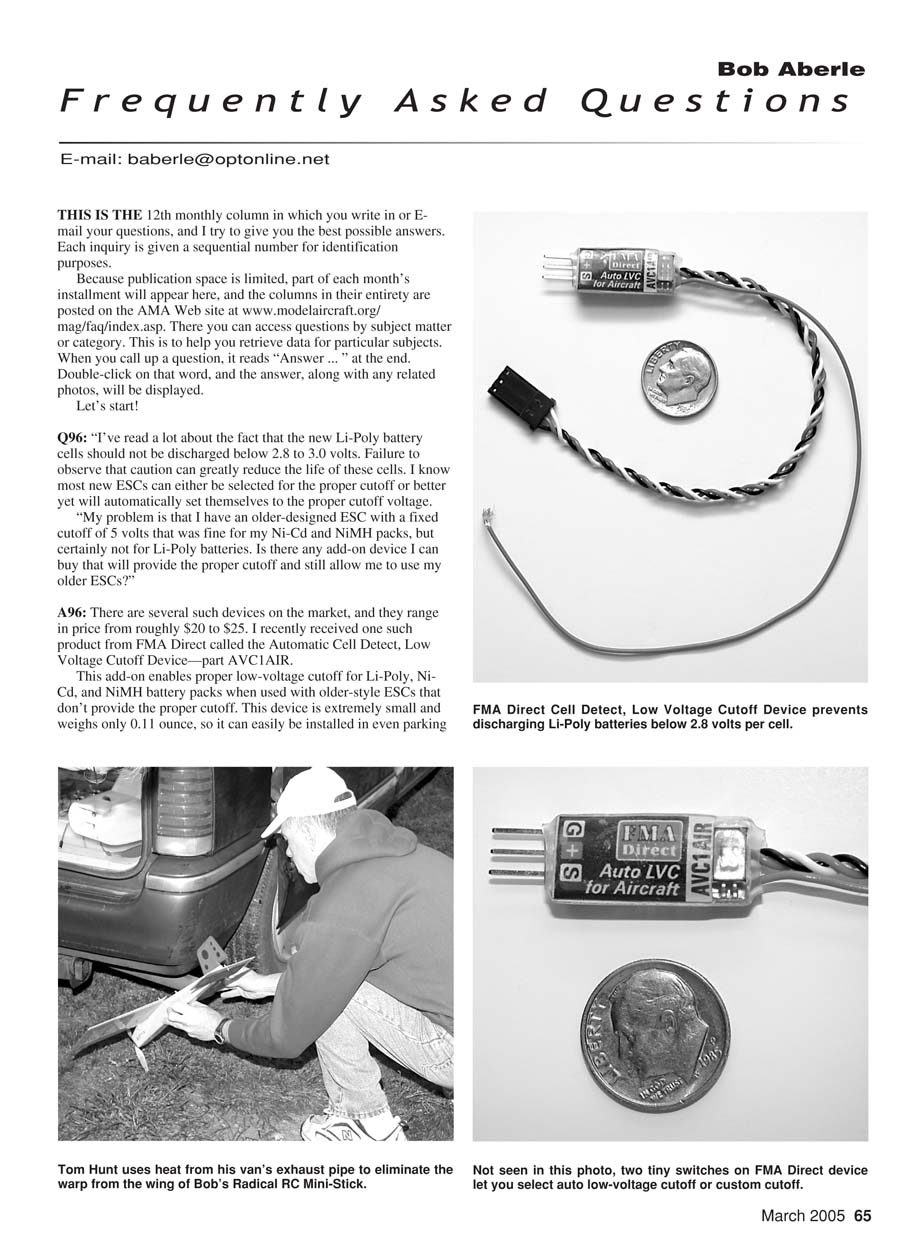
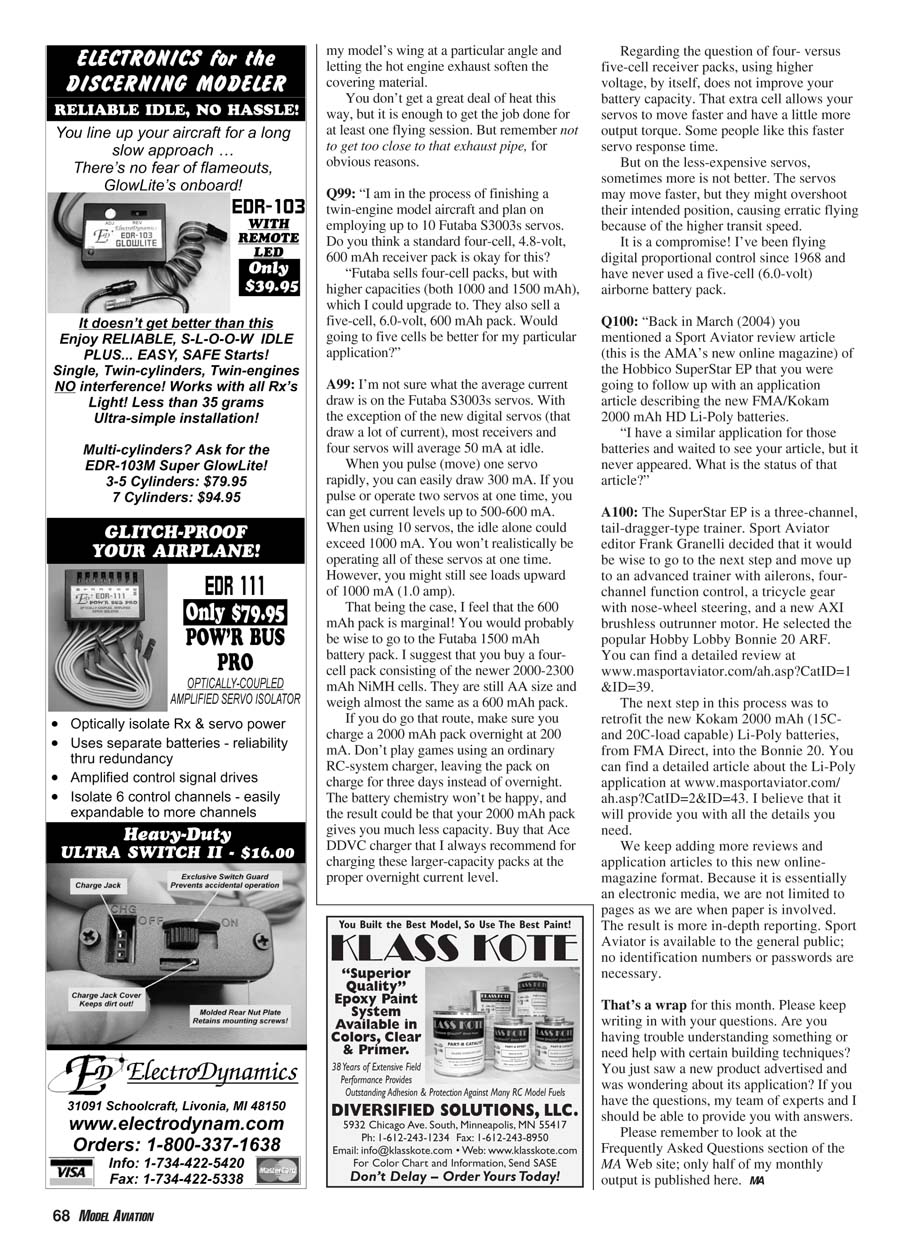
There are several such devices on the market, typically in the $20–$25 range. I recently received one from FMA Direct called the Automatic Cell Detect, Low Voltage Cutoff Device (part AVC1AIR).
This add-on provides proper low-voltage cutoff for Li-Poly, Ni-Cd, and NiMH battery packs when used with older ESCs that don't have the proper cutoff. The device is extremely small (about 0.11 ounce), so it can be installed in even small models with negligible weight penalty.
Installation and operation:
- Plug the servo lead from your ESC into the connector on one end of the device.
- Plug the cable exiting the device into the throttle port on your receiver.
- Splice the device's single extra wire into the positive (+) battery lead as it exits the ESC.
- Detailed installation instructions are provided with the unit.
Operation modes:
- Automatic cutoff: the device samples the battery pack and sets an appropriate cutoff automatically.
- Custom cutoff: you can establish and store your own voltage-cutoff point; the device retains that setting until you change it.
More information:
- FMA Direct: www.fmadirect.com — search for "AVC1AIR".
- A similar product, the Li-Saver, is available from Diversity Model Aircraft Inc. at www.flydma.com/flydmahome.asp (priced around $24.95).
Either product will help ensure your Li-Poly batteries are not discharged below the recommended ~2.8 volts per cell.
Q97
"I have a few questions concerning '3-D' type model aircraft. Like what is the difference between a '3-D' airplane and a fun-fly type? Where can I get plans or kits for '3-D' type airplanes? Where can I find a description of '3-D' type maneuvers?"
A97
The term "3-D" began a few years ago with the development of a new style of maneuvers. 3-D airplanes are capable of hovering and performing maneuvers such as torque rolls, harriers, rollers, and similar moves.
Key characteristics of 3-D aircraft:
- Power-to-weight ratio of at least 2:1.
- Extremely quick throttle response to correct deviations while hovering or flying behind the power curve.
- "3-D" typically refers to glow or gas-powered models; "E-3-D" describes the electric equivalents.
Where to learn more:
- Quiet Flyer publisher Wil Byers has introduced 3-D Flyer magazine, specializing in this discipline (see MA Special Issue 2004, p. 158 for an ad and offer).
- Dave Baron writes a monthly "Freestyle" column for Fly RC magazine and has excellent articles on the physics and dynamics of flying behind the power curve.
These references should provide a good starting point for plans, kits, and maneuver descriptions.
Q98
"I recently had a situation where my RC pilot instructor told me at the flying field that I had a warp in my wing and that I should remove it before he would allow me to fly. That was the end of my flying for that day, before I even started.
"I learned my lesson and will be more observant in the future. But looking back, is there any way I could have saved my day of flying?"
A98
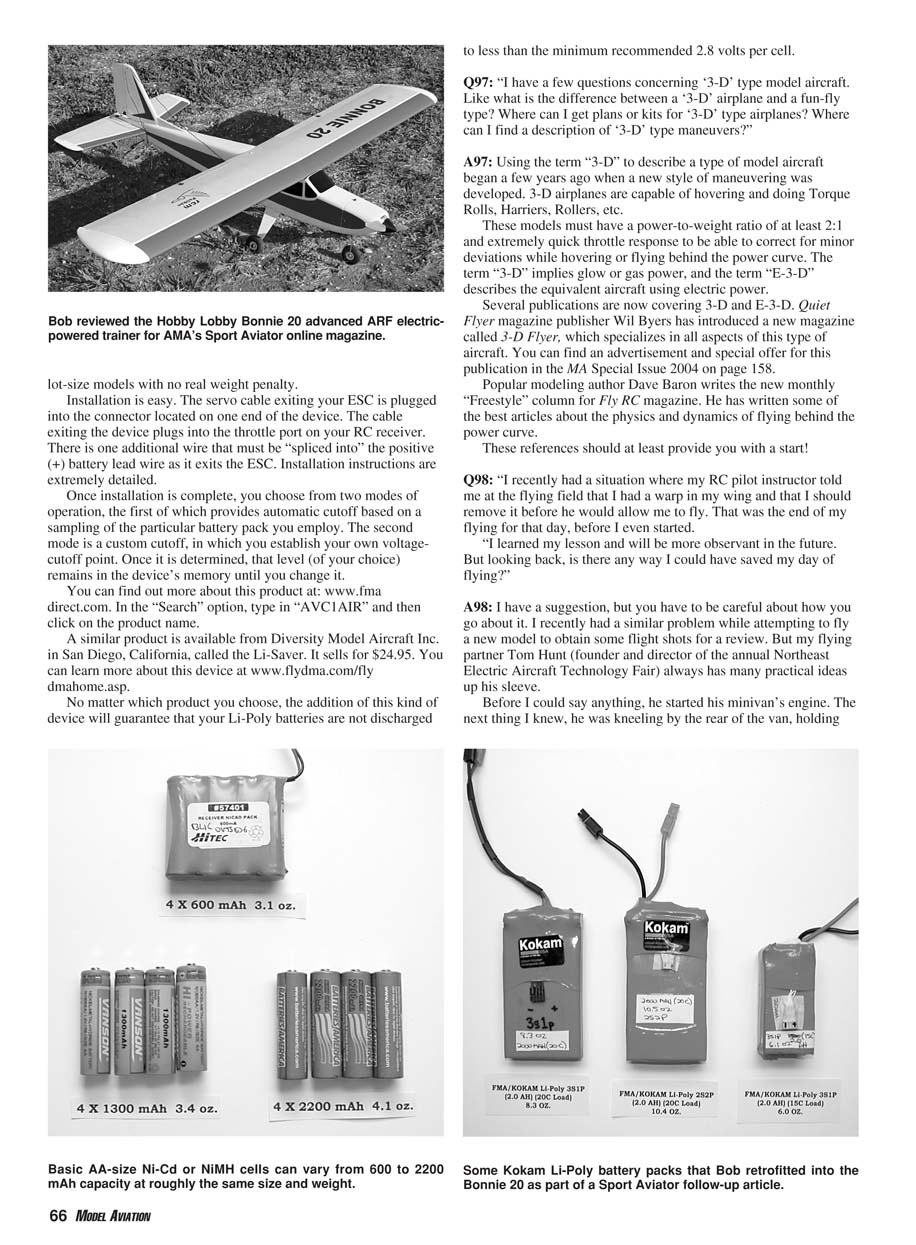
There is a practical—but cautious—trick you can use. I had a similar problem while preparing to fly a new model. My flying partner, Tom Hunt, used his minivan's hot engine exhaust to soften the covering and remove the warp.
Method:
- Hold the wing at the needed angle and expose the warped area to the hot exhaust just long enough to soften the covering so it relaxes.
- Be very careful not to bring the covering too close to the exhaust pipe, and avoid overheating or burning the covering.
This will usually get the job done for at least one flying session, but exercise caution for safety and to avoid damage.
Q99
"I am in the process of finishing a twin-engine model aircraft and plan on employing up to 10 Futaba S3003 servos. Do you think a standard four-cell, 4.8-volt, 600 mAh receiver pack is okay for this?
"Futaba sells four-cell packs, but with higher capacities (both 1000 and 1500 mAh), which I could upgrade to. They also sell a five-cell, 6.0-volt, 600 mAh pack. Would going to five cells be better for my particular application?"
A99
Servo current draw varies, but here are some typical figures and recommendations:
- Most non-digital servos idle at about 50 mA each.
- A single servo moving rapidly can draw ~300 mA.
- Two servos moving together can approach 500–600 mA.
- Ten servos could have an idle draw exceeding 1,000 mA (1 A). You won't operate all simultaneously, but peak loads can still be around 1 A or higher.
Given that, a 600 mAh pack is marginal for 10 servos. I recommend:
- Use a higher-capacity pack such as Futaba's 1500 mAh, or better yet, a four-cell pack made of modern NiMH cells in the 2000–2300 mAh range (still AA size and similar weight to a 600 mAh pack).
- Charge a 2000 mAh pack overnight at 200 mA (proper slow charge). Do not leave it on a basic RC charger for days—use a proper charger and correct charging current to preserve capacity (I recommend the Ace DDVC charger for overnight charging of large packs).
On using four vs. five cells:
- A higher voltage (five cells, 6.0 V) does not increase capacity; it increases servo speed and torque.
- Faster response can be beneficial, but on inexpensive servos it can cause overshoot and erratic control.
- It’s a trade-off; personally I have flown digital proportional systems since 1968 and have not used five-cell (6.0 V) airborne packs.
Q100
"Back in March (2004) you mentioned a Sport Aviator review article (this is the AMA's new online magazine) of the Hobbico SuperStar EP that you were going to follow up with an application article describing the new FMA/Kokam 2000 mAh HD Li-Poly batteries.
"I have a similar application for those batteries and waited to see your article, but it never appeared. What is the status of that article?"
A100
The SuperStar EP is a three-channel, tail-dragger trainer. Sport Aviator editor Frank Granelli decided to move up to an advanced trainer with ailerons and four-channel control, tricycle gear with nose-wheel steering, and a new AXI brushless outrunner motor. He selected the Hobby Lobby Bonnie 20 ARF. See the detailed review at:
The Kokam 2000 mAh Li-Poly (15C and 20C capable) batteries from FMA Direct were retrofitted into the Bonnie 20. A detailed application article is available at:
Sport Aviator is an online magazine open to the public, and because it's electronic we can include more photos and more in-depth reporting. We keep adding reviews and application articles to the site.
That's a wrap for this month. Please keep writing in with your questions. If you need help understanding something, want building technique advice, or are wondering about a new product's application, my team of experts and I will do our best to get answers for you.
Please remember to look at the Frequently Asked Questions section of the MA Web site; only half of my monthly output is published here.
MA
Transcribed from original scans by AI. Minor OCR errors may remain.

