

Frequently Asked Questions - 2005/06
Bob Aberle
- E-mail: [email protected]
THIS IS THE 15th monthly column in which I will try to give you the best possible answers to questions you have written in or E-mailed to me. Each new question is given a sequential number for identification purposes. Because publication space is limited, part of this column will appear in print and the columns in their entirety will be posted on the AMA Web site at www.modelaircraft.org/mag/faq/index.asp. There, you can access particular questions by subject matter or categories; that allows you to retrieve data for specific topics. When you call up a question, at the end it reads “Answer …” Double-click on that word, and the answer and any related photos will be displayed. Let's start!
Q116: Operating flaps
Q: "I've heard that operating flaps can be added to model aircraft and that they can provide roughly the same advantages they do on full-scale aircraft, namely provide more lift at low flying speeds, especially when landing. Being pretty much a beginner in the RC hobby I would like to try flaps to possibly make my landing approaches easier (slower) for me."
A: Operating (or deployable) flaps have been used on RC models for years, with considerable success. The flaps are located inboard of the regular aircraft ailerons. The ailerons produce the model’s roll motion by banking it left or right. Concurrent with that roll action, the inboard flaps can be deployed to add lift to the wing, allowing the airplane to be slowed more than normal, without stalling.
Adding operating flaps to your airplane will take additional time and result in some added complexity. You will need:
- An extra channel function on your RC transmitter and receiver.
- An extra servo to work the flaps.
- A decision on how far to deploy the flaps (angle).
If there is too much downward angle, your model will tend to pitch down. That nose-down tendency must be immediately compensated for with up-elevator control at the time of flap deployment. The farther down you drop the flaps, the more elevator compensation you will need.
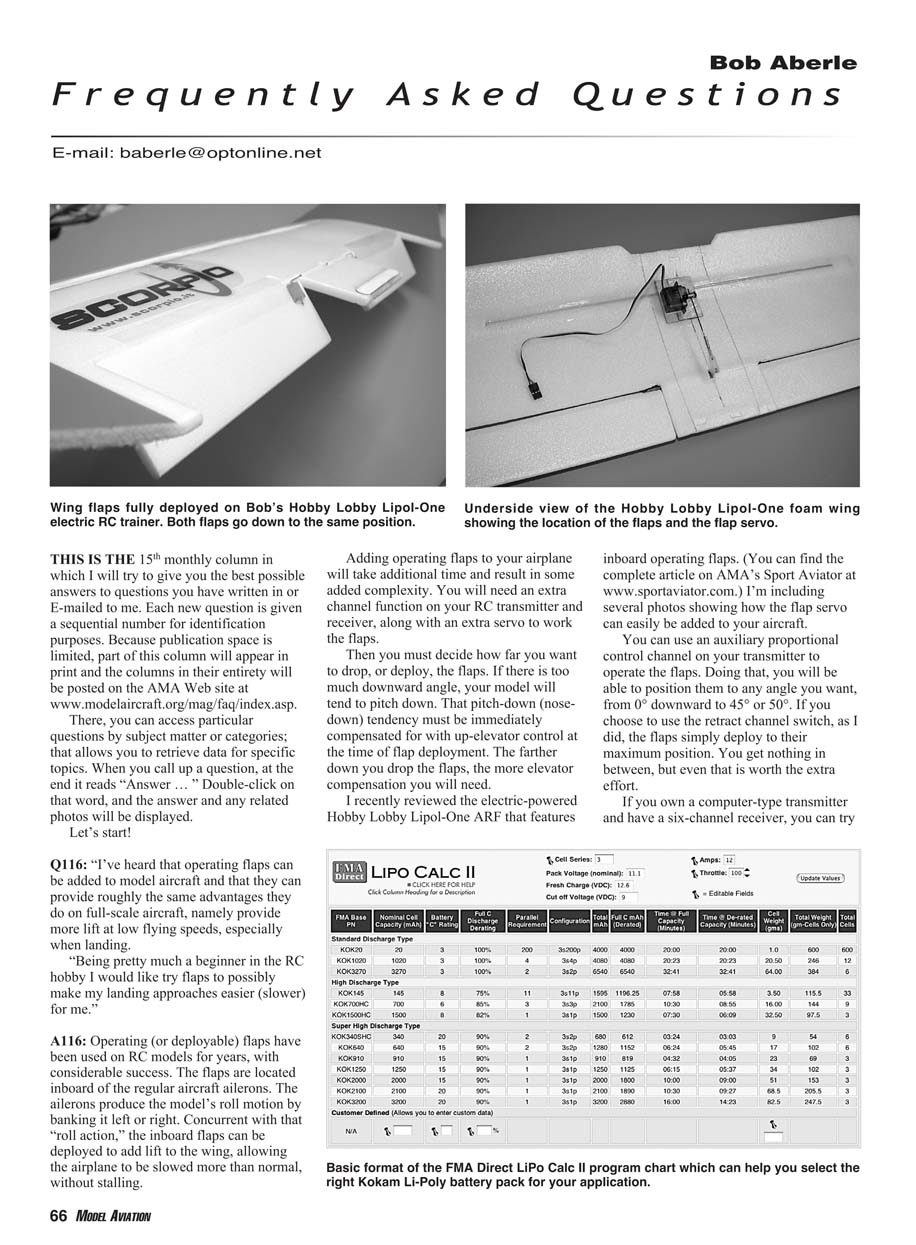
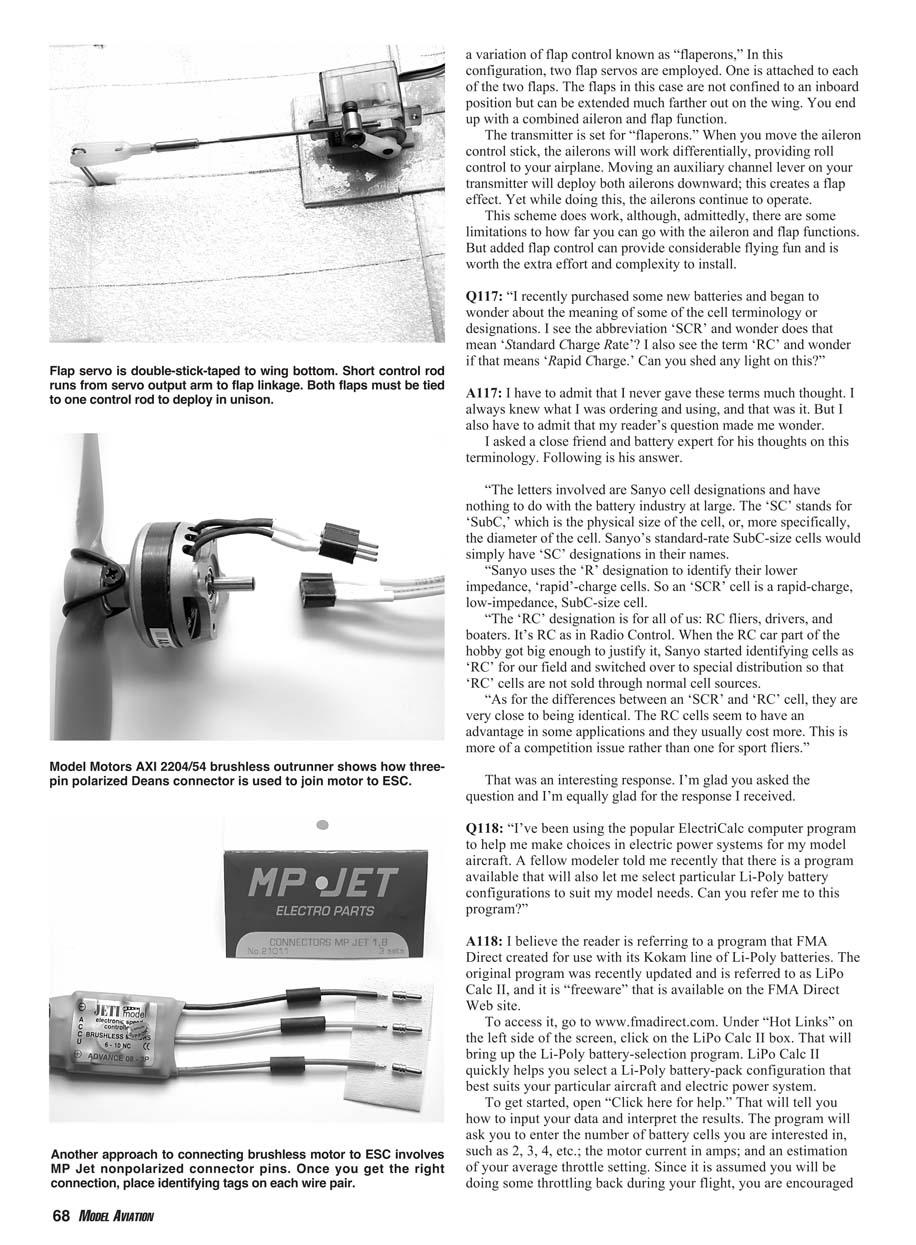
I recently reviewed the electric-powered Hobby Lobby Lipol-One ARF that features inboard operating flaps. (You can find the complete article on AMA’s Sport Aviator at www.sportaviator.com.) I’m including several photos showing how the flap servo can easily be added to your aircraft.
You can use an auxiliary proportional control channel on your transmitter to operate the flaps. Doing that, you will be able to position them to any angle you want, from 0° downward to 45° or 50°. If you choose to use the retract channel switch, as I did, the flaps simply deploy to their maximum position. You get nothing in between, but even that is worth the extra effort.
If you own a computer-type transmitter and have a six-channel receiver, you can try a variation of flap control known as "flaperons." In this configuration:
- Two flap servos are employed, one attached to each of the two flaps.
- The flaps are not confined to an inboard position and can extend much farther out on the wing.
- You end up with a combined aileron and flap function.
Set the transmitter for "flaperons." When you move the aileron control stick, the ailerons work differentially, providing roll control. Moving an auxiliary channel lever on your transmitter deploys both ailerons downward, creating a flap effect while the ailerons continue to operate.
This scheme does work, although there are some limitations to how far you can go with the combined aileron and flap functions. Added flap control can provide considerable flying fun and is worth the extra effort and complexity to install.
---
Q117: Battery cell designations (SCR, RC)
Q: "I recently purchased some new batteries and began to wonder about the meaning of some of the cell terminology or designations. I see the abbreviation 'SCR' and wonder does that mean 'Standard Charge Rate'? I also see the term 'RC' and wonder if that means 'Rapid Charge.' Can you shed any light on this?"
A: I have to admit that I never gave these terms much thought. I always knew what I was ordering and using, and that was it. But my reader's question made me wonder.
I asked a close friend and battery expert for his thoughts on this terminology. Following is his answer:
- The letters involved are Sanyo cell designations and have nothing to do with the battery industry at large.
- "SC" stands for "SubC," which is the physical size of the cell, specifically the diameter. Sanyo's standard-rate SubC-size cells would simply have "SC" in their names.
- Sanyo uses the "R" designation to identify their lower-impedance, "rapid"-charge cells. So an "SCR" cell is a rapid-charge, low-impedance, SubC-size cell.
- The "RC" designation is for Radio Control — RC fliers, drivers, and boaters. When the RC car part of the hobby grew big enough, Sanyo started identifying cells as "RC" for our field and switched to special distribution so that "RC" cells are not sold through normal cell sources.
- As for differences between an "SCR" and "RC" cell, they are very close to being identical. RC cells seem to have an advantage in some applications and usually cost more. This is more of a competition issue than one for sport fliers.
That was an interesting response. I'm glad you asked the question and glad for the answer I received.
---
Q118: Li-Poly battery selection program
Q: "I've been using the popular ElectriCalc computer program to help me make choices in electric power systems for my model aircraft. A fellow modeler told me recently that there is a program available that will also let me select particular Li-Poly battery configurations to suit my model needs. Can you refer me to this program?"
A: I believe the reader is referring to a program that FMA Direct created for use with its Kokam line of Li-Poly batteries. The original program was recently updated and is referred to as LiPo Calc II, and it is freeware available on the FMA Direct Web site.
To access it, go to www.fmadirect.com. Under "Hot Links" on the left side of the screen, click on the LiPo Calc II box. That will bring up the Li-Poly battery-selection program. LiPo Calc II quickly helps you select a Li-Poly battery-pack configuration that best suits your particular aircraft and electric power system.
To get started, open "Click here for help." That will tell you how to input your data and interpret the results. The program will ask you to enter:
- The number of battery cells you are interested in (2, 3, 4, etc.).
- The motor current in amps.
- An estimate of your average throttle setting (pick a number less than 100% since you will throttle back during flight).
After making the three entries, click on "Update Values." Alternative battery-pack configurations will appear in tabular form. It takes a while to get used to the program's format, but the output information can be quite helpful—and the service is free!
---
Q119: Brushless motors and three wires
Q: "I just bought my first brushless electric motor and noticed that unlike all my previous ferrite motors, this new motor has three wires coming out of it. My ferrite motors only required two wires.
"I also read in the instructions that come with my brushless motor that if it runs backward, swap any two of the three wires to get it to run in the correct direction. What is that all about? Why can't they just supply a wiring diagram and employ color-coded wires?"
A: The reader is understandably frustrated by this seeming lack of instruction for new brushless motors. In defense of the manufacturers, sensorless brushless motors and their ESCs have become second nature to many electric enthusiasts, and sometimes manufacturers assume that familiarity.
The facts:
- Brushless motors have three wires exiting the case, and the companion sensorless ESC also has three input wires.
- Most manufacturers suggest using individual, nonpolarized connector pins (such as MP Jet item MJ12011 connector pins) to connect the three wires between the motor and the ESC.
- Initially run the motor to determine rotation direction. With a forward-facing motor, rotation should be counterclockwise and propwash should blow rearward, toward the tail of the model.
- If the propeller is rotating the opposite way and the propwash blows forward, reverse any two of the three wires and the rotation will be corrected.
- After you determine the correct wiring, place small tags on each pair of wires for future identification.
I prefer to use multipin polarized connectors to join my brushless motor and ESC. Once set up, I can move a particular motor to another model that has its own ESC inside the fuselage: mount the motor, plug in the connector, and go flying. I even do this at the flying field. It allows me to share one motor with several aircraft.
That's a wrap for "Frequently Asked Questions" column 15! MA
Transcribed from original scans by AI. Minor OCR errors may remain.

