
Frequently Asked Questions - 2006/02
Ideas for mounting a digital camera in your model and taking in-air photos
Bob Aberle | [email protected]
Also included in this column:
- Where to find basic electric-flight information
- Mounting adapters for electric motors
About this column
This is the 23rd monthly column in which I will try to give you the best possible answers to questions you have written or e-mailed to me. Each new inquiry has a sequential number for identification purposes. Because publication space is limited, part of this month’s material will be published here, and you can find the column in its entirety on the AMA Web site at www.modelaircraft.org/mag/faq/index.asp. All questions and answers are posted there. Once the material is posted to the Web site, you must access particular questions and answers by subject matter or categories. This is done to help you retrieve data for particular subjects. When you call up a question, it reads “Answer …”
Q181: “I have seen references recently to modelers who are taking excellent digital photographs from their RC aircraft. I think I have a pretty good idea how to do this, but I’m not sure as to the selection of an appropriate camera nor do I have a feel for the size aircraft required to do the job. As so many people ask you, can you point me in the right direction?”
A181
At the September 2005 Northeast Electric Aircraft Technology (NEAT) Fair, noted New England cartoonist and longtime electric-power flier Don Bousquet showed up with his new “camera plane.” He calls it the “Demoiselle Photographique” because it has the appearance of a Demoiselle. He chose that design because he could place the camera in a forward position with an unobstructed view. This aircraft employs a modified Mini-Telemaster wing (400 square inches of area, 57 inches span). The total all-up weight with the camera is only 29 ounces.
Don uses:
- E-flite 400/920 KV outrunner brushless motor
- 20-amp E-flite ESC
- APC 10 x 3.8E propeller
- Kokam 3-cell, 910 mAh Li-Poly battery
- JR radio with a total of five servos
The motor current is about 14 amps and the power input is 156 watts.
Don has successfully used the Pentax Optio and Olympus D630 digital cameras. They are relatively inexpensive, light in weight, and small in size. The camera is set for the “landscape” function that focuses at infinity (long distances). An extra RC servo presses down on the shutter release.
Most of these cameras require that you press the shutter release halfway down, wait for it to focus, then continue pressing until the shutter goes off. Since this camera is preset to infinity, the servo need only make one positive thrust to activate the shutter.
Unlike film cameras, digital types allow you to take many pictures during the course of a single flight. Don claims that he has taken more than 10,000 aerial photos to date.
Don has made a business of his aerial photography. Local realtors, architects, and builders seek his service to enhance their businesses. Payment can be excellent because the alternative of using full-scale aircraft can be extremely expensive.
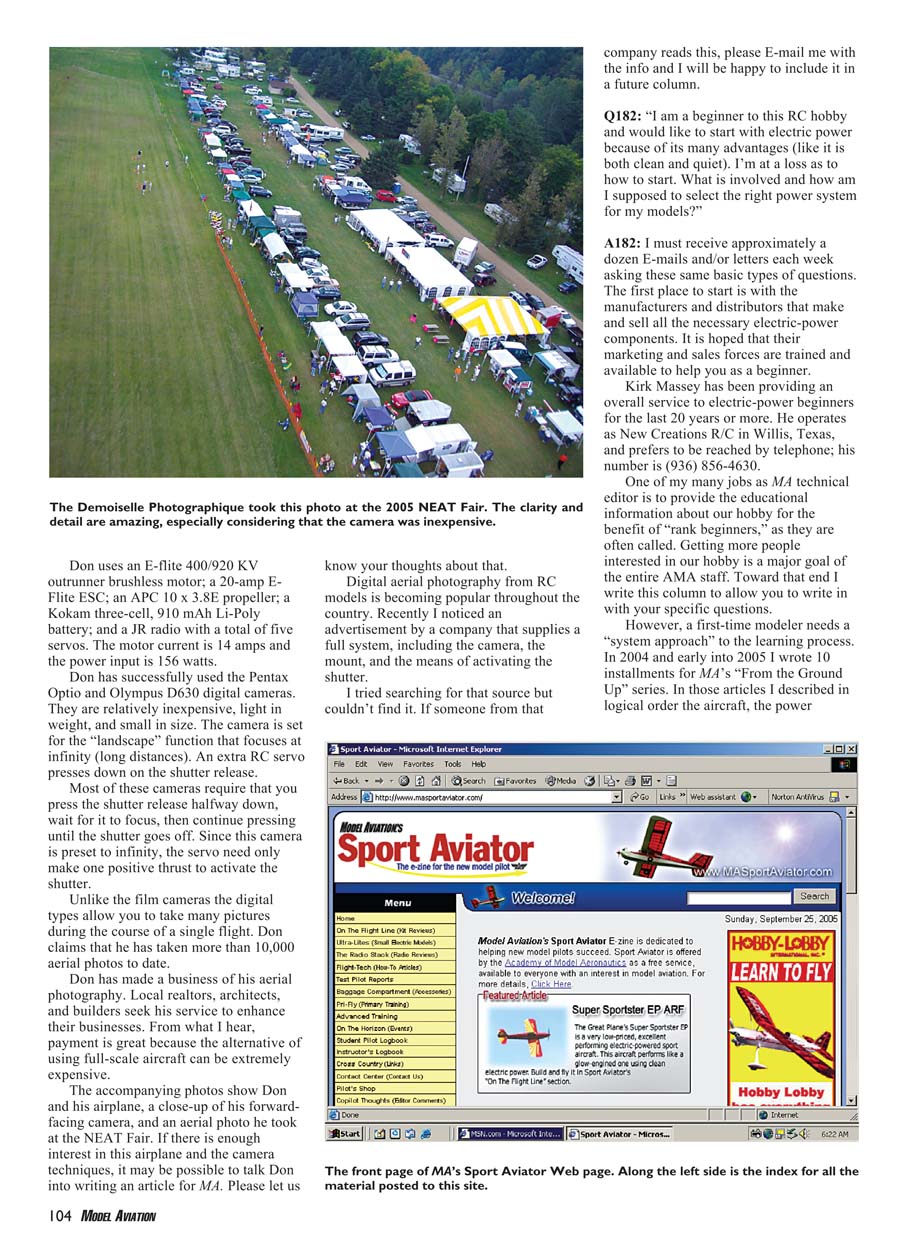
The accompanying photos (in the original publication) show Don and his airplane, a close-up of his forward-facing camera, and an aerial photo he took at the NEAT Fair. If there is enough interest in this airplane and the camera techniques, it may be possible to talk Don into writing an article for Model Aviation. Please let us know your thoughts about that.
Q182: “I am a beginner to this RC hobby and would like to start with electric power because of its many advantages (like it is both clean and quiet). I'm at a loss as to how to start. What is involved and how am I supposed to select the right power system for my models?”
A182
I receive approximately a dozen e-mails and/or letters each week asking these basic questions. The first place to start is with the manufacturers and distributors that make and sell the necessary electric-power components. Their marketing and sales forces are trained and available to help you as a beginner.
Kirk Massey has provided an overall service to electric-power beginners for more than 20 years. He operates New Creations R/C in Willis, Texas; his telephone number is (936) 856-4630.
One of my jobs as Model Aviation technical editor is to provide educational information for “rank beginners.” Getting more people interested in our hobby is a major goal of the entire AMA staff. Toward that end I write this column to allow you to write in with your specific questions.
A first-time modeler needs a “system approach” to the learning process. In 2004 and early 2005 I wrote 10 installments for MA’s “From the Ground Up” series. In those articles I described in logical order the aircraft, power systems, and radio systems, then model assembly and flying. I even published a simple design called the Scratch-One that allows you to construct your first model from raw materials (not a kit). That entire 10-part series can be found at: www.modelaircraft.org/mag/FTGU/Part1/index.html
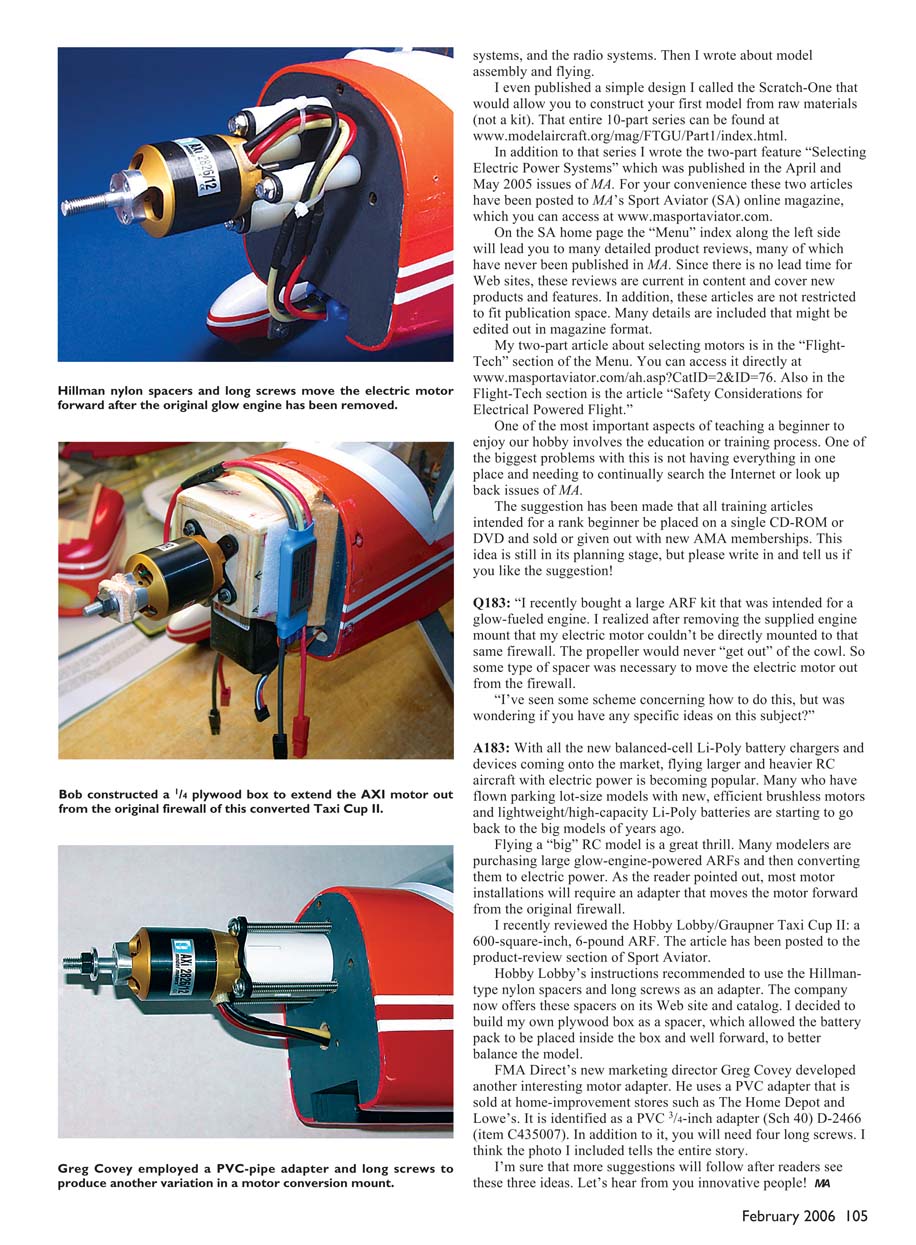
In addition, I wrote a two-part feature "Selecting Electric Power Systems" published in the April and May 2005 issues of Model Aviation. For convenience these two articles have been posted to MA's Sport Aviator (SA) online magazine at: www.masportaviator.com
On the SA home page, the "Menu" index along the left side leads to many detailed product reviews, many of which have never been published in MA. Because there is no lead time for web sites, these reviews are current and cover new products and features. Also, these articles are not restricted by magazine space, so many details are included that might be edited out in print.
My two-part article about selecting motors is in the "FlightTech" section of the Menu and can be accessed directly at: www.masportaviator.com/ah.asp?CatID=2&ID=76
Also in the FlightTech section is the article "Safety Considerations for Electrical Powered Flight."
One of the most important aspects of teaching a beginner to enjoy the hobby involves the education or training process. A big problem is not having everything in one place and needing to continually search the Internet or look up back issues of MA.
The suggestion has been made that all training articles intended for rank beginners be placed on a single CD-ROM or DVD and sold or given with new AMA memberships. This idea is still in the planning stage; please write in and tell us if you like the suggestion.
Q183: "I recently bought a large ARF kit that was intended for a glow-fueled engine. I realized after removing the supplied engine mount that my electric motor couldn't be directly mounted to that same firewall. The propeller would never 'get out' of the cowl. So some type of spacer was necessary to move the electric motor out from the firewall. I've seen some schemes concerning how to do this, but was wondering if you have any specific ideas on this subject?"
A183
With all the new balanced-cell Li-Poly battery chargers and devices coming onto the market, flying larger and heavier RC aircraft with electric power is becoming popular. Many who have flown parking-lot-size models with efficient brushless motors and lightweight/high-capacity Li-Poly batteries are starting to return to the big models of years ago.
Many modelers are purchasing large glow-engine ARFs and converting them to electric power. As the reader pointed out, most motor installations will require an adapter that moves the motor forward from the original firewall.
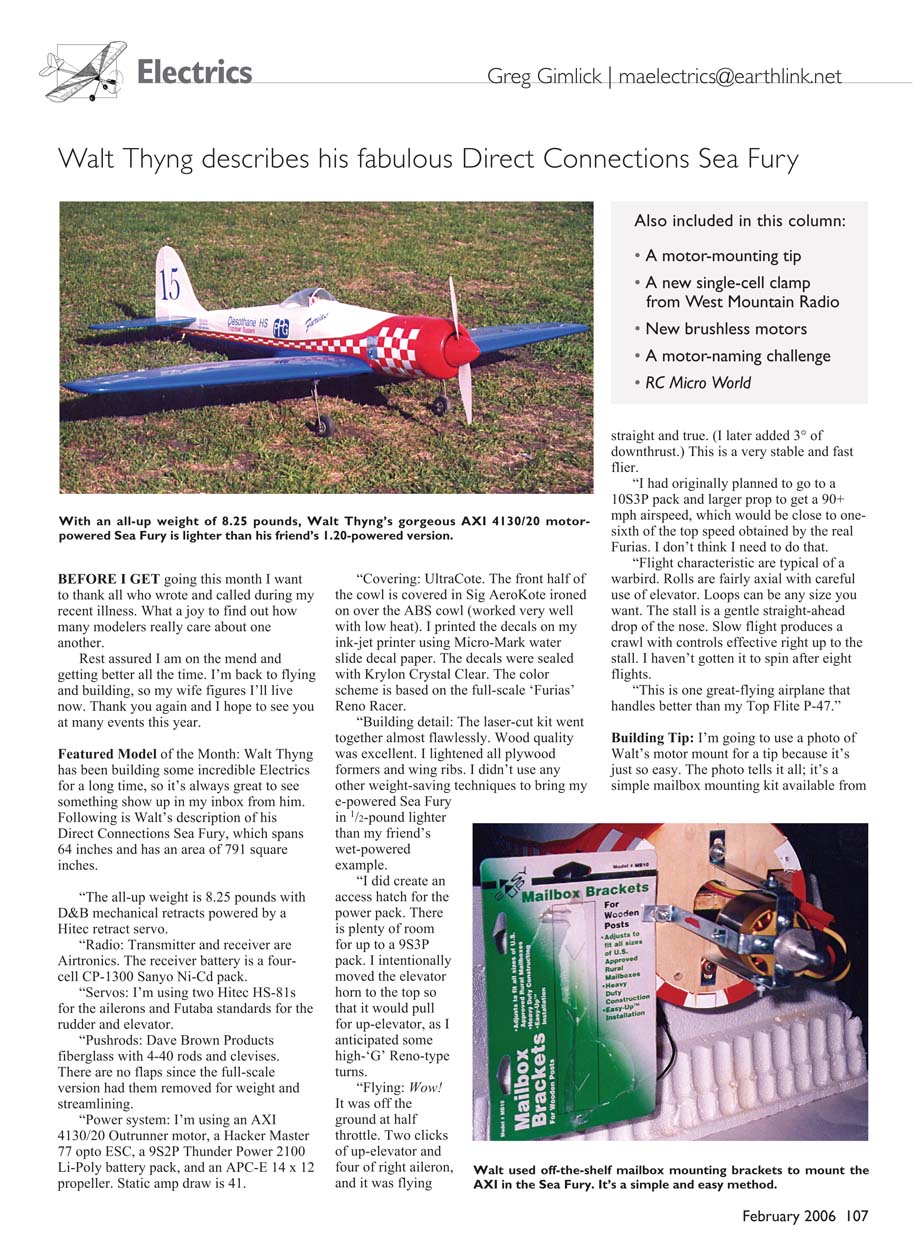
I recently reviewed the Hobby Lobby/Graupner Taxi Cup II: a 600-square-inch, 6-pound ARF. The article has been posted to the product-review section of Sport Aviator. Hobby Lobby's instructions recommended using Hillman-type nylon spacers and long screws as an adapter. The company now offers these spacers on its web site and catalog.
I decided to build my own plywood box as a spacer, which allowed the battery pack to be placed inside the box and well forward to better balance the model.
FMA Direct's marketing director Greg Covey developed another interesting motor adapter. He uses a PVC adapter sold at home-improvement stores such as The Home Depot and Lowe's. It is identified as a PVC 3/4-inch adapter (Sch 40) D-2466 (item C435007). In addition to it, you will need four long screws.
I'm sure more suggestions will follow after readers see these three ideas. Let's hear from you innovative people!
Transcribed from original scans by AI. Minor OCR errors may remain.

