
Frequently Asked Questions
Bob Aberle | [email protected]
An update on RC Spread Spectrum systems
This is the 24th monthly column in which I will try to give you the best possible answers to questions you have written or E‑mailed to me. Each new inquiry has a sequential number for identification purposes.
Because publication space is limited, part of this month's material will be published here, and you can find the column in its entirety on the AMA Web site at www.modelaircraft.org/mag/faq/index.asp. All questions and answers are posted there.
Once the material is posted to the Web site, you must access particular questions and answers by subject matter or categories. This is done to help you retrieve data for particular subjects. When you call up a question, it reads "Answer ..." Double‑click on that word, and that information, along with any related photos, will appear.
Let's get started!
Also included in this column:
- Affordable micro RC systems
- Dimension Engineering's products
- Wendell Hostetler's plans
- Are Li‑Polys getting safer?
Q189: "I know you already mentioned the RC spread spectrum system that Horizon Hobby was offering for surface vehicles (cars and boats); what have you heard about a similar system intended for flying model aircraft?"
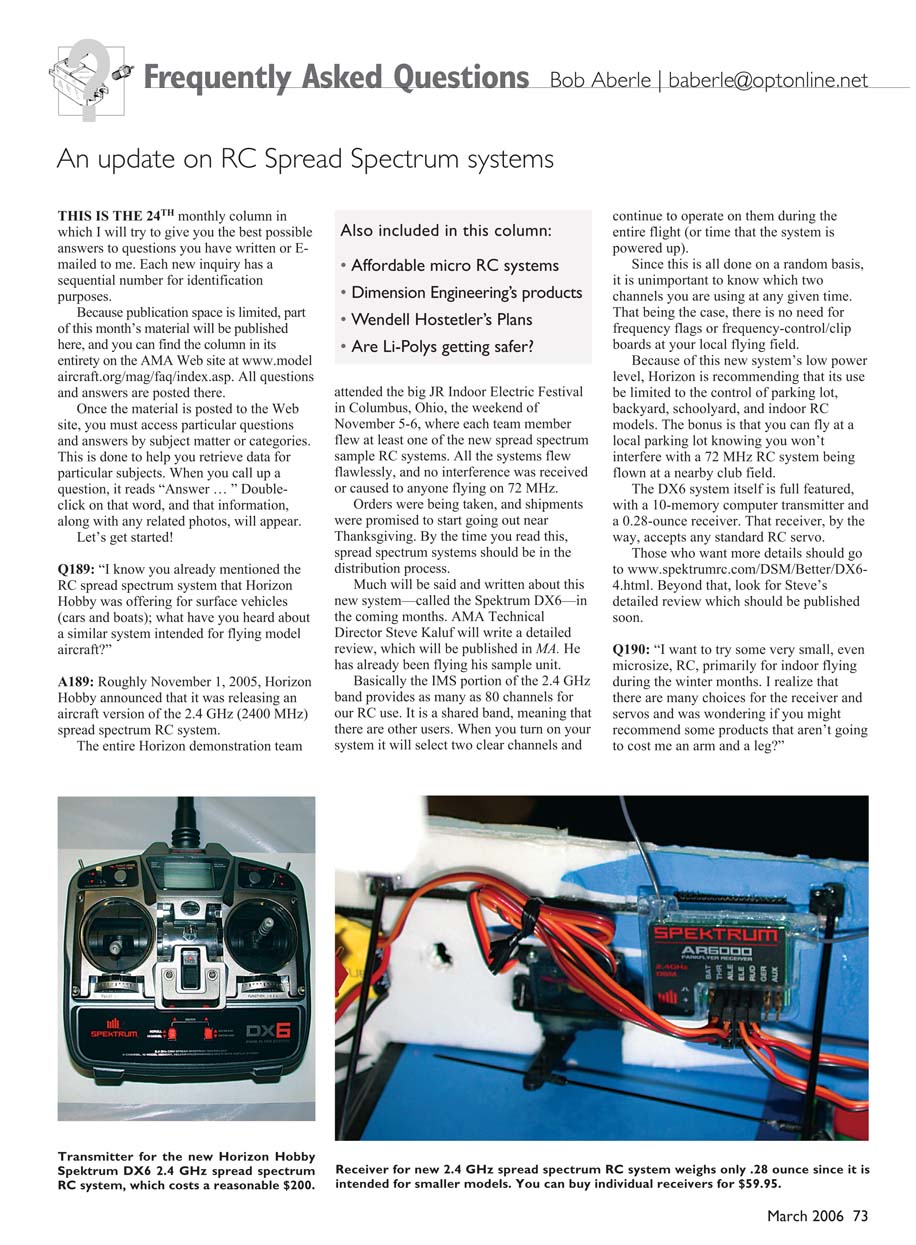
A189: Roughly November 1, 2005, Horizon Hobby announced that it was releasing an aircraft version of the 2.4 GHz (2400 MHz) spread spectrum RC system.
The entire Horizon demonstration team attended the big JR Indoor Electric Festival in Columbus, Ohio, the weekend of November 5–6, where each team member flew at least one of the new spread spectrum sample RC systems. All the systems flew flawlessly, and no interference was received or caused to anyone flying on 72 MHz. Orders were being taken, and shipments were promised to start going out near Thanksgiving. By the time you read this, spread spectrum systems should be in the distribution process.
Much will be said and written about this new system—called the Spektrum DX6—in the coming months. AMA Technical Director Steve Kaluf will write a detailed review, which will be published in MA. He has already been flying his sample unit.
Basically, the IMS portion of the 2.4 GHz band provides as many as 80 channels for our RC use. It is a shared band, meaning that there are other users. When you turn on your system it will select two clear channels and continue to operate on them during the entire flight (or time that the system is powered up). Since this is all done on a random basis, it is unimportant to know which two channels you are using at any given time. That being the case, there is no need for frequency flags or frequency-control/clip boards at your local flying field.
Because of this new system's low power level, Horizon is recommending that its use be limited to the control of parking-lot, backyard, schoolyard, and indoor RC models. The bonus is that you can fly at a local parking lot knowing you won't interfere with a 72 MHz RC system being flown at a nearby club field.
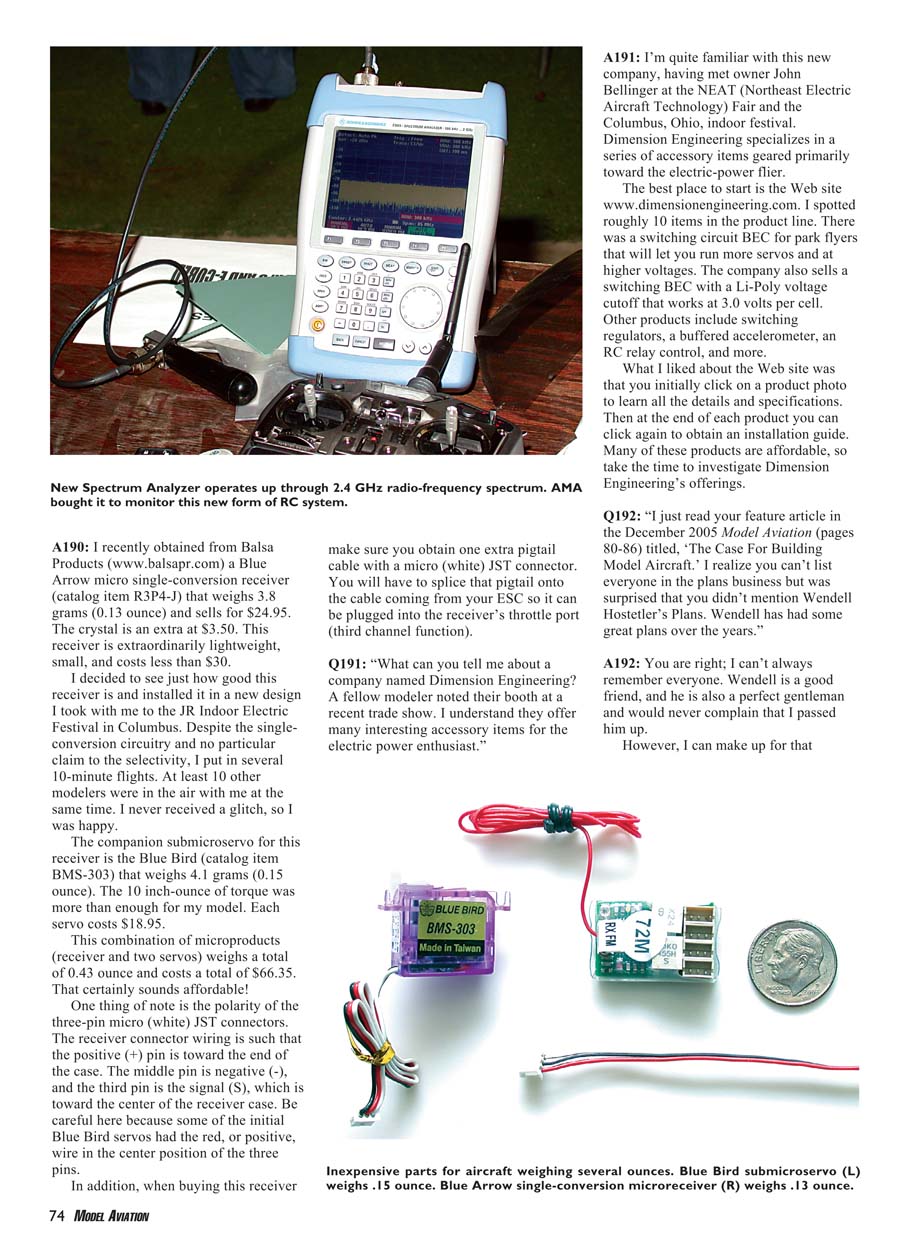
The DX6 system itself is full featured, with a 10-memory computer transmitter and a 0.28-ounce receiver. That receiver, by the way, accepts any standard RC servo. Those who want more details should go to www.spektrumrc.com/DSM/Better/DX6-4.html. Beyond that, look for Steve's detailed review, which should be published soon.
Q190: "I want to try some very small, even microsize, RC, primarily for indoor flying during the winter months. I realize that there are many choices for the receiver and servos and was wondering if you might recommend some products that aren't going to cost me an arm and a leg?"
A190: I recently obtained from Balsa Products (www.balsapr.com) a Blue A Arrow micro single‑conversion receiver (catalog item RP34-J) that weighs 3.8 grams (0.13 ounce) and sells for $24.95. The crystal is an extra at $3.50. This receiver is extraordinarily lightweight, small, and costs less than $30.
I decided to see just how good this receiver is and installed it in a new design I took with me to the JR Indoor Electric Festival in Columbus. Despite the single‑conversion circuitry and no particular claim to selectivity, I put in several 10‑minute flights. At least 10 other modelers were in the air with me at the same time. I never received a glitch, so I was happy.
The companion sub‑micro servo for this receiver is the Blue Bird (catalog item BMS-303) that weighs 4.1 grams (0.15 ounce). The 10 inch‑ounce of torque was more than enough for my model. Each servo costs $18.95.
This combination of micro products (receiver and two servos) weighs a total of 0.43 ounce and costs a total of $66.35. That certainly sounds affordable!
One thing of note is the polarity of the three‑pin micro (white) JST connectors. The receiver connector wiring is such that the positive (+) pin is toward the end of the case. The middle pin is negative (-), and the third pin is the signal (S), which is toward the center of the receiver case. Be careful here because some of the initial Blue Bird servos had the red, or positive, wire in the center position of the three pins.
In addition, when buying this receiver make sure you obtain one extra pigtail cable with a micro (white) JST connector. You will have to splice that pigtail onto the cable coming from your ESC so it can be plugged into the receiver's throttle port (third channel function).
Q191: "What can you tell me about a company named Dimension Engineering? A fellow modeler noted their booth at a recent trade show. I understand they offer many interesting accessory items for the electric power enthusiast."
A191: I'm quite familiar with this company, having met owner John Bellinger at the NEAT (Northeast Electric Aircraft Technology) Fair and the Columbus, Ohio, indoor festival. Dimension Engineering specializes in a series of accessory items geared primarily toward the electric‑power flier.
The best place to start is the Web site www.dimensionengineering.com. I spotted roughly 10 items in the product line. There was a switching circuit BEC for park flyers that will let you run more servos and at higher voltages. The company also sells a switching BEC with a Li‑Poly voltage cutoff that works at 3.0 volts per cell. Other products include switching regulators, a buffered accelerometer, an RC relay control, and more.
What I liked about the Web site was that you initially click on a product photo to learn all the details and specifications. Then at the end of each product you can click again to obtain an installation guide. Many of these products are affordable, so take the time to investigate Dimension Engineering's offerings.
Q192: "Up til about a year ago I kept hearing about safety problems associated with the charging and use of Li‑Poly batteries. I've noticed in more recent times no such reports. Can I assume things are getting better?"
A192: You are right; I can't always remember everyone. Wendell is a good friend, and he is also a perfect gentleman and would never complain that I passed him up.
However, I can make up for that omission right now because I just received a photo of Wendell's latest plans, for a 40‑inch‑span Cessna 150 with 230 square inches of wing area. It is a parking‑lot‑size model, powered with a Hobby Lobby Nippy Black 0508/73 outrunner brushless motor and two Kokam 340 mAh Li‑Poly cells.
Those are exactly the kind of plans I had in mind when I wrote my article. It is possible to get one of the laser‑cutting services I referenced to cut the basic parts for you.
Contact Wendell to obtain one of his current plans catalogs. He can be reached at: 545 Jerome Dr., Orrville, OH 44667 Tel.: (330) 682-8896 E-mail: [email protected]
Q193: "Up til about a year ago I kept hearing about safety problems associated with the charging and use of Li‑Poly batteries. I've noticed in more recent times no such reports. Can I assume things are getting better?"
A193: You can, and electric‑power enthusiasts are thrilled with what is now the "routine" use of Li‑Poly batteries.
At the recent JR Indoor Electric Festival in Columbus there were more than 150 registered pilots, hundreds of aircraft flown, and I'd have to guess more than 1,000 battery packs in use. I'd also have to say that 99% of those packs were Li‑Poly.
At this big gathering Horizon Hobby/JR and Radical RC made sure every registered pilot received a free cartridge case. The idea was to place the Li‑Poly battery inside this sealed case (that has a vent hole) while charging or when storing the battery after removing it from a model. Also present along the flightline were buckets of sand to put the packs in if a situation occurred.
To my knowledge there was not a single reported incident. Several fliers had packs open as a result of a crash, and to be safe they placed them in the sand buckets. But there were no fires! However, let's never relax our safety vigil when using any type of battery pack.
MA
Transcribed from original scans by AI. Minor OCR errors may remain.

