
Frequently Asked Questions - 2006/04
Bob Aberle | [email protected]
This is the 25th monthly column in which I try to give the best possible answers to questions you have written or emailed to me. Each new inquiry has a sequential number for identification purposes. Because publication space is limited, part of this month's material will be published here; you can find the column in its entirety on the AMA web site at www.modelaircraft.org/mag/faq/index.asp. All questions and answers will be posted there.
Once the material is posted to the web site, you must access particular questions and answers by subject matter or category. This is done to help you retrieve data for particular subjects. When you call up a question, it reads "Answer ...". Double-click that word, and that information, along with any related photos, will appear.
Let's start!
Q199: What are the differences between the original FMA Direct M5 receiver and the new v2 version? Also, how do I connect power if I use all five channels?
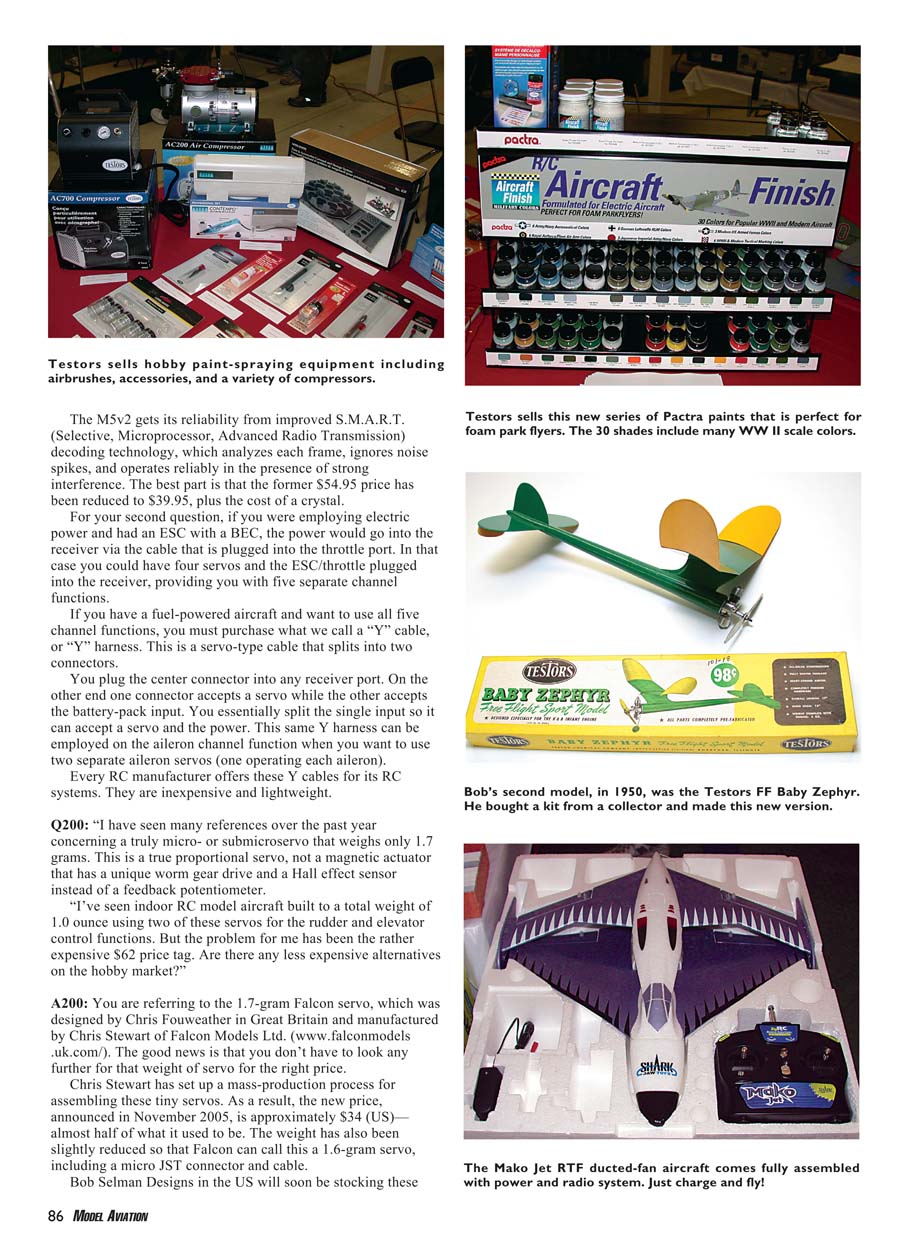
A199: The FMA Direct M5 is the smallest and lightest-weight dual-conversion FM RC receiver on the market. I asked FMA Direct Marketing Director Greg Covey about the differences between the original and the new v2; the following is paraphrased from his response.
- The new M5 v2 is compatible with digital servos and other supersensitive servos.
- It has increased resolution compared to the original receiver (400 steps vs. 200 steps).
- It includes built-in decoding technology that digitally filters the transmitter's signal from noise, providing a fail-safe–type protection for any standard FM system. The aircraft will "fly through" temporary interference with servos remaining unchanged; after three seconds of signal loss the receiver's throttle channel signals the ESC to shut down the motor, helping to prevent fly-aways.
- The M5 v2 uses improved S.M.A.R.T. (Selective, Microprocessor, Advanced Radio Transmission) decoding technology, which analyzes each frame, ignores noise spikes, and operates reliably in the presence of strong interference.
- The former $54.95 price has been reduced to $39.95, plus the cost of a crystal.
Regarding powering the receiver when using all five channels:
- If you are using electric power and have an ESC with a BEC, power is supplied to the receiver via the cable plugged into the throttle port. In that case you can have four servos plus the ESC/throttle plugged into the receiver, giving you five channel functions.
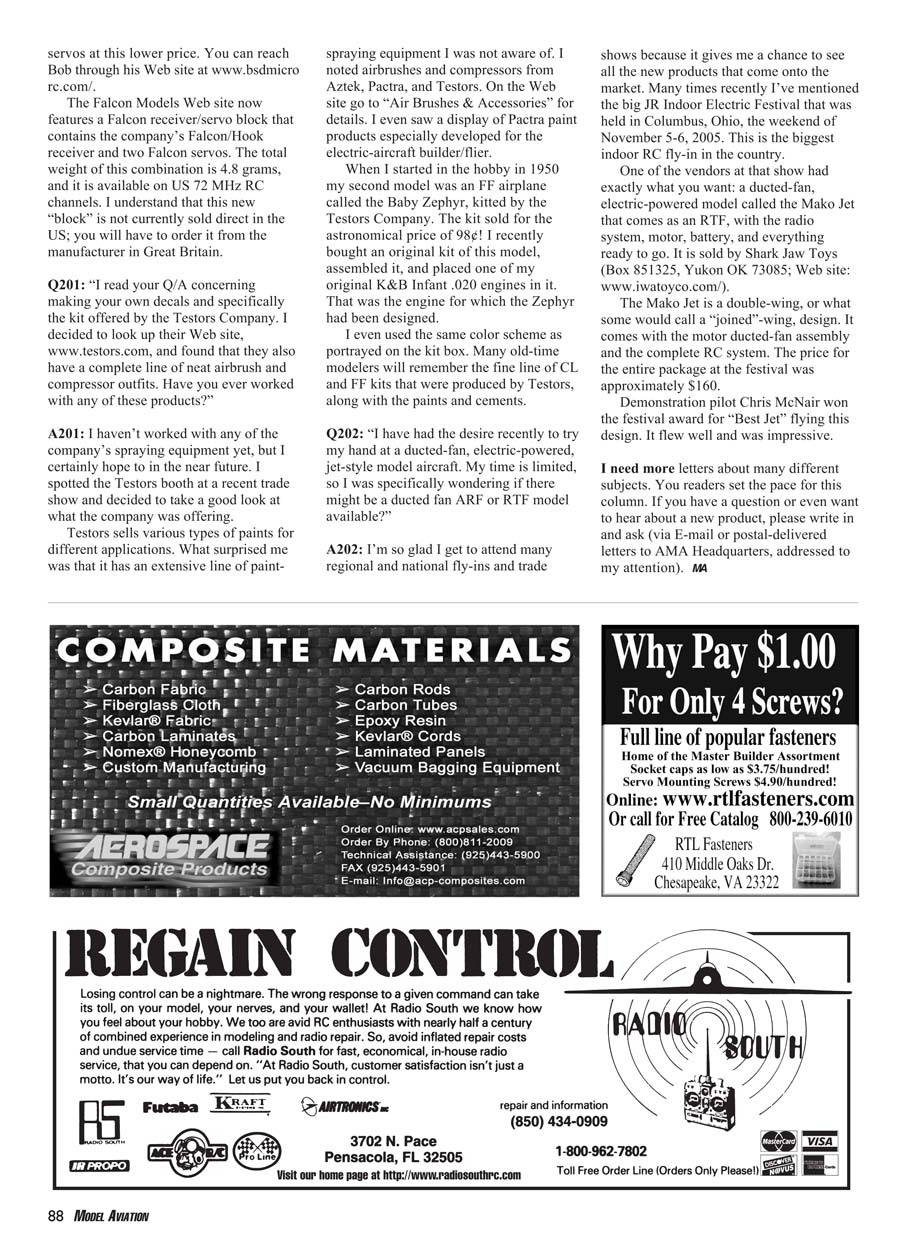
- If you have a fuel-powered aircraft and want to use all five channels, you must purchase a "Y" cable (or "Y" harness). This is a servo-type cable that splits into two connectors. You plug the center connector into any receiver port; on the other end, one connector accepts a servo while the other accepts the battery-pack input, effectively splitting the single input so it can accept both a servo and power. The same Y harness can be used on an aileron channel when you want two separate aileron servos (one for each aileron). Every RC manufacturer offers these Y cables; they are inexpensive and lightweight.
Q200: Are there less expensive alternatives to the 1.7-gram Falcon proportional servo (previously priced around $62)?
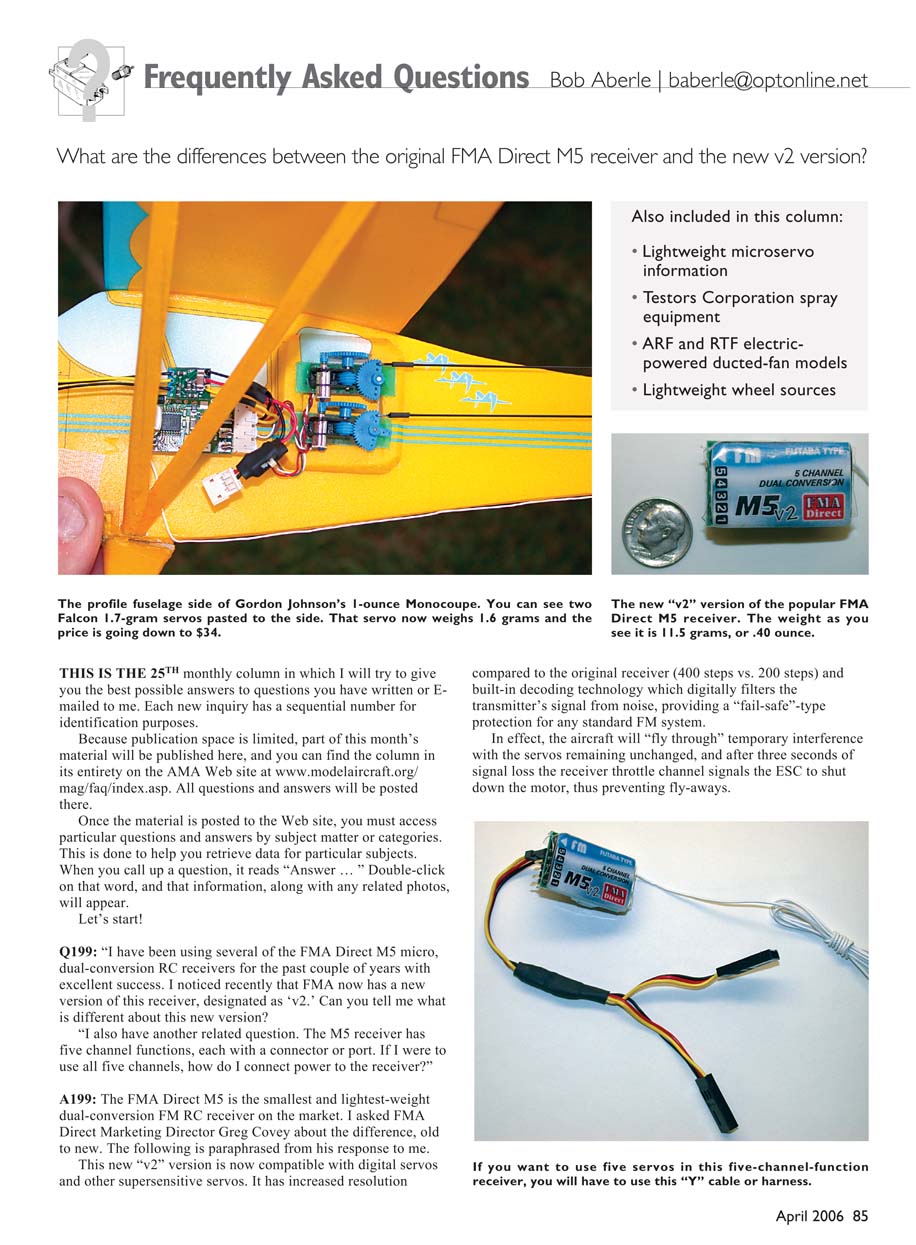
A200: You are referring to the 1.7-gram Falcon servo, designed by Chris Fouweather in Great Britain and manufactured by Chris Stewart of Falcon Models Ltd. (www.falconmodels.co.uk). Good news: Falcon has set up a mass-production process and announced a new price (November 2005) of approximately $34 (US) — almost half the previous price. The weight has been slightly reduced so Falcon now calls it a 1.6-gram servo, including a micro JST connector and cable.
Bob Selman Designs in the U.S. will soon be stocking these servos at the lower price; see www.bsdmicrorc.com. Falcon Models' web site now features a Falcon receiver/servo block that contains the company's Falcon/Hook receiver and two Falcon servos. The total weight of this combination is 4.8 grams, and it is available on U.S. 72 MHz RC channels. I understand this new block is not currently sold direct in the U.S.; you must order it from the manufacturer in Great Britain.
Q201: Have you ever worked with Testors airbrush and compressor products?
A201: I haven't worked with Testors' spraying equipment yet, but I hope to soon. I spotted the Testors booth at a recent trade show and took a good look at what the company is offering.
Testors sells various types of paints for different applications and has an extensive line of paint-spraying equipment. I noted airbrushes and compressors from Aztek, Pactra, and Testors. On the web site, go to "Air Brushes & Accessories" for details. I even saw a display of Pactra paint products developed especially for the electric-aircraft builder/flier (www.testors.com).
When I started in the hobby in 1950, my second model was a free-flight airplane called the Baby Zephyr, kitted by the Testors Company. The kit sold for the astronomical price of 98¢! I recently bought an original kit of this model, assembled it, and placed one of my original K&B Infant .020 engines in it — the engine for which the Zephyr had been designed. I even used the same color scheme as portrayed on the kit box. Many old-time modelers will remember the fine line of control-line and free-flight kits that were produced by Testors, along with the paints and cements.
Q202: Are there ducted-fan, electric-powered, jet-style ARF or RTF models available?
A202: Yes. I attend many regional and national fly-ins and trade shows, which lets me see new products. At the JR Indoor Electric Festival in Columbus, Ohio (weekend of November 5–6, 2005), one vendor offered exactly what you want: a ducted-fan, electric-powered model called the Mako Jet that comes RTF, with the radio system, motor, battery, and everything ready to go. It is sold by Shark Jaw Toys (Box 851325, Yukon, OK 73085; web site: www.itawtoyco.com).
The Mako Jet is a double-wing (or "joined"-wing) design. It comes with the motor/ducted-fan assembly and the complete RC system. The price for the entire package at the festival was approximately $160. Demonstration pilot Chris McNair won the festival award for "Best Jet" flying this design. It flew well and was impressive.
I need more letters about many different subjects. You readers set the pace for this column. If you have a question or want to hear about a new product, please write in and ask (via email or postal mail to AMA Headquarters, addressed to my attention). MA
Transcribed from original scans by AI. Minor OCR errors may remain.

