
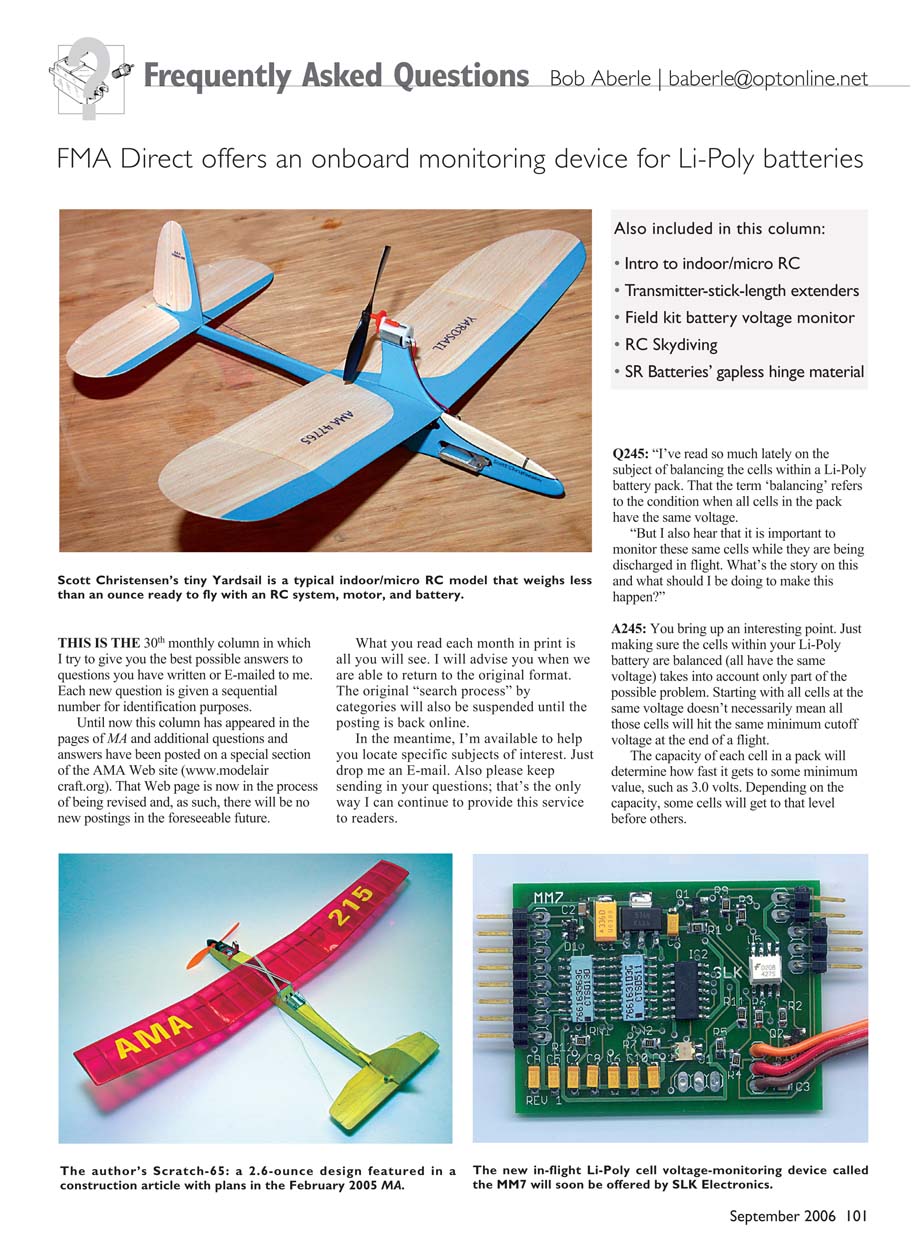
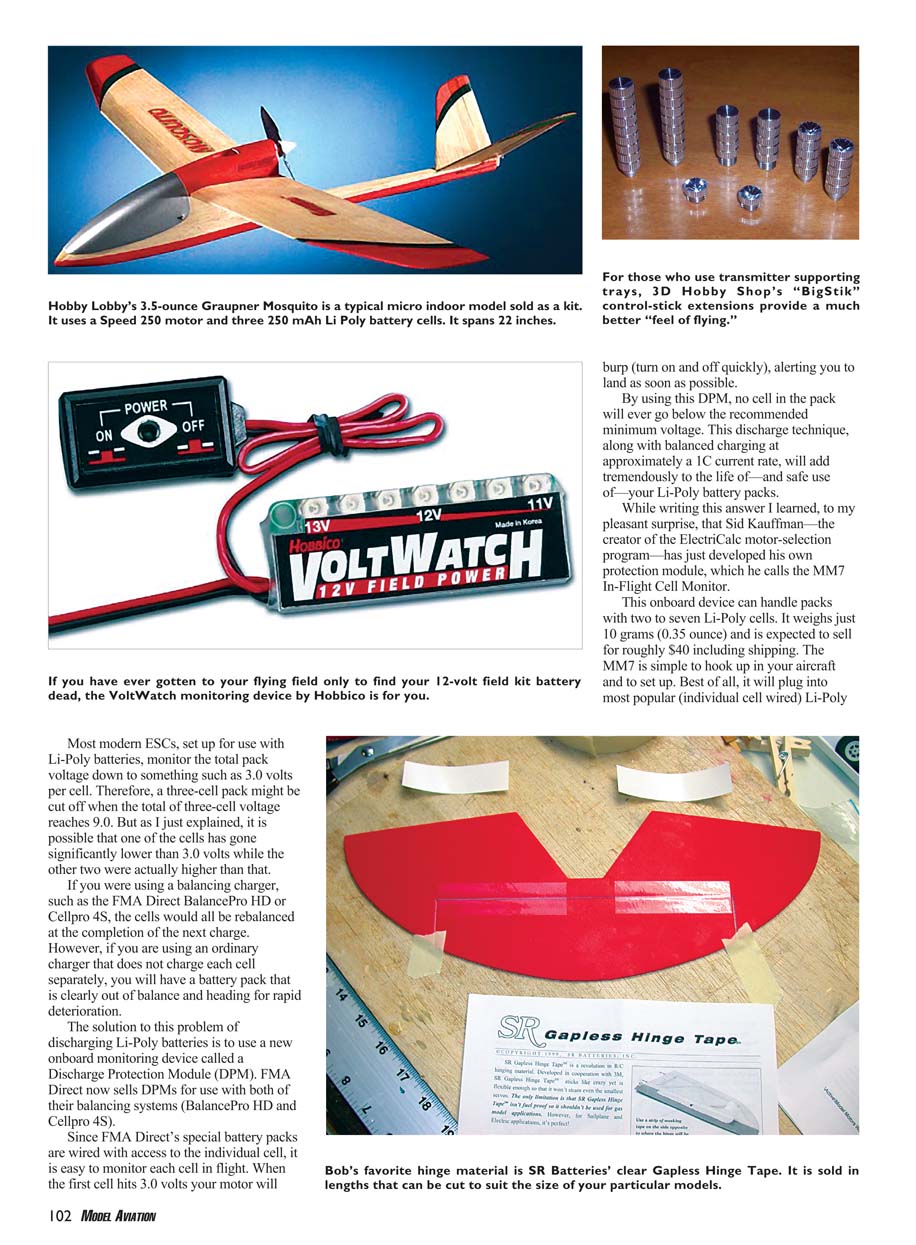
Frequently Asked Questions
Bob Aberle | [email protected]
This is the 30th monthly column in which I try to give you the best possible answers to questions you have written or e-mailed to me. Each new question is given a sequential number for identification purposes.
Until now this column has appeared in the pages of MA and additional questions and answers have been posted on a special section of the AMA web site (www.modelaircraft.org). That web page is now in the process of being revised and, as such, there will be no new postings in the foreseeable future.
What you read each month in print is all you will see. I will advise you when we are able to return to the original format. The original "search process" by categories will also be suspended until the posting is back online.
In the meantime, I'm available to help you locate specific subjects of interest. Just drop me an e-mail. Also please keep sending in your questions; that's the only way I can continue to provide this service to readers.
Q245: I’ve read so much lately on the subject of balancing the cells within a Li-Poly battery pack. That the term ‘balancing’ refers to the condition when all cells in the pack have the same voltage. But I also hear that it is important to monitor these same cells while they are being discharged in flight. What’s the story on this and what should I be doing to make this happen?
A245: You bring up an important point. Making sure the cells within your Li-Poly battery are balanced (all have the same voltage) addresses only part of the problem. Starting with all cells at the same voltage doesn’t necessarily mean all those cells will hit the same minimum cutoff voltage at the end of a flight. The capacity of each cell in a pack will determine how fast it reaches some minimum value, such as 3.0 volts. Depending on capacity, some cells may reach that level before others.
Most modern ESCs, set up for use with Li-Poly batteries, monitor the total pack voltage down to something such as 3.0 volts per cell. Therefore, a three-cell pack might be cut off when the total reaches roughly 9.0 volts. But as I just explained, it is possible that one cell has gone significantly below 3.0 volts while the other two are still higher.
If you use a balancing charger, such as the FMA Direct BalancePro HD or Cellpro 4S, the cells will be rebalanced at the completion of the next charge. However, if you use an ordinary charger that does not charge each cell separately, your battery pack can become out of balance and head for rapid deterioration.
The solution for monitoring discharging Li-Poly batteries in flight is to use an onboard Discharge Protection Module (DPM). FMA Direct sells DPMs for use with both their BalancePro HD and Cellpro 4S balancing systems.
Because FMA Direct's special battery packs are wired with access to the individual cells, it is easy to monitor each cell in flight. When the first cell hits 3.0 volts the motor will "burp" (turn on and off quickly), alerting you to land as soon as possible. By using this DPM, no cell in the pack should go below the recommended minimum voltage. This discharge technique, along with balanced charging at approximately a 1C rate, will greatly extend the life and safe use of your Li-Poly packs.
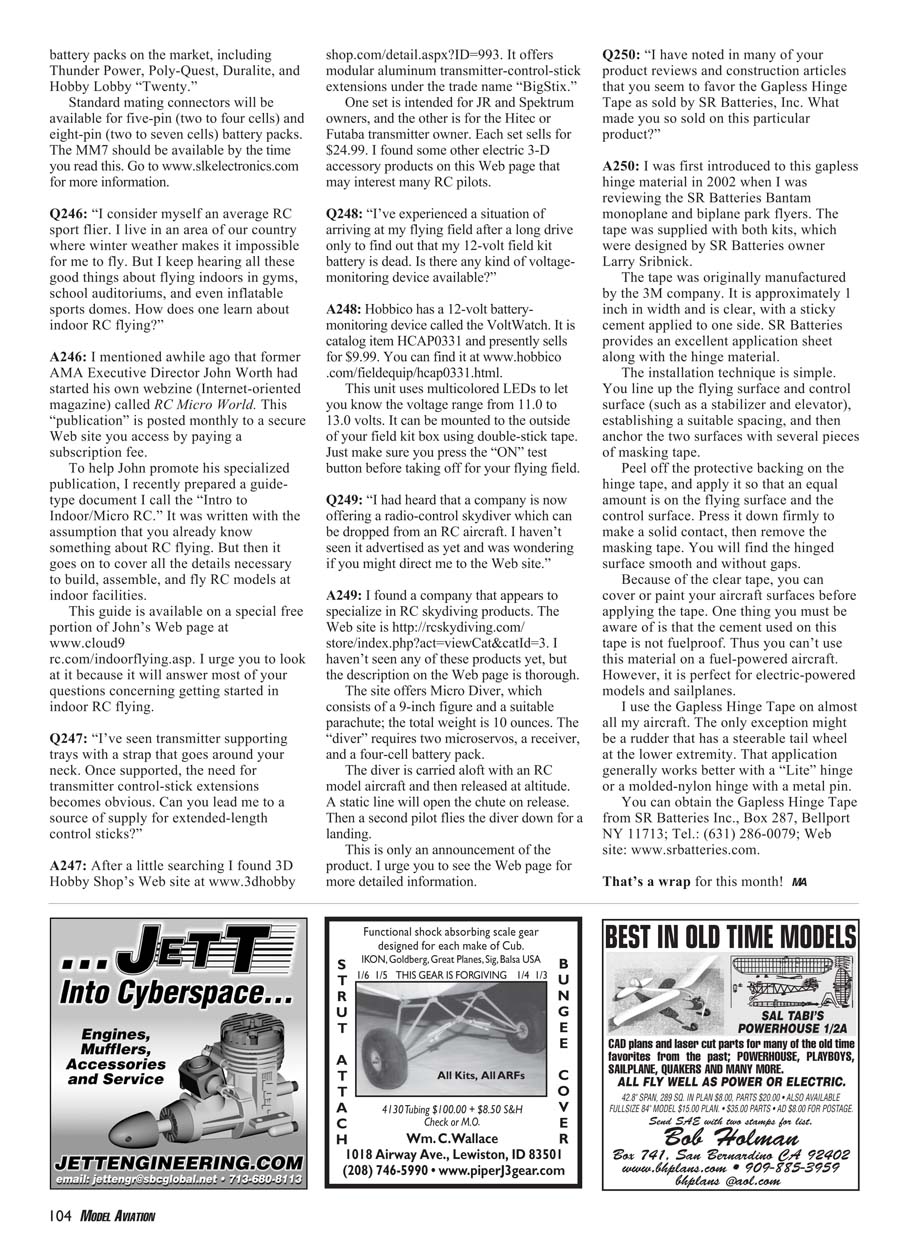
While writing this answer I learned that Sid Kauffman—the creator of the ElectriCalc motor-selection program—has developed his own protection module called the MM7 In-Flight Cell Monitor. Highlights:
- Handles packs with two to seven Li-Poly cells.
- Weighs about 10 grams (0.35 ounce).
- Expected price roughly $40 including shipping.
- Simple to hook up and set up.
- Plugs into most popular individual-cell-wired Li-Poly packs, including Thunder Power, Poly-Quest, Duralite, and Hobby Lobby "Twenty."
- Standard mating connectors will be available for five-pin (two to four cells) and eight-pin (two to seven cells) battery packs.
The MM7 should be available by the time you read this. For more information, see www.slkelectronics.com.
Q246: I consider myself an average RC sport flier. I live in an area of our country where winter weather makes it impossible for me to fly. But I keep hearing all these good things about flying indoors in gyms, school auditoriums, and even inflatable sports domes. How does one learn about indoor RC flying?
A246: Former AMA Executive Director John Worth started a webzine called RC Micro World, a subscription-based Internet publication. To help John promote this specialized publication, I prepared a guide called "Intro to Indoor/Micro RC." It assumes you already know something about RC flying, then covers the details needed to build, assemble, and fly RC models in indoor facilities.
The guide is available on a special free portion of John's web page: www.cloud9rc.com/indoorflying.asp. I recommend you look at it — it will answer most questions about getting started in indoor RC flying.
Q247: I've seen transmitter supporting trays with a strap that goes around your neck. Once supported, the need for transmitter control-stick extensions becomes obvious. Can you lead me to a source of supply for extended-length control sticks?
A247: I found 3D Hobby Shop's modular aluminum transmitter-control-stick extensions called "BigStix." There are versions for JR and Spektrum owners, and another for Hitec or Futaba transmitters. Each set sells for $24.99. See www.3dhobbyshop.com/detail.aspx?ID=993 for details. The site also carries other electric 3-D accessory products you might find useful.
Q248: I've experienced arriving at my flying field after a long drive only to find out that my 12-volt field kit battery is dead. Is there any kind of voltage-monitoring device available?
A248: Hobbico makes a 12-volt battery-monitoring device called the VoltWatch (catalog item HCAP0331), currently priced at $9.99. It uses multicolored LEDs to indicate voltage ranges from 11.0 to 13.0 volts and can be mounted to the outside of your field kit box with double-stick tape. Make sure you press the "ON" test button before leaving for the field. See www.hobbico.com/fieldequip/hcap0331.html.
Q249: I had heard that a company is now offering a radio-control skydiver which can be dropped from an RC aircraft and then steer and land like a parachute. I haven't seen it advertised yet and was wondering if you might direct me to the web site.
A249: I found a company that appears to specialize in RC skydiving products: http://rcskydiving.com/store/index.php?act=viewCat&catId=3. One product, the Micro Diver, consists of a 9-inch figure and a suitable parachute; total weight is about 10 ounces. The diver requires two micro servos, a receiver, and a four-cell battery pack.
The diver is carried aloft by an RC aircraft, released at altitude, and a static line opens the chute on release. Then a second pilot flies the diver down for landing. This is an announcement of the product; see the web page for detailed information.
Q250: I have noted in many of your product reviews and construction articles that you seem to favor the Gapless Hinge Tape as sold by SR Batteries, Inc. What made you so sold on this particular product?
A250: I first used this gapless hinge material in 2002 when reviewing the SR Batteries Bantam monoplane and biplane park flyers. The tape was supplied with both kits, which were designed by SR Batteries owner Larry Sribnick.
The tape was originally manufactured by 3M. It is about 1 inch wide, clear, with an adhesive on one side. SR Batteries provides an excellent application sheet along with the hinge material.
Installation technique:
- Line up the flying surface and control surface (for example, stabilizer and elevator) and establish the proper spacing.
- Anchor the two surfaces with several pieces of masking tape.
- Peel off the protective backing on the hinge tape and apply it so an equal amount is on the flying surface and the control surface.
- Press it down firmly to make solid contact, then remove the masking tape.
You will find the hinged surface smooth and without gaps. Because the tape is clear, you can cover or paint your aircraft surfaces before applying it. Note that the adhesive is not fuelproof, so do not use it on fuel-powered aircraft. It is, however, perfect for electric-powered models and sailplanes.
I use the Gapless Hinge Tape on almost all my aircraft. One exception is a rudder with a steerable tail wheel at the lower extremity; that application generally works better with a "Lite" hinge or a molded-only hinge with a metal pin.
You can obtain Gapless Hinge Tape from SR Batteries Inc., Box 287, Bellport NY 11713; Tel.: (631) 286-0079; Web site: www.srbatteries.com.
That's a wrap for this month! MA
Transcribed from original scans by AI. Minor OCR errors may remain.

