

Frequently Asked Questions - 2006/10
Bob Aberle | [email protected]
This is my 31st monthly column in which I try to give you the best possible answers to questions you have written or e‑mailed to me. Each new question is given a sequential number for identification purposes. Until the August 2005 column this material appeared in the pages of MA, and additional questions and answers had been posted in a special section of the AMA web site (www.modelaircraft.org). That web page is now being revised and, as such, there will be no new postings in the foreseeable future.
What you read each month in print is all you will see for now. I will advise you when we are able to return to the original format. The original "search process" by categories will also be suspended until the posting is back online.
In the meantime, I'm available to help you locate specific subjects of interest — just drop me an e‑mail. Also, please keep sending in your questions; that's the only way I can continue to provide this service to readers.
Q251: "I'm very new to the hobby and I'm not sure what kind of field support equipment I need to be able to fuel and start my glow engine."
A251: Before answering I looked at several catalogs from the major mail‑order suppliers to see what type of field support equipment is available. It is amazing how much variety exists — it can be bewildering to the newcomer. Your local hobby shop will gladly set you up with the right items. I'll describe what I use and why, but recognize there are many perfectly valid alternatives.
The basic needs for fueling and starting a glow engine are:
- filling the fuel tank,
- lighting (or powering) the glow plug located at the top of the engine's cylinder head, and
- flipping or turning the propeller over until the engine fires (starts).
Some modelers favor a field kit with a power panel that provides distribution from a single 12‑volt gel‑cell battery to an electric fuel pump, a glow‑plug lighter, and a starter motor. This is a good concept because only one 12‑volt battery needs to be charged before heading to the flying field.
Using an electric fuel pump is fast and easy, but it has drawbacks:
- If you don't stop the pump in time (or leave it running), you can overflow fuel onto the ground, which is an environmental concern.
- You will need separate cables running up to the glow plug and to the starter motor, resulting in a lot of wire hanging off your field kit.
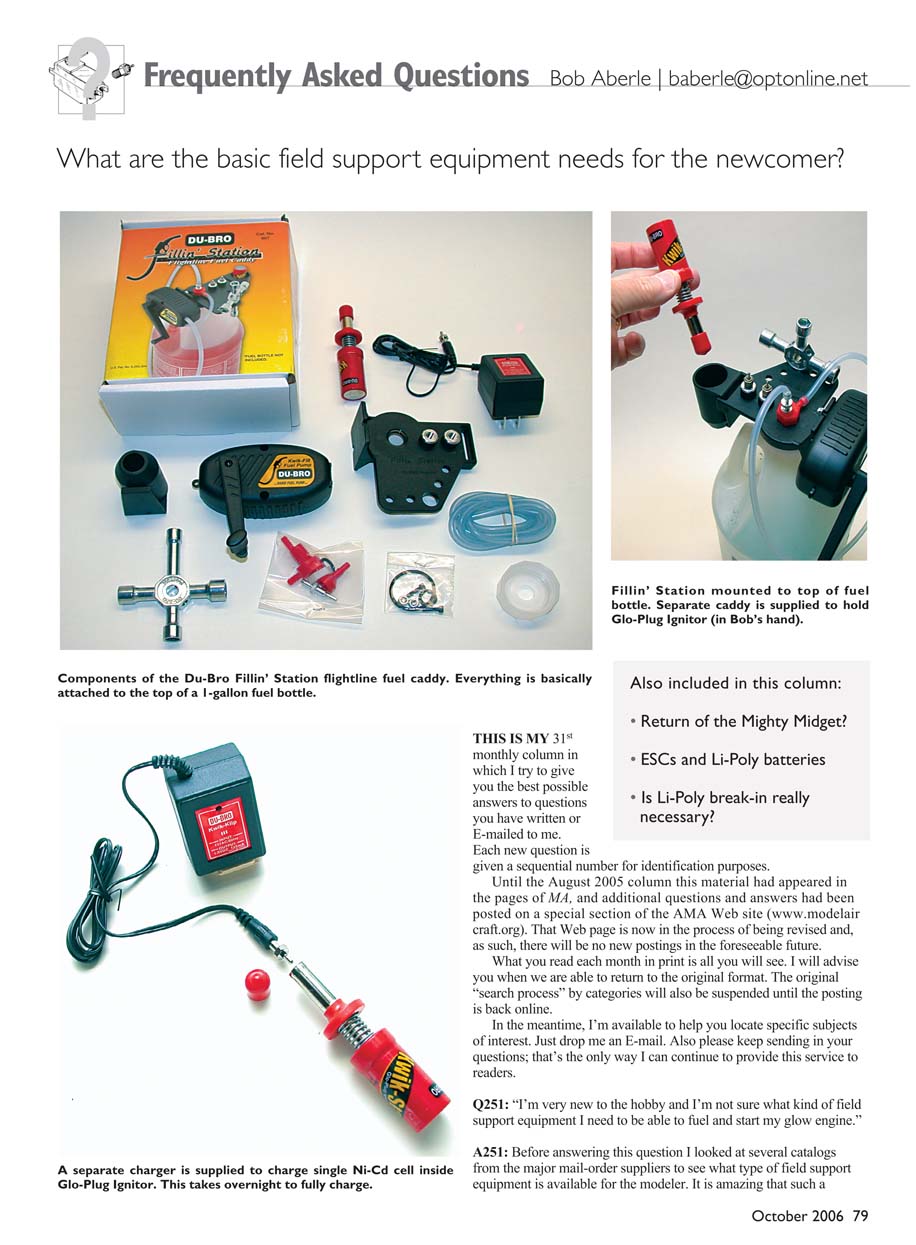
My approach is different: I use the Du‑Bro Fillin’ Station flightline fuel caddy (catalog no. 907). It is made from a molded plastic that is not affected by glow fuel or gasoline.
Key features of the Fillin’ Station:
- The main bracket mounts on top of a 1‑gallon fuel bottle in place of the normal cap.
- A manual (hand‑crank) fuel pump attaches to the bracket.
- Provisions for several tools; a four‑way socket wrench is included (for removing glow plugs and tightening prop nuts).
- Space for two extra glow plugs.
- A Du‑Bro Kwik Start Glo‑Plug Ignitor is provided, with a separate charger for the single Ni‑Cd cell inside the ignitor (takes overnight to fully charge).
- Simple screw‑on clips attach to the bracket for the glow‑plug lead and for the starter lead.
- The glow‑plug lead is a clip that attaches directly to the glow‑plug head.
- The starter is a very small electric unit that slips over the propeller hub and is held in place by a rubber band; it connects to a small 6‑volt battery pack (4 AA cells) stored in a bracket.
This setup is compact, robust, and avoids the tangle of wires associated with larger power panels.
Q252: "I noted that a new series of microsize brushless motors is now available under the name Mighty Midget. Didn't I hear that same name used years ago?"
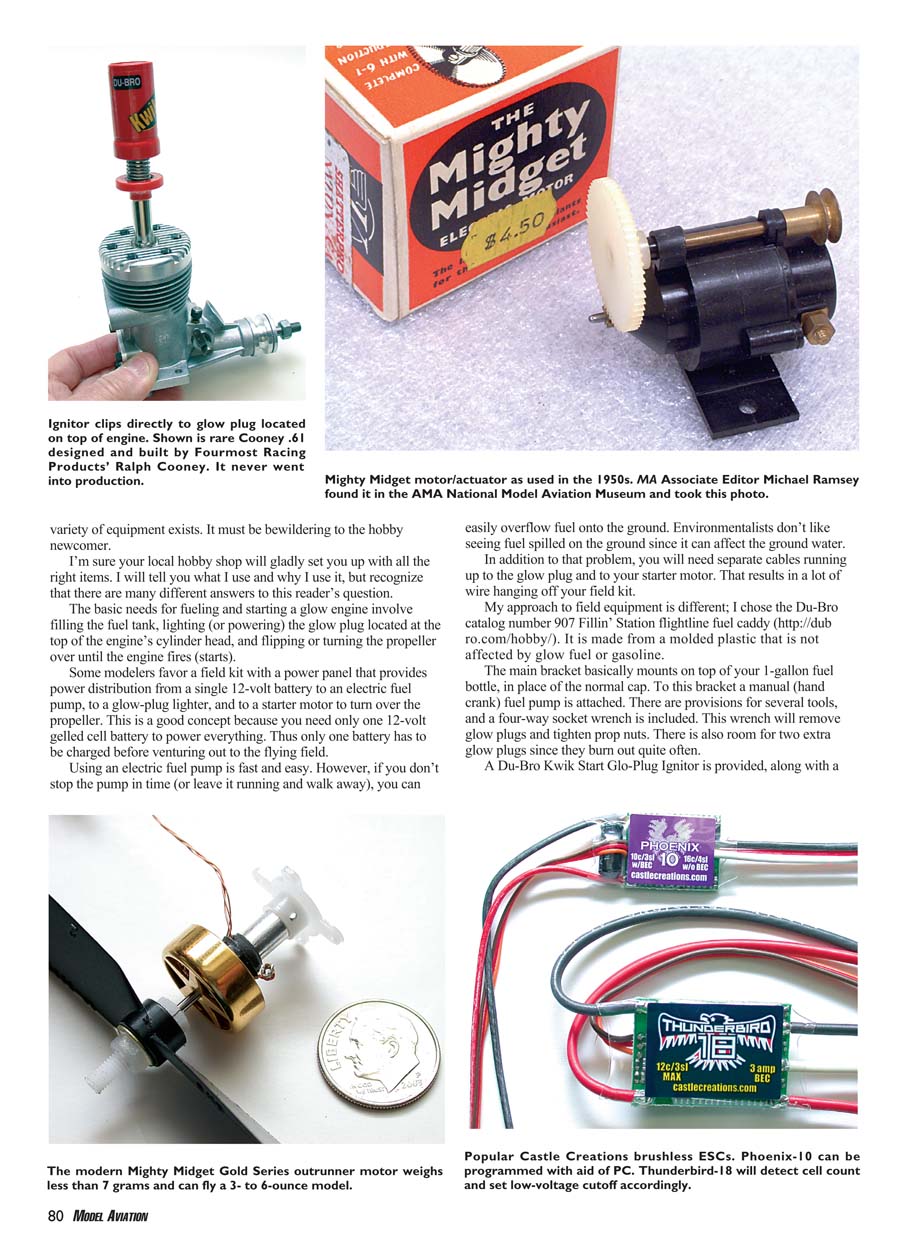
A252: Yes — the name "Mighty Midget" goes back a long way. One of our old actuators for galloping ghost RC systems used a geared electric motor called the "Mighty Midget."
MA Associate Editor Michael Ramsey located a Mighty Midget in the AMA museum and photographed it. In contrast, the new Mighty Midget Gold Series motors have just been introduced in the U.S. and are available from Bob Selman Designs (www.bsmdcrrc.com/products.cfm?catID=10037). These motors are made by N. Chandrashekhar and his son Uttam of Bangalore, India.
Specifications and intended use for the new outrunner:
- Weight: about 7 grams (0.25 ounce) including propeller, propeller adapter, mount, and connector.
- Power: runs on two Li‑Poly cells at roughly 1.5 amps motor current, approximately 10–12 watts input.
- Suitable for flying models weighing about 3–6 ounces.
I plan to use this motor in a new 4‑ounce design employing a Castle Creations Phoenix‑10 ESC, an FMA Direct M5V2 receiver, and two Hitec HS‑50 servos. With suitable micro substitutes it should be easy to fly models under 3 ounces while still using proportional‑feedback servos.
Q253: "We have been told not to discharge Li‑Poly battery cells below approximately 3.0 volts. Our modern ESCs now have built‑in cutoff circuits that limit the total voltage to not less than 3.0 volts per cell. But I discovered that not all ESCs work the same way. Can you explain this further?"
A253: Many modern ESCs (especially brushless types) either let you program the exact voltage cutoff or use cell‑count detection to set the cutoff to about 3.0 volts per cell when using Li‑Poly batteries.
However, not every ESC does this. Some use a scheme in which the total pack voltage is measured at the time the power is turned on, and then a percentage (for example, 70% of that measured total) is selected for the cutoff.
The problem with that approach:
- If you have a battery that can run your motor for 30 minutes but you choose to make three separate flights on one charge, the pack voltage will be lower each time you restart.
- If the ESC sets cutoff as 70% of the voltage measured at power‑up, each successive start will allow the battery to discharge to a progressively lower absolute voltage — potentially below the safe ~3.0 volts per cell threshold.
- That scheme is not appropriate for Li‑Poly packs.
Ask about the cutoff method when purchasing any ESC. If the vendor can't answer clearly, you should be wary.
Castle Creations ESCs can be programmed for cutoff, and even the less expensive Thunderbird line employs actual cell‑count detection. Castle Creations ESCs also follow a power‑on sequence that beeps the number of cells in the pack to confirm the voltage cutoff for that flight — a useful feature.
Q254: "I keep hearing pros and cons about cycling (charging and discharging) new Li‑Poly batteries initially at moderate rates as a form of break‑in. Is this really necessary?"
A254: The jury is still out on break‑in for Li‑Poly batteries because it's a relatively new technology and our knowledge continues to evolve. Several vendors told me that breaking in new Li‑Poly packs is essential.
I received an opposite viewpoint from a respected source, Fred Marks (President, FMA Direct). Paraphrasing his message: if you take the time and trouble to do a so‑called "break‑in" on new Li‑Poly packs, it may only increase capacity by a fraction of a percent up to perhaps about 10 cycles. It's often not worth the effort. Proper balanced cell charging will achieve far more in terms of service life and sustained capacity than any break‑in procedure.
For now, I'll follow Fred's advice and keep on flying.
Transcribed from original scans by AI. Minor OCR errors may remain.

