
Frequently Asked Questions - 2006/11
Bob Aberle | [email protected]
Stuck on your work? Bob describes a cyanoacrylate release agent.
Also included in this column:
- RC Spotlight Internet search engine
- Mini Ultra Stick landing-gear modification
- E Cubed R/C antenna-length clarification
- Where to get ignition-engine parts
- AstroFlight Lithium Charger (item 109) upgrade
- Alternative balsa supplier
THIS IS MY 32nd monthly column in which I try to give you the best possible answers to questions you have written or E-mailed to me. Each new inquiry is given a sequential number for identification purposes.
Until the August 2005 column this material had been published in MA and additional questions and answers had been posted on a special section of the AMA Web site (www.modelaircraft.org). That Web page is now in the process of being revised, and there will be no new postings in the foreseeable future.
What you read each month in print is all you will see. I will advise you when we are able to return to the original format. The original "search process" by categories will also be suspended until the posting is back online.
In the meantime, I'm available to help you locate specific subjects of interest. Just drop me an E-mail. Also please keep sending in your questions; that's the only way I can continue to provide this service to readers.
Q255
"I have accidentally stuck myself many times to my model or my workbench while using the cyanoacrylate-type instant glues and accelerators.
"I also recently received a good burn because I had gotten a few drops of cyanoacrylate cement on my finger, and then without realizing it sprayed the accelerator in the same area. It kicked off the cement and gave me a good burn that later became infected.
"Aside from the solvents offered, is there anything else I might keep on hand to prevent this from becoming a problem?"
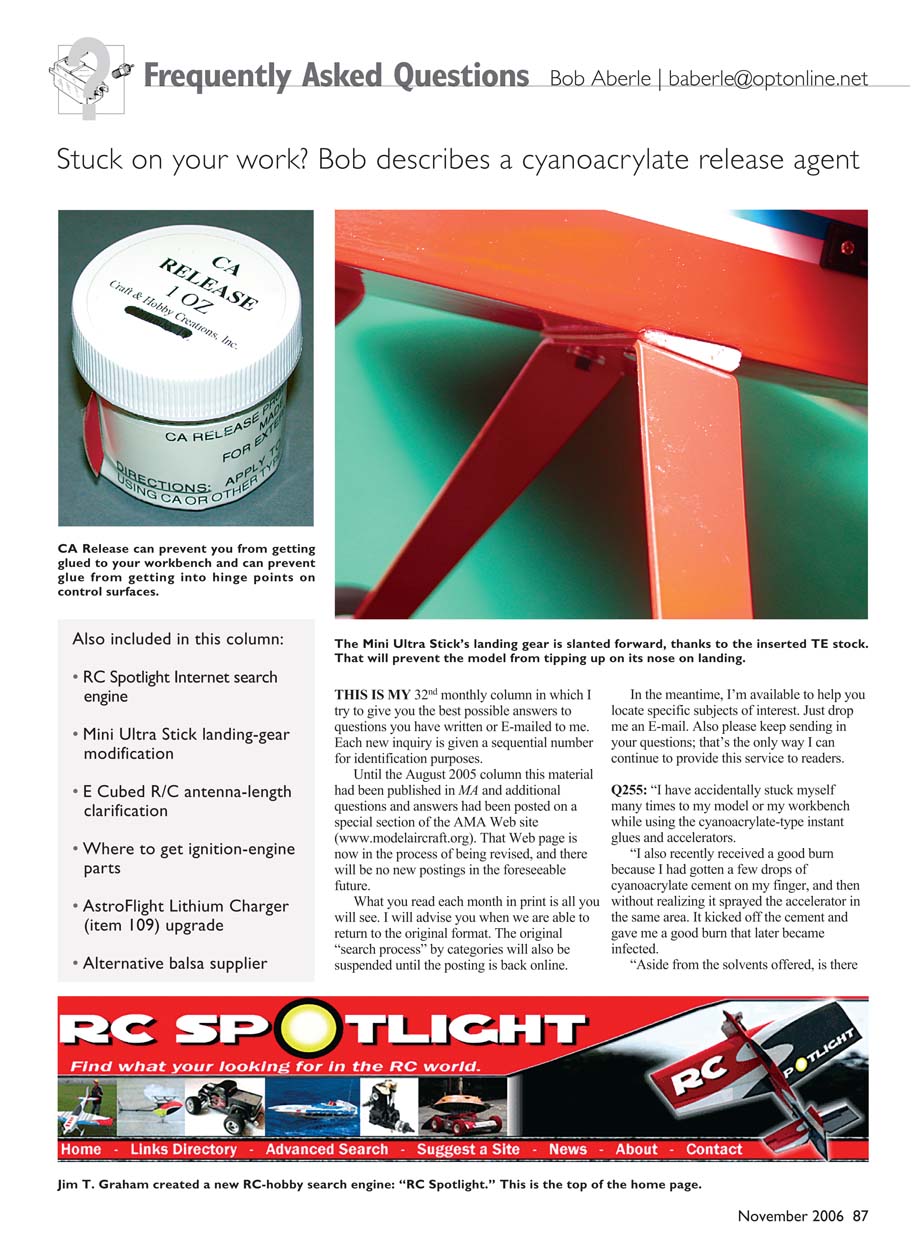
A255: I recently learned about a skin-protection product called CA Release, sold by Jim McCoul of Craft & Hobby Creations of Sterling Heights, Michigan. It is sold in 1-ounce jars for $4.50, and you pay a lower price if you purchase five or more jars.
CA Release is a white, creamlike substance. You apply it to your hands or fingers before using cyanoacrylate-type cement, other hobby glues, and even hobby paint products. With this product, if any cement or paint gets on your hands or fingers, you can easily peel it off after it dries without affecting your skin in any way. I've tried CA Release, and it does work as claimed.
There is also a bonus with this product. When installing control-surface hinges on your aircraft, apply some CA Release at the hinge line before the cement. The result is that the hinge will be cemented to the structure, but the hinge line will be free to move.
When I went to Jim's Web site (www.wideopenwest.com/~mmc9892), I was surprised to see quite a few other interesting products such as servo-cable conduit tubes, hole cutters for the passage of conduit tubes, fuel-line clamps, and wood clamps. Visit the site and check out the various products. It always amazes me how one item can lead to another and another!
Q256
“I just wanted you to know that I recently learned of a new Internet search engine that is geared specifically to our RC hobby. It is called ‘RC Spotlight’—the world’s first RC search engine. I suggest you try it!”
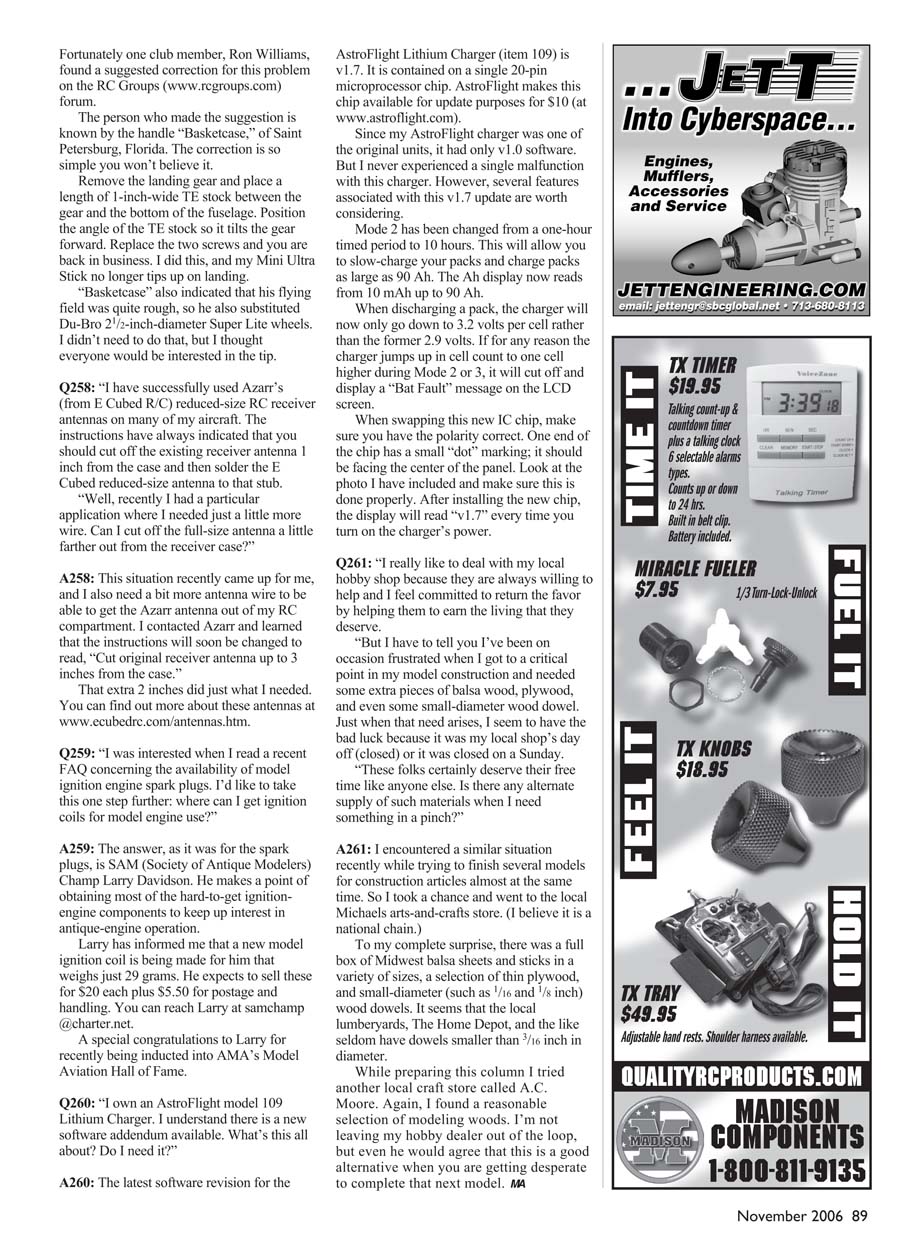
A256: (Or in this case, follow-up 256.) I took the reader’s advice and looked up this new search engine. The address is www.rcspotlight.com. It was created by Jim T. Graham, who was formerly with Hobby Lobby International and now runs his own RC hobby business known as Billy Hell RC (www.billyhell.com).
I’ve tried Jim’s new search engine, and it does work. It will probably take a while to get it fully organized and operational, but the concept is interesting and I urge you to try this new service for the RC modeler.
Q257
“I read your review of the E-flite Mini Ultra Stick ARF which is posted to the AMA’s webzine Sport Aviator. Your flight shots looked so great I went right out and bought my own ‘Stick.’
“I like it very much, but I have noticed that the position of the landing gear is such that the airplane almost always tips up on its nose with every landing. What do you recommend? Relocating the landing gear?”
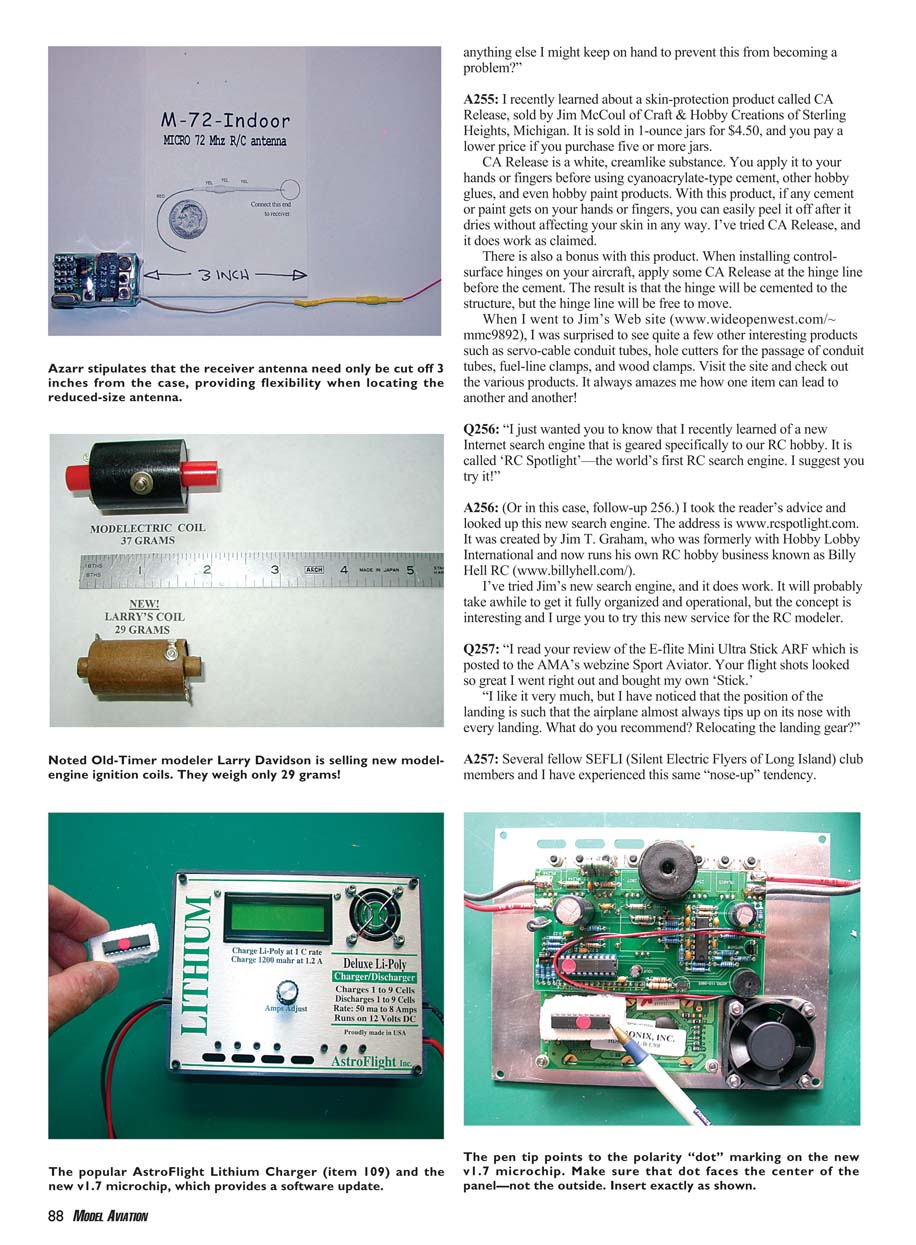
A257: Several fellow SEFLI (Silent Electric Flyers of Long Island) club members and I have experienced this same “nose-up” tendency. Fortunately one club member, Ron Williams, found a suggested correction for this problem on the RC Groups forum (www.rcgroups.com).
The person who made the suggestion is known by the handle "Basketcase," of Saint Petersburg, Florida. The correction is so simple you won't believe it.
Remove the landing gear and place a length of 1-inch-wide TE stock between the gear and the bottom of the fuselage. Position the angle of the TE stock so it tilts the gear forward. Replace the two screws and you are back in business. I did this, and my Mini Ultra Stick no longer tips up on landing.
"Basketcase" also indicated that his flying field was quite rough, so he also substituted Du-Bro 2-1/2-inch-diameter Super Lite wheels. I didn't need to do that, but I thought everyone would be interested in the tip.
Q258
"I have successfully used Azarr's (from E Cubed R/C) reduced-size RC receiver antennas on many of my aircraft. The instructions have always indicated that you should cut off the existing receiver antenna 1 inch from the case and then solder the E Cubed reduced-size antenna to that stub.
"Well, recently I had a particular application where I needed just a little more wire. Can I cut off the full-size antenna a little farther out from the receiver case?"
A258: This situation recently came up for me, and I also needed a bit more antenna wire to be able to get the Azarr antenna out of my RC compartment. I contacted Azarr and learned that the instructions will soon be changed to read, "Cut original receiver antenna up to 3 inches from the case."
That extra 2 inches did just what I needed. You can find out more about these antennas at www.ecubedrc.com/antennas.htm.
Q259
"I was interested when I read a recent FAQ concerning the availability of model ignition engine spark plugs. I'd like to take this one step further: where can I get ignition coils for model engine use?"
A259: The answer, as it was for the spark plugs, is SAM (Society of Antique Modelers) Champ Larry Davidson. He makes a point of obtaining most of the hard-to-get ignition-engine components to keep up interest in antique-engine operation.
Larry has informed me that a new model ignition coil is being made for him that weighs just 29 grams. He expects to sell these for $20 each plus $5.50 for postage and handling. You can reach Larry at [email protected].
A special congratulations to Larry for recently being inducted into AMA's Model Aviation Hall of Fame.
Q260
"I own an AstroFlight model 109 Lithium Charger. I understand there is a new software addendum available. What's this all about? Do I need it?"
A260: The latest software revision for the AstroFlight Lithium Charger (item 109) is v1.7. It is contained on a single 20-pin microprocessor chip. AstroFlight makes this chip available for update purposes for $10 (see www.astroflight.com).
Since my AstroFlight charger was one of the original units, it had only v1.0 software. But I never experienced a single malfunction with this charger. However, several features associated with this v1.7 update are worth considering.
- Mode 2 has been changed from a one-hour timed period to 10 hours. This will allow you to slow-charge your packs and charge packs as large as 90 Ah.
- The Ah display now reads from 10 mAh up to 90 Ah.
- When discharging a pack, the charger will now only go down to 3.2 volts per cell rather than the former 2.9 volts.
- If for any reason the charger jumps up in cell count to one cell higher during Mode 2 or 3, it will cut off and display a "Bat Fault" message on the LCD screen.
When swapping this new IC chip, make sure you have the polarity correct. One end of the chip has a small "dot" marking; it should be facing the center of the panel. After installing the new chip, the display will read "v1.7" every time you turn on the charger's power.
Q261
"I really like to deal with my local hobby shop because they are always willing to help and I feel committed to return the favor by helping them to earn the living that they deserve.
"But I have to tell you, I've been on occasion frustrated when I got to a critical point in my model construction and needed some extra pieces of balsa wood, plywood, and even some small-diameter wood dowel. Just when that need arises, I seem to have the bad luck because it was my local shop's day off (closed) or it was closed on a Sunday.
"These folks certainly deserve their free time like anyone else. Is there any alternate supply of such materials when I need something in a pinch?"
A261: I encountered a similar situation recently while trying to finish several models for construction articles almost at the same time. So I took a chance and went to the local Michaels arts-and-crafts store (a national chain).
To my complete surprise, there was a full box of Midwest balsa sheets and sticks in a variety of sizes, a selection of thin plywood, and small-diameter (such as 1/16 and 1/8 inch) wood dowels. It seems that local lumberyards, The Home Depot, and the like carry dowels smaller than 3/16 inch in diameter.
While preparing this column I tried another local craft store called A.C. Moore. Again, I found a reasonable selection of modeling woods. I'm not leaving my hobby dealer out of the loop, but even he would agree that this is a good alternative when you are getting desperate to complete that next model.
MA
Transcribed from original scans by AI. Minor OCR errors may remain.

