

AMA's quick-start guide for beginners
Also included in this column:
- The How High altimeter’s See How readout device
- Soldering: suggested tools and materials
- Web sites and forums
- RC transmitter battery
This is the 37th monthly column in which I try to give you the best possible answers to questions you have written or e-mailed to me. Each new inquiry is given a sequential number for future reference. Many questions and answers have been posted to the AMA Web site at www.modelaircraft.org/mag/faq/index.asp. Unfortunately that posting stopped in August 2005 and will not continue until this section of the AMA Web site is revamped. In the meantime, if you can’t find the subject matter you are interested in, drop me an e-mail or letter and I will try to assist you.
Q285: “I heard from a local modeling friend recently that you had authored a new guide intended for the RC beginner. This friend had been given a ‘beta test’ copy to review and comment on.
“My local club has always found it hard to get a newcomer started with the RC flight learning process. So I’m most interested in what you may soon have to offer.”
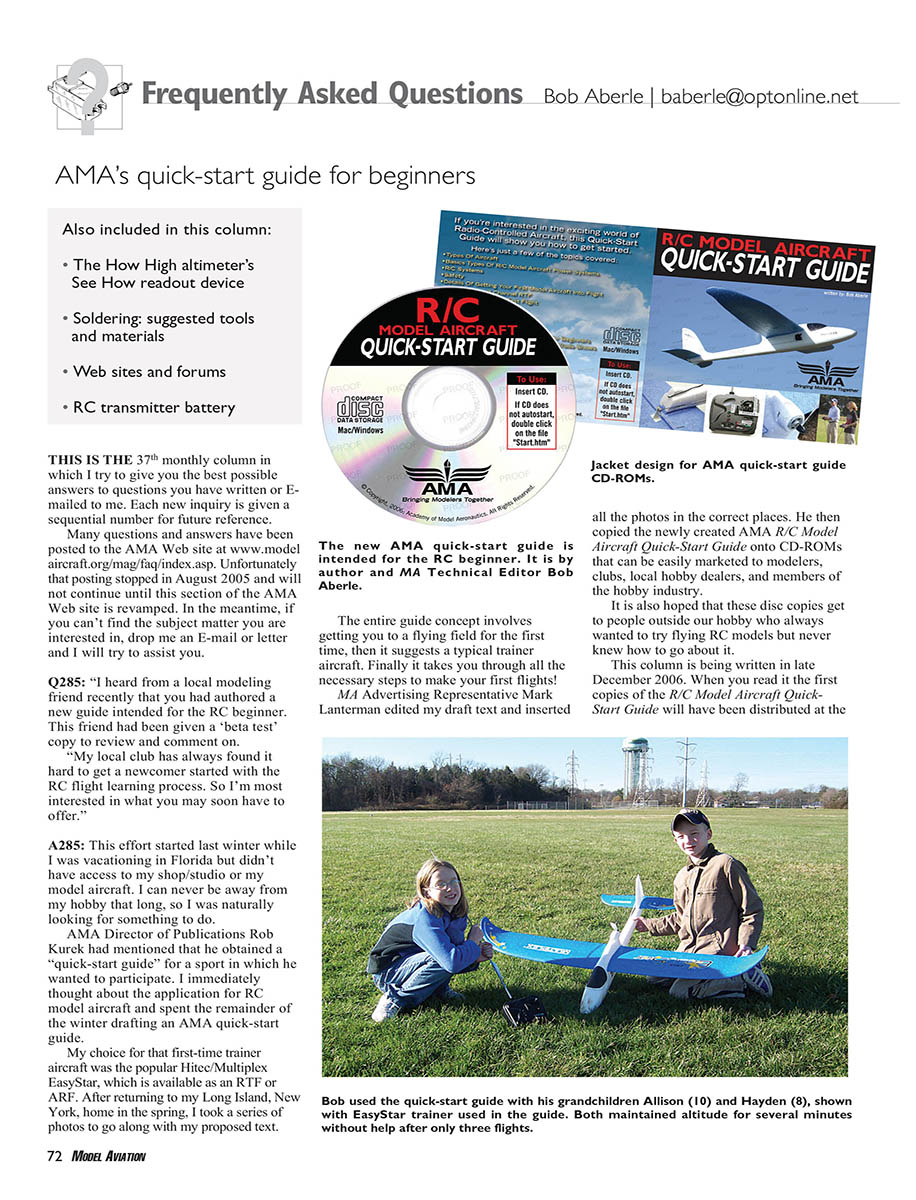
A285: This effort started last winter while I was vacationing in Florida but didn’t have access to my shop/studio or my model aircraft. I can never be away from my hobby that long, so I was naturally looking for something to do. AMA Director of Publications Rob Kurek had mentioned that he obtained a “quick-start guide” for a sport in which he wanted to participate. I immediately thought about the application for RC model aircraft and spent the remainder of the winter drafting an AMA quick-start guide.
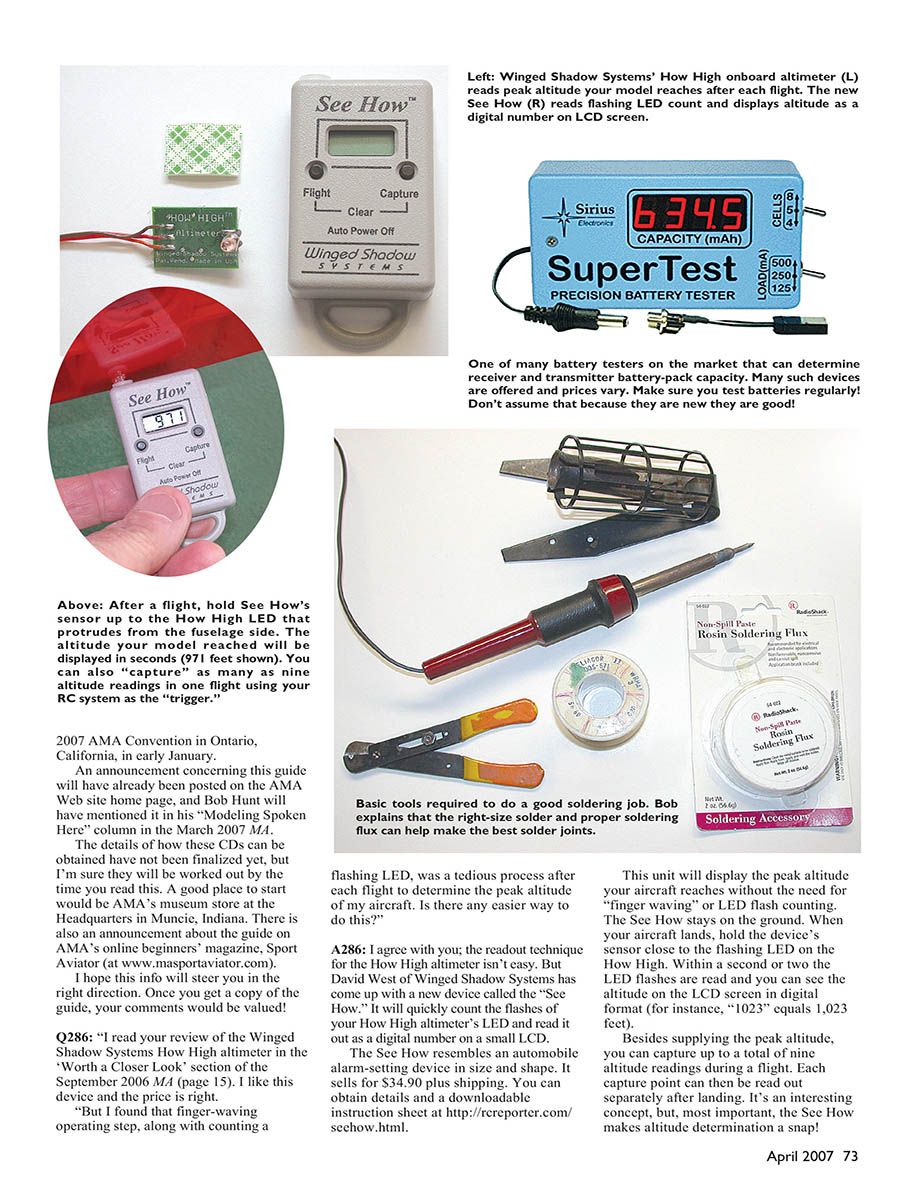
My choice for that first-time trainer aircraft was the popular Hitec/Multiplex EasyStar, which is available as an RTF or ARF. After returning to my Long Island, New York, home in the spring, I took a series of photos to go along with my proposed text.
The entire guide concept involves getting you to a flying field for the first time, then it suggests a typical trainer aircraft. Finally it takes you through all the necessary steps to make your first flights. AMA Advertising Representative Mark Lanterman edited my draft text and inserted all the photos in the correct places. He then copied the newly created R/C Model Aircraft Quick-Start Guide onto CD-ROMs that can be easily marketed to modelers, clubs, local hobby dealers, and members of the hobby industry. It is also hoped that these disc copies get to people outside our hobby who always wanted to try flying RC models but never knew how to go about it.
This column was written in late December 2006. When you read it the first copies of the R/C Model Aircraft Quick-Start Guide will have been distributed at the 2007 AMA Convention in Ontario, California, in early January.
An announcement concerning this guide will have already been posted on the AMA Web site home page, and Bob Hunt will have mentioned it in his "Modeling Spoken Here" column in the March 2007 MA.
The details of how these CDs can be obtained have not been finalized yet, but I'm sure they will be worked out by the time you read this. A good place to start would be AMA's museum store at Headquarters in Muncie, Indiana. There is also an announcement about the guide on AMA's online beginners' magazine, Sport Aviator (www.sportaviator.com).
I hope this info will steer you in the right direction. Once you get a copy of the guide, your comments would be valued!
Q286: "I read your review of the Winged Shadow Systems How High altimeter in the 'Worth a Closer Look' section of the September 2006 MA (page 15). I like this device and the price is right.
"But I found that finger-waving operating step, along with counting a flashing LED, was a tedious process after each flight to determine the peak altitude of my aircraft. Is there any easier way to do this?"
A286: I agree with you; the readout technique for the How High altimeter isn't easy. But David West of Winged Shadow Systems has come up with a new device called the "See How." It will quickly count the flashes of your How High altimeter's LED and read it out as a digital number on a small LCD.
The See How resembles an automobile alarm-setting device in size and shape. It sells for $34.90 plus shipping. You can obtain details and a downloadable instruction sheet at http://rcreporter.com/seehow.html.
This unit will display the peak altitude your aircraft reaches without the need for "finger waving" or LED flash counting. The See How stays on the ground. When your aircraft lands, hold the device's sensor close to the flashing LED on the How High. Within a second or two the LED flashes are read and you can see the altitude on the LCD screen in digital format (for instance, "1023" equals 1,023 feet).
Besides supplying the peak altitude, you can capture up to a total of nine altitude readings during a flight. Each capture point on the unit can be read out separately after landing. It's an interesting concept, but, most important, the See How makes altitude determination a snap.
Application-wise the How High altimeter can be used without an RC system to check on peak altitude of free flight (FF), sailplane, and rubber-powered models. All you need is a Li-Poly battery (for example, a single-cell 130 mAh) to power it. You won’t be able to use the capture features without RC, but peak-altitude recording is no problem.
Also consider using the How High to check on your radio system’s overhead range. It might surprise you that when your aircraft is almost out of sight, it is at an altitude of only 500–600 feet. Try it!
Q287: “I have been trying to improve my soldering skills, but unfortunately don’t seem to get past the basics.
“My common sense tells me that heavy gauge wire needs a higher wattage soldering iron than lighter gauge wire. I’m also sure that the type and size of the solder itself is another important consideration. I wonder about the use of a flux to make the solder flow more freely, producing the proper joint.
“Can you set me in the right direction?”
A287: I have used Ungar soldering irons and those sold by RadioShack for many years. Both generally have a handle and a heating element.
For most 16-gauge and lighter wire I use a heating element of approximately 15–25 watts. Heavier-gauge wire, such as 14- to 10-gauge, requires a much hotter element such as 40–50 watts.
I always use a multicore-type solder that has a built-in flux inside the core. I also select a thin-gauge (diameter) solder so it melts faster under normal heat levels.
RadioShack makes a .032-inch-diameter solder I like very much. It is identified as catalog numbers 64-017, 64-005, and 64-009, depending on the amount of solder on the roll.
Even though this solder has its own flux, I generally add more flux of the paste variety (RadioShack item 64-022). This is a rosin soldering flux and the only type you should use for electrical wiring. Never use acid flux as sold in plumbing-supply stores since it is highly corrosive.
I never use a soldering gun. This is the type that heats up almost instantly when you pull a trigger. The problem with it is that depending on your patience the heat at the tip can vary and often produces cold solder joints.
The proof of a good solder job is a shiny, silverlike solder joint. A gray-colored, dull-looking solder joint did not get enough heat; that is what we call a "cold solder joint." It is to be avoided because the joint can quickly separate, creating an open circuit or at least an intermittent connection.
Q288: “I had heard that a new forum type Web site was recently introduced by Air Age. Can you steer me to that Web site?”
A288: My understanding is that the Web site you are referring to—Radio Control Zone—has been up and working for almost a year. It is sponsored by Air Age Media, which publishes Model Airplane News and Backyard Flyer magazines (and others). Only recently has this forum been advertised. You can find it at www.radiocontrolzone.com.
The site is divided into major categories of aircraft, cars, and boats. Within the airplane category are many subcategories such as "Model Aerodynamics," "Park and Backyard Flyers," "Post Your Project Photos," "Sailplanes," and many more. There are also "Buy/Sell/Trade" and "Items Wanted" sections. This forum is definitely worth looking into.
Q289: “I fly electric-powered model aircraft and recently suffered a bad crash. The aftermath of that flight indicated that my RC transmitter battery pack had died early into my flying session.
"I later tested that pack and discovered that it had a bad cell. What can I do to prevent this problem?”
A289: I’ve answered this kind of question many times, but the problem will never go away. The fact that you tested your transmitter battery pack after the crash tells me that you have the equipment and experience to test that kind of pack.
So your problem is that you went on flying month after month or year after year and never bothered testing the battery pack’s capacity until you suffered a crash. When you fly electric power, if the model can’t get off the ground the airborne battery either has a problem or wasn’t charged.
You can correct that situation without a resulting crash. Of course if you must use a separate receiver/servo battery in your aircraft, it must be charged and checked just like your RC transmitter.
Your RC transmitter usually has a digital voltmeter that indicates the voltage on an LCD screen, but it doesn’t tell you capacity. If your transmitter voltmeter drops off quickly after several flights, that certainly raises a flag.
If your transmitter uses AA-size alkaline cells and the LED indicator changes from green to amber, that means caution. Don’t wait for the red LED to glow—change the cells right away.
There are many good RC transmitter battery-pack testers on the market for less than $100, one of which is the West Mountain Radio CBA II (www.westmountainradio.com/CBA.htm). Another good tester is the Sirius Electronics Super Test Precision Battery Tester ($69.95). You can learn more about it at www.siriuselectronics.com/index.php?main_page=product_info&cPath=1&produ....
Hobbico offers the Accu-Cycle Pro-Series Elite, which covers charging and discharging battery-test functions (www.hobbico.com/filedequip/hs-hcap0280.html).
Keep in mind that the charging circuits inside most RC transmitters employ a blocking diode, which means you won’t be able to read voltage through the charging jack. That usually means you must remove the battery pack and hook it up directly to the tester using an adapter cable that is available from the RC manufacturer or an accessory supplier such as Radical RC (www.radicalrc.com).
MA
Transcribed from original scans by AI. Minor OCR errors may remain.

