
Frequently Asked Questions - 2007/06
Bob Aberle | [email protected]
Sanding wing dihedral and polyhedral joints
Also included in this column:
- Du-Bro Micro Profile Landing Gear
- Rubber-band replacement
- Expo rate control
- Battery-storage recommendations
This is the 39th monthly column in which I try to give you the best possible answers to questions you have written or emailed to me. Each new inquiry is given a sequential number for future reference.
Many questions and answers have been posted to the AMA web site at www.modelaircraft.org/mag/faq/index.asp. Unfortunately that posting stopped in August 2005 and will not continue until this section of the AMA web site is revamped. In the meantime, if you can't find the subject matter you are interested in, drop me an email or letter and I will try to assist you.
Q295: Cutting the proper angle for a dihedral or polyhedral wing joint
Q295: "I've been building model aircraft for quite a long time. But I have to admit that despite all my experience there is one aspect of the building process that drives me crazy and that is cutting the proper angle for a dihedral or polyhedral wing joint. Is there any tool or machine available to make this job easier?"
A295: Years ago a company offered a wing-joint sander that allowed a sanding block to ride on rails, or a track. You physically moved the sanding block back and forth to sand the proper angle into your wing-section joint. It was still a difficult job because the wing could easily shift position.
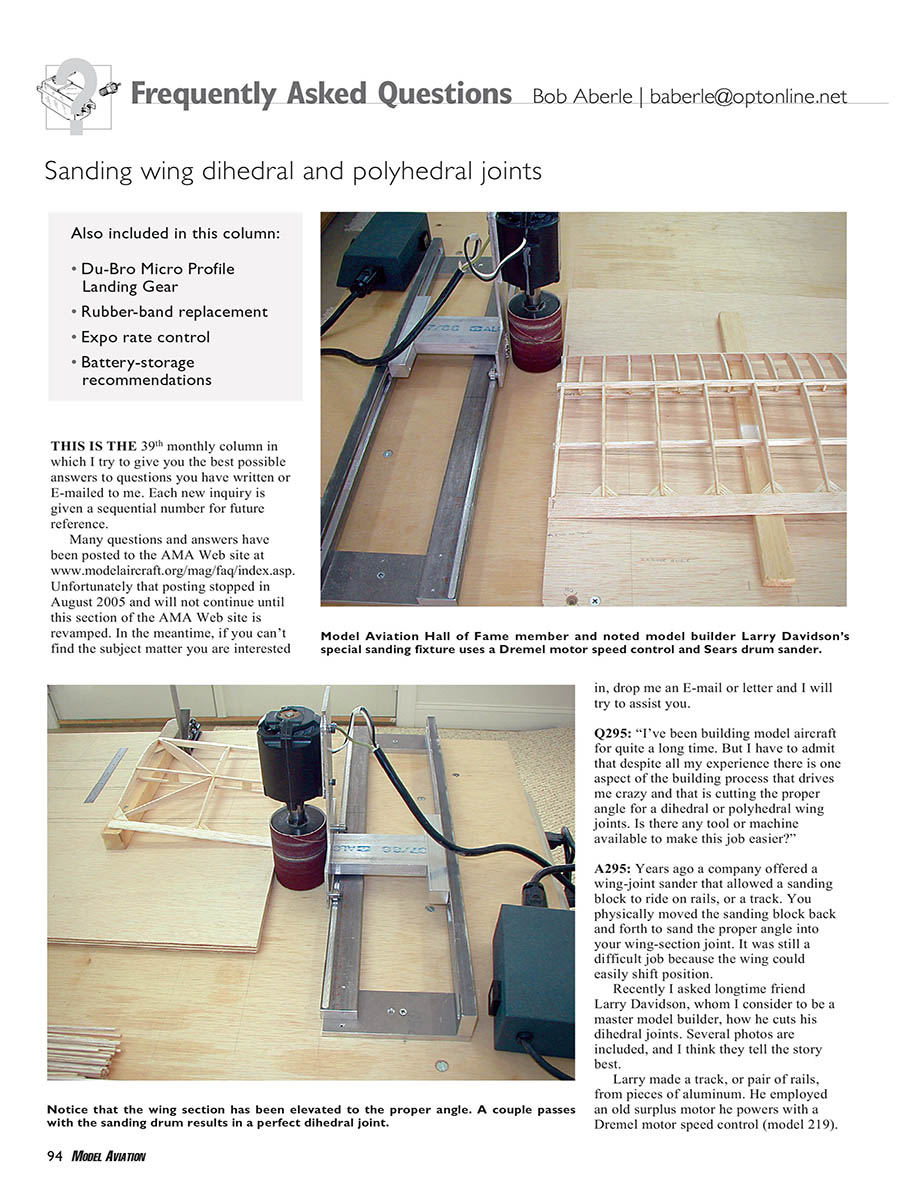
Recently I asked longtime friend Larry Davidson, whom I consider to be a master model builder, how he cuts his dihedral joints. Several photos are included, and I think they tell the story best.
Larry made a track, or pair of rails, from pieces of aluminum. He employed an old surplus motor he powers with a Dremel motor speed control (model 219). He attached a large-diameter Sears drum sander to the motor shaft. The speed control allows Larry to adjust the drum sander’s speed.
The wing is placed on a flat board and elevated to the proper dihedral or polyhedral angle. While holding the wing to the board, Larry moves the drum sander back and forth on the metal track. All it takes is several passes to establish a perfect-fitting joint.
After seeing this I’m sure many modelers will be able to duplicate Larry’s sanding device. Honestly I’m hoping that some enterprising modeler will decide to build the device and market it.
Q296: Lightweight landing gear for profile fuselages
Q296: “I’m trying to design some ‘foamie type’ E-3-D models for the fun of it. Most likely I will employ a profile fuselage because it is fast to build and basically a simple structure.
“But one of the items I could use is a good, lightweight landing gear assembly that is expressly designed for use with a profile fuselage. To your knowledge is there a product out there that I have missed?”
A296: In the December 2006 MA on page 104 (question-and-answer 263) I showed a metal landing gear that was intended for profile fuselages, offered by 3D Hobby Shop. This will certainly work, but it comes in only one size.
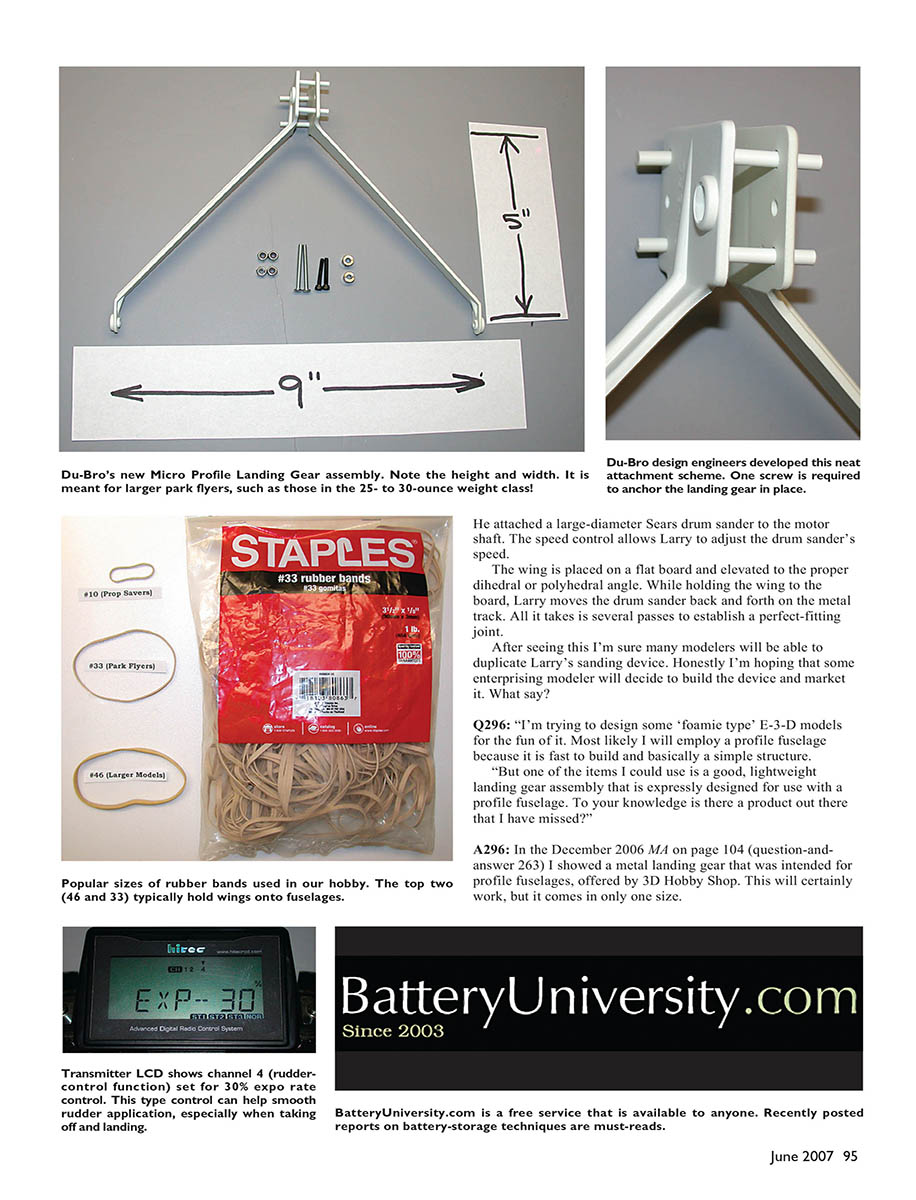
I recently learned that Du-Bro came out with a Micro Profile Landing Gear (catalog number 943) that is made from a plastic material. As shown, it has an interesting mounting pad that should work well with balsa or foam profile fuselages.
However, this gear is large and will probably be best suited for larger parking-lot flyers, such as those weighing 25–30 ounces with 300 square inches of wing area and 100–125 watts of input power. I like this gear's mounting design and overall quality, but I suggest to my friends at Du-Bro that they consider several other smaller sizes. You can find this gear at www.shopatron.com/product/product_id=DUB943/101.0.
Q297: Reusing rubber bands
Q297: "I’m sure you can’t use rubber bands over and over again without noting some form of deterioration. Since we use these rubber bands, in many cases, to hold our wings in place, are there any precautions that I should take?"
A297: I purchase my rubber bands mostly in bulk packages from one of the national stationery stores such as Staples or Office Max. The price is certainly right.
You should select a rubber band that is the right size for the particular application. For my larger models, say 4 pounds and heavier, I use the old time-honored size 64 rubber band. My smaller parking-lot flyers do better with a size 33 rubber band. For the propeller savers on my small AXI brushless motors, I have been using the much smaller size 11.
When I used rubber bands on my glow-fueled aircraft years ago, I discarded the bands after each flying session, no matter what. That is because they had a fuel-residue coating after several flights, and that softened the rubber, causing them to disintegrate quickly.
When it came to "clean" electric-powered flight I was tempted to save or reuse my wing hold-down rubber bands. Don't do it! Throw the rubber bands out after every flight. The sun's ultraviolet rays cause the rubber to deteriorate quickly. If your model's wing falls off the fuselage in flight, it won't matter how good your RC system is—the aircraft will be history.
Q298: Using exponential (expo) rate control for ground maneuvering
Q298: "A fellow club member of mine seems to think that I can use exponential (expo) rate control on my rudder function to help smooth out the ground maneuvering of my four-channel RC aircraft.
"Will that really prove a help? It seems that when I taxi to and from the takeoff area and even during my takeoff run, my aircraft zigs and zags all over the place!"
A298: I did much of my original proportional-control flying in the late 1950s and early 1960s using a form of single-stick RC transmitter. You held the transmitter case with your left hand. Your index finger worked the throttle. Your right hand gripped a single control stick that provided a three-axis control.
You rocked the stick left and right for aileron control, moved it up and down for elevator or pitch control, and rotated the entire stick for rudder control. It felt natural to me then.
Eventually everyone gravitated toward dual-transmitter stick control. To my disappointment I was forced to steer the aircraft with rudder using my left hand and bank the model with my right hand using the ailerons. I found that my left hand could not smoothly steer the airplane while it was on the ground.
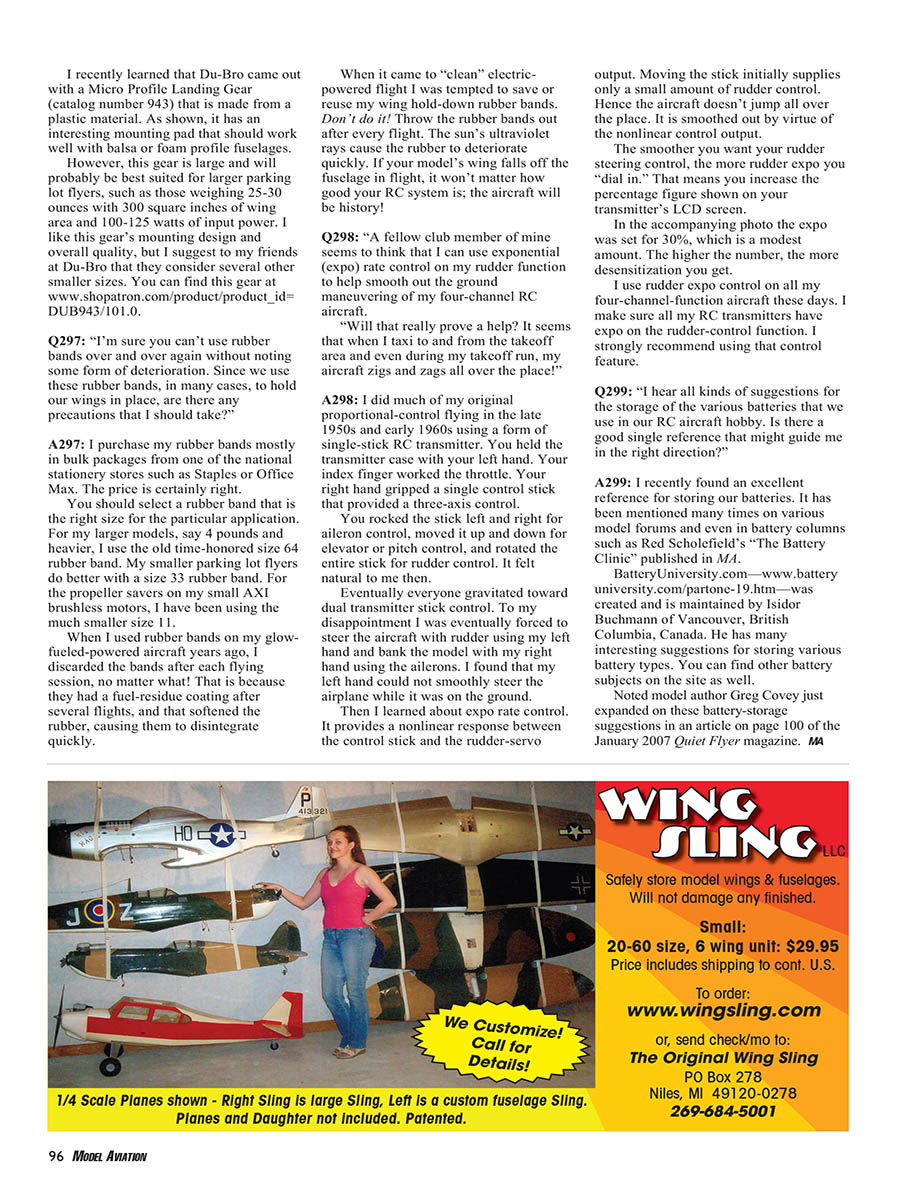
Then I learned about expo rate control. It provides a nonlinear response between the control stick and the rudder-servo output. Moving the stick initially supplies only a small amount of rudder control. Hence the aircraft doesn’t jump all over the place. It is smoothed out by virtue of the nonlinear control output.
The smoother you want your rudder steering control, the more rudder expo you "dial in." That means you increase the percentage figure shown on your transmitter's LCD screen.
In the accompanying photo the expo was set for 30%, which is a modest amount. The higher the number, the more desensitization you get.
I use rudder expo control on all my four-channel-function aircraft these days. I make sure all my RC transmitters have expo on the rudder-control function. I strongly recommend using that control feature.
Q299: Battery-storage recommendations
Q299: "I hear all kinds of suggestions for the storage of the various batteries that we use in our RC aircraft hobby. Is there a good single reference that might guide me in the right direction?"
A299: I recently found an excellent reference for storing our batteries. It has been mentioned many times on various model forums and even in battery columns such as Red Schofield's "The Battery Clinic" published in MA.
BatteryUniversity.com—www.batteryuniversity.com/partone-19.htm—was created and is maintained by Isidor Buchmann of Vancouver, British Columbia, Canada. He has many interesting suggestions for storing various battery types. You can find other battery subjects on the site as well.
Noted model author Greg Covey just expanded on those battery-storage suggestions in an article on page 100 of the January 2007 Quiet Flyer magazine. MA
Transcribed from original scans by AI. Minor OCR errors may remain.

