
Frequently Asked Questions 2008/04
Bob Aberle | [email protected]
As Hobby Lobby puts it, "Never launch a plane with a near empty battery pack again." If you normally obtain several flights on a single charge, a Li-Poly cell meter can quickly help you determine, on the flightline, when it is time to go back on the charger. It's useful on the flightline prior to launching your aircraft.
The CellMeter comes in two types:
- two- to four-cell version — $90
- two- to eight-cell version — $120
The CellMeter can quickly determine the state of charge of your Li-Poly battery pack and express it as a percentage. It can also tell you the voltage of each cell in your pack (provided that your pack has a balanced-node connector). If all the cells in the pack have approximately the same voltage, the pack is considered "balanced."
The 2.5 mm connector pin spacing on the CellMeter 4 connects directly to PolyQuest, Art-Tech, RCer, RICCS, and E-Sky Li-Poly packs. Special adapters are available for Thunder Power / Flight Power battery packs.
The CellMeter is a quality product. If your current charger already provides the information above, you probably don't need the CellMeter unless you want a quick check on the flightline. However, if your charger is a basic model without an LCD screen, the CellMeter may prove to be an asset to your Li-Poly charging process.
Q340
"I have heard that paper aircraft models are still in existence. If that is true I'd like to learn of some references and where I might purchase some of these models. I see a wonderful opportunity to use these planes with my grandchildren for educational purposes."
A340
I have read Web-site threads on one of the model forums concerning paper models. The one that was mentioned was Fiddlers Green Paper Models.
On the Web site select "Aircraft" or "Fun Stuff." From what I gather, these paper airplanes can be downloaded from the site for a reasonable fee and then printed on your computer ink-jet printer. The available categories include:
- Airships
- Bombers
- Early Flying Machines
- Helicopters
- Light Aircraft
- Racers
- Trainers
- and many more
The site offers one free download for a paper-model version of the Piper J-3 Cub.
Take the time to search around this site because it contains a great deal of information. Micro-airplane enthusiasts will appreciate the scale detail, three-views, and photos. There are even flying models made from paper.
There is too much to describe here, but I strongly suggest that you look up the Fiddlers Green Web site. You won't be sorry.
Q341
"I've been flying in Society of Antique Modeler contests for many years. Some of my planes are powered by original and replica ignition engines and some by electric motors. In either case I have experienced problems with electrical noise interfering with my RC receiver.
I heard recently that the new 2.4 GHz spread spectrum radios eliminate those problems. What's the true story?"
A341
Many fliers are currently using 2.4 GHz spread spectrum RC systems with large 1/4 and 1/3-scale aircraft powered by large ignition engines and are experiencing no interference problems. The literature about these systems concentrates on many advantages, but it has not emphasized noise interference specifically. From what I hear, electrical-noise-type interference does not happen when using a 2.4 GHz spread spectrum radio. If I'm wrong, please write in with your comments.
I asked Jack Hiner, a noted SAM and AMA Nats Electrics competitor, about his experiences. He indicated that many SAM ignition fliers have switched to 2.4 GHz spread spectrum and now have no interference problems. He mentioned that several fliers who could not fly at all on 72 MHz now fly, with no problems, on 2.4 GHz.
The message seems clear: the much-higher-frequency spread spectrum radio systems are opening many new doors to Old-Timer competition fliers.
Another advantage is scheduling flexibility: if you note thermal activity, you don't have to wait for the frequency pin; you can fly right away and take advantage of the conditions.
Q342
"I've progressed enough in the hobby to want to try a large or giant scale RC aircraft. Can you provide some reference information to help me get started?"
A342
A good place to start is MA's "Radio Control Giants" column, written by fellow Long Islander Sal Cavagna. Sal has been writing this column for years.
I found a Web site Joe Huntly created known as "Completely Scale RC." When I went there I was referred to Joe's newer site, "Great War R/C." Joe's site offers categories such as "Scale Tips" and has an extensive list of "Important Links" that should keep you busy for some time.
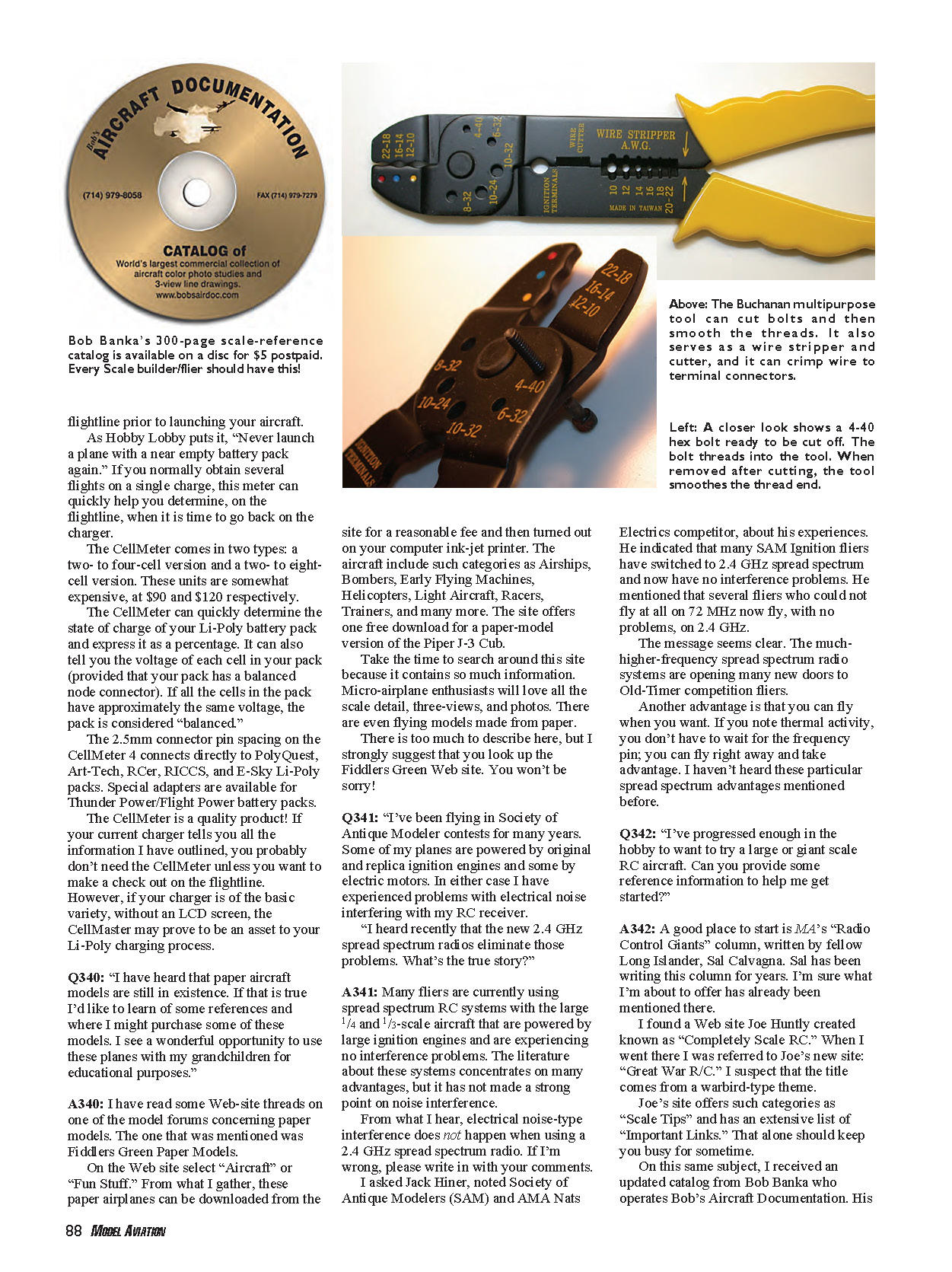
On this same subject, I received an updated catalog from Bob Banka, who operates Bob's Aircraft Documentation.
No continuation of the primary article "Frequently Asked Questions 2008/04" appears on this scanned page. The page contains only advertisements and product images.
No continuation of "Frequently Asked Questions 2008/04" appears on this scanned page; the page contains only advertisements and product images.
Transcribed from original scans by AI. Minor OCR errors may remain.

