
Frequently Asked Questions - 2008/07
Bob Aberle | [email protected]
PLEASE WRITE IN with your questions since that is the only way we can keep this column format going. When referring to already published Q/As (for follow-ups), provide the number as a reference.
Note that references to addresses and Web sites are placed in a group, separate from the text, at the end of this column.
Q353: "I attended the JR Indoor RC Festival and noted this year that many of the indoor/parking size aircraft were being flown off a 15 x 60 feet long tank of water. It really looks like fun. Many of the pilots were using twin pink foam floats on their models. Can you point me to the source of these floats?"
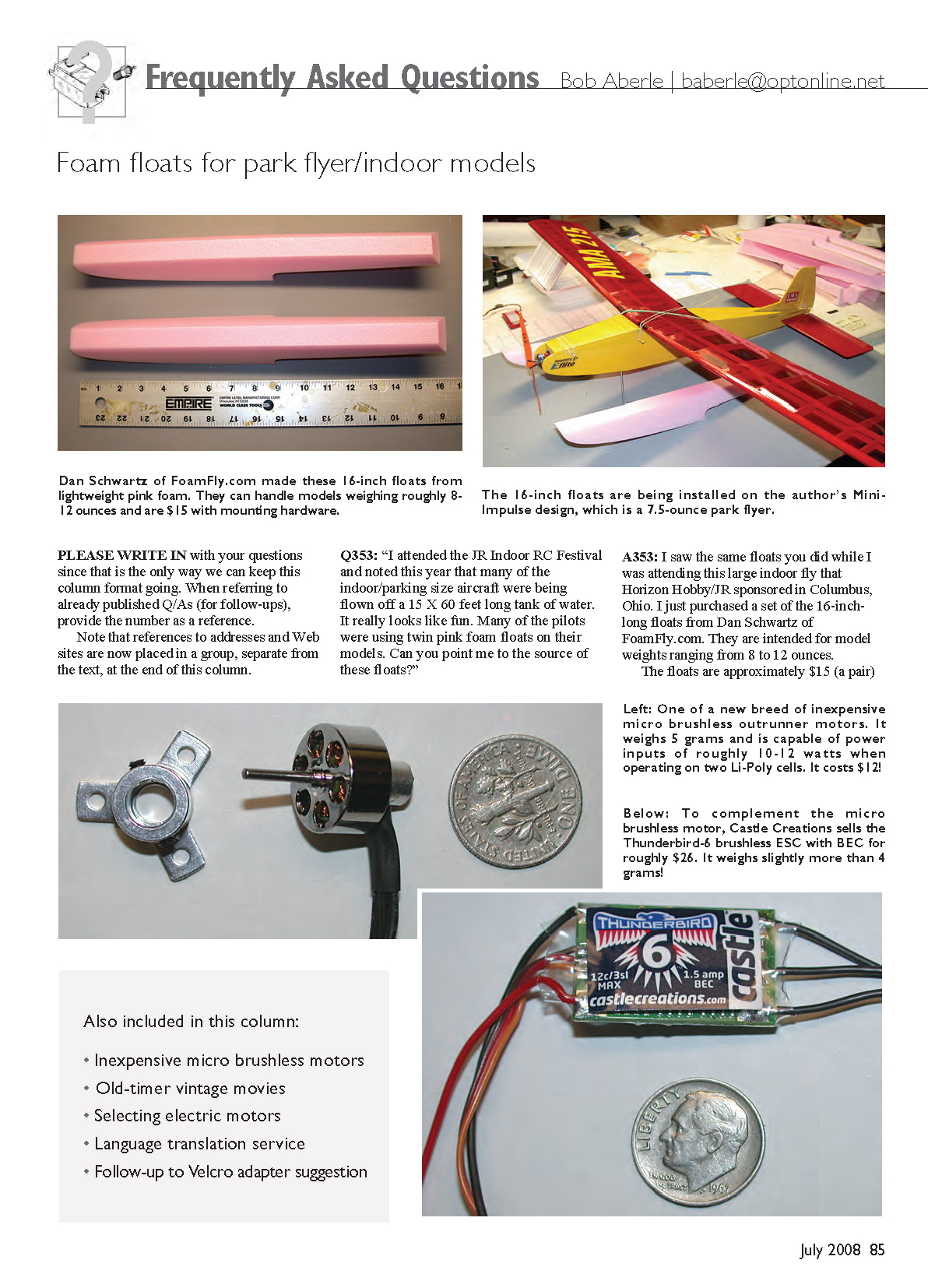
A353: I saw the same floats you did while attending this large indoor fly that Horizon Hobby/JR sponsored in Columbus, Ohio. I purchased a set of the 16-inch-long floats from Dan Schwartz of FoamFly.com. They are intended for model weights ranging from 8 to 12 ounces.
The floats are approximately $15 (a pair) and include mounting hardware and detailed installation instructions. They are made from dense pink foam and the claim is that no covering is necessary. You can easily paint them with a foam-friendly spray paint, such as Krylon H2O, which is latex-based. The floats seem somewhat flexible, so you might want to add carbon tape or strapping tape for reinforcement—determine that need from your personal experience.
A set of these floats, with mounting hardware, will hardly add an ounce of weight to your aircraft. There are several brands of foam floats on the market. I liked this particular size and type because it lends itself well to the average park flyer-type model. In the near future FoamFly.com will sell larger floats measuring 19 and 24 inches long, giving you a wider range of application. I also heard that a special 9-inch float might be developed for the popular ParkZone Cessna 210 Centurion sold through Horizon Hobby.
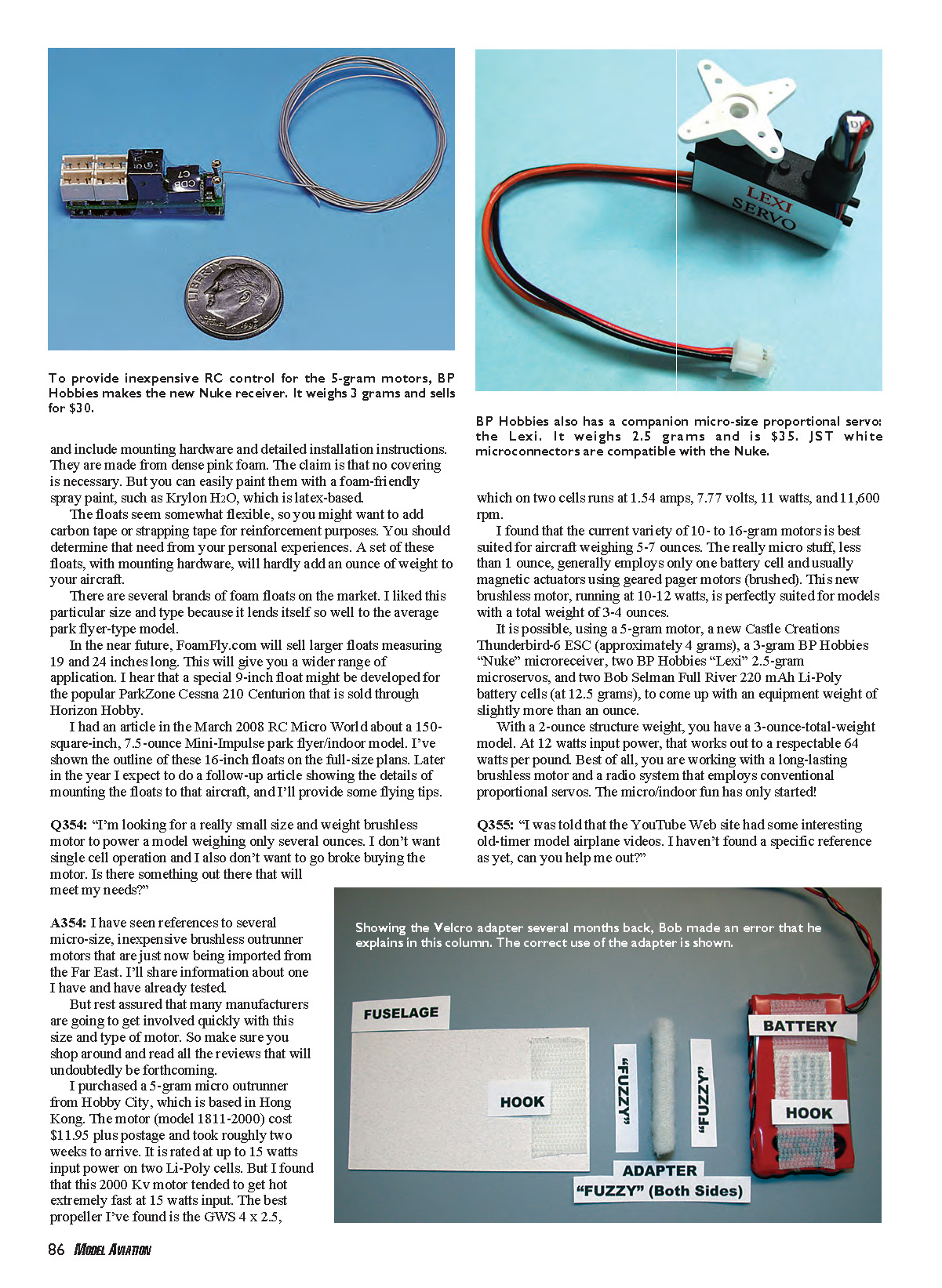
I had an article in the March 2008 RC Micro World about a 150-square-inch, 7.5-ounce Mini-Impulse park flyer/indoor model. I've shown the outline of these 16-inch floats on the full-size plans. Later in the year I expect to do a follow-up article showing the details of mounting the floats to that aircraft, and I'll provide some flying tips.
---
Q354: "I'm looking for a really small size and weight brushless motor to power a model weighing only several ounces. I don't want single cell operation and I also don't want to go broke buying the motor. Is there something out there that will meet my needs?"
A354: Several micro-size, inexpensive brushless outrunner motors are being imported from the Far East. I'll share information about one I have already tested.
I purchased a 5-gram micro outrunner from HobbyCity (based in Hong Kong). The motor (model 1811-2000) cost $11.95 plus postage and took roughly two weeks to arrive. It is rated at up to 15 watts input power on two Li-Poly cells. I found that this 2000 Kv motor tended to get hot extremely fast at 15 watts input. The best propeller I've found is the GWS 4x2.5, which on two cells runs at 1.54 amps, 7.77 volts, 11 watts, and 11,600 rpm.
The current variety of 10- to 16-gram motors is best suited for aircraft weighing 5–7 ounces. The really micro stuff (less than 1 ounce) generally employs single-cell operation and usually uses geared pager motors (brushed). This new brushless motor, running at 10–12 watts, is perfectly suited for models with a total weight of 3–4 ounces.
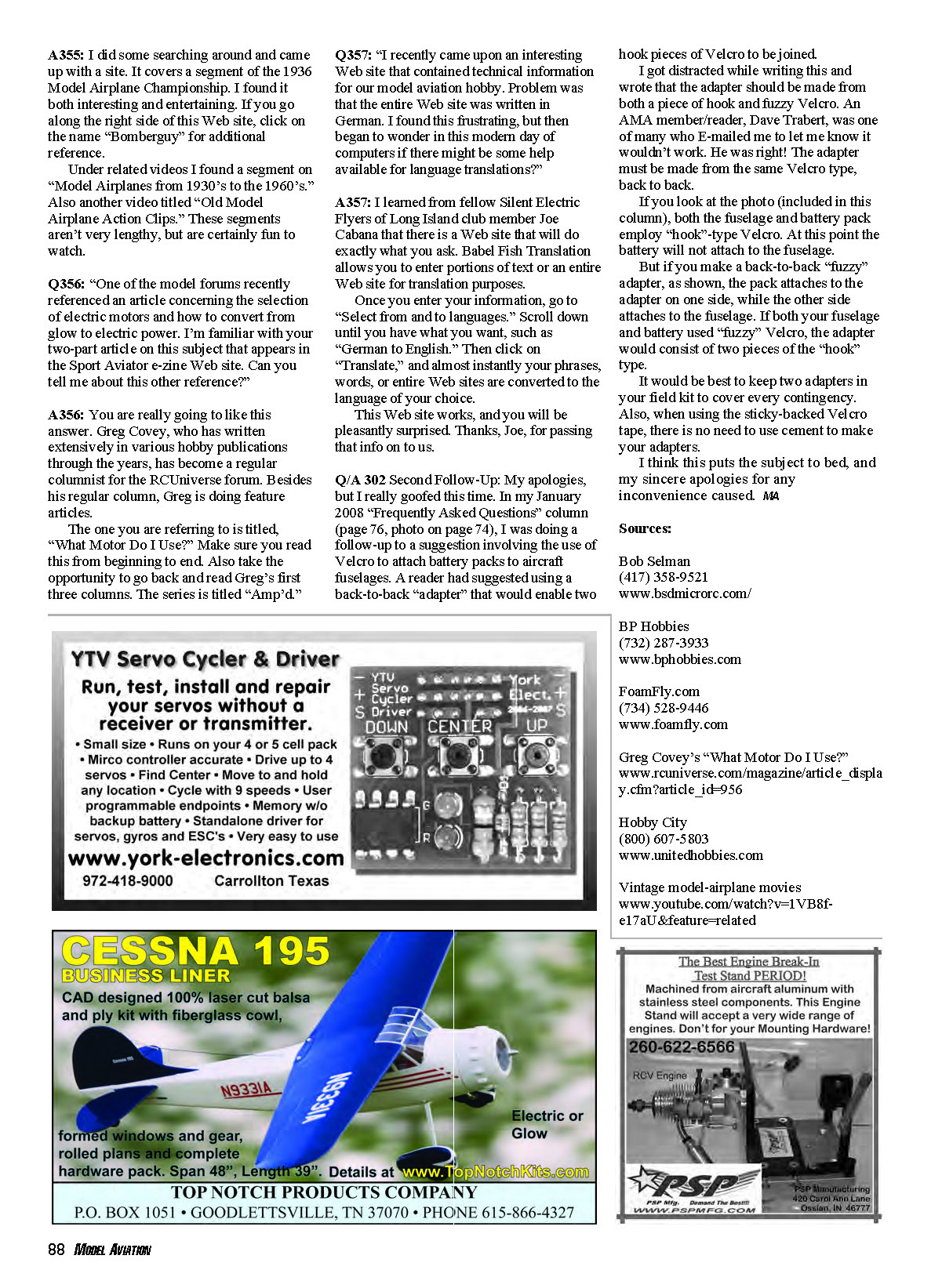
It is possible, using a 5-gram motor, a new Castle Creations Thunderbird-6 ESC (approximately 4 grams), a 3-gram BP Hobbies "Nuke" micro receiver, two BP Hobbies "Lexi" 2.5-gram micro servos, and two Bob Selman Full River 220 mAh Li-Poly battery cells (at 12.5 grams), to come up with an equipment weight of slightly more than an ounce.
With a 2-ounce structure weight, you have a 3-ounce total-weight model. At 12 watts input power, that works out to a respectable 64 watts per pound. Best of all, you are working with a long-lasting brushless motor and a radio system that employs conventional proportional servos. The micro/indoor fun has only started!
---
Q355: "I was told that the YouTube Web site had some interesting old-timer model airplane videos. I haven't found a specific reference as yet, can you help me out?"
A355: I did some searching and found a site that covers a segment of the 1936 Model Airplane Championship. I found it both interesting and entertaining. If you go along the right side of the YouTube page, click on the name "Bomberguy" for additional reference.
Under related videos I found a segment on "Model Airplanes from 1930's to the 1960's" and another titled "Old Model Airplane Action Clips." These segments aren't lengthy, but are fun to watch.
---
Q356: "One of the model forums recently referenced an article concerning the selection of electric motors and how to convert from glow to electric power. I'm familiar with your two-part article on this subject that appears in the Sport Aviator e-zine Web site. Can you tell me about this other reference?"
A356: Greg Covey, who has written extensively in various hobby publications through the years, has become a regular columnist for the RCUniverse forum. Besides his regular column, Greg is doing feature articles.
The one you are referring to is titled "What Motor Do I Use?" Read it from beginning to end. Also go back and read Greg's first three columns in the series titled "Amp'd."
---
Q357: "I recently came upon an interesting Web site that contained technical information for our model aviation hobby. Problem was that the entire Web site was written in German. I found this frustrating, but then began to wonder in this modern day of computers if there might be some help available for language translations?"
A357: Joe Cabana (Silent Electric Flyers of Long Island) told me about Babel Fish Translation, a Web site that will translate portions of text or an entire Web site.
Enter your information, then go to "Select from and to languages." Scroll to select the language pair you want (for example, "German to English") and click "Translate." Almost instantly your phrases, words, or entire Web pages are converted to the language of your choice.
This site works well—thanks to Joe for passing that info along.
---
Q/A 302 — Second Follow-Up
My apologies — I really goofed this time. In my January 2008 "Frequently Asked Questions" column (page 76, photo on page 74), I was doing a follow-up to a suggestion involving the use of Velcro to attach battery packs to aircraft fuselages. A reader had suggested using a back-to-back "adapter" that would enable two hook pieces of Velcro to be joined.
I got distracted while writing and wrote that the adapter should be made from both a piece of hook and fuzzy Velcro. An AMA member/reader, Dave Trabert, and many others e‑mailed to let me know it wouldn't work. He was right! The adapter must be made from the same Velcro type, back to back.
If you look at the photo (included in that column), both the fuselage and battery pack employ "hook"-type Velcro. At that point the battery will not attach to the fuselage.
But if you make a back-to-back "fuzzy" adapter, the pack attaches to the adapter on one side while the other side attaches to the fuselage. If both your fuselage and battery used "fuzzy" Velcro, the adapter would consist of two pieces of the "hook" type.
It would be best to keep two adapters in your field kit to cover every contingency. Also, when using sticky-backed Velcro tape, there is no need to use cement to make your adapters.
I think this puts the subject to bed, and my sincere apologies for any inconvenience caused. — MA
Sources
- Bob Selman — (417) 358-9521 — www.bsdmicrorc.com/
- BP Hobbies — (732) 287-3933 — www.bphobbies.com
- FoamFly.com — (734) 528-9446 — www.foamfly.com
- Greg Covey, "What Motor Do I Use?" — www.rcuniverse.com/magazine/article_display.cfm?article_id=956
- HobbyCity — (800) 607-5803 — www.unitedhobbies.com
- Vintage model-airplane movies — www.youtube.com/watch?v=1VB8f-e17aU&feature=related
Transcribed from original scans by AI. Minor OCR errors may remain.

