
Frequently Asked Questions
Bob Aberle | [email protected]
Please write in with your questions; that is the only way we can keep this column format going. When referring to published Q-and-As (for follow-ups), provide the number as a reference.
References to addresses and Web sites are now placed in a group, separate from the text, at the end of this column under "Sources."
Q393: Removing iron-on covering
Q393: "How do you remove iron-on covering, like MonoKote, that has been applied to aircraft sheeting? A close friend of mine asked me to help him strip the insignia blue MonoKote iron-on covering off of his F4U Corsair.
"I remember a technique using a plastic bag, painting on paint thinner and then putting the parts inside the bag. I would guess you have to go over the area with pins to sort of perforate the area so that the thinner can penetrate through the covering. In other words to allow the thinner or solvent to get to the adhesive part of the covering. Does this sound right to you?"
A393: The answer is: it's not easy! Most modelers are normally concerned with getting the iron-on covering to stick to an aircraft structure and remain in place. We don't even want to see blisters or the like that require frequent reironing. But there are times when a covering must be removed, especially when aircraft repairs are necessary.
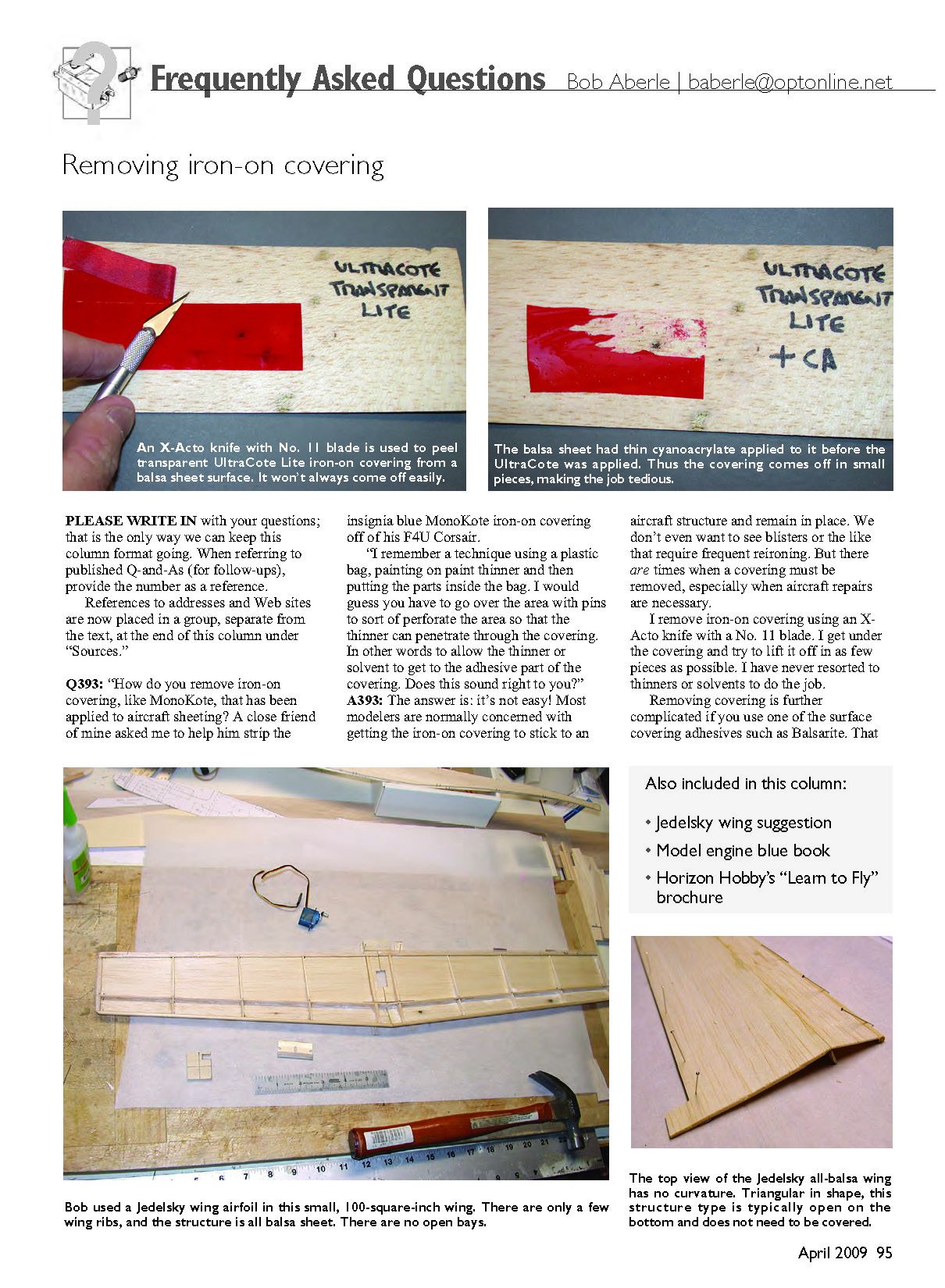
I remove iron-on covering using an X-Acto knife with a No. 11 blade. I get under the covering and try to lift it off in as few pieces as possible. I have never resorted to thinners or solvents to do the job.
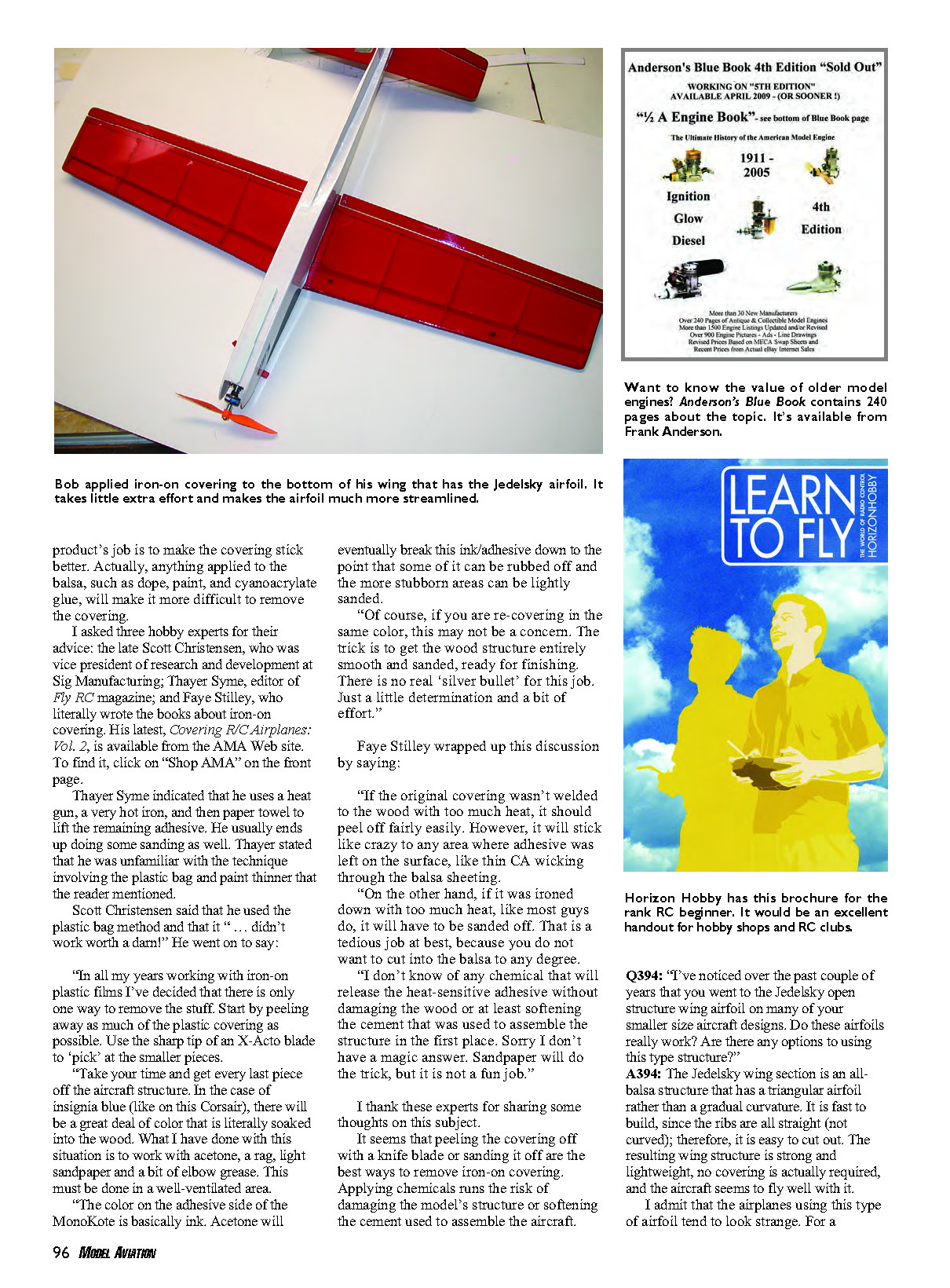
Removing covering is further complicated if you use one of the surface covering adhesives such as Balsarite. That product's job is to make the covering stick better. Actually, anything applied to the balsa, such as dope, paint, and cyanoacrylate glue, will make it more difficult to remove the covering.
I asked three hobby experts for their advice: the late Scott Christensen, who was vice president of research and development at Sig Manufacturing; Thayer Syme, editor of Fly RC magazine; and Faye Stilley, who literally wrote the books about iron-on covering. Her latest, Covering R/C Airplanes: Vol. 2, is available from the AMA Web site. To find it, click on "Shop AMA" on the front page.
Thayer Syme indicated that he uses a heat gun, a very hot iron, and then a paper towel to lift the remaining adhesive. He usually ends up doing some sanding as well. Thayer stated that he was unfamiliar with the technique involving the plastic bag and paint thinner that the reader mentioned.
Scott Christensen said that he used the plastic bag method and that it "... didn't work worth a darn!" He went on to say: "In all my years working with iron-on plastic films I've decided that there is only one way to remove the stuff. Start by peeling away as much of the plastic covering as possible. Use the sharp tip of an X-Acto blade to 'pick' at the smaller pieces.
"Take your time and get every last piece off the aircraft structure. In the case of insignia blue (like on this Corsair), there will be a great deal of color that is literally soaked into the wood. What I have done with this situation is to work with acetone, a rag, light sanding, and a bit of elbow grease. This must be done in a well-ventilated area.
"The color on the adhesive side of the MonoKote is basically ink. Acetone will eventually break this ink/adhesive down to the point that some of it can be rubbed off and the more stubborn areas can be lightly sanded.
"Of course, if you are re-covering in the same color, this may not be a concern. The trick is to get the wood structure entirely smooth and sanded, ready for finishing. There is no real 'silver bullet' for this job. Just a little determination and a bit of effort."
Faye Stilley wrapped up this discussion by saying:
"If the original covering wasn't welded to the wood with too much heat, it should peel off fairly easily. However, it will stick like crazy to any area where adhesive was left on the surface, like thin CA wicking through the balsa sheeting.
"On the other hand, if it was ironed down with too much heat, like most guys do, it will have to be sanded off. That is a tedious job at best, because you do not want to cut into the balsa to any degree.
"I don't know of any chemical that will release the heat-sensitive adhesive without damaging the wood or at least softening the cement that was used to assemble the structure in the first place. Sorry I don't have a magic answer. Sandpaper will do the trick, but it is not a fun job."
I thank these experts for sharing some thoughts on this subject.
It seems that peeling the covering off with a knife blade or sanding it off are the best ways to remove iron-on covering. Applying chemicals runs the risk of damaging the model's structure or softening the cement used to assemble the aircraft.
Q394: Jedelsky open-structure wing airfoil — does it work?
Q394: "I've noticed over the past couple of years that you went to the Jedelsky open-structure wing airfoil on many of your smaller-size aircraft designs. Does this airfoil really work? Are there any options to using this type structure?"
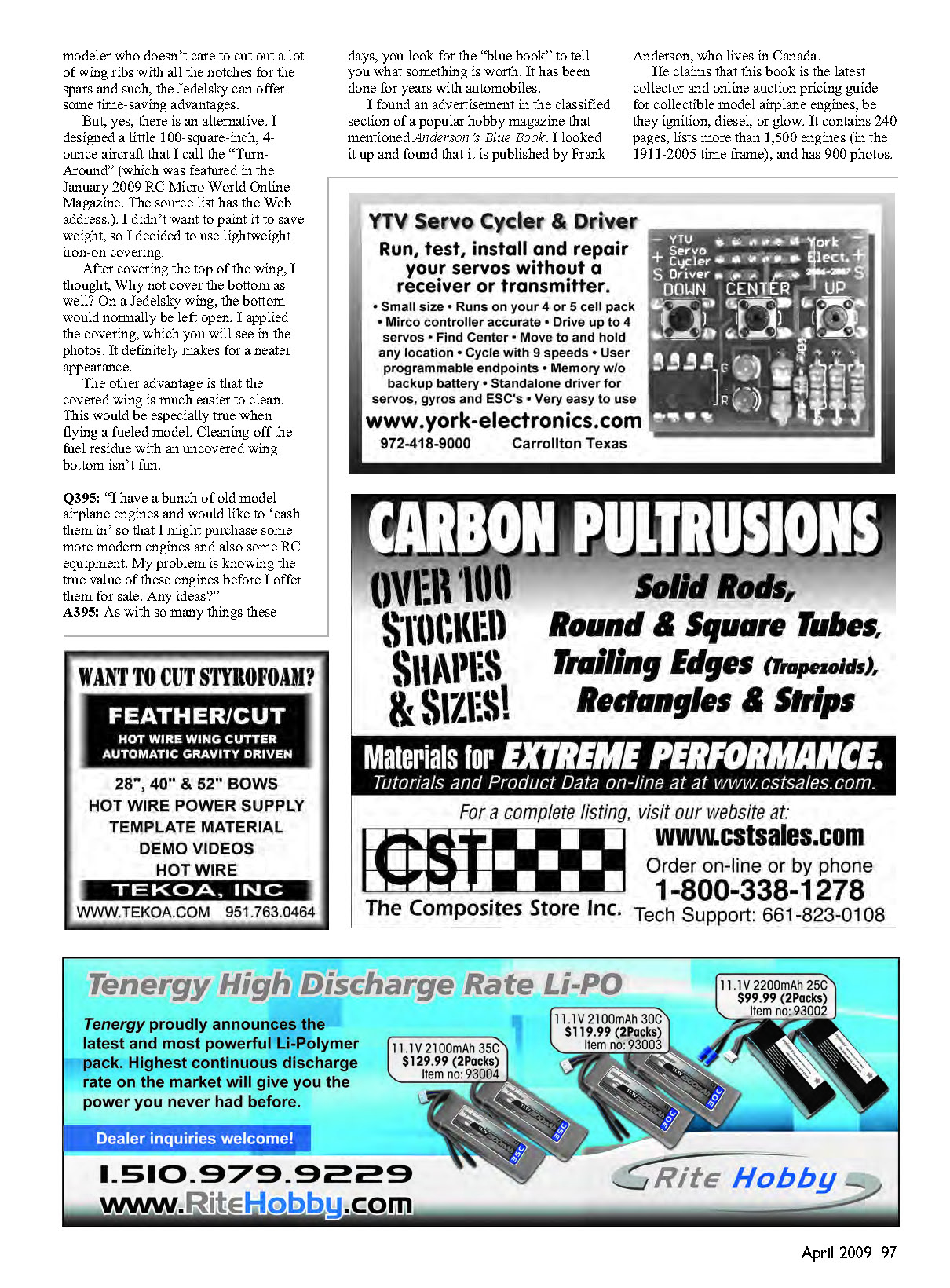
A394: The Jedelsky wing section is an all-balsa structure that has a triangular airfoil rather than a gradual curvature. It is fast to build, since the ribs are all straight (not curved); therefore, it is easy to cut out. The resulting wing structure is strong and lightweight; no covering is actually required, and the aircraft seems to fly well with it.
I admit that the airplanes using this type of airfoil tend to look strange. For a modeler who doesn't care to cut out a lot of wing ribs with all the notches for the spars and such, the Jedelsky can offer some time-saving advantages.
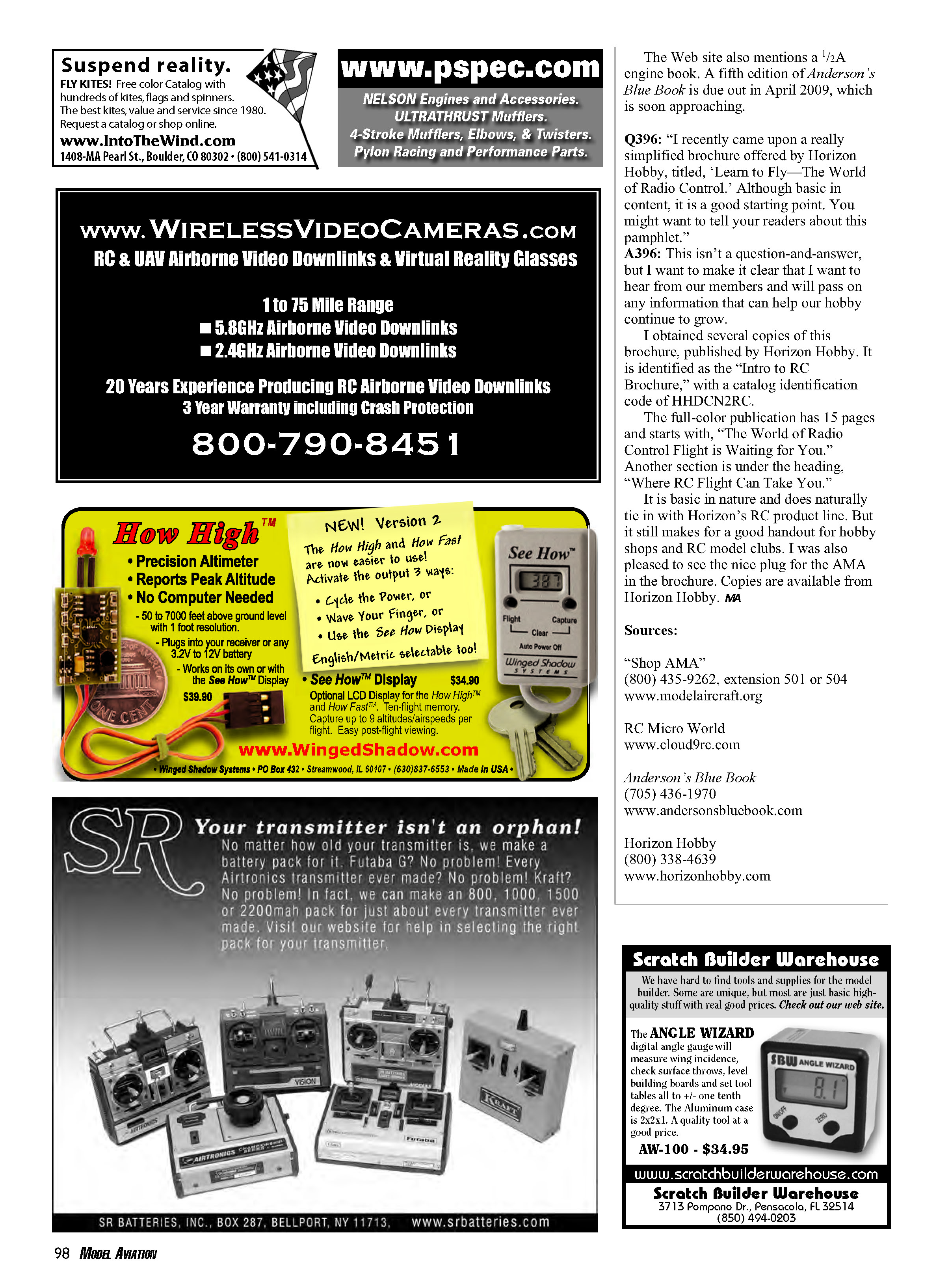
But, yes, there is an alternative. I designed a little 100-square-inch, 4-ounce aircraft that I call the "Turn-Around" (which was featured in the January 2009 RC Micro World Online Magazine. The source list has the Web address.) I didn't want to paint it to save weight, so I decided to use lightweight iron-on covering.
After covering the top of the wing, I thought, Why not cover the bottom as well? On a Jedelsky wing, the bottom would normally be left open. I applied the covering, which you will see in the photos. It definitely makes for a neater appearance.
The other advantage is that the covered wing is much easier to clean. This would be especially true when flying a fueled model. Cleaning off the fuel residue with an uncovered wing bottom isn't fun.
Q395: Valuing old model airplane engines
Q395: "I have a bunch of old model airplane engines and would like to 'cash them in' so that I might purchase some more modern engines and also some RC equipment. My problem is knowing the true value of these engines before I offer them for sale. Any ideas?"
A395: As with so many things these days, you look for the "blue book" to tell you what something is worth. It has been done for years with automobiles.
I found an advertisement in the classified section of a popular hobby magazine that mentioned Anderson's Blue Book. I looked it up and found that it is published by Frank Anderson, who lives in Canada.
He claims that this book is the latest collector and online auction pricing guide for collectible model airplane engines, be they ignition, diesel, or glow. It contains 240 pages, lists more than 1,500 engines (in the 1911–2005 time frame), and has 900 photos. The Web site also mentions a 1/2A engine book. A fifth edition of Anderson’s Blue Book was due out in April 2009.
Q396: Horizon Hobby "Learn to Fly" brochure
Q396: “I recently came upon a really simplified brochure offered by Horizon Hobby, titled, ‘Learn to Fly—The World of Radio Control.’ Although basic in content, it is a good starting point. You might want to tell your readers about this pamphlet.”
A396: This isn’t a question-and-answer, but I want to make it clear that I want to hear from our members and will pass on any information that can help our hobby continue to grow.
I obtained several copies of this brochure, published by Horizon Hobby. It is identified as the "Intro to RC Brochure," with a catalog identification code of HHDCN2RC.
The full-color publication has 15 pages and starts with, "The World of Radio Control Flight is Waiting for You." Another section is under the heading, "Where RC Flight Can Take You."
It is basic in nature and does naturally tie in with Horizon’s RC product line. But it still makes for a good handout for hobby shops and RC model clubs. I was also pleased to see the nice plug for the AMA in the brochure. Copies are available from Horizon Hobby.
Sources:
- "Shop AMA" (800) 435-9262, extension 501 or 504 www.modelaircraft.org
- RC Micro World www.cloud9rc.com
- Anderson’s Blue Book (705) 436-1970 www.andersonsbluebook.com
- Horizon Hobby (800) 338-4639 www.horizonhobby.com
Transcribed from original scans by AI. Minor OCR errors may remain.

