
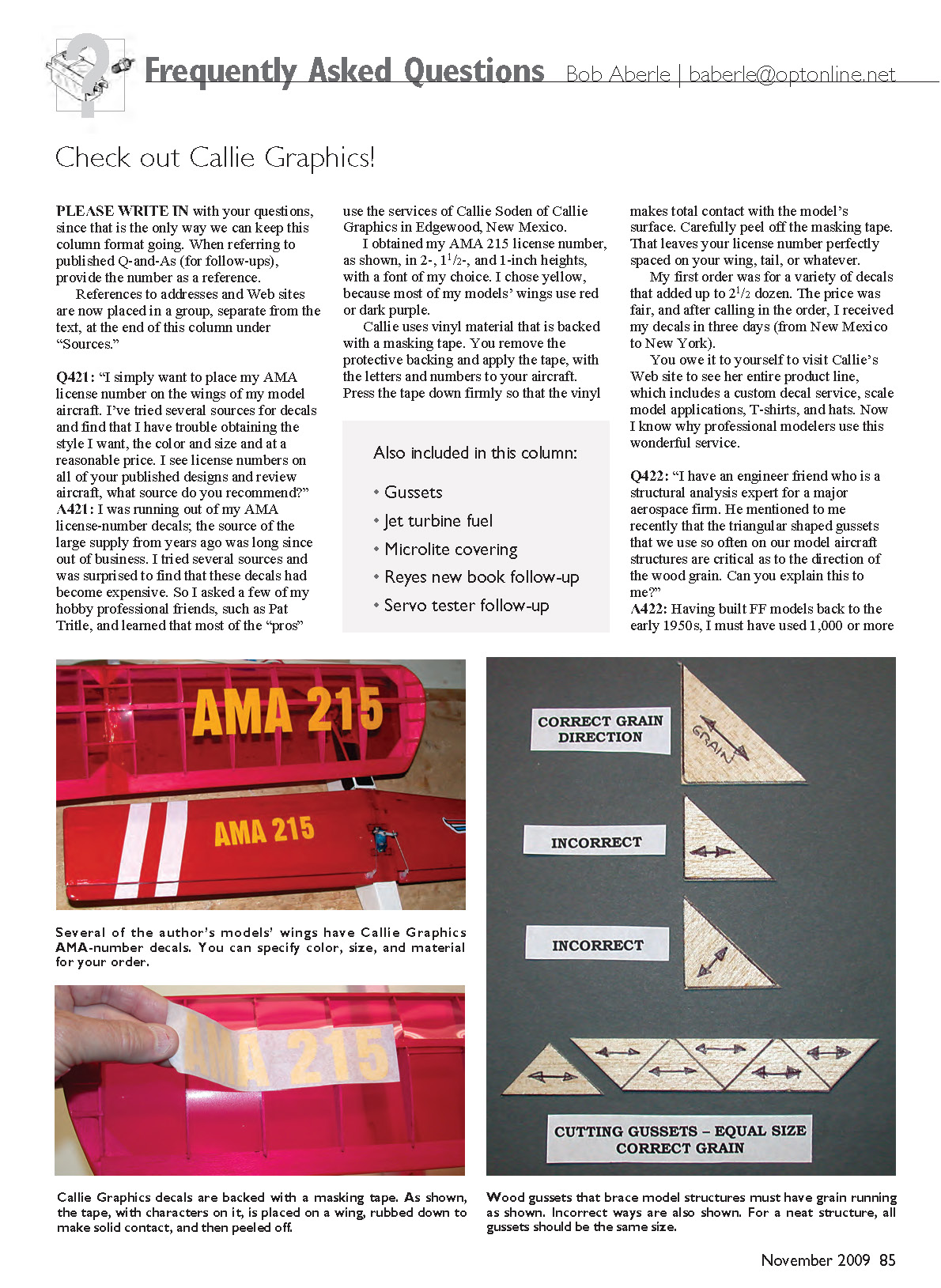
Frequently Asked Questions - 2009/11
Bob Aberle | [email protected]
PLEASE WRITE IN with your questions, since that is the only way we can keep this column format going. When referring to published Q-and-As (for follow-ups), provide the number as a reference.
References to addresses and Web sites are now placed in a group, separate from the text, at the end of this column under "Sources."
Check out Callie Graphics!
Q421: "I simply want to place my AMA license number on the wings of my model aircraft. I've tried several sources for decals and find that I have trouble obtaining the style I want, the color and size and at a reasonable price. I see license numbers on all of your published designs and review aircraft, what source do you recommend?"
A421: I was running out of my AMA license-number decals; the source of the large supply from years ago was long since out of business. I tried several sources and was surprised to find that these decals had become expensive. So I asked a few of my hobby professional friends, such as Pat Tritle, and learned that most of the "pros" use the services of Callie Soden of Callie Graphics in Edgewood, New Mexico.
I obtained my AMA 215 license number, as shown, in 2-, 1 1/2-, and 1-inch heights, with a font of my choice. I chose yellow because most of my models' wings use red or dark purple.
Callie uses vinyl material that is backed with a masking tape. You remove the protective backing and apply the tape, with the letters and numbers, to your aircraft. Press the tape down firmly so that the vinyl makes total contact with the model's surface. Carefully peel off the masking tape. That leaves your license number perfectly spaced on your wing, tail, or whatever.
My first order was for a variety of decals that added up to two-and-a-half dozen. The price was fair, and after calling in the order, I received my decals in three days (from New Mexico to New York).
You owe it to yourself to visit Callie's Web site to see her entire product line, which includes a custom decal service, scale model applications, T-shirts, and hats. Now I know why professional modelers use this wonderful service.
Also included in this column:
- Gussets
- Jet turbine fuel
- Microlite covering
- Reyes new book follow-up
- Servo tester follow-up
Q422: "I have an engineer friend who is a structural analysis expert for a major aerospace firm. He mentioned to me recently that the triangular shaped gussets that we use so often on our model aircraft structures are critical as to the direction of the wood grain. Can you explain this to me?"
A422: Having built free-flight (FF) models back to the early 1950s, I must have used a thousand or more gussets on my various aircraft. Back then, the gusset was used mostly to add gluing area to a critical wing or tail joint. But as I learned years later, these same gussets add strength to the structure. The critical part of using a gusset is the direction of the wood grain.
I originally cut these triangular-shaped wood gussets randomly from sheet balsa. I never concerned myself with the wood-grain direction. That is wrong, which is exactly what your engineer friend is trying to tell you.
The included photo clarifies this point. I tried to show the right way, along with several wrong ways.
The other thing I want to mention is a method for making all of your gussets the same size. Some modelers cut triangles at random.
You will be surprised by how professional your model looks if you make each gusset the same size, especially when you use a gusset at the trailing edge of each wing rib. Think about that the next time you are constructing a wing or stabilizer.
Q423: "I believe I read recently that Jet-A (turbine) fuel intended for anything other than full-scale aircraft is not legal. Unfortunately I can't find that specific reference any longer. Is this true? Where should one buy fuel for their jet turbine engines?"
A423: I don't own a jet turbine engine, so I turned to several experts who know all about this sort of thing. The first name that came to my mind was AMA's technical director, Greg Hahn. He earned first place, again, at the 2009 Top Gun event in Florida, flying his now-famous giant-scale B-25.
Greg pointed out that most of the model jet pilots at Top Gun used Jet-A turbine fuel. It is usually obtainable at local airports (known as Fixed Base Operators, or FBOs).
Some FBOs can be difficult to deal with, since they want to sell hundreds of gallons of fuel—not just the few gallons needed for model use. But it is definitely legal to purchase this kind of fuel for our jet-powered aircraft. These same FBOs also sell the special turbine oil that is used with the fuel.
Greg went on to answer my question with an interesting story about jet-turbine fuel in general, which follows.
"Actually Jet-A is less refined than K-1 kerosene and both are more refined than #2 household heating oil. A turbine engine will burn all three. That was one of the pluses when the military went to jets; fuel specifics became much less an issue. In WWII specific fuel octane ratings were a huge factor in the life span of aircraft engines.
"A turbine will burn almost anything you can pump into it. Being less refined, Jet-A has more lubricating qualities than K-1 kerosene (if you are burning K-1 you'll need more lubricating oil). Yes, the oil is another big item but is sold by most of the turbine engine manufacturers so it's not hard to get.
"At least modelers don't have to worry about anti-fungal additives, which are needed in full-scale jets. It's hard to believe but moss will grow inside a jet's fuel tanks and clog up the engine system."
Q424: "I'm looking for a lightweight iron-on covering material that is readily available, easy to apply and doesn't cost a fortune. Since you are so deep into micro/indoor flying you must have some recommendations?"
A424: Much of the choice of lightweight covering material depends on a model's size and speed. Too light a covering tends to tear easily, requiring constant patching. Too fast a model could result in structural failure in flight, because the covering didn't add enough strength.
For my full-size competition electric sailplanes and Old-Timers, I have always used Top Flite MonoKote—usually transparent. For my smaller electric Texaco models, as well as the class-A electric sailplanes, I used UltraCote Lite transparent.
Next down the line, for the 10- to 12-ounce park-flyer-size models, I like Solite from BP Hobbies. It goes on easily, is inexpensive, and is available in many opaque and transparent colors.
More recently, I wanted an even lighter-weight covering, still with its own built-in adhesive. At the suggestion of a friend, I tried the Coverite Microlite iron-on covering.
It is readily available from mail-order houses such as Tower Hobbies. A large roll costs approximately $12 plus shipping, and I can cover at least three models with two different-color rolls of it.
I like this newfound covering a lot. But I learned that Microlite doesn't like a lot of heat. You should use an iron, because heat-gun application, if you get careless, can easily melt it.
This material does stick well to the aircraft structure and to itself when you wrap it around leading edges (LEs) and trailing edges (TEs). Once ironed in place, the covering rarely needs reinforcing; it stays in place.
Microlite also shrinks well, so you won't end up with wrinkles. Even though it shrinks considerably, it doesn't tend to warp a model's flying surfaces.
How light is it? I weighed an entire 200-square-inch, reduced-size Lanzo Bomber before covering it. After applying Microlite to every part of the airplane, I found that the material added only 0.6 ounce. That is certainly light.
But there is one problem with which you will have to cope. The built-in adhesive attracts like a magnet.
As you peel off the protective backing, you can easily get one part of the Microlite to stick to another. When that happens, sometimes you have to throw out a ball of material and start again. So be careful when that backing comes off as you apply the covering to your aircraft.
Q409 Follow-Up (August 2009 MA, page 86)
I already shared with you how impressed I was with a new model aircraft author, Carlos Reyes, who lives in New Mexico. Now, only a few months later, he has introduced his second book: RCadvisor's ModiFly.
The opening page of this 150-page book says it all: "Design and Build From Scratch Your Own Modern Flying Model Airplane In One Day for just $5.00."
As the index shows, Carlos takes you through the design process of an extremely simple electric-powered RC model. Then he discusses materials, building, components you must buy, finishing, and flying. Finally, he leads you into follow-on subjects such as design enhancements, variations, and how to design your next airplane.
This is definitely a book worth owning for your hobby reference purposes. You can buy it direct from Carlos via the Web site.
Q330 Follow-Up (January 2008 MA, page 73)
In that Q-and-A, I mentioned a servo tester, or exerciser, that allows you to operate an RC servo without its being connected to your RC system. This comes in handy when installing and setting up controls in a new aircraft.
A reader wrote in recently to tell me that he purchased a York Electronics YTV Servo Cycler & Driver and that it cost him only $20. I checked out the company's Web site, and it verifies what my reader friend indicated.
I found the Web site to be informative and was able to confirm the low selling price. It is worth looking into.
Sources
- Callie Graphics
(505) 281-9310 www.callie-graphics.com
- Coverite
- RCadvisor
(505) 206-1569 www.rcadvisor.com
- York Electronics
(972) 418-9000 www.york-electronics.com
Transcribed from original scans by AI. Minor OCR errors may remain.

