
Frequently Asked Questions - 2013/02
RC Advisor online newsletter
Q564: You mentioned a while back that a new online newsletter had been started that was proving to be very interesting. Is this free service still being provided? Tell me why I might want to sign up.
A564: The RC Advisor online newsletter was started last year by Carlos Reyes, who resides in New Mexico. It is alive and growing. Carlos recently indicated that he has more than 10,000 subscribers. He posts a new edition weekly, typically on Friday. Each newsletter has between six and ten new items of interest.
The subject matter covers all aspects of our hobby. Generally, Carlos supplies video presentations that he has made for the benefit of modelers. Each video is brief but thorough, the subjects are interesting, and there are follow-up references.
This newsletter service is free. Sign up, and each week a new posting will be sent to your email address. There is neither advertising nor banners. That may change because Carlos must eventually be able to make a living providing this service.
You asked for a reason that would justify signing up to receive RC Advisor. The recent RC Advisor, Number 33 (they are sequentially numbered), provided a website that lists 20 sources for free model aircraft plans. You may have seen some of these plans referenced before, but in this case, 20 are listed in one place. I’ve included the link for RC Advisor Number 33, which contains this free plans listing, in the “Sources” section.
I’ve also listed the RC Advisor website where you can sign up to receive regular postings. That site will direct you to a page that allows you to look up every previously posted RC Advisor since its inception. Try it. I think you will be surprised and pleased.
Carlos has a logo that appears on decals and T-shirts. I included a photo of the new logo.
Pull-Pull Control Wire Installation
Q565: I’m looking for a pull-pull control wire hookup for a scale model project. I want to run a cable to either side of my rudder, rather than a length of semirigid wire running inside a tube. Can you point me to a solution?
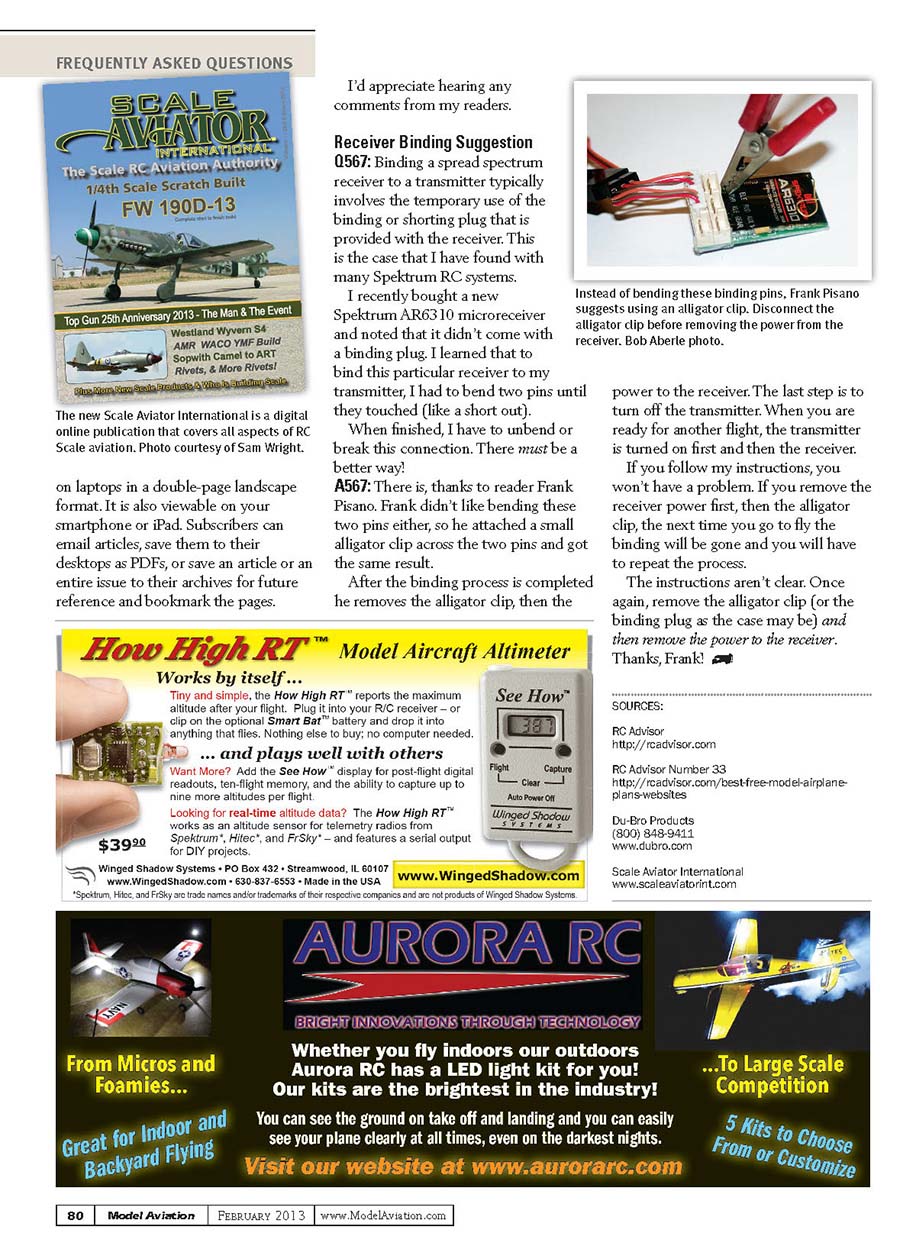
A565: My longtime friend Jerry Smith sent a simple scheme he came up with for installing a pull-pull control setup for a rudder, elevator, or aileron. The photo tells most of the story.
Jerry used short lengths of .032-inch diameter wire, probably no more than an inch long. He soldered a No. 2 washer to the end of the wire, which is held to the servo output arm with a Du-Bro EZ connector. You then connect flexible wire or thread from the washer to the control horns on your control surfaces. You can loosen the EZ connector screws and pull the wire or thread to obtain the right tension and then retighten the screw. This works easily and allows for adjustments, even at the flying field. Thanks, Jerry!
Scale Aviator International
Q566: A friend told me about this new online RC Scale aircraft publication. I haven’t located the website yet. Can you provide me with some detailed information?
A566: The Scale Aviator International digital online magazine was launched in early 2012. It was created and is edited by Sam Wright. I’ve listed the homepage of this new website in the “Sources” section. When you first look at this site, you will notice that it offers a 25-page sample. This should give you a good idea of the content. I noted articles about scale techniques, scale aircraft reviews, scale detail information, and construction. I’d appreciate hearing any comments from my readers.
Receiver Binding Suggestion
Q567: Binding a spread spectrum receiver to a transmitter typically involves the temporary use of the binding or shorting plug that is provided with the receiver. This is the case that I have found with many Spektrum RC systems.
I recently bought a new Spektrum AR6310 microreceiver and noted that it didn't come with a binding plug. I learned that to bind this particular receiver to my transmitter, I had to bend two pins until they touched (like a short out).
When finished, I have to unbend or break this connection. There must be a better way!
A567: There is, thanks to reader Frank Pisano. Frank didn't like bending these two pins either, so he attached a small alligator clip across the two pins and got the same result.
Recommended procedure:
- Power the receiver and put the transmitter into bind mode as required by your system.
- Attach a small alligator clip across the two binding pins (or use the supplied binding plug if available).
- Complete the bind process.
- Remove the alligator clip (or binding plug).
- Remove power to the receiver.
- Turn off the transmitter.
For normal flying power-up sequence: turn the transmitter on first, then apply power to the receiver. If you remove receiver power before removing the alligator clip (or binding plug), the binding may be lost and you'll have to repeat the process. The key point: remove the alligator clip (or binding plug) first, then remove power to the receiver, then turn off the transmitter. Thanks, Frank!
Sources
- RC Advisor: http://rcadvisor.com
- RC Advisor Number 33 (free plans listing): http://rcadvisor.com/best-free-model-airplane-plans-websites
- Du-Bro Products: (800) 848-9411, www.dubro.com
- Scale Aviator International: www.scaleaviatorint.com
Transcribed from original scans by AI. Minor OCR errors may remain.

