
RC paper airplanes
Q599: I saw a reference to a radio-controlled, electric-powered paper airplane on one of the RC forums. I believe this airplane was controlled by a smartphone. Could you please supply me with a website where I could gain more detailed information?
A599: PowerUp Toys is the company that developed this paper airplane and related equipment. Their website provides excellent information. When you open it, click on "How To" to find sections that describe folding the paper airplane and how to adjust and fly it.
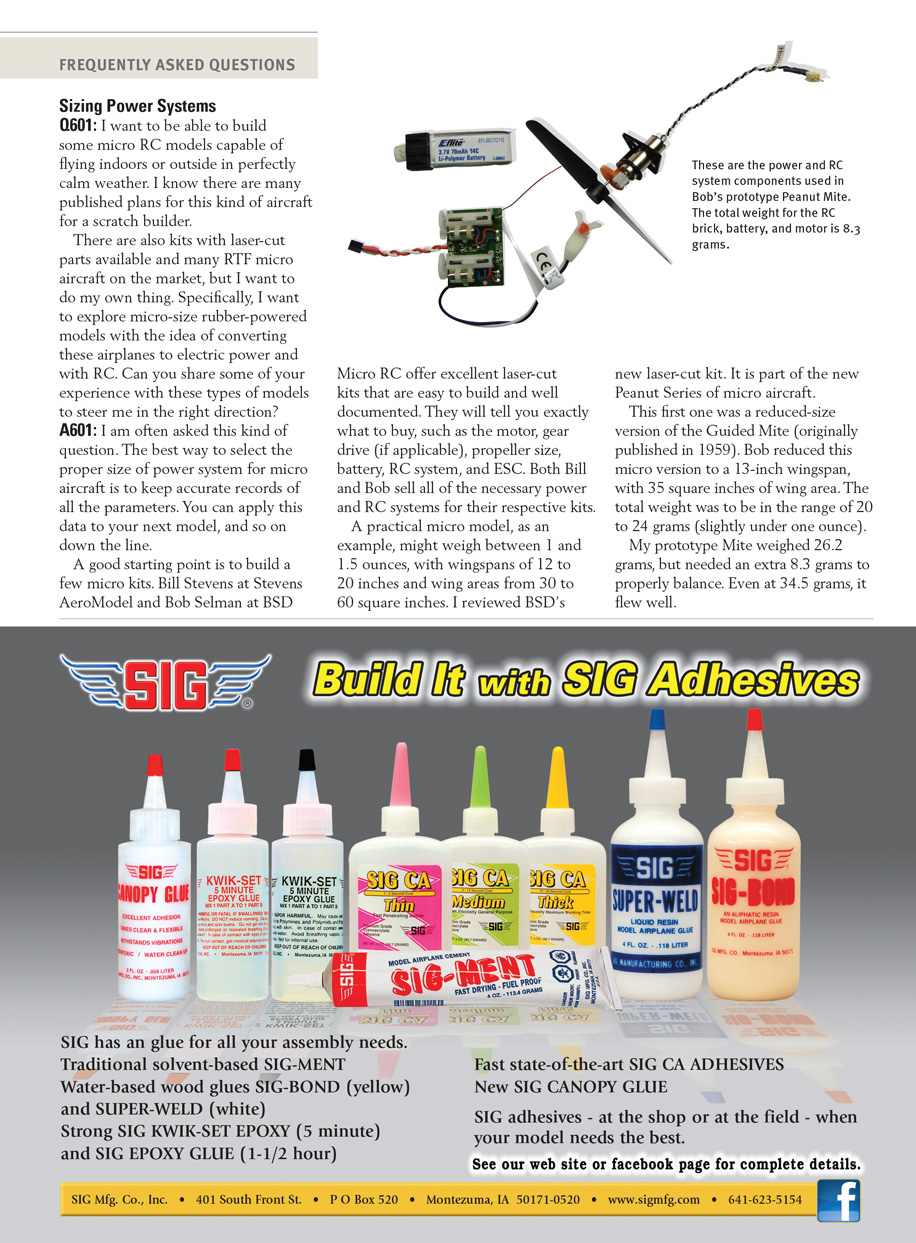
You can download the PowerUp Guide by clicking on "Guide." This section provides plans for constructing the paper airplane and explains how to set up your smartphone so that it will act like an RC transmitter. The site also has many flying tips and interesting videos of the paper airplane in flight. PowerUp sells the RC module and the electric motor/propeller. From what I have read, it takes roughly 15 seconds to charge the battery and that charge provides about a 30-second flight.
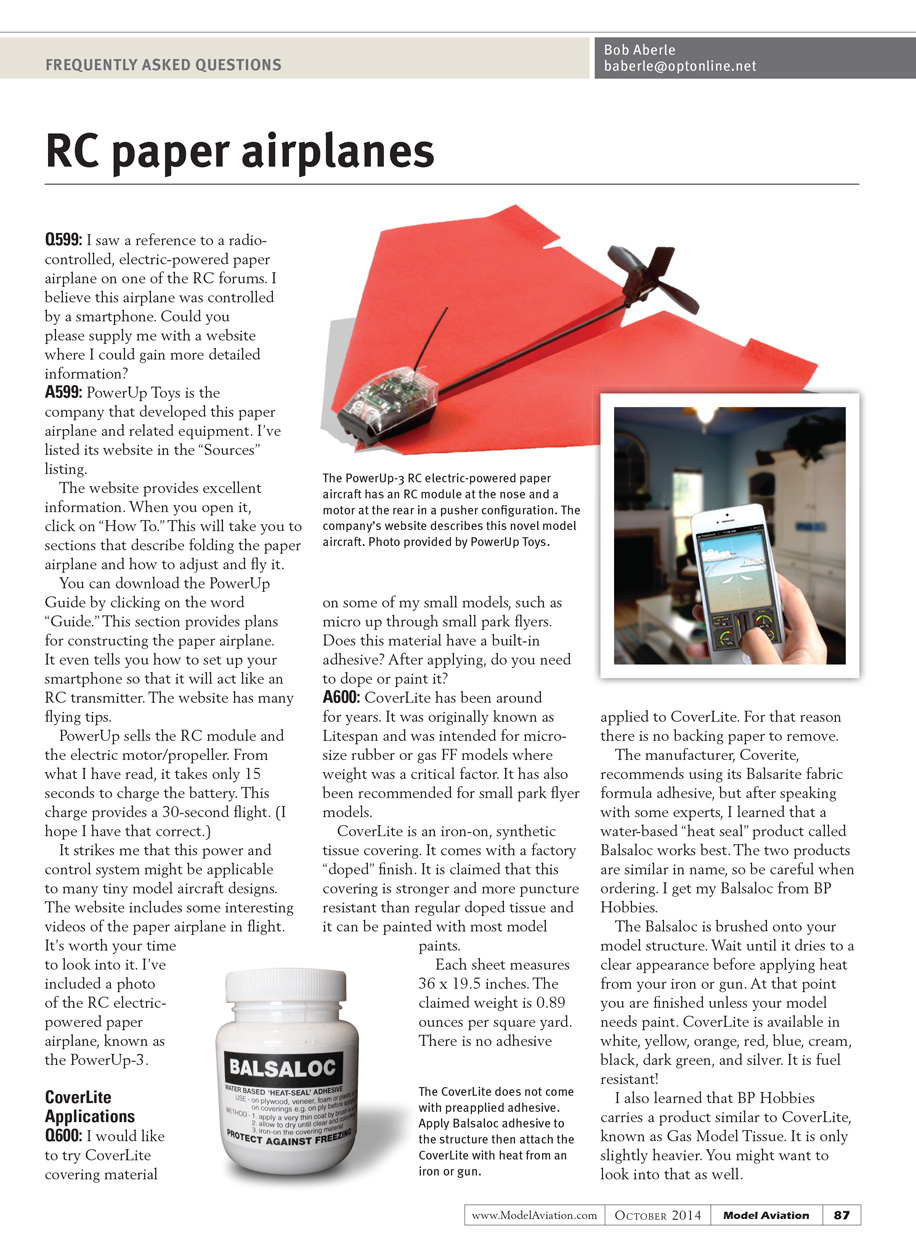
It strikes me that this power-and-control system might be applicable to many tiny model aircraft designs. It’s worth your time to look into it. I’ve included a photo of the RC electric-powered paper airplane, known as the PowerUp-3.
CoverLite Applications
Q600: I would like to try CoverLite covering material on some of my small models, such as micro up through small park-flyers. Does this material have a built-in adhesive? After applying, do you need to dope or paint it?
A600: CoverLite has been around for years. Originally it was known as Litespan and was intended for micro-size rubber or gas free-flight models where weight was critical. It has also been recommended for small park-flyer models.
CoverLite is an iron-on, synthetic tissue covering and comes with a factory "doped" finish. It is claimed to be stronger and more puncture resistant than regular doped tissue, and it can be painted with most model paints.
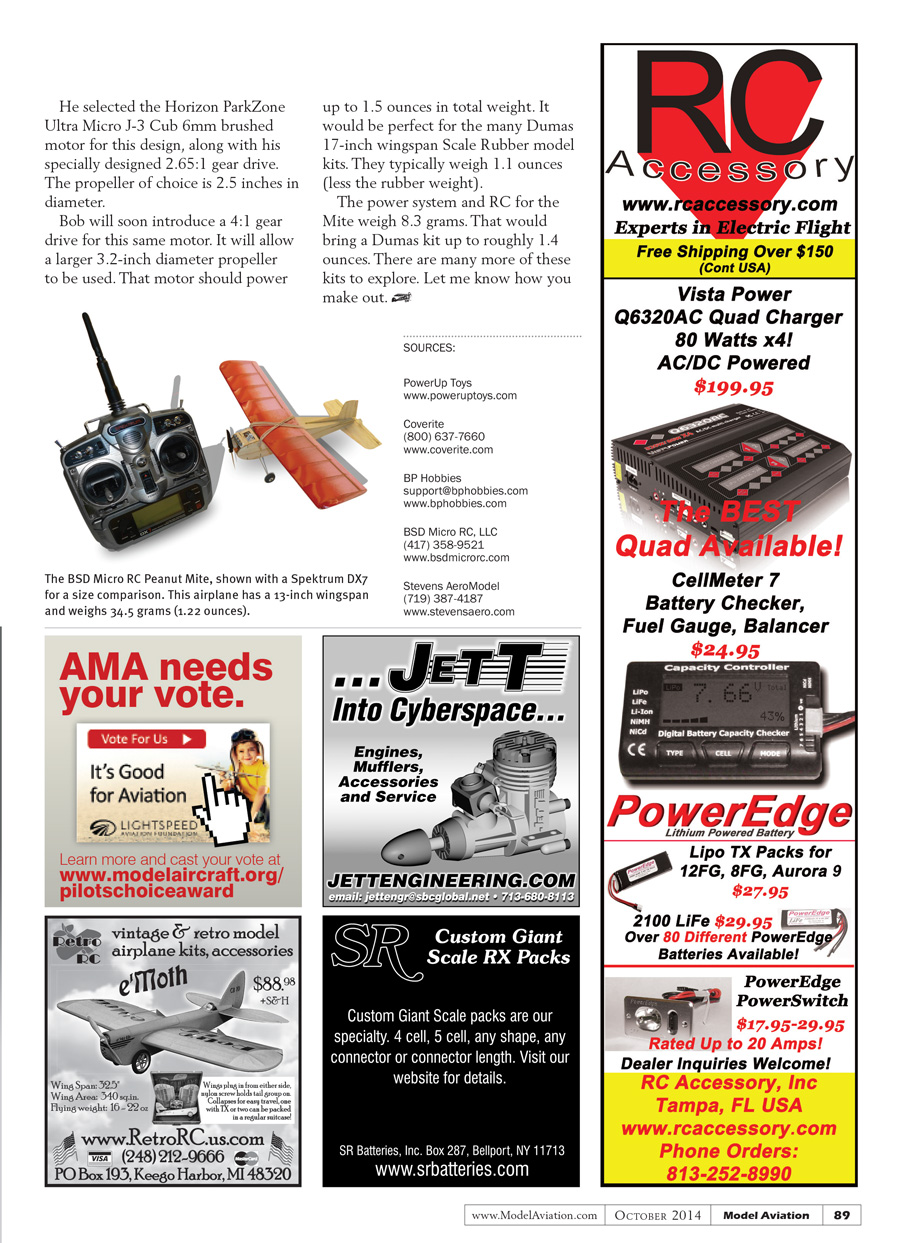
Each sheet measures 36 x 19.5 inches. The claimed weight is 0.89 ounces per square yard. There is no adhesive applied to CoverLite, so there is no backing paper to remove. The manufacturer, Coverite, recommends using its Balsarite fabric formula adhesive, but after speaking with some experts I learned that a water-based "heat seal" product called Balsaloc works best. The two product names are very similar, so be careful when ordering. I get my Balsaloc from BP Hobbies.
Balsaloc is brushed onto your model structure. Wait until it dries to a clear appearance before applying heat from your iron or heat gun. At that point you are finished unless your model needs paint. CoverLite is available in white, yellow, orange, red, blue, cream, black, dark green, and silver. It is fuel resistant.
BP Hobbies also carries a product similar to CoverLite, known as Gas Model (GM) Tissue, which is only slightly heavier.
Sizing Power Systems
Q601: I want to be able to build some micro RC models capable of flying indoors or outside in perfectly calm weather. I know there are many published plans for this kind of aircraft for a scratch builder. There are also kits with laser-cut parts available and many RTF micro aircraft on the market, but I want to do my own thing. Specifically, I want to explore micro-size rubber-powered models with the idea of converting these airplanes to electric power and with RC. Can you share some of your experience with these kinds of models to steer me in the right direction?
A601: The best way to select properly sized power systems for micro aircraft is to keep accurate records of all the parameters involved and apply that data to future models. A good starting point is to build a few micro kits. Bill Stevens at Stevens AeroModel and Bob Selman at BSD Micro RC offer excellent laser-cut kits that are easy to build and well documented. They will tell you exactly what to buy, such as motor, gear drive (if applicable), propeller size, battery, RC system, and ESC. Both Bill and Bob sell all of the necessary power and RC systems for their respective kits.
A practical micro model might weigh between 1 and 1.5 ounces, with wingspans of 12 to 20 inches and wing areas from 30 to 60 square inches. I reviewed BSD's new laser-cut kit, part of the Peanut Series of micro aircraft. The first one was a reduced-size version of the Guided Mite (originally published in 1959). Bob reduced this micro version to a 13-inch wingspan with 35 square inches of wing area. The total weight was in the range of 20 to 24 grams (slightly under one ounce).
My prototype Mite weighed 26.2 grams but needed an extra 8.3 grams to properly balance. Even at 34.5 grams it flew well. Bob selected the Horizon ParkZone Ultra Micro J-3 Cub 6mm brushed motor for this design, along with his specially designed 2.65:1 gear drive and a 2.5-inch diameter propeller.
Bob will soon introduce a 4:1 gear drive for the same motor, which will allow a larger 3.2-inch diameter propeller to be used. That motor should power up to 1.5 ounces in total weight and would be suitable for many Dumas 17-inch wingspan scale rubber model kits; they typically weigh about 1.1 ounces (less the rubber weight).
The power system and RC for the Mite weigh 8.3 grams. That would bring a Dumas kit up to roughly 1.4 ounces. There are many more kits and options to explore—let me know how you make out.
SOURCES:
- PowerUp Toys
- Coverite
(800) 637-7660 www.coverite.com
- BP Hobbies
[email protected] www.bphobbies.com
- BSD Micro RC, LLC
(417) 358-9521 www.bsdmicrorc.com
- Stevens AeroModel
(719) 387-4187 www.stevensaero.com
Transcribed from original scans by AI. Minor OCR errors may remain.

