
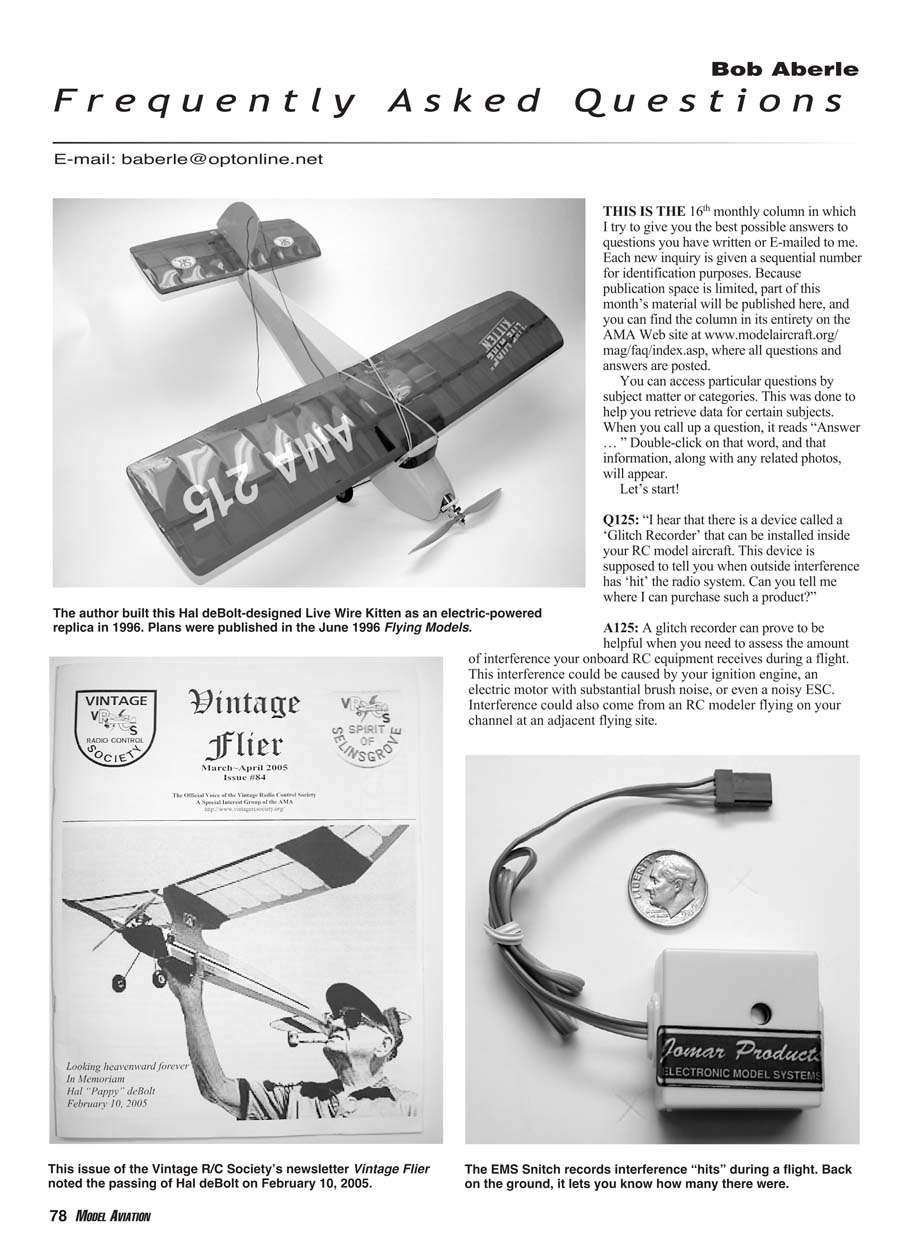
Frequently Asked Questions
Bob Aberle
E-mail: [email protected]
THIS IS THE 16th monthly column in which I try to give you the best possible answers to questions you have written or E-mailed to me. Each new inquiry is given a sequential number for identification purposes. Because publication space is limited, part of this month's material will be published here, and you can find the column in its entirety on the AMA Web site at www.modelaircraft.org/mag/faq/index.asp, where all questions and answers are posted.
You can access particular questions by subject matter or categories. This was done to help you retrieve data for certain subjects. When you call up a question, it reads "Answer ..." Double-click on that word, and that information, along with any related photos, will appear.
Let's start!
Q125: "I hear that there is a device called a 'Glitch Recorder' that can be installed inside your RC model aircraft. This device is supposed to tell you when outside interference has 'hit' the radio system. Can you tell me where I can purchase such a product?"
A125: A glitch recorder can prove to be helpful when you need to assess the amount of interference your onboard RC equipment receives during a flight. This interference could be caused by your ignition engine, an electric motor with substantial brush noise, or even a noisy ESC. Interference could also come from an RC modeler flying on your channel at an adjacent flying site.
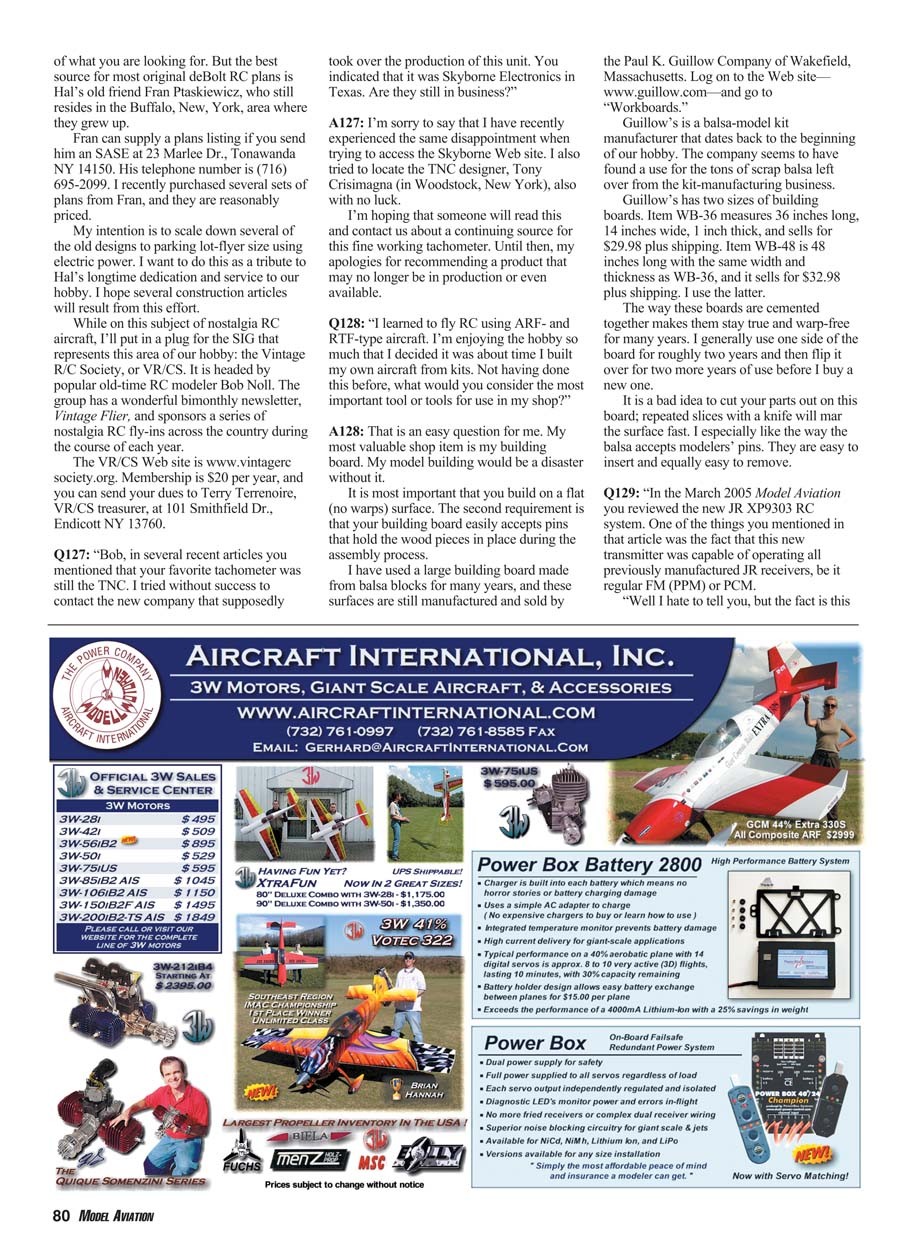
There are several glitch recorders on the hobby market. I believe I reported on one awhile back. Another such product that has come to my attention recently is the Snitch, which is made by Electronic Model Systems (EMS), 22605 East La Palma Ave., Suite 516, Yorba Linda CA 92887; Web site: www.emsjonar.com.
This device comes in a small plastic box measuring 1 1/4 inches square by 5/8 inch, weighing 0.6 ounce. The 10-inch-long cable plugs into an auxiliary port on your RC receiver.
As a glitch recorder, the Snitch will record missing frames and extra pulses coming into your RC receiver. "Glitch" in this sense is extra noise pulses or missed transmitter frames as seen by your receiver. The Snitch produces a sequence of audible beeps that allow you to count the incidents of interference your RC system experienced while the aircraft was in flight.
This same device will perform a preflight frequency check, and if you turn your transmitter off but not your receiver, it will produce an audible warning alarm to remind you to turn it off. The Snitch is $39.95, and it is easy to install and use.
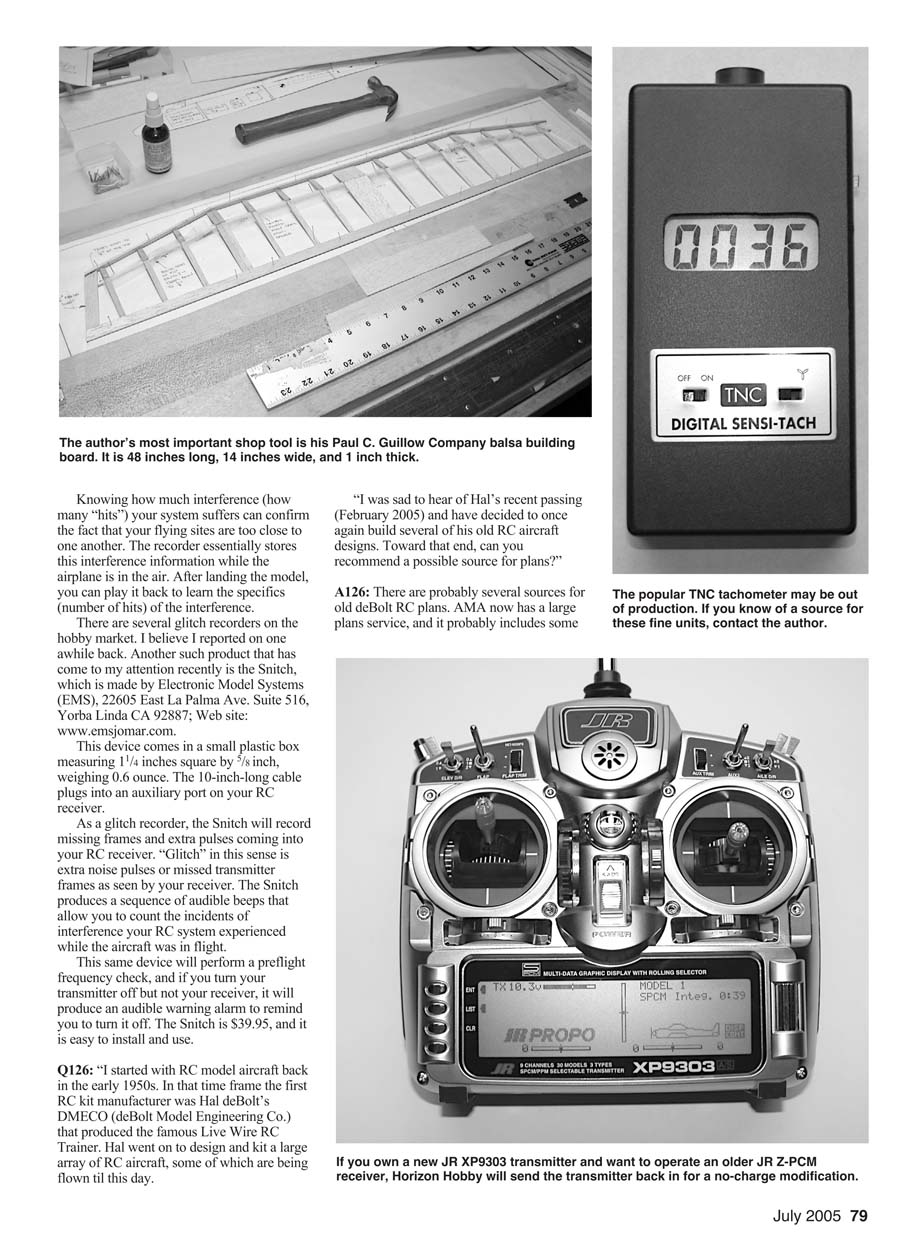
Q126: "I started with RC model aircraft back in the early 1950s. In that time frame the first RC kit manufacturer was Hal deBolt's DMECO (deBolt Model Engineering Co.) that produced the famous Live Wire RC Trainer. Hal went on to design and kit a large array of RC aircraft, some of which are being flown till this day.
"I was sad to hear of Hal's recent passing (February 2005) and have decided to once again build several of his old RC aircraft designs. Toward that end, can you recommend a possible source for plans?"
A126: There are probably several sources for old deBolt RC plans. AMA now has a large plans service, and it probably includes some
The popular TNC tachometer may be out of production. If you know of a source for these fine units, contact the author.
If you own a new JR XP9303 transmitter and want to operate an older JR Z-PCM receiver, Horizon Hobby will send the transmitter back in for a no-charge modification.
Q127: "Bob, in several recent articles you mentioned that your favorite tachometer was still the TNC. I tried without success to contact the new company that supposedly took over the production of this unit. You indicated that it was Skyborne Electronics in Texas. Are they still in business?"
A127: I'm sorry to say that I have recently experienced the same disappointment when trying to access the Skyborne Web site. I also tried to locate the TNC designer, Tony Crisigmana (in Woodstock, New York), also with no luck.
I'm hoping that someone will read this and contact us about a continuing source for this fine working tachometer. Until then, my apologies for recommending a product that may no longer be in production or even available.
Q128: "I learned to fly RC using ARF- and RTF-type aircraft. I'm enjoying the hobby so much that I decided it was about time I built my own aircraft from kits. Not having done this before, what would you consider the most important tool or tools for use in my shop?"
A128: That is an easy question for me. My most valuable shop item is my building board. My model building would be a disaster without it.
It is most important that you build on a flat (no warps) surface. The second requirement is that your building board easily accepts pins that hold the wood pieces in place during the assembly process.
I have used a large building board made from balsa blocks for many years, and these surfaces are still manufactured and sold by the Paul K. Guillow Company of Wakefield, Massachusetts. Log on to the Web site—www.guillow.com—and go to "Workboards."
Guillow's is a balsa-model kit manufacturer that dates back to the beginning of our hobby. The company seems to have found a use for the tons of scrap balsa left over from the kit-manufacturing business. Guillow's has two sizes of building boards. Item WB-36 measures 36 inches long, 14 inches wide, 1 inch thick, and sells for $29.98 plus shipping. Item WB-48 is 48 inches long with the same width and thickness as WB-36, and it sells for $32.98 plus shipping. I use the latter.
The way these boards are cemented together makes them stay true and warp-free for many years. I generally use one side of the board for roughly two years and then flip it over for two more years of use before I buy a new one.
It is a bad idea to cut your parts out on this board; repeated slices with a knife will mar the surface fast. I especially like the way the balsa accepts modelers' pins. They are easy to insert and equally easy to remove.
Q129: "In the March 2005 Model Aviation you reviewed the new JR XP9303 RC system. One of the things you mentioned in that article was the fact that this new transmitter was capable of operating all previously manufactured JR receivers, be it regular FM (PPM) or PCM.
'Well I hate to tell you, but the fact is this" "9303 transmitter cannot operate the older JR Z-PCM receivers. I bought this system with this application in mind and you have disappointed me."
A129: I'm sorry to say I made the wrong assumption by saying "every" JR receiver ever made. I received a total of four reader letters registering complaints about my statement. I could have left it at that with an apology.
However, in my mind many things can be done to an RC transmitter thanks to modern microprocessors. So I took a chance and corresponded with Steve Goodreau, who is Horizon Hobby's senior publicity and media planner. He has been a good friend for many years.
"We will be posting this shortly on our Web site," he said. "Anyone who would like to have Z-PCM receiver operation capability added to their 9303 system can send their transmitter back to the Horizon Service Center and we will do it at no charge."
I thank Steve and Horizon Hobby for reacting so promptly and willingly to solve this problem. It is probably a minor problem at that, but at least the company was willing to help out.
Next time I promise to be more thorough when making statements concerning the compatibility with older RC-system components.
That's a wrap! MA
Transcribed from original scans by AI. Minor OCR errors may remain.

