

Frequently Asked Questions
Bob Aberle
E-mail: [email protected]
This is the 17th monthly column in which I try to give you the best possible answers to questions you have written or E-mailed to me. Each new inquiry has a sequential number for identification purposes.
Because publication space is limited, part of this month's material will be published here, and you can find the column in its entirety on the AMA Web site at www.modelaircraft.org/mag/faq/index.asp. All questions and answers are posted there.
You can access particular questions by subject matter or categories. This was done to help you retrieve data for certain subjects. When you call up a question, it reads "Answer ..." Double-click on that word, and that information, along with any related photos, will appear.
Let's start!
Q135: "I recently attended the Weak Signals' RC Show in Toledo, Ohio. During my travels around the show I was surprised to see what appeared to be a new concept in RC systems being shown at one of the booths. I believe the new concept was called 'Spread Spectrum.' Can you provide some details on this?"
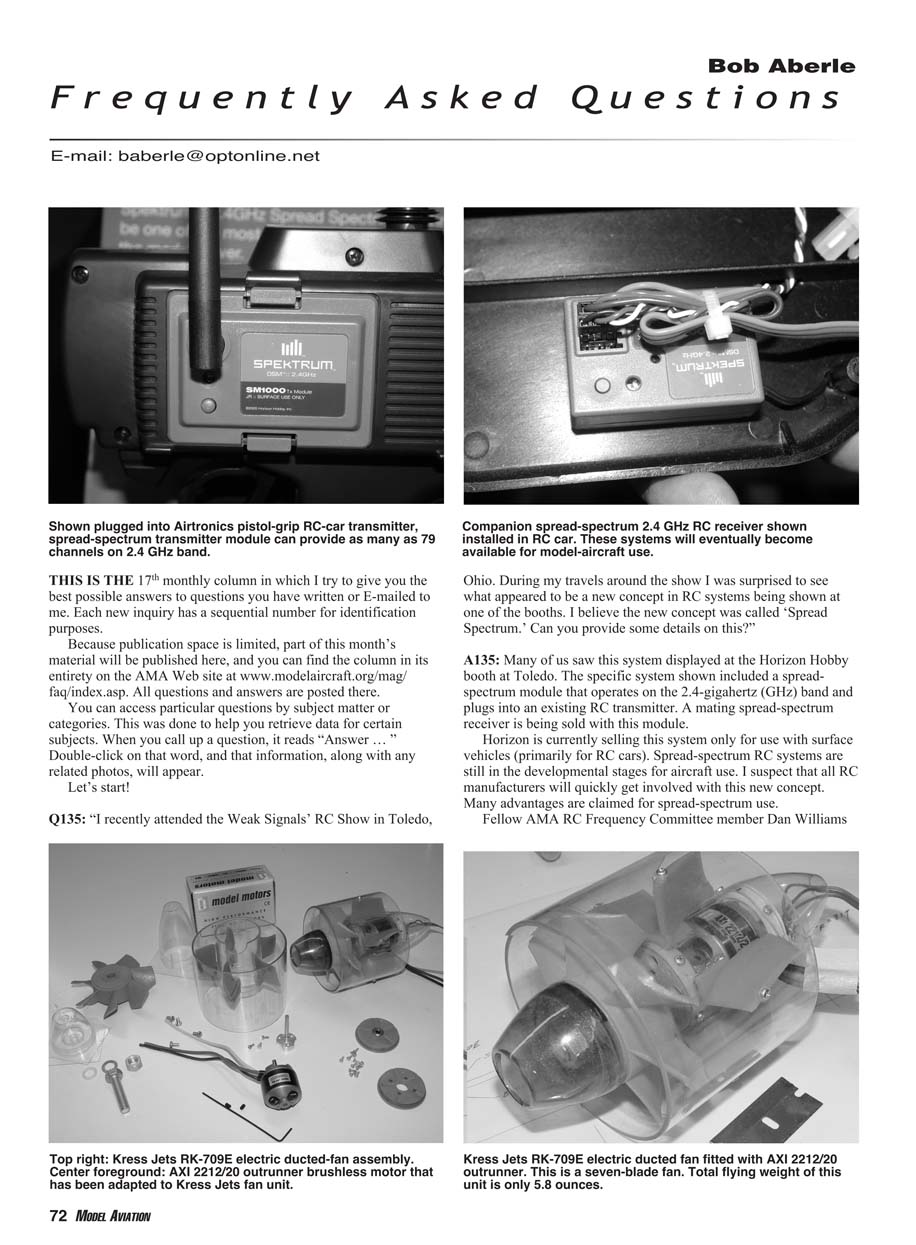
A135: Many of us saw this system displayed at the Horizon Hobby booth at Toledo. The specific system shown included a spread-spectrum module that operates on the 2.4-gigahertz (GHz) band and plugs into an existing RC transmitter. A mating spread-spectrum receiver is being sold with this module.
Horizon is currently selling this system only for use with surface vehicles (primarily for RC cars). Spread-spectrum RC systems are still in the developmental stages for aircraft use. I suspect that all RC manufacturers will quickly get involved with this new concept. Many advantages are claimed for spread-spectrum use.
Fellow AMA RC Frequency Committee member Dan Williams was asked to prepare a technical article about spread-spectrum RC for MA, and it is scheduled for publication in the July 2005 issue. Read that article; it will bring you up to speed on what this technology is, how it works, and what we might expect from it in the future.
A big positive is that spread-spectrum RC systems will not render any of our present systems obsolete or take anything away from our regular 50 RC channels that operate on 72-73 MHz. The new channels will be in a different portion of the radio spectrum.
Keep in mind that 2.4 GHz is the same as 2400 MHz, so you can compare 2400 MHz with our present 72 MHz. It is totally unlikely that one band of operation could interfere with the other. Knowing that you aren’t losing anything but may be gaining something, please keep an open mind and read all future articles about this subject to keep abreast of the progress.
Q136: “Years ago I enjoyed flying a variety of ducted-fan units in semiscale RC models. These fans were all powered by high-performance glow-fueled engines and manufactured at the time by a company known as Kress Jets.
“Having recently become involved with electric-powered flight, I wondered about the possibility of using some of the new outrunner-type brushless motors along with Li-Poly battery packs to power ducted-fan units. Do you have any ideas or suggestions?”
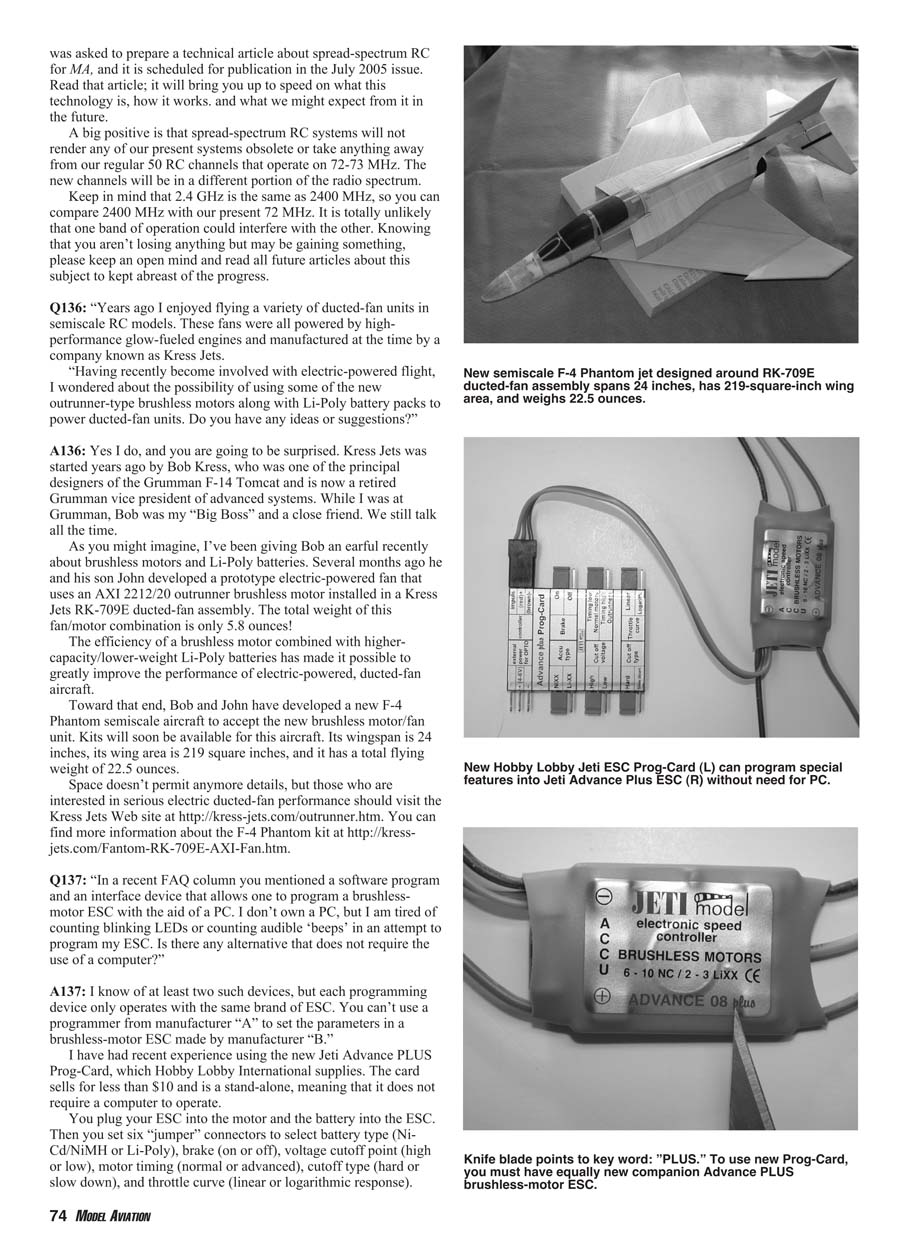
A136: Yes I do, and you are going to be surprised. Kress Jets was started years ago by Bob Kress, who was one of the principal designers of the Grumman F-14 Tomcat and is now a retired Grumman vice president of advanced systems. While I was at Grumman, Bob was my “Big Boss” and a close friend. We still talk all the time.
As you might imagine, I’ve been giving Bob an earful recently about brushless motors and Li-Poly batteries. Several months ago he and his son John developed a prototype electric-powered fan that uses an AXI 2212/20 outrunner brushless motor installed in a Kress Jets RK-709E ducted-fan assembly. The total weight of this fan/motor combination is only 5.8 ounces!
The efficiency of a brushless motor combined with higher-capacity/lower-weight Li-Poly batteries has made it possible to greatly improve the performance of electric-powered, ducted-fan aircraft.
Toward that end, Bob and John have developed a new F-4 Phantom semiscale aircraft to accept the new brushless motor/fan unit. Kits will soon be available for this aircraft. Its wingspan is 24 inches, its wing area is 219 square inches, and it has a total flying weight of 22.5 ounces.
Space doesn’t permit any more details, but those who are interested in serious electric ducted-fan performance should visit the Kress Jets Web site at http://kress-jets.com/outrunner.htm. You can find more information about the F-4 Phantom kit at http://kress-jets.com/Fantom-RK-709E-AXI-Fan.htm.
Q137: “In a recent FAQ column you mentioned a software program and an interface device that allows one to program a brushless-motor ESC with the aid of a PC. I don’t own a PC, but I am tired of counting blinking LEDs or counting audible ‘beeps’ in an attempt to program my ESC. Is there any alternative that does not require the use of a computer?”
A137: I know of at least two such devices, but each programming device only operates with the same brand of ESC. You can’t use a programmer from manufacturer “A” to set the parameters in a brushless-motor ESC made by manufacturer “B.”
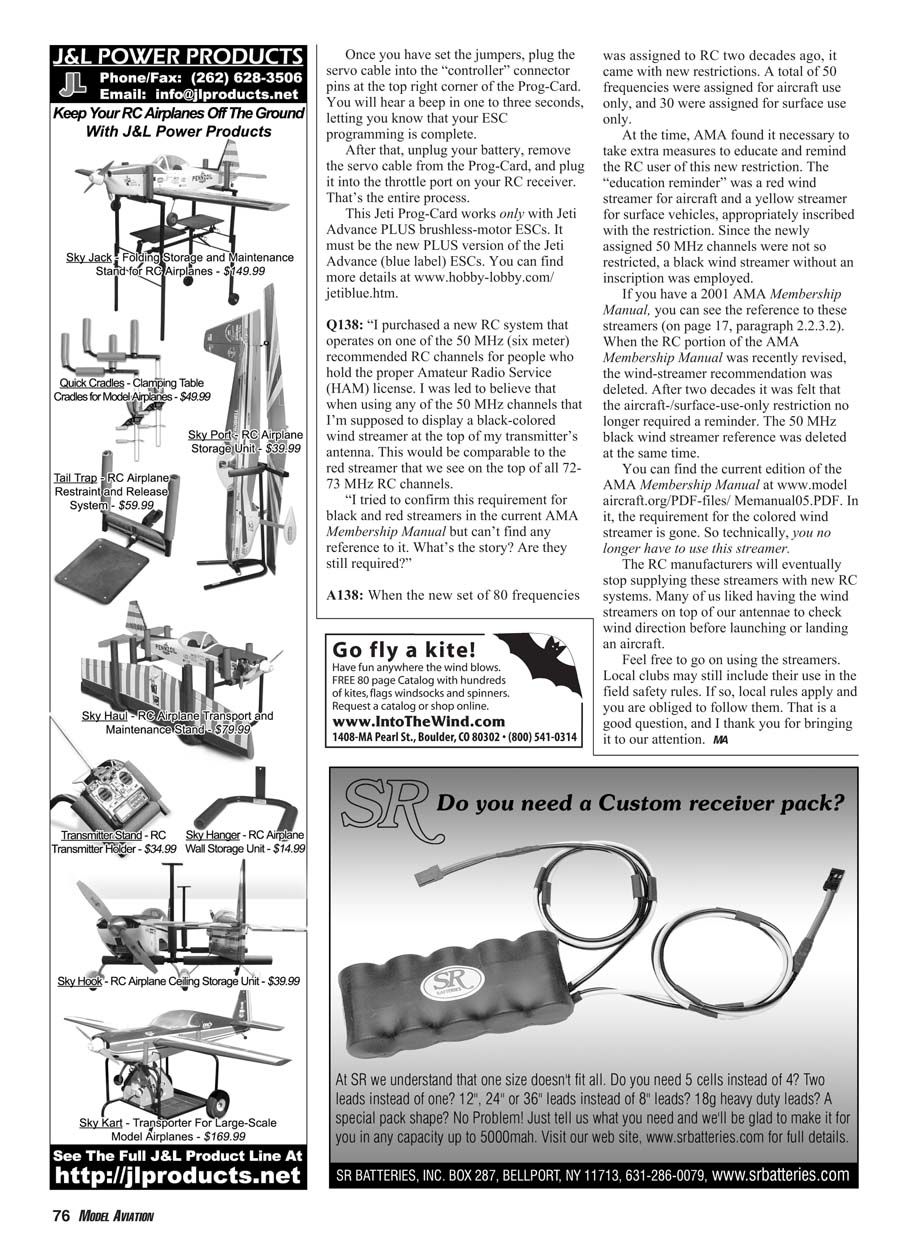
I have had recent experience using the new Jeti Advance PLUS Prog-Card, which Hobby Lobby International supplies. The card sells for less than $10 and is a stand-alone, meaning that it does not require a computer to operate.
You plug your ESC into the motor and the battery into the ESC. Then you set six “jumper” connectors to select battery type (NiCd/NiMH or Li-Poly), brake (on or off), voltage cutoff point (high or low), motor timing (normal or advanced), cutoff type (hard or slow down), and throttle curve (linear or logarithmic response). Once you have set the jumpers, plug the servo cable into the "controller" connector pin at the top right corner of the Prog-Card. You will hear a beep in one to three seconds, letting you know that your ESC programming is complete.
After that, unplug your battery, remove the servo cable from the Prog-Card, and plug it into the throttle port on your RC receiver. That's the entire process.
This Jeti Prog-Card works only with Jeti Advance PLUS brushless-motor ESCs. It must be the new PLUS version of the Jeti Advance (blue label) ESCs. You can find more details at www.hobby-lobby.com/jetiblue.htm.
Q138: "I purchased a new RC system that operates on one of the 50 MHz (six meter) recommended RC channels for people who hold the proper Amateur Radio Service (HAM) license. I was led to believe that when using any of the 50 MHz channels that I'm supposed to display a black-colored wind streamer at the top of my transmitter's antenna. This would be comparable to the red streamer that we see on the top of all 72-73 MHz RC channels.
"I tried to confirm this requirement for black and red streamers in the current AMA Membership Manual but can't find any reference to it. What's the story? Are they still required?"
A138: When the new set of 80 frequencies was assigned to RC two decades ago, it came with new restrictions. A total of 50 frequencies were assigned for aircraft use only, and 30 were assigned for surface use only.
At the time, AMA found it necessary to take extra measures to educate and remind the RC user of this new restriction. The "education reminder" was a red wind streamer for aircraft and a yellow streamer for surface vehicles, appropriately inscribed with the restriction. Since the newly assigned 50 MHz channels were not so restricted, a black wind streamer without an inscription was employed.
If you have a 2001 AMA Membership Manual, you can see the reference to these streamers (on page 17, paragraph 2.2.3.2). When the RC portion of the AMA Membership Manual was recently revised, the wind-streamer recommendation was deleted. After two decades it was felt that the aircraft-/surface-use-only restriction no longer required a reminder. The 50 MHz black wind streamer reference was deleted at the same time.
You can find the current edition of the AMA Membership Manual at www.modelaircraft.org/PDF-files/Manual005.PDF. In it, the requirement for the colored wind streamer is gone. So technically, you no longer have to use this streamer.
The RC manufacturers will eventually stop supplying these streamers with new RC systems. Many of us liked having the wind streamers on top of our antennae to check wind direction before launching or landing an aircraft.
Feel free to go on using the streamers. Local clubs may still include their use in the field safety rules. If so, local rules apply and you are obliged to follow them. That is a good question, and I thank you for bringing it to our attention. MA
Transcribed from original scans by AI. Minor OCR errors may remain.

