
In-air flying-field mishaps: who's responsible?
Bob Aberle | [email protected]
Please write in with your questions, since that is the only way we can keep this column format going. When referring to already published Q/As (for follow-ups), provide the number as a reference.
References to addresses and Web sites are placed in a group, separate from the text, at the end of this column under "Sources."
Q380
"I'm relatively new to the RC hobby and have a question concerning flying field etiquette and the AMA Insurance Program. During a recent flying session at my local field, I saw a very fast delta wing aircraft come very close to a slow-flying scale biplane. After both planes landed the biplane owner was upset and cautioned the other pilot that his biplane was worth $1,500 and it could have been lost had the fast-flying delta wing plane hit it.
"This got me to thinking, would the delta wing pilot have been responsible for any damage inflicted on the biplane? Would the AMA insurance step in and pay for the biplane? This situation is very important to me because as a beginner I can't always keep my plane where I want it to be. I'm worried about crashing into another model and being responsible for the damages. I can't afford to shell out a thousand dollars for a split-second mistake."
A380
I felt that this was a very important question and decided to refer it to Ilona Maine, who coordinates the AMA insurance program. Following is her answer.
"The AMA liability policy has an exclusion for property damage to any model airplanes by another model airplane. So unfortunately AMA coverage wouldn't apply in the situation you just outlined. Keep in mind that AMA insurance coverage is excess insurance, so a claim would have to be filed with the pilot's primary carrier (generally homeowner's coverage) first, who may provide coverage for this incident."
With more than 50 years of flying RC models, I admit to being involved in several midair collisions that resulted in damage to both aircraft. The other modelers caused a few of those incidents.
I was clearly at fault on one occasion. I offered a replacement aircraft to the modeler, who at first refused but finally accepted. That was my solution to the situation.
I hope that most of our members would be willing to work with other pilots toward an amicable solution. This is a hobby, and we should all be able to have fun and enjoy it.
Q381
"I heard several friends talking about a Virtual Aircraft Museum that can be found on a Web site. I tried several search engines but couldn't quite find what I was looking for. Can you help me out?"
A381
Many of my answers of late have involved references to Web sites; I feel like I'm directing traffic. But many of these sites are proving to be helpful. If you find these references useful, please write in and let me know.
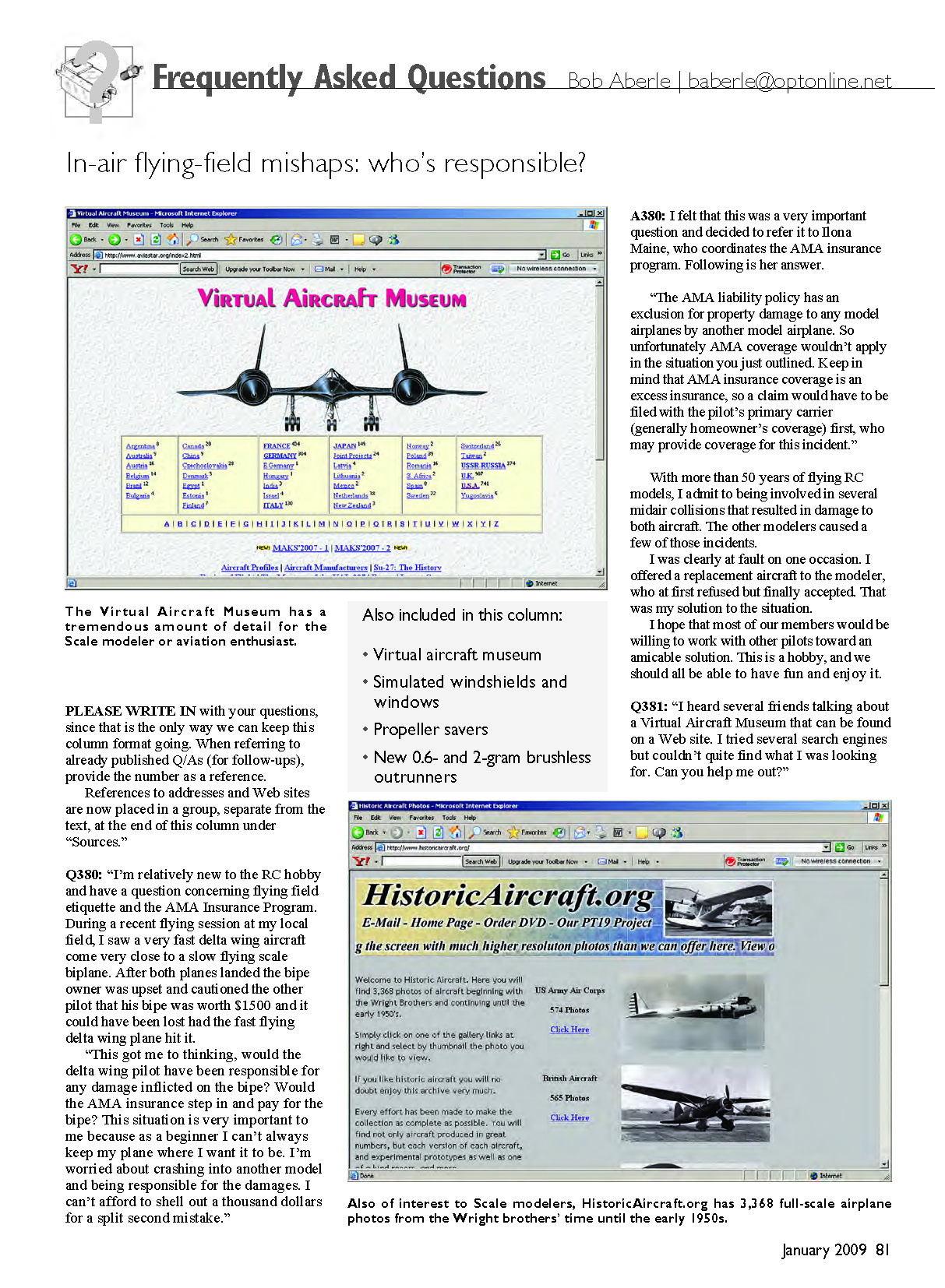
In this instance, I started with several regular search engines such as Google and ASK. At first I kept getting a virtual museum for helicopters. I stayed with it and finally got to the Virtual Aircraft Museum. See the 'Sources' list for the Web site address.
Maxim Sirotin of Estonia maintains the site. There is a place on the home page where you can send him an e-mail.
The site is absolutely amazing. The home page lists 39 countries, and clicking on each will bring up the aircraft manufactured there. Some of these nations' sections contain more than 400 airplanes. There are photos, descriptive text, specifications, and even three-views.
Another section of the site called 'Aircraft "Profiles"' is worth a look; you can access it from the home page. In the "Related Resources" section, I found a link to an interesting site containing historical scale data. There is so much on this site that you owe it to yourself to keep digging.
Q382
"I've been trying to find a source for simulated windshields and windows for use on stand-off-scale model aircraft. I've tried using iron-on covering in both white and black, but the finish is always too glossy. I'd like to have a flat or matte finish. What do you use?"
A382
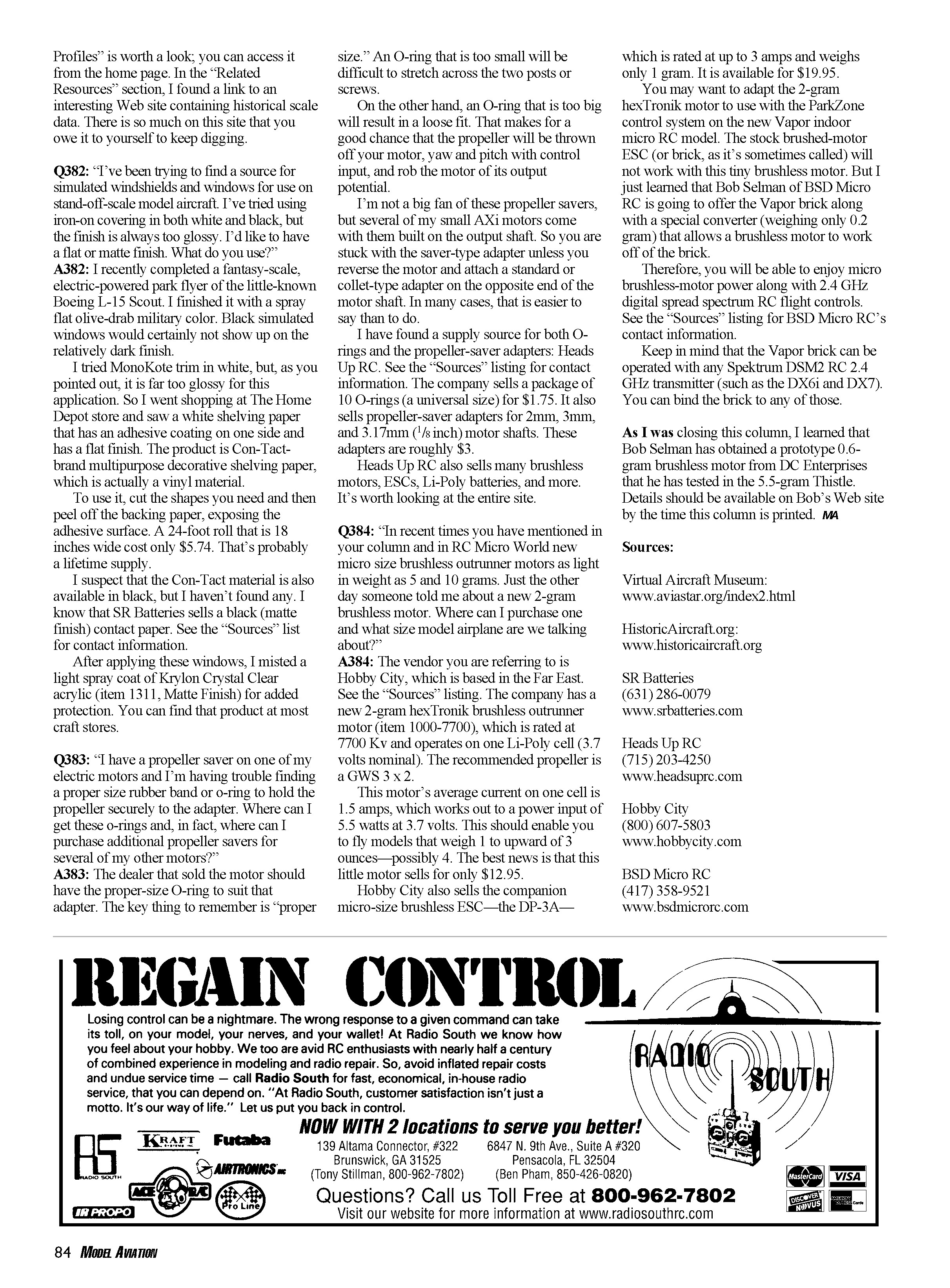
I recently completed a fantasy-scale, electric-powered park flyer of the little-known Boeing L-15 Scout. I finished it with a spray flat olive-drab military color. Black simulated windows would certainly not show up on the relatively dark finish.
I tried MonoKote trim in white, but, as you pointed out, it is far too glossy for this application. So I went shopping at The Home Depot and saw a white shelving paper that has an adhesive coating on one side and a flat finish. The product is Con-Tact® multi-purpose decorative shelving paper, which is actually a vinyl material.
To use it, cut the shapes you need and then peel off the backing paper, exposing the adhesive surface. A 24-foot roll that is 18 inches wide cost only $5.74 — probably a lifetime supply.
I suspect that the Con-Tact material is also available in black, but I haven't found any. I know that SR Batteries sells a black (matte finish) contact paper. See the "Sources" list for contact information.
After applying these windows, I misted a light spray coat of Krylon Crystal Clear acrylic (item 1311, Matte Finish) for added protection. You can find that product at most craft stores.
Q383
"I have a propeller saver on one of my electric motors and I'm having trouble finding a proper size rubber band or O-ring to hold the propeller securely to the adapter. Where can I get these O-rings and, in fact, where can I purchase additional propeller savers for several of my other motors?"
A383
The dealer that sold the motor should have the proper-size O-ring to suit that adapter. The key thing to remember is "proper size." An O-ring that is too small will be difficult to stretch across the two posts or screws.
On the other hand, an O-ring that is too big will result in a loose fit. That makes for a good chance that the propeller will be thrown off your motor, yaw and pitch with control input, and rob the motor of its output potential.
I'm not a big fan of these propeller savers, but several of my small AXi motors come with them built on the output shaft. So you are stuck with the saver-type adapter unless you reverse the motor and attach a standard or collet-type adapter on the opposite end of the motor shaft. In many cases, that is easier said than done.
I have found a supply source for both O-rings and propeller-saver adapters: Heads Up RC. See the "Sources" listing for contact information. The company sells a package of 10 O-rings (a universal size) for $1.75. It also sells propeller-saver adapters for 2 mm, 3 mm, and 3.17 mm (1/8 inch) motor shafts. These adapters are roughly $3.
Heads Up RC also sells many brushless motors, ESCs, Li-Poly batteries, and more. It's worth looking at the entire site.
Q384
"In recent times you have mentioned in your column and in RC Micro World new micro-size brushless outrunner motors as light in weight as 5 and 10 grams. Just the other day someone told me about a new 2-gram brushless motor. Where can I purchase one and what size model airplane are we talking about?"
A384
The vendor you are referring to is HobbyCity, which is based in the Far East. See the "Sources" listing. The company has a new 2-gram hexTronik brushless outrunner motor (item 1000-7700), which is rated at 7,700 Kv and operates on one Li-Poly cell (3.7 volts nominal). The recommended propeller is a GWS 3 x 2.
This motor's average current on one cell is 1.5 amps, which works out to a power input of about 5.5 watts at 3.7 volts. This should enable you to fly models that weigh 1 to upward of 3 ounces—possibly 4 ounces. The best news is that this little motor sells for only $12.95.
HobbyCity also sells the companion micro-size brushless ESC—the DP-3A—which is rated at up to 3 amps and weighs only 1 gram. It is available for $19.95.
You may want to adapt the 2-gram hexTronik motor to use with the ParkZone control system on the new Vapor indoor micro RC model. The stock brushed-motor ESC (or brick, as it's sometimes called) will not work with this tiny brushless motor. I just learned that Bob Selman of BSD Micro RC is going to offer the Vapor brick along with a special converter (weighing only 0.2 gram) that allows a brushless motor to work off the brick.
Therefore, you will be able to enjoy micro brushless-motor power along with 2.4 GHz digital spread-spectrum RC flight controls. See the "Sources" listing for BSD Micro RC's contact information.
Keep in mind that the Vapor brick can be operated with any Spektrum DSM2 RC 2.4 GHz transmitter (such as the DX6i and DX7). You can bind the brick to any of those.
As I was closing this column, I learned that Bob Selman has obtained a prototype 0.6-gram brushless motor from DC Enterprises that he has tested in the 5.5-gram Thistle. Details should be available on Bob's Web site by the time this column is printed.
MA
Sources:
- Virtual Aircraft Museum: www.aviastar.org/index2.html
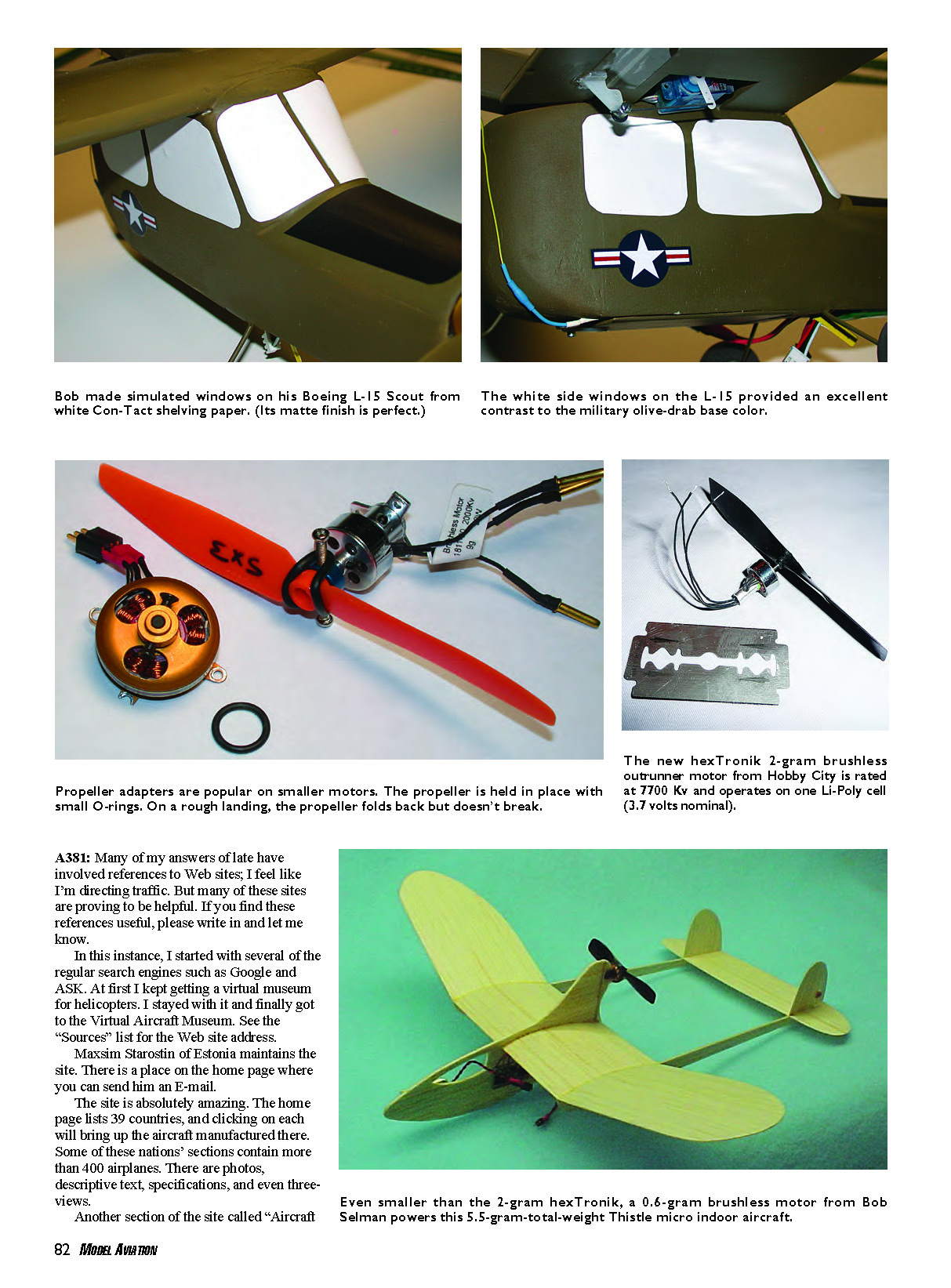
- HistoricAircraft.org: www.historicaircraft.org
- SR Batteries: (631) 286-0079 — www.srbatteries.com
- Heads Up RC: (715) 203-4250 — www.headsuprc.com
- HobbyCity: (800) 607-5803 — www.hobbycity.com
- BSD Micro RC: (417) 358-9521 — www.bsdmicrorc.com
Transcribed from original scans by AI. Minor OCR errors may remain.

