
Futaba 4EXA System
by Bob Aberle
An inexpensive computerized RC system any beginner can easily grow with and every sport flier can appreciate.
Features:
- Four-channel computerized FM airplane radio system
- 40-segment LCD screen
- Trainer-box capability
- Low-battery alarm
- One-year limited warranty
- $149.99 street price (as tested)
Includes:
- Futaba 4EXA transmitter
- 9.6-volt Ni-Cd transmitter battery
- R127DF seven-channel receiver
- Ni-Cd receiver battery
- Dual-output charger
- Four S3004 servos with hardware
- Switch/charge harness
- Transmitter strap
- 9-inch servo extension
- Servo tray
- Frequency flag
Airplane Program Features:
- Four-model memory
- Exponential for ailerons, elevator, and rudder
- Wing mixing function for V-tail and elevons
- Servo reversing
- Trim memory
- End Point Adjustment (EPA) on all four channels
- Data reset
- Trainer system
Manufacturer:
Futaba 3002 N. Apollo Dr. Suite 1 Champaign, IL 61822 (217) 398-8970 www.futaba-rc.com
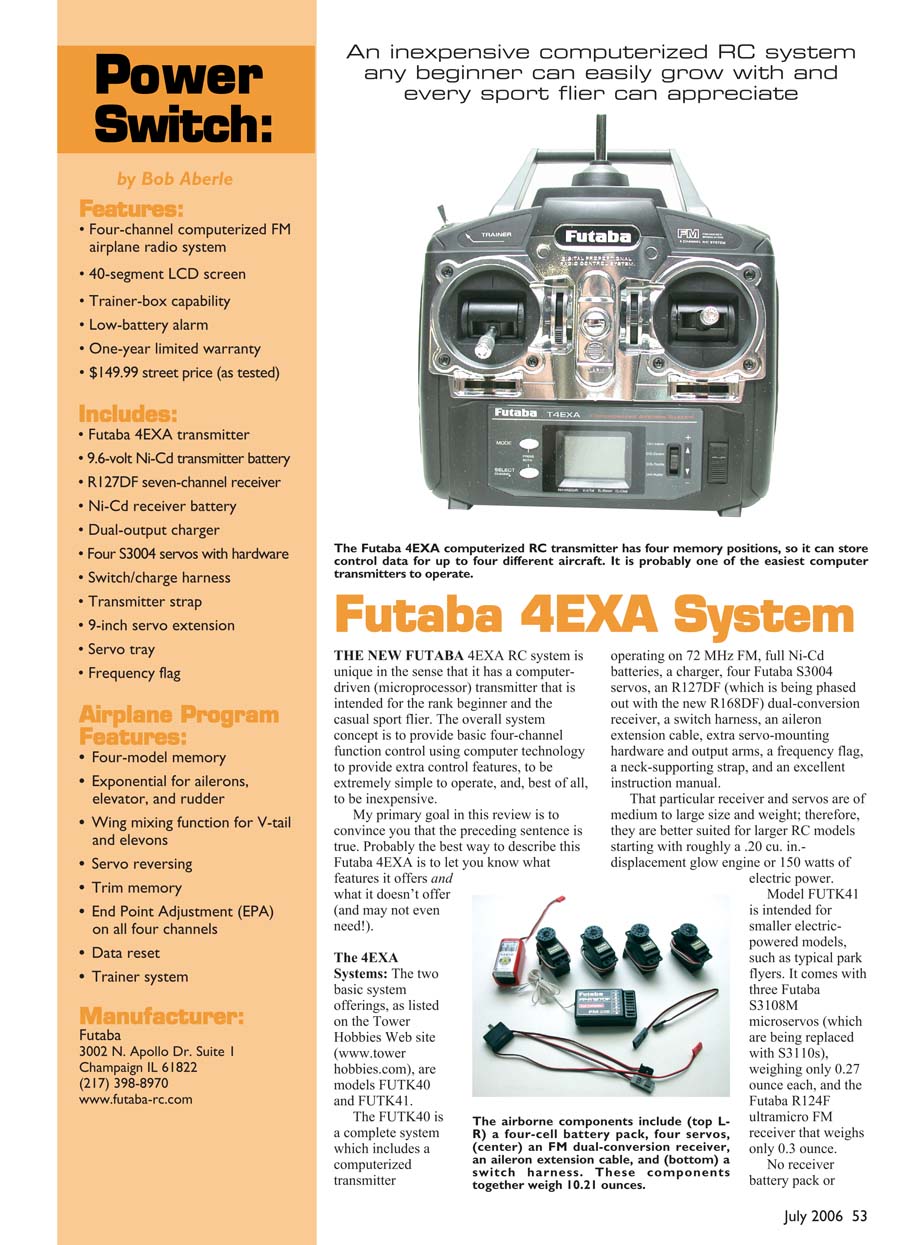
The new Futaba 4EXA RC system is unique in that it has a computer-driven (microprocessor) transmitter intended for the rank beginner and the casual sport flier. The overall system concept is to provide basic four-channel function control using computer technology to provide extra control features, to be extremely simple to operate, and—best of all—to be inexpensive.
My primary goal in this review is to convince you that the preceding sentence is true. Probably the best way to describe the Futaba 4EXA is to let you know what features it offers and what it doesn't offer (and may not even need).
The 4EXA Systems:
The two basic system offerings, as listed on the Tower Hobbies website (www.towerhobbies.com), are models FUTK40 and FUTK41.
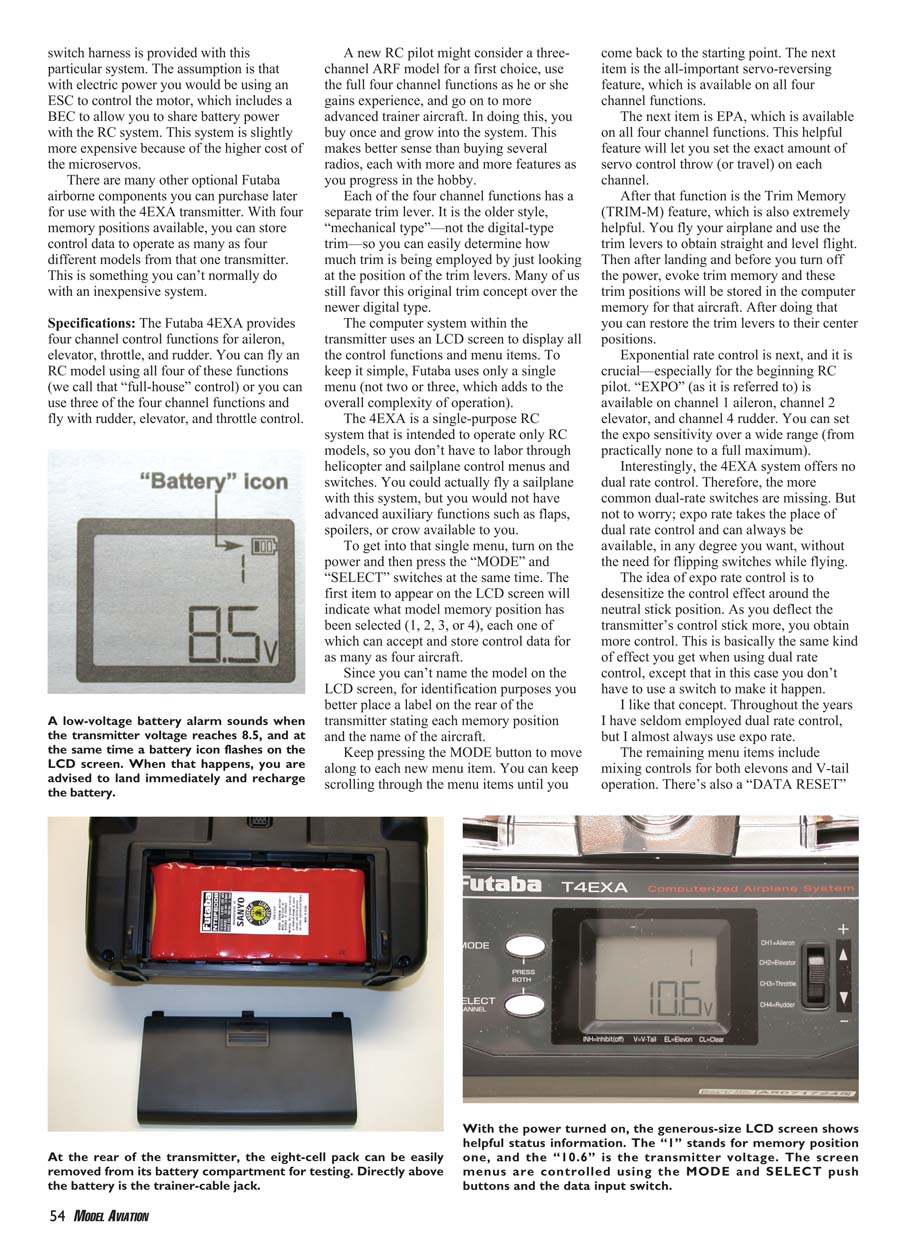
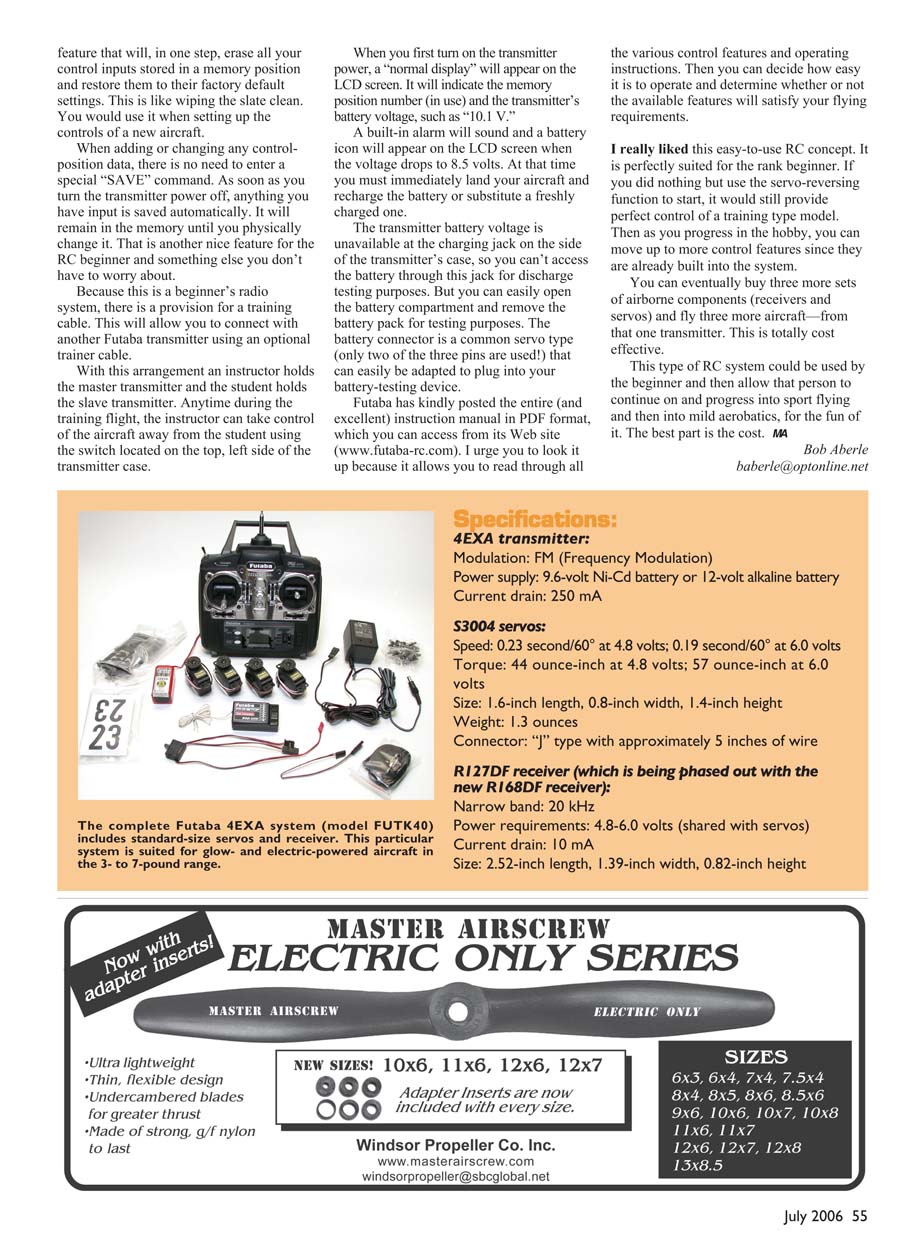
- FUTK40 is a complete system that includes a computerized transmitter operating on 72 MHz FM, full Ni-Cd batteries, a charger, four Futaba S3004 servos, an R127DF dual-conversion receiver (being phased out with the new R168DF), a switch harness, an aileron extension cable, extra servo-mounting hardware and output arms, a frequency flag, a neck-supporting strap, and an excellent instruction manual. The receiver and servos in this kit are medium to large in size and weight; therefore, they are better suited for larger RC models starting with roughly a .20 cu. in.-displacement glow engine or about 150 watts of electric power.
- FUTK41 is intended for smaller electric-powered models, such as typical park flyers. It comes with three Futaba S3108M microservos (being replaced with S3110s), weighing only 0.27 ounce each, and the Futaba R124F ultramicro FM receiver, which weighs only 0.3 ounce. No receiver battery pack or switch harness is provided with this system. The assumption is that with electric power you would be using an ESC to control the motor, which includes a BEC to allow you to share battery power with the RC system. This system is slightly more expensive because of the higher cost of the microservos.
There are many other optional Futaba airborne components you can purchase later for use with the 4EXA transmitter. With four memory positions available, you can store control data to operate as many as four different models from that one transmitter. This is something you can't normally do with an inexpensive system.
The Futaba 4EXA provides four-channel control functions for aileron, elevator, throttle, and rudder. You can fly an RC model using all four of these functions (we call that "full-house" control) or you can use three of the four channel functions and fly with rudder, elevator, and throttle control.
A new RC pilot might consider a three-channel ARF model for a first choice, use the full four-channel functions as he or she gains experience, and go on to more advanced trainer aircraft. In doing this, you buy once and grow into the system. This makes better sense than buying several radios, each with more and more features as you progress in the hobby.
Each of the four channel functions has a separate trim lever. It is the older style, mechanical trim—rather than digital—so you can easily determine how much trim is being employed by just looking at the position of the trim levers. Many of us still favor this original trim concept over the newer digital type.
The computer system within the transmitter uses an LCD screen to display all the control functions and menu items. To keep it simple, Futaba uses only a single menu (not two or three, which adds to overall complexity).
The 4EXA is a single-purpose RC system intended to operate fixed-wing RC models only, so you don't have to labor through helicopter and sailplane control menus and switches. You could fly a sailplane with this system, but you would not have advanced auxiliary functions such as flaps, spoilers, or crow.
To enter the single menu, turn on the power and then press the MODE and SELECT switches at the same time. The first item to appear on the LCD screen will indicate what model memory position has been selected (1, 2, 3, or 4). Each memory position stores the control data for a single aircraft.
Keep pressing the MODE button to move along to each new menu item. You can keep scrolling through the menu items until you come back to the starting point. The next item is the all-important servo-reversing feature, which is available on all four channel functions.
The next item is EPA, which is available on all four channel functions. This helpful feature lets you set the exact amount of servo control throw (or travel) on each channel.
After that function is the Trim Memory (TRIM-M) feature, which is also extremely helpful. You fly your airplane and use the trim levers to obtain straight and level flight. Then, after landing and before you turn off the power, evoke trim memory and these trim positions will be stored in the computer memory for that aircraft. After doing that you can restore the trim levers to their center positions.
Exponential rate control is next, and it is crucial—especially for the beginning RC pilot. EXPO (as it is referred to) is available on channel 1 aileron, channel 2 elevator, and channel 4 rudder. You can set the expo sensitivity over a wide range (from practically none to a full maximum).
Interestingly, the 4EXA system offers no dual-rate control. Therefore, the more common dual-rate switches are missing. But not to worry; expo rate takes the place of dual-rate control and can always be available, in any degree you want, without the need for flipping switches while flying.
The idea of expo rate control is to desensitize the control effect around the neutral stick position. As you deflect the transmitter's control stick, you obtain more control. This is basically the same kind of effect you get when using dual rate control, except that in this case you don't have to use a switch to make it happen.
I like that concept. Throughout the years I have seldom employed dual-rate control, but I almost always use expo rate.
The remaining menu items include mixing controls for both elevons and V-tail operation. There's also a DATA RESET feature that will, in one step, erase all your control inputs stored in a memory position and restore them to their factory default settings. This is like wiping the slate clean. You would use it when setting up the controls of a new aircraft.
When adding or changing any control-position data, there is no need to enter a special SAVE command. As soon as you turn the transmitter power off, anything you have input is saved automatically. It will remain in the memory until you physically change it. That is another nice feature for the RC beginner and something else you don't have to worry about.
Because this is a beginner's radio system, there is a provision for a trainer cable. This will allow you to connect with another Futaba transmitter using an optional trainer cable.
With this arrangement an instructor holds the master transmitter and the student holds the slave transmitter. Anytime during the training flight, the instructor can take control of the aircraft away from the student using the switch located on the top left side of the transmitter case.
When you first turn on the transmitter power, a normal display will appear on the LCD screen. It will indicate the memory position number in use and the transmitter's battery voltage, such as "10.1 V."
A built-in alarm will sound and a battery icon will appear on the LCD screen when the voltage drops to 8.5 volts. At that time you must immediately land your aircraft and recharge the battery or substitute a freshly charged one.
The transmitter battery voltage is unavailable at the charging jack on the side of the transmitter's case, so you can't access the battery through this jack for discharge testing purposes. But you can easily open the battery compartment and remove the battery pack for testing. The battery connector is a common servo type (only two of the three pins are used) that can easily be adapted to plug into your battery-testing device.
Futaba has posted the entire (and excellent) instruction manual in PDF format on its website (www.futaba-rc.com). I urge you to look it up because it allows you to read through all the various control features and operating instructions. Then you can decide how easy it is to operate and determine whether or not the available features will satisfy your flying requirements.
I really liked this easy-to-use RC concept. It is perfectly suited for the rank beginner. If you did nothing but use the servo-reversing function to start, it would still provide perfect control of a training-type model. Then, as you progress in the hobby, you can move up to more control features since they are already built into the system.
You can eventually buy three more sets of airborne components (receivers and servos) and fly three more aircraft from that one transmitter. This is totally cost effective.
This type of RC system could be used by the beginner and then allow that person to continue on and progress into sport flying and then into mild aerobatics, for the fun of it. The best part is the cost.
Bob Aberle [email protected]
Specifications:
4EXA transmitter:
- Modulation: FM (Frequency Modulation)
- Power supply: 9.6-volt Ni-Cd battery or 12-volt alkaline battery
- Current drain: 250 mA
S3004 servos:
- Speed: 0.23 second/60° at 4.8 volts; 0.19 second/60° at 6.0 volts
- Torque: 44 ounce-inch at 4.8 volts; 57 ounce-inch at 6.0 volts
- Size: 1.6-inch length, 0.8-inch width, 1.4-inch height
- Weight: 1.3 ounces
- Connector: "J" type with approximately 5 inches of wire
R127DF receiver (being phased out with the new R168DF receiver):
- Narrow band: 20 kHz
- Power requirements: 4.8–6.0 volts (shared with servos)
- Current drain: 10 mA
- Size: 2.52-inch length, 1.39-inch width, 0.82-inch height
Transcribed from original scans by AI. Minor OCR errors may remain.

