
The Gift of Flight
Vernon W. Smith
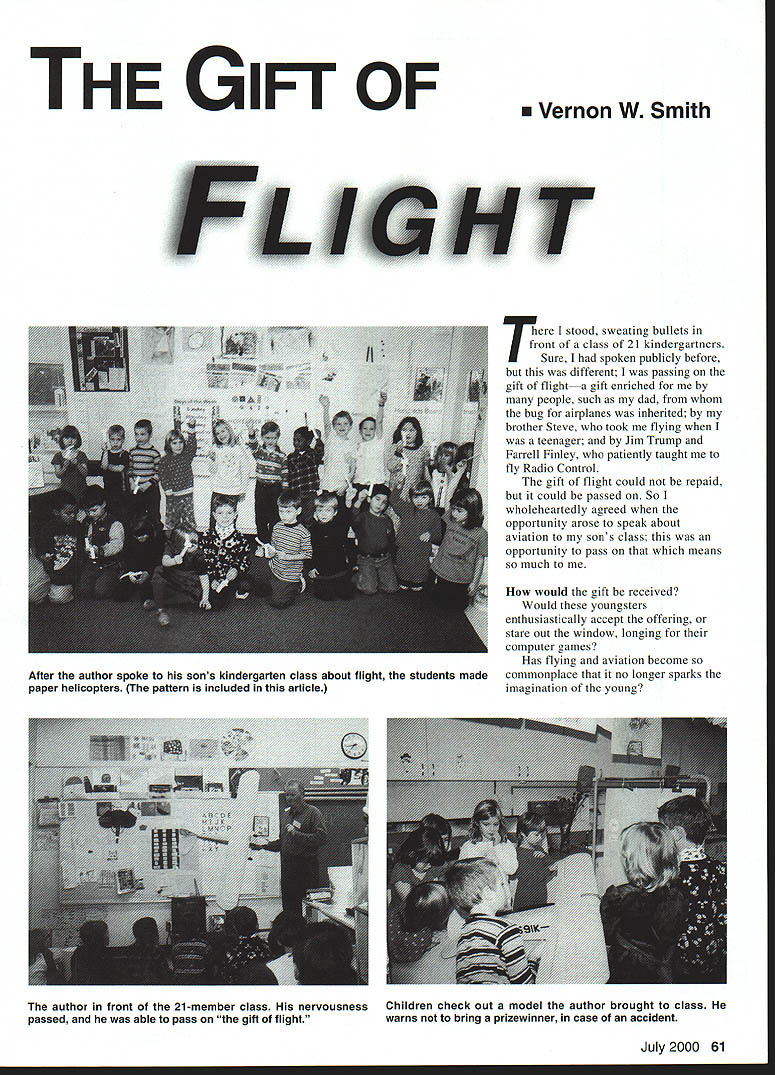
There I stood, sweating bullets in front of a class of 21 kindergartners. Sure, I had spoken publicly before, but this was different; I was passing on the gift of flight — a gift enriched for me by many people, such as my dad, from whom the bug for airplanes was inherited; by my brother Steve, who took me flying when I was a teenager; and by Jim Trump and Farrell Finley, who patiently taught me to fly Radio Control.
The gift of flight could not be repaid, but it could be passed on. So I wholeheartedly agreed when the opportunity arose to speak about aviation to my son's class; this was an opportunity to pass on that which means so much to me.
How would the gift be received? Would these youngsters enthusiastically accept the offering, or stare out the window, longing for their computer games? Has flying and aviation become so commonplace that it no longer sparks the imagination of the young?
Fortunately, the answer is a resounding no! As long as we are willing to share the gift given to us, flight will never be mundane.
Nothing is commonplace to kindergarteners. There may be more distractions as they get older, but at this age, flying is a marvel that deserves exploration. After all, how does an airplane stay up with nothing visibly supporting it?
Preparing to talk to anyone—even about something you love—can seem an insurmountable hurdle. What do you say about flying to a roomful of kids? The end of this article includes a brief outline that can be followed.
Be prepared! Kindergartners ask some amazing questions, and can grasp simplified explanations of matters, such as Sir Isaac Newton's third law of motion: to every action there is an equal and opposite reaction.
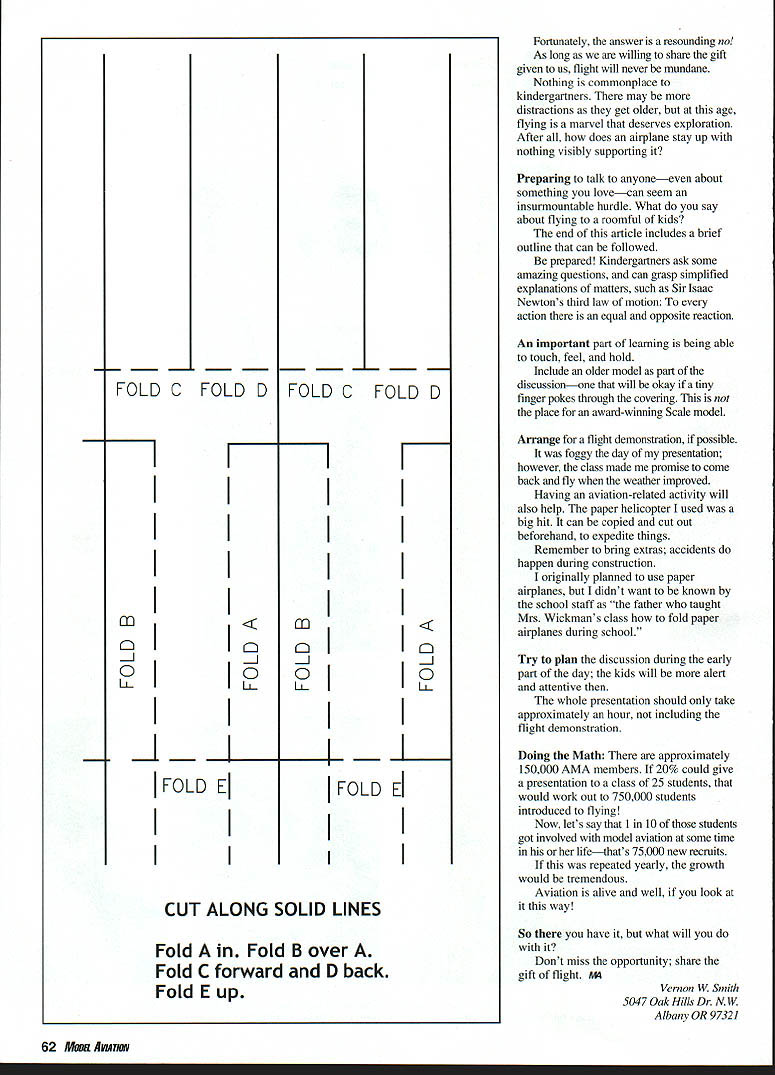
An important part of learning is being able to touch, feel, and hold. Include an older model as part of the discussion—one that will be okay if a tiny finger pokes through the covering. This is not the place for an award-winning scale model.
Arrange for a flight demonstration, if possible. It was foggy the day of my presentation; however, the class made me promise to come back and fly when the weather improved.
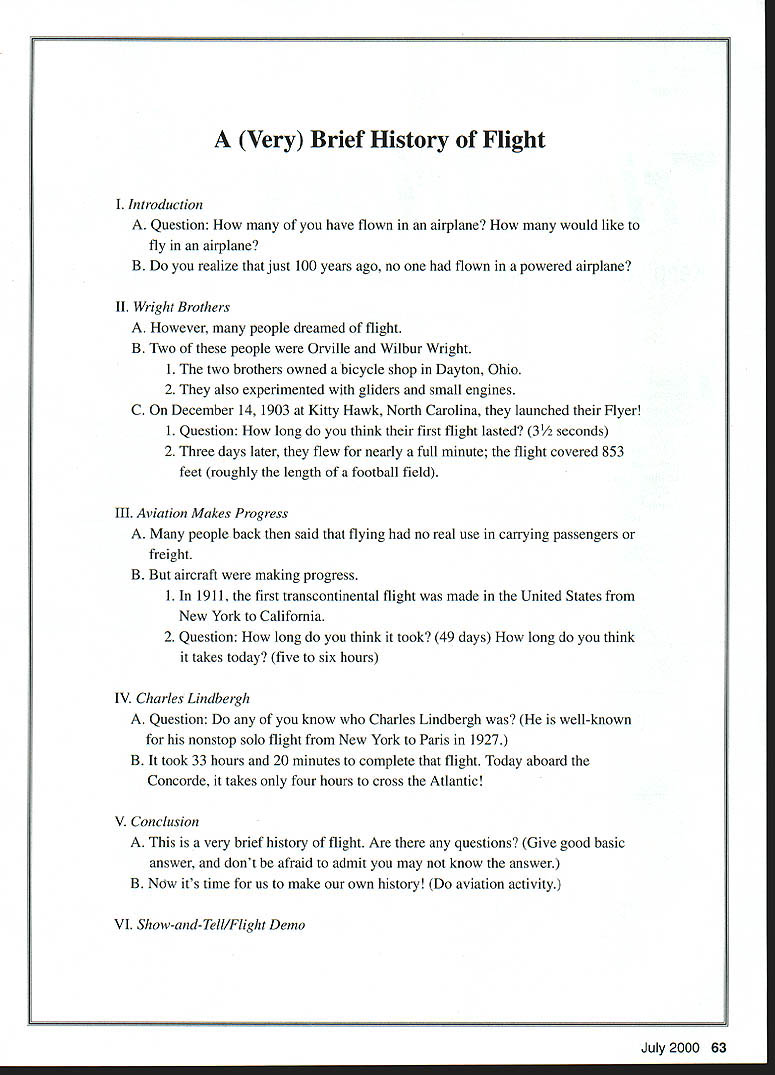
Having an aviation-related activity will also help. The paper helicopter I used was a big hit. It can be copied and cut out beforehand, to expedite things. Remember to bring extras; accidents do happen during construction.
I originally planned to use paper airplanes, but I didn't want to be known by the school staff as "the father who taught Mrs. Wickman's class how to fold paper airplanes during school."
Try to plan the discussion during the early part of the day; the kids will be more alert and attentive then. The whole presentation should only take approximately an hour, not including the flight demonstration.
Doing the Math:
- There are approximately 150,000 AMA members.
- If 20% could give a presentation to a class of 25 students, that would work out to 750,000 students introduced to flying.
- If 1 in 10 of those students got involved with model aviation at some time in his or her life, that's 75,000 new recruits.
If this were repeated yearly, the growth would be tremendous. Aviation is alive and well, if you look at it this way!
So there you have it, but what will you do with it? Don't miss the opportunity; share the gift of flight.
MA Vernon W. Smith 5047 Oak Hills Dr. N.W. Albany OR 97321
A (Very) Brief History of Flight
I. Introduction
- Question: How many of you have flown in an airplane? How many would like to fly in an airplane?
- Do you realize that just 100 years ago, no one had flown in a powered airplane?
II. Wright Brothers
- However, many people dreamed of flight.
- Two of these people were Orville and Wilbur Wright.
- The two brothers owned a bicycle shop in Dayton, Ohio.
- They also experimented with gliders and small engines.
- On December 14, 1903 at Kitty Hawk, North Carolina, they launched their Flyer!
- Question: How long do you think their first flight lasted? (3½ seconds)
- Three days later, they flew for nearly a full minute; the flight covered 853 feet (roughly the length of a football field).
III. Aviation Makes Progress
- Many people back then said that flying had no real use in carrying passengers or freight.
- But aircraft were making progress.
- In 1911, the first transcontinental flight was made in the United States from New York to California.
- Question: How long do you think it took? (49 days) How long do you think it takes today? (five to six hours)
IV. Charles Lindbergh
- Question: Do any of you know who Charles Lindbergh was? (He is well-known for his nonstop solo flight from New York to Paris in 1927.)
- It took 33 hours and 20 minutes to complete that flight. Today aboard the Concorde, it takes only four hours to cross the Atlantic!
V. Conclusion
- This is a very brief history of flight. Are there any questions? (Give good basic answers, and don’t be afraid to admit you may not know the answer.)
- Now it’s time for us to make our own history! (Do aviation activity.)
VI. Show-and-Tell / Flight Demo
- Arrange a simple show-and-tell and, if possible, a flight demonstration to reinforce the lesson.
Transcribed from original scans by AI. Minor OCR errors may remain.

