
Great Planes Avistar Elite
Terry Dunn
A trainer with a focus on aerobatic ability
The Avistar Elite presents a way to try out the excitement of aerobatics without having to abandon your training wheels. It retains the slow-speed stability of a trainer while offering the power and maneuverability needed to expand your competence and confidence.
New RC pilots are often eager to move on to aerobatics soon after learning to solo. Whether they've mastered the basics with an instructor or on a simulator hardly seems to matter. They've ascended that first daunting slope of the learning curve and are ready to move on.
Most inexperienced pilots are probably not quite ready for an all-out, wing-bending aerobat. That's where an advanced trainer such as the Avistar Elite comes in. It provides a step up in performance compared to a basic trainer, while catering to the stability needs of pilots who are still building their confidence.
The Avistar has all the ingredients of a modern ARF, including a prebuilt balsa and plywood airframe, colorful covering scheme, and prehinged control surfaces. The
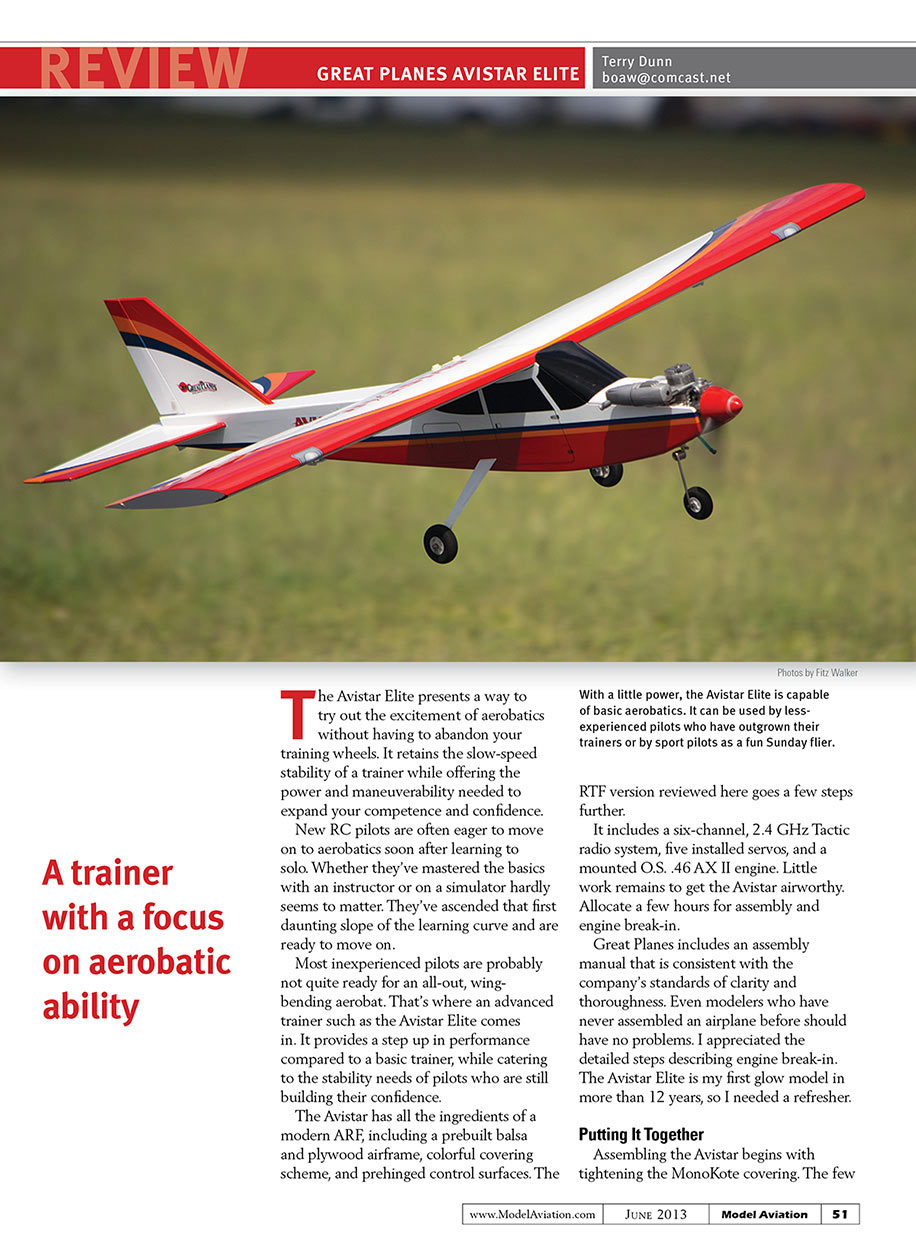
With a little power, the Avistar Elite is capable of basic aerobatics. It can be used by less-experienced pilots who have outgrown their trainers or by sport pilots as a fun Sunday flier.
RTF version reviewed here goes a few steps further.
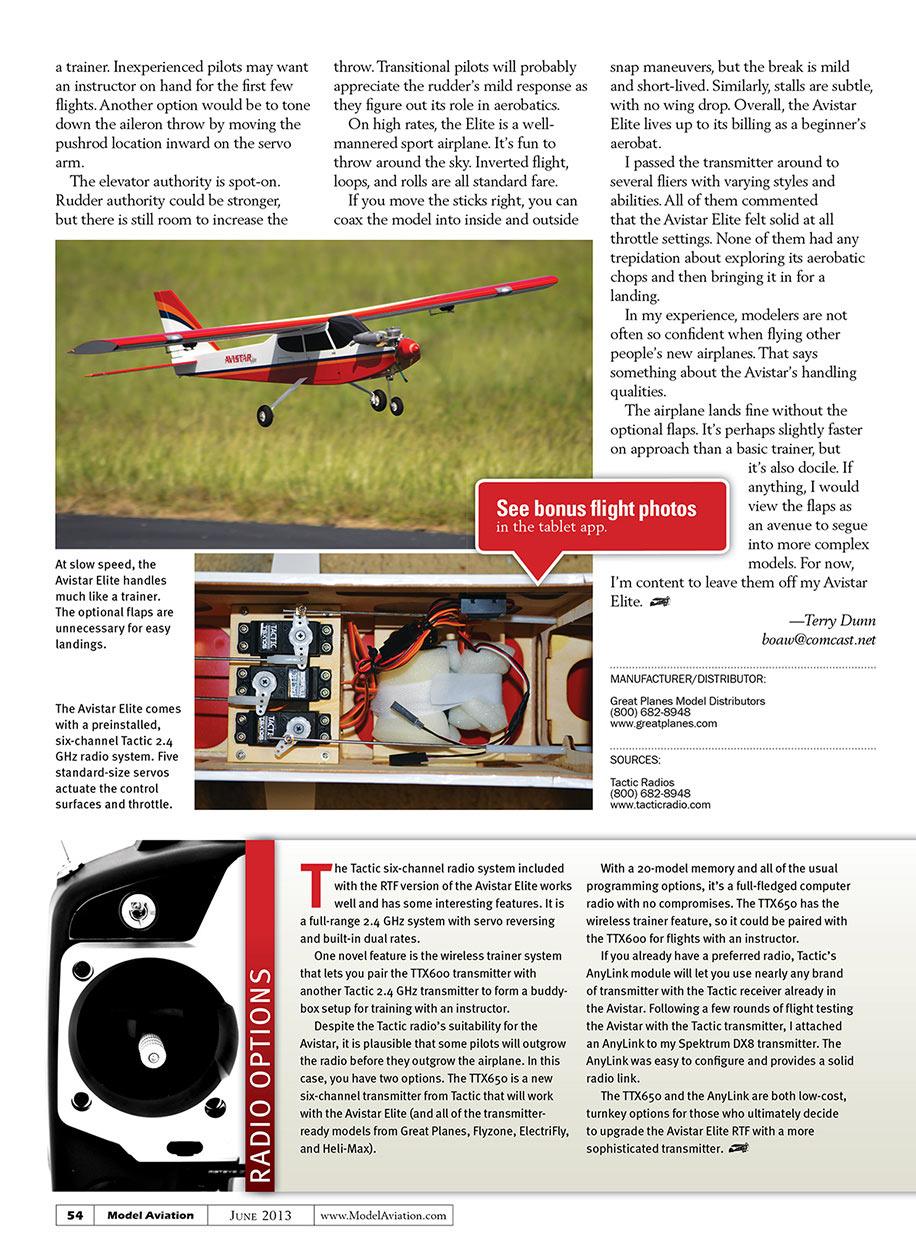
It includes a six-channel, 2.4 GHz Tactic radio system, five installed servos, and a mounted O.S. .46 AX II engine. Little work remains to get the Avistar airworthy. Allocate a few hours for assembly and engine break-in.
Great Planes includes an assembly manual that is consistent with the company's standards of clarity and thoroughness. Even modelers who have never assembled an airplane before should have no problems. I appreciated the detailed steps describing engine break-in. The Avistar Elite is my first glow model in more than 12 years, so I needed a refresher.
Putting It Together
Assembling the Avistar begins with tightening the MonoKote covering. The few loose areas were easily corrected with a covering iron. Next, I installed the main landing gear by snapping it into place. The wheel collars use large screws as setscrews. They're effective, but gaudy.
The tail feathers are fastened to the fuselage with nylon thumb screws. I tightened the screws as tight as I dared, but the horizontal stabilizer never solidly locked into place. I didn't plan to remove the tail feathers, so I used a small dab of Goop adhesive to secure the stabilizer to the fuselage.
The wing halves were joined with an aluminum tube that slides into place. The plywood root ribs join to form a tab that mates with a slot on the fuselage former at the wing's LE. The wing's TE is held in place with two nylon bolts.
At this point, I was less than an hour into assembly and the Avistar Elite looked complete, but it wasn't quite ready to fly.
After bolting the included propeller and spinner into place, I installed the provided AA alkaline batteries into the Tactic TTX600 transmitter and onboard battery holder. Thick foam and a Velcro strap secure the battery and receiver in the fuselage. Make sure that the receiver antenna is adequately extended, and not caught up in the foam. This could affect radio reception.
When I fired up the radio, everything worked perfectly. Even the transmitter's servo-reversing switches were properly set (but always check). I centered the trims and adjusted the pushrod clevises to align all of the control surfaces.
The Avistar Elite includes the necessary hardware to incorporate flaps onto the wings. The six-channel radio is ready to accept this modification as well. All that is needed are two additional standard-size servos, servo extensions, and some time to bolt everything into place. However, I wanted to try the Avistar in stock form, so I have not yet installed the flaps.
The O.S. .46 AX II is factory installed to an isolation mount to decrease vibration on the airframe, but there is still significant vibration, especially at lower rpms. Be sure to secure all of the metal-to-metal fasteners with threadlocker. I initially overlooked this step and lost the setscrew from one of my pushrod quick links during engine break-in.
The included fuel tank comes plumbed to the engine and installed behind the firewall. A large, magnetic hatch provides access to the compartment.
As I previously mentioned, the manual includes detailed steps to break in the engine. I used 10% fuel and had no problem firing up the engine and correctly adjusting it.
With an empty fuel tank, my Avistar weighs 6.6 pounds. This weight is on the bottom end of the listed range. I didn't have to add any lead to correctly balance it.
Flying
On the Avistar Elite's first outing, it attracted a surprising amount of attention from my club members. Many of them had flown earlier versions of the Avistar and they were anxious to see what this sportier style could do. As you would expect from a model with tricycle landing gear, ground handling was no problem. I did, however, manage to scuff a wingtip with ham-fisted taxiing in a stiff crosswind.
The .46 engine, combined with its 12 x 5 propeller, provides good acceleration for takeoff and a strong climb rate. The tradeoff for this pull is limited top-end speed, but I think that's a good choice for this airplane. I can't see rookie aerobatic pilots wishing for more zip than this power combination provides.
On low rates, the airplane is capable of most four-channel aerobatics. It performs them slowly, but the Avistar Elite's roll responsiveness is a notable step up from throw. Transitional pilots will probably appreciate the rudder's mild response as they figure out its role in aerobatics.
On high rates, the Elite is a well-mannered sport airplane. It's fun to throw around the sky. Inverted flight, loops, and rolls are all standard fare.
If you move the sticks right, you can coax the model into inside and outside snap maneuvers, but the break is mild and short-lived. Similarly, stalls are subtle, with no wing drop. Overall, the Avistar Elite lives up to its billing as a beginner's aerobat.
I passed the transmitter around to several fliers with varying styles and abilities. All of them commented that the Avistar Elite felt solid at all throttle settings. None of them had any trepidation about exploring its aerobatic chops and then bringing it in for a landing.
In my experience, modelers are not often so confident when flying other people's new airplanes. That says something about the Avistar's handling qualities.
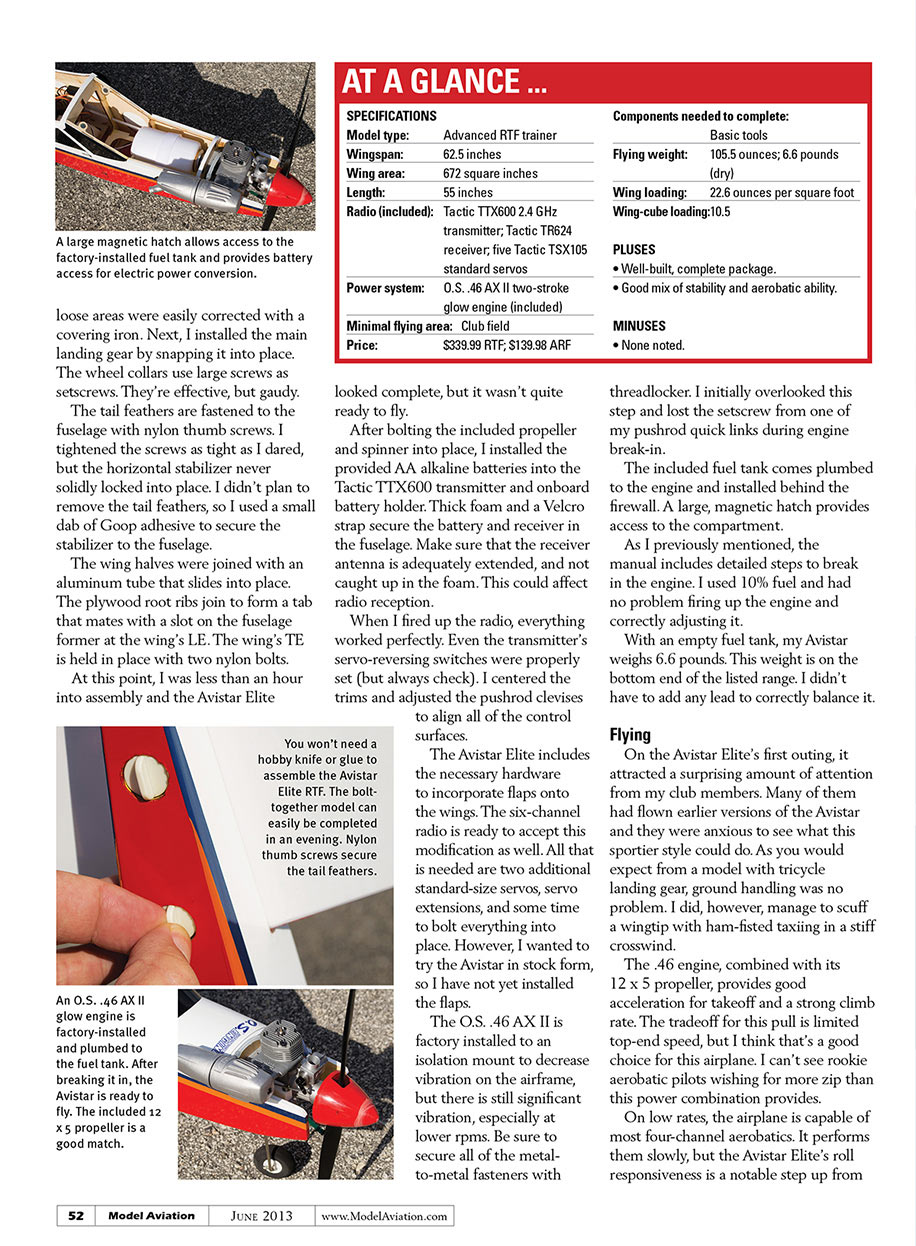
The airplane lands fine without the optional flaps. It's perhaps slightly faster on approach than a basic trainer, but it's also docile. If anything, I would view the flaps as an avenue to segue into more complex models. For now, I'm content to leave them off my Avistar Elite.
—Terry Dunn [email protected]
MANUFACTURER/DISTRIBUTOR: Great Planes Model Distributors (800) 682-8948 www.greatplanes.com
SOURCES: Tactic Radios (800) 682-8948 www.tacticradio.com
RADIO OPTIONS
The Tactic six-channel radio system included with the RTF version of the Avistar Elite works well and has some interesting features. It is a full-range 2.4 GHz system with servo reversing and built-in dual rates.
One novel feature is the wireless trainer system that lets you pair the TTX600 transmitter with another Tactic 2.4 GHz transmitter to form a buddy-box setup for training with an instructor.
Despite the Tactic radio's suitability for the Avistar, it is plausible that some pilots will outgrow the radio before they outgrow the airplane. In this case, you have two options. The TTX650 is a new six-channel transmitter from Tactic that will work with the Avistar Elite (and all of the transmitter-ready models from Great Planes, Flyzone, ElectriFly, and Heli-Max).
With a 20-model memory and all of the usual programming options, it's a full-fledged computer radio with no compromises. The TTX650 has the wireless trainer feature, so it could be paired with the TTX600 for flights with an instructor.
If you already have a preferred radio, Tactic's AnyLink module will let you use nearly any brand of transmitter with the Tactic receiver already in the Avistar. Following a few rounds of flight testing the Avistar with the Tactic transmitter, I attached an AnyLink to my Spektrum DX8 transmitter. The AnyLink was easy to configure and provides a solid radio link.
The TTX650 and the AnyLink are both low-cost, turnkey options for those who ultimately decide to upgrade the Avistar Elite RTF with a more sophisticated transmitter.
Transcribed from original scans by AI. Minor OCR errors may remain.

