
Great Planes Christen Eagle GP/EP ARF
Jason Danhakl
OUT OF THE BOX, the low parts count was a welcome sight. If you have ever assembled a biplane, you know that most have many parts to assemble. Great Planes made sure the airframe is packed to survive less-than-desirable shipping conditions.
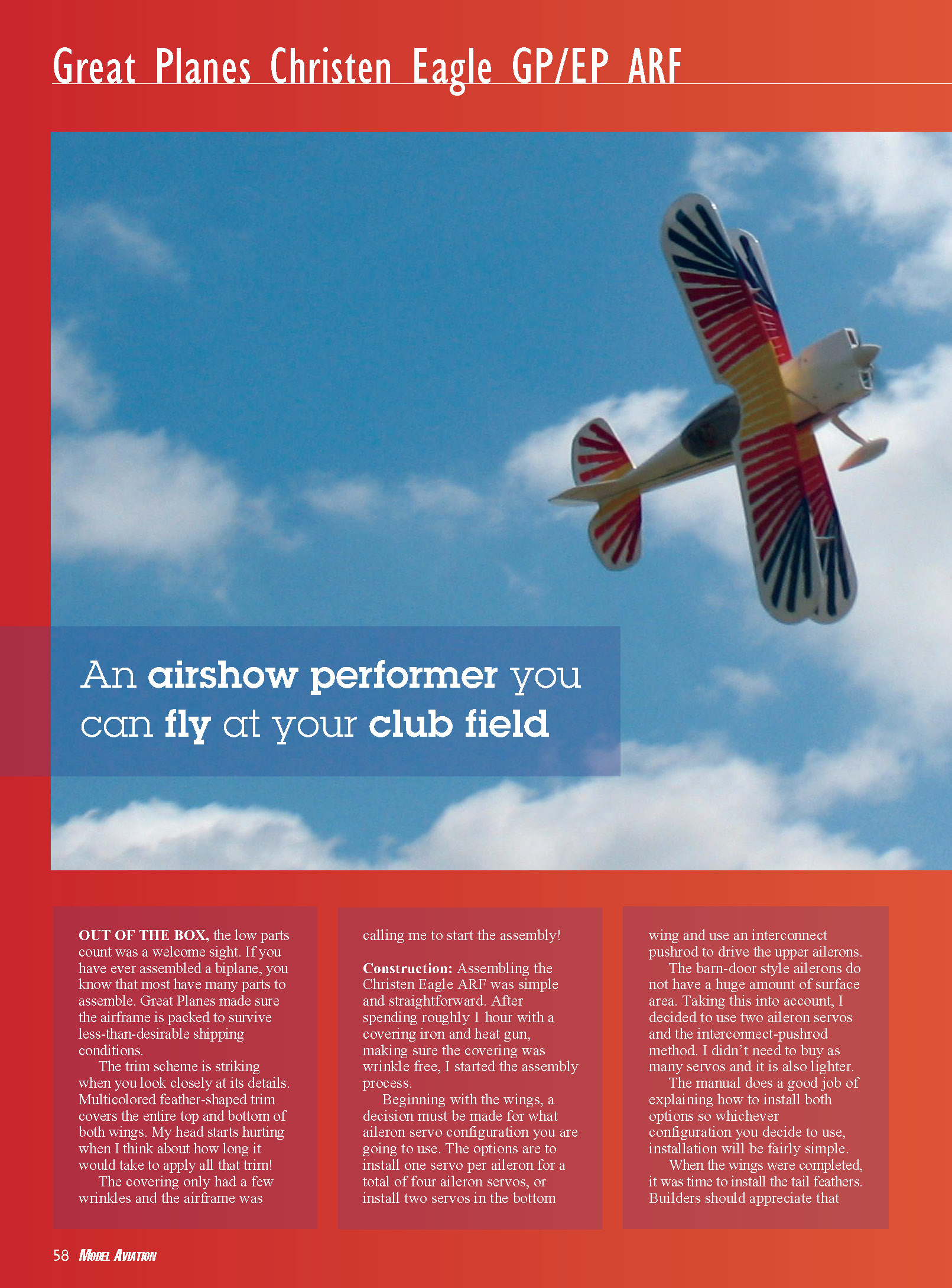
The trim scheme is striking when you look closely at its details. Multicolored feather-shaped trim covers the entire top and bottom of both wings. My head starts hurting when I think about how long it would take to apply all that trim!
The covering only had a few wrinkles and the airframe was calling me to start the assembly!
Construction: Assembling the Christen Eagle ARF was simple and straightforward. After spending roughly 1 hour with a covering iron and heat gun, making sure the covering was wrinkle free, I started the assembly process.
Beginning with the wings, a decision must be made for what aileron servo configuration you are going to use. The options are to install one servo per aileron for a total of four aileron servos, or install two servos in the bottom wing and use an interconnect pushrod to drive the upper ailerons.
The barn-door style ailerons do not have a huge amount of surface area. Taking this into account, I decided to use two aileron servos and the interconnect-pushrod method. I didn't need to buy as many servos and it is also lighter.
The manual does a good job of explaining how to install both options so whichever configuration you decide to use, installation will be fairly simple.
When the wings were completed, it was time to install the tail feathers. Builders should appreciate that some time-consuming steps are completed out of the box for you here. The covering is already trimmed from the stabilizers, promising a proper glue joint into the fuselage. This is a huge timesaver and ensures the tail feathers' structural integrity. Installing the elevator joiner rod and tail-wheel bracket was simple. The precut slots fit these parts perfectly making a dreaded step simple!
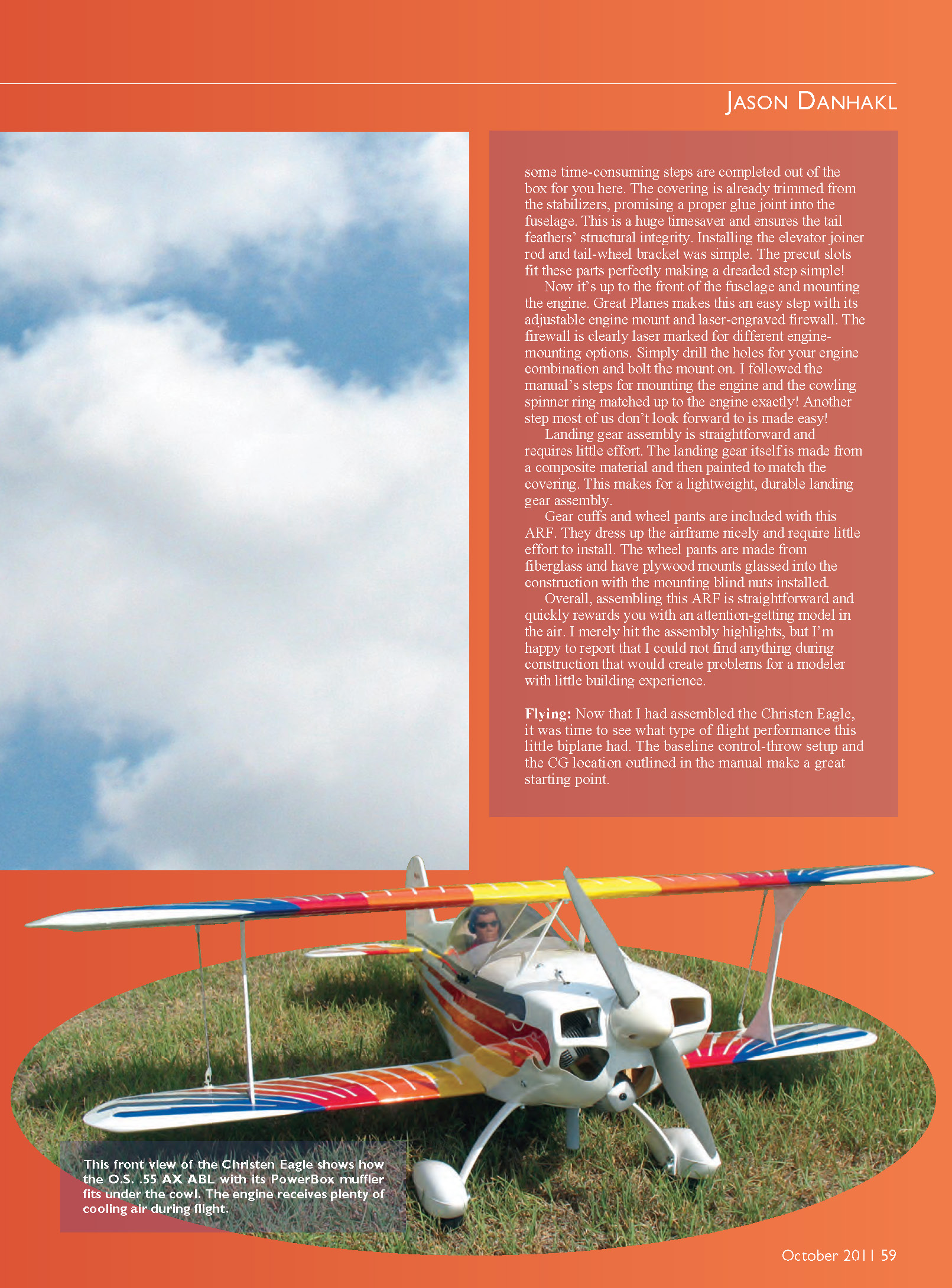
Now it's up to the front of the fuselage and mounting the engine. Great Planes makes this an easy step with its adjustable engine mount and laser-engraved firewall. The firewall is clearly laser marked for different engine-mounting options. Simply drill the holes for your engine combination and bolt the mount on. I followed the manual's steps for mounting the engine and the cowling spinner ring matched up to the engine exactly! Another step most of us don't look forward to is made easy!
Landing gear assembly is straightforward and requires little effort. The landing gear itself is made from a composite material and then painted to match the covering. This makes for a lightweight, durable landing gear assembly.
Gear cuffs and wheel pants are included with this ARF. They dress up the airframe nicely and require little effort to install. The wheel pants are made from fiberglass and have plywood mounts glassed into the construction with the mounting blind nuts installed.
Overall, assembling this ARF is straightforward and quickly rewards you with an attention-getting model in the air. I merely hit the assembly highlights, but I'm happy to report that I could not find anything during construction that would create problems for a modeler with little building experience.
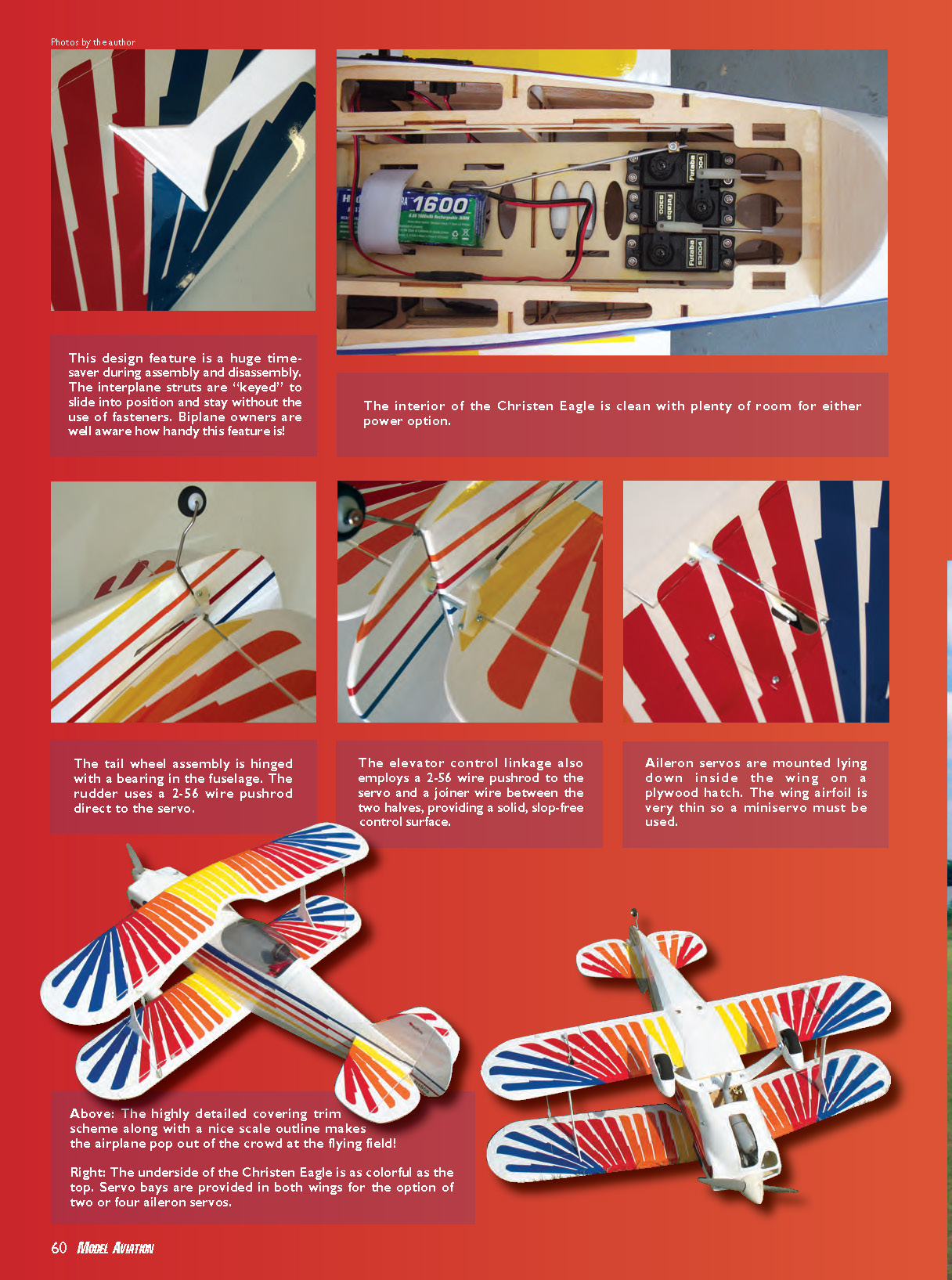
Flying: Now that I had assembled the Christen Eagle, it was time to see what type of flight performance this little biplane had. The baseline control-throw setup and the CG location outlined in the manual make a great starting point. This design feature is a huge time-saver during assembly and disassembly. The interplane struts are "keyed" to slide into position and stay without the use of fasteners. Biplane owners are well aware how handy this feature is!
The interior of the Christen Eagle is clean with plenty of room for either power option.
The tail wheel assembly is hinged with a bearing in the fuselage. The rudder uses a 2-56 wire pushrod direct to the servo.
The elevator control linkage also employs a 2-56 wire pushrod to the servo and a joiner wire between the two halves, providing a solid, slop-free control surface.
Aileron servos are mounted lying down inside the wing on a plywood hatch. The wing airfoil is very thin so a miniserve must be used.
Above: The highly detailed covering trim scheme along with a nice scale outline makes the airplane pop out of the crowd at the flying field!
Right: The underside of the Christen Eagle is as colorful as the top. Servo bays are provided in both wings for the option of two or four aileron servos.
Specifications
- Model type: Semiscale ARF
- Skill level: Intermediate builder; intermediate pilot
- Wingspan: Top: 42.5 inches; bottom: 40 inches
- Wing area: 441 square inches
- Airfoil: Symmetrical
- Length: 39.5 inches
- Weight: 5.75–6.25 pounds
- Engine: .46 to .55 two-stroke, .72 four-stroke, Rimfire .55 (42–60–480) brushless outrunner
- Radio: Four-channel minimum with five servos
- Construction: Built-up balsa and plywood
- Covering/finish: MonoKote, painted fiberglass cowl and wheel pants
- Price: $279.99
Test Model Details
- Engine used: O.S. .55 AX ABL with PowerBox muffler
- Propeller: APC 12 x 5
- Radio system: Futaba 7C; Futaba FASST R617 receiver; three Futaba s3004 servos (rudder, elevator, throttle); two Futaba s3115 (ailerons)
- Ready-to-fly weight: 5 pounds, 6 ounces
- Flight duration: 15 minutes or more with provided fuel tank
Pluses and Minuses
+ Ready-to-fly weight is lighter than advertized.
+ Interplane struts are keyed for easy assembly at the field.
+ Composite landing gear construction is lightweight and provides exceptional durability.
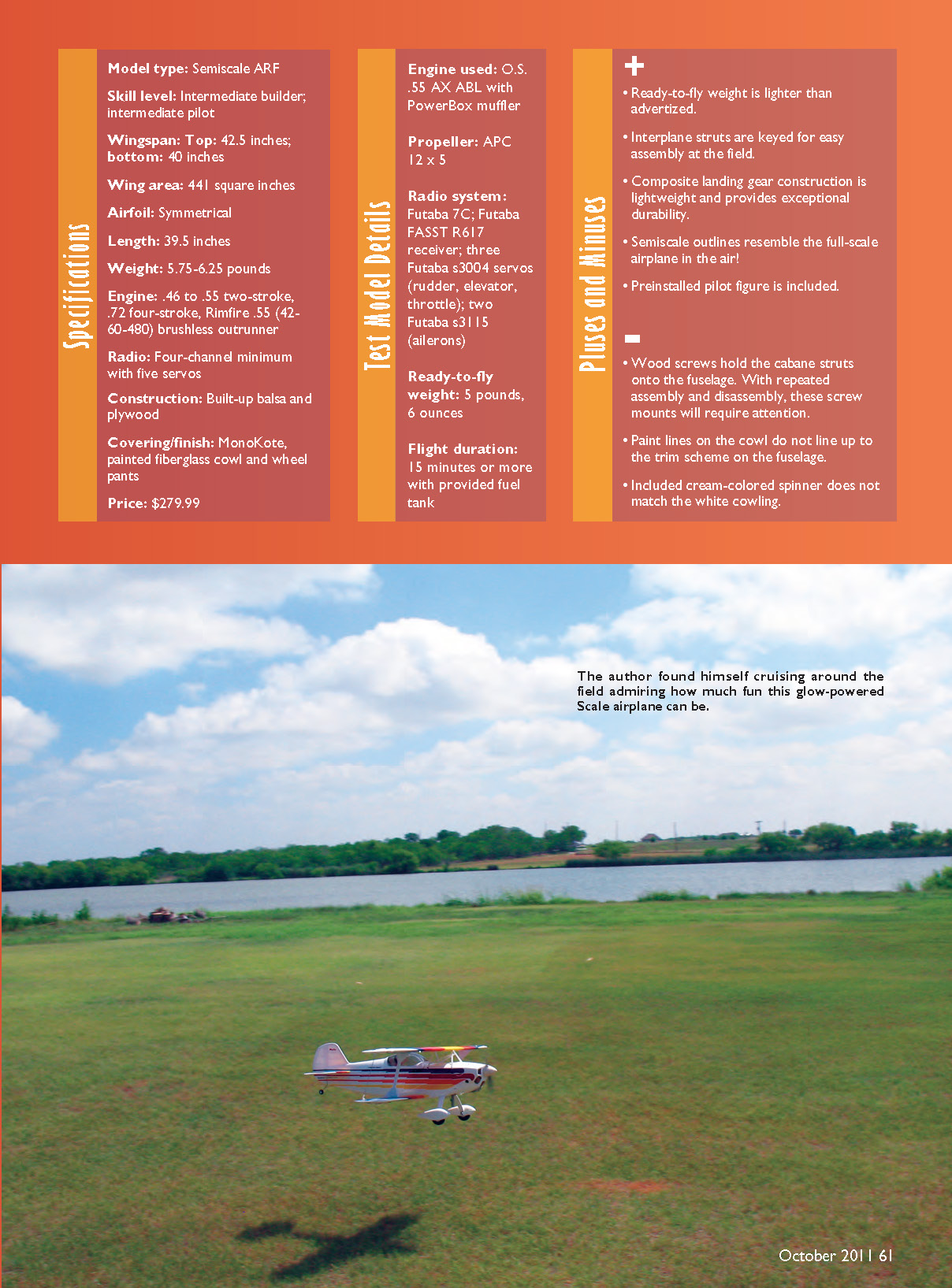
+ Semiscale outlines resemble the full-scale airplane in the air!
+ Preinstalled pilot figure is included.
- Wood screws hold the cabane struts onto the fuselage. With repeated assembly and disassembly, these screw mounts will require attention.
- Paint lines on the cowl do not line up to the trim scheme on the fuselage.
- Included cream-colored spinner does not match the white cowling.
Be sure to set up the dual rates because recommended low-rate control throws are soft. I'm confident that most pilots will have the high rates active in the first flight.
Since I was using a new O.S. .55 AX, the first order of business was getting the engine running properly. I've had many O.S. engines throughout the years, so I was not too worried about achieving reliable engine performance right out of the box.
Using PowerMaster 15% Powerblend fuel, the .55 fired up with little fuss. After adjusting the high-speed needle with a slight error to the rich side, the engine was running as though it had a couple hours of run time. The engine was performing so well I decided it was time to see how the airplane was going to perform.
One thing became painfully clear on my first takeoff: you must use full up-elevator during the initial takeoff rollout if flying from grass. I nosed it over in the first 6 inches on my first attempt! My second takeoff attempt went much better. Holding full up-elevator for the first couple of feet gets the airplane rolling nicely and tracking right down the runway.
Once the airplane is rolling, relax the elevator until the airplane is up to flying speed. Any slight bump in the runway will send it into the air. I must admit that the ground-handling traits of a .46-size short coupled biplane had me concerned, but it handles well on the ground and I was flying from a fairly rough grass runway.
I'm going to save you from all the first-flight details and talk about how this airplane flies and the standout traits after flying it a dozen times. Because it is a short coupled biplane, the first flight characteristic I wanted to know about was the controllable speed range and what was going to happen when I stalled the wings.
With a nice altitude cushion, I slowed the airspeed down with approximately 1/4 up-elevator and the stall was a gentle wingtip drop to the right. The airplane does not snap roll when the stall occurs and the ailerons remain effective up to the stall point. Top speed is quick for an aerobatic airplane and the tracking at full speed is predictable.
Turning the Christen Eagle takes a slightly different approach than your typical bank-and-yank method. If the bank angle exceeds approximately 40° the elevator will cause a rapid loss of altitude! This will get your full attention the first flight, but once you make a few circuits it becomes second nature to not bank the turns steeply.
Airspeed doesn't seem to make any difference on the turning characteristics. Just keep in mind on the first flight that steep bank angles are a bad idea.
Basic aerobatics are where this airplane really shines and will bring a smile to your face. Four-point rolls are an absolute thing of beauty with the Christen Eagle. At half power from straight and level, the airplane performs a four-point roll as though it's on a string. One trick to remember with all airplanes, but is especially true with the Eagle, is more power and less rudder during the points on knife-edge.
During inverted flight, it takes some time to figure out exactly what the airplane likes and dislikes. At full speed, inverted flight is predictable and tracks well, but when you start slowing down, at roughly half power, the attitude of the fuselage changes from level to slightly nose-up to maintain altitude.
When this happens, considerably more elevator input is needed. This will get your attention in a hurry! When you know it's going to happen, it requires nothing more than a slight adjustment in elevator input, but it will take a few flights before you can be comfortable doing slow-speed inverted passes.
Knife-edge performance is solid and requires only a slight amount of opposite aileron to maintain a nice, straight path. Air show-style aerobatics are by far the most enjoyable to perform with the Christen Eagle. It looks like the full-scale airplane when performing any type of tumbling or snap-rolling maneuver.
You can get wrapped up in watching how cool it looks and forget you are the pilot! It's really hard to get bored with doing Avalanches and massive up-lines with four or five tumble cycles thrown in. The O.S. .55 will pull the airframe with unlimited vertical execution, so the sky is truly the limit for performance.
Of course I had to attempt some 3-D-style maneuvers with the Christen Eagle, although it is not designed for this realm of flight. The airplane will torque roll and harrier roll, but it doesn't have enough control surface to recover from these maneuvers without some altitude to assist in the recovery.
If you want to learn how to perform on-the-deck 3-D maneuvers, this airplane is not the best choice. They are still great fun to perform and look cool, but just make sure you leave room to recover.
It took me a few flights to get a handle on slow-speed flying and landing. You can slow the airplane down and maintain control, but when it's time to land, keeping a little speed seems to work best.
The secret to greasing in "butterfly-with-sore-feet landings" is timing the flair perfectly. On final, keep the speed up so you're using very little elevator input to maintain a shallow descent. When the airplane is roughly a foot off the ground, kill the power and slowly start flaring the elevator until the wheels touch down. If you time it just right, the elevator stick will hit the stop right when the wheels start rolling.
Landing the Christen Eagle without bouncing takes some practice. If you start flaring above roughly 3 feet in altitude, the airplane is going to bounce like a basketball! You have to wait for it to get into the ground effect and then start flaring for the roll out. Right after touchdown, the ground handling is great thanks to the composite landing gear. Treat the Eagle like a standard taildragger and taxi to your feet.
Conclusion: Overall, Great Planes has produced an all-around, fun-to-fly, great-looking model of the Christen Eagle. This is a perfect opportunity to own a nice-flying model of a world-famous, full-scale air show performer.
The few times I've had the airplane out at the flying field it has drawn much attention. You have the opportunity to be an air show pilot with a great-performing airplane. MA
Jason Danhakl [email protected]
Manufacturer/Distributor: Great Planes Model Manufacturing (217) 398-8970 www.greatplanes.com
Sources: Futaba (217) 398-0007 www.futaba-rc.com
VP/PowerMaster Fuels (210) 635-7755 www.powermasterfuels.com
Landing Products (530) 661-0399 www.apcprop.com
Transcribed from original scans by AI. Minor OCR errors may remain.

