
Great Planes E-Fest 2009
by Michael Ramsey and Jay Smith
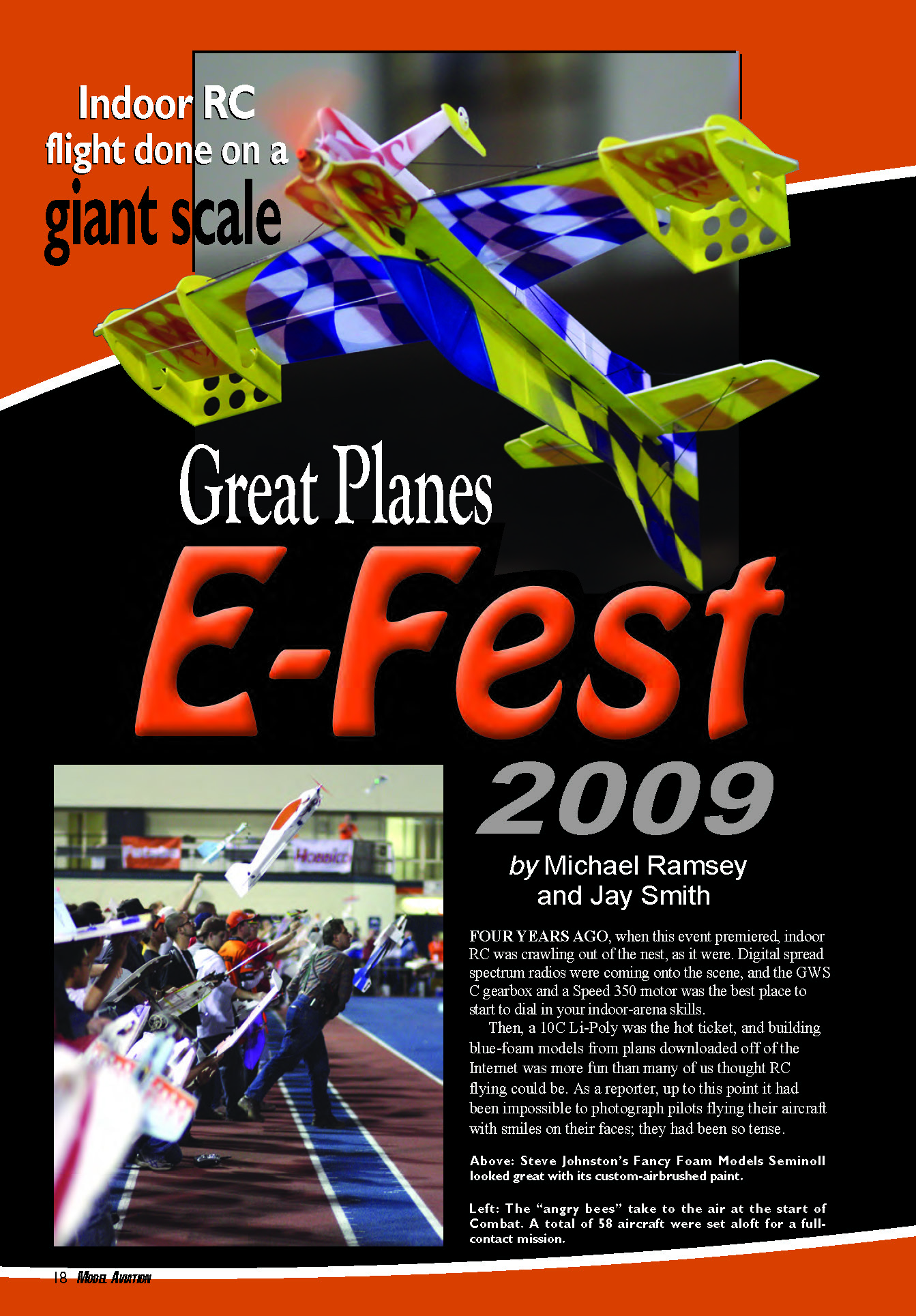
Four years ago, when this event premiered, indoor RC was crawling out of the nest. Digital spread-spectrum radios were coming onto the scene, and the GWS C gearbox paired with a Speed 350 motor was the best place to start to dial in your indoor-arena skills.
Then, a 10C Li-Poly was the hot ticket, and building blue-foam models from plans downloaded off the Internet was more fun than many of us thought RC flying could be. As a reporter, up to that point it had been impossible to photograph pilots flying their aircraft with smiles on their faces; they had been so tense.
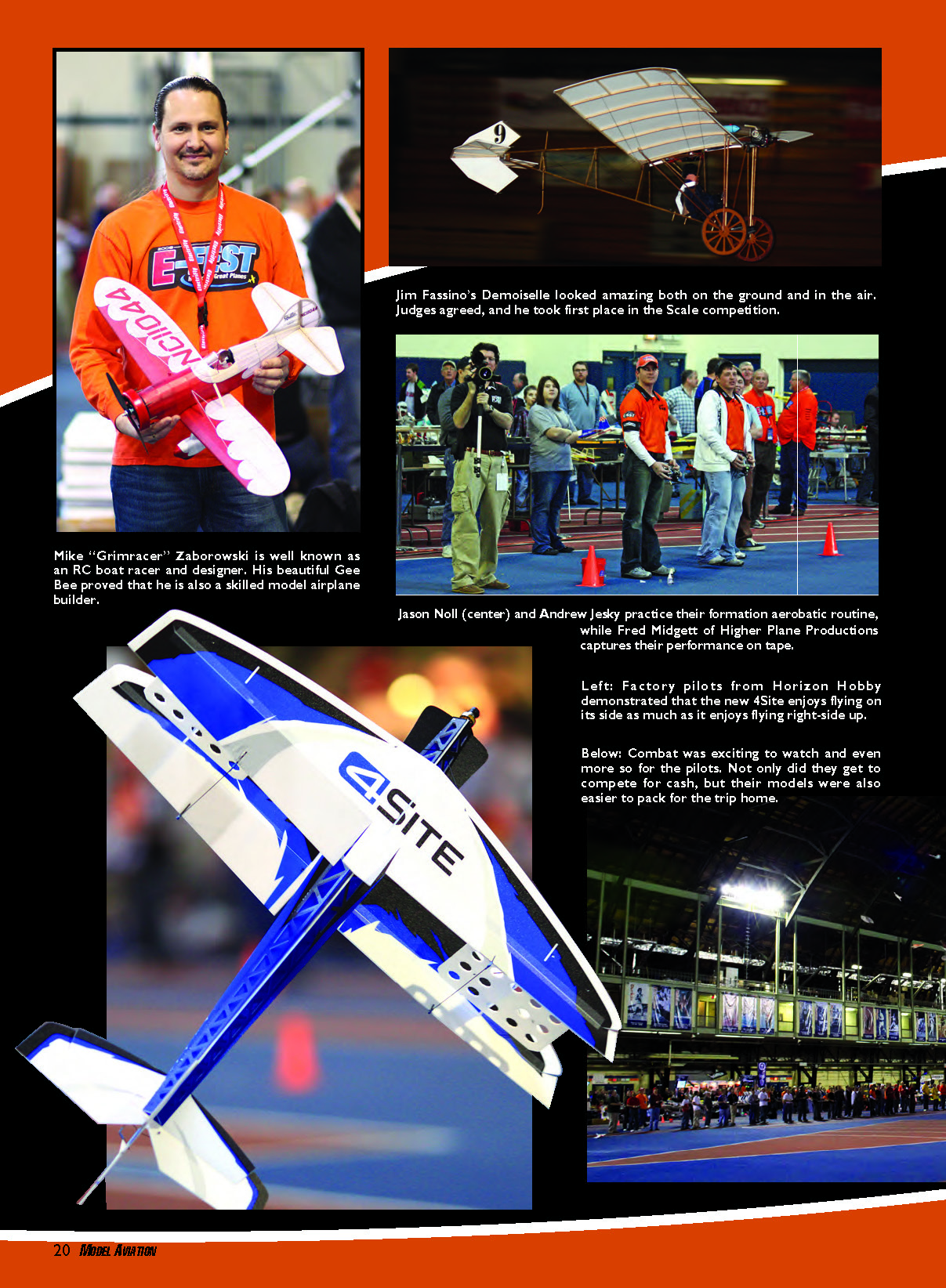
Jason Noll (center) and Andrew Jesky practice their formation aerobatic routine, while Fred Midgett of Higher Plane Productions captures their performance on tape.
Combat was exciting to watch and even more so for the pilots. Not only did they get to compete for cash, but their models were also easier to pack for the trip home.
Factory pilots from Horizon Hobby demonstrated that the new 4Site enjoys flying on its side as much as it enjoys flying right-side up.
Mike "Grimracer" Zaborowski is well known as an RC boat racer and designer. His beautiful Gee Bee proved that he is also a skilled model airplane builder.
Jim Fassino’s Demoiselle looked amazing both on the ground and in the air. Judges agreed, and he took first place in the Scale competition.
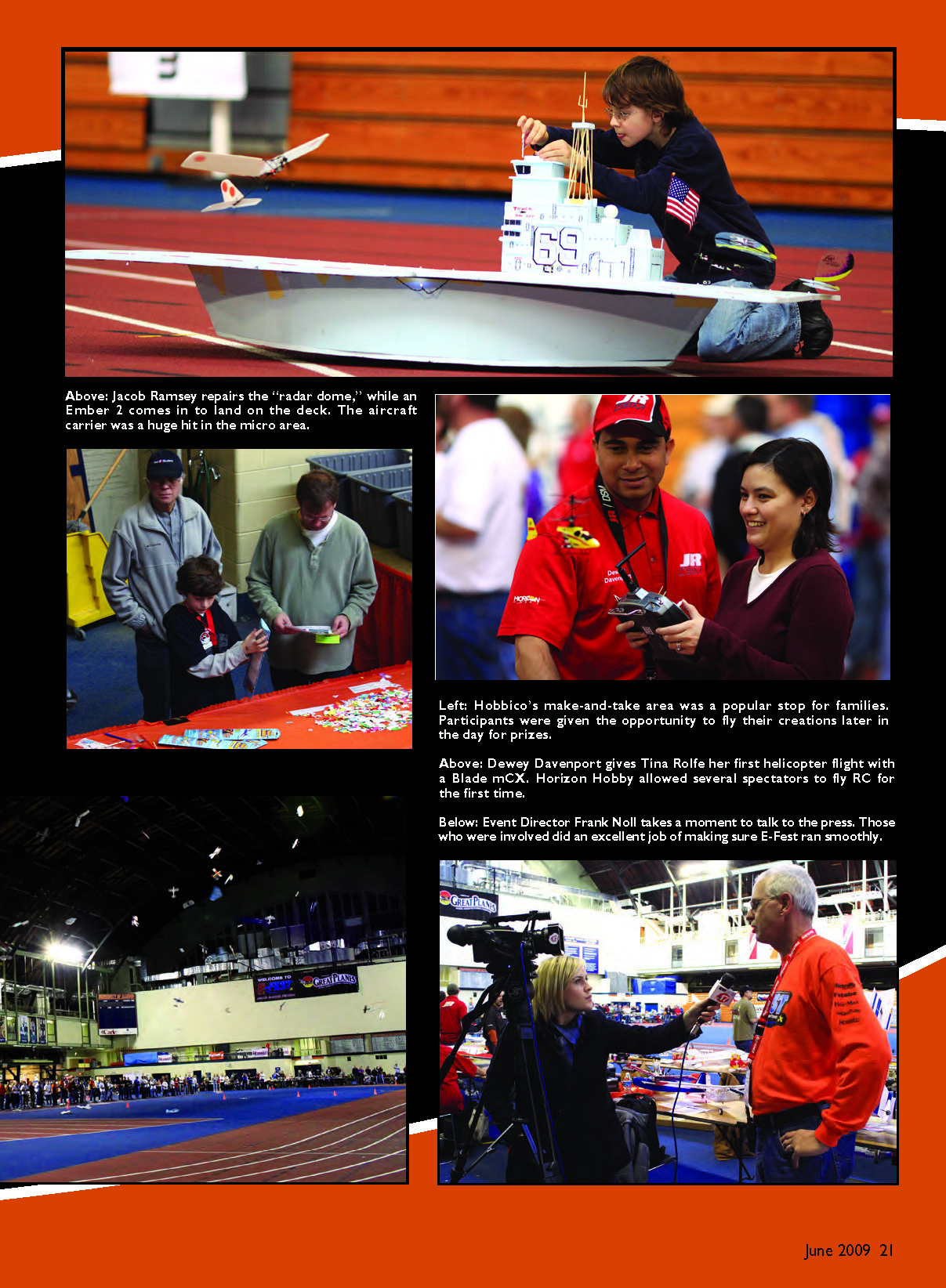
Event Director Frank Noll takes a moment to talk to the press. Those who were involved did an excellent job of making sure E-Fest ran smoothly.
The Great Planes E-Fest is about fun for the pilots, but it also puts on a heck of a show for the spectators, who are typically friends and families of the fliers who live nearby. Many former spectators of all ages attended E-Fest during the first weekend in February this year as bona fide RC pilot participants.
MA dedicated two staff members to cover this groundbreaking event for AMA members. Jay Smith reported from the "fixed wing" point of view, and Michael Ramsey gave an account of the air-beating helicopter perspective.
The final count for the 2009 E-Fest was 308 registered pilots, and more than half of them registered as both helicopter and airplane enthusiasts. We've come a long way!
—MA Staff
Airplanes
Before this year's event, the closest I had gotten to flying in the University of Illinois at Urbana-Champaign's Armory Track & Field (where E-Fest is held) was on my flight simulator. Even after seeing pictures and a video from previous gatherings, I was unprepared for the sheer size of it all; this event needs to be experienced to be believed.
Three flightlines and a micro-flyer area were employed during the entire gathering. The largest flying section was used to fly aircraft in a racetrack configuration. Aerobatics were allowed as long as pilots followed the pattern. A 3-D area was provided for hovering and extreme aerobatics. Both areas were well run and pilots were considerate of one another, which led to fewer midairs than you would expect from the number of models flown at any given time.
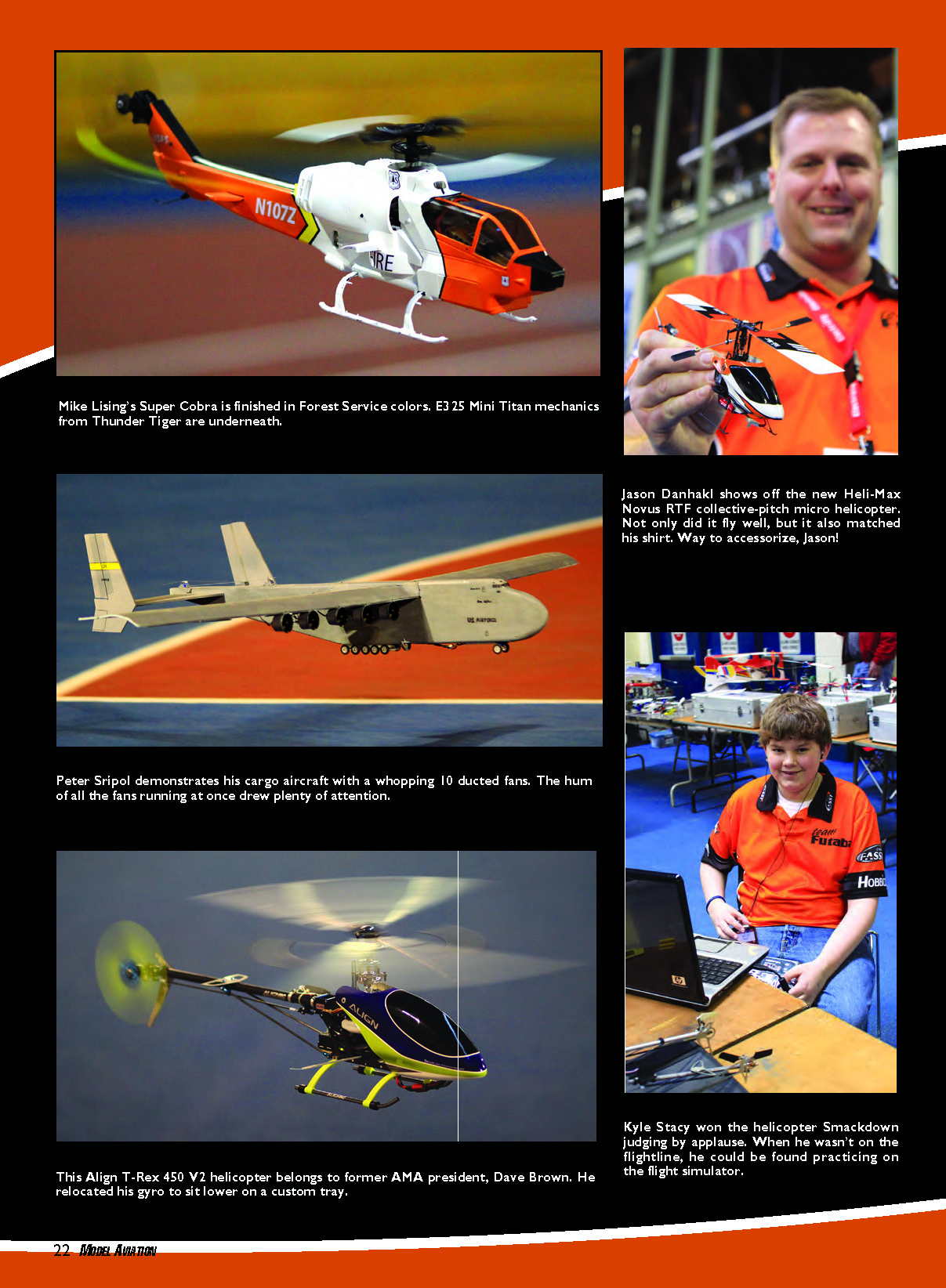
The micro-flying area was hugely popular and was used to fly both production and scratch-built aircraft. Peter and Stephan Sripol brought a scratch-built aircraft carrier with working lights and a radar dome. It was driven into the micro area, where pilots swarmed it, trying their best to land micro airplanes and helicopters on the deck.
Horizon Hobby set up in the micro area on Saturday with ParkZone Vapors, Embers, and E-flite mCX helicopters, allowing attendees to get in on the excitement of RC flight. Hobbico hosted a make-and-take venue where children made gliders and custom-decorated them. Later in the day, all flightlines were shut down so children could launch their models and win prizes for the flights that went the longest distances.
Several activities at E-Fest helped break things up and keep it exciting for both the pilots and the crowd. Some of the events included:
- Combat
- Pylon race
- Indoor scale competition
- Balloon busting
Fifty-eight Combat participants launched their aircraft into an immediate "furball" for the chance to win cash prizes. The aircraft looked like an angry mass of bees, intent on taking their anger out on one another. Various types of models were used in Combat, including 3-D aircraft, designated combat airplanes, slow flyers, flying wings, and—just for fun—even a Vapor or two (unofficially) made their way into the competition. The finale was throwing all of the battered aircraft in a huge pile at show center.
The Scale competition was in stark contrast to Combat: the miniature masterpieces were flown one at a time in a scale-like manner. The only rules were that entries could weigh no more than 18 ounces ready to fly and were required to fly during their scheduled time slots. After both static and flight judging were complete, two awards were given: Jim Fassino received honors for his Demoiselle, and Steve Beros earned recognition with his Antonov An-2.
Several new aircraft were shown and flown at the event. Two releases that garnered considerable attention were the flying birds from Dream It RC and a micro Sukhoi from the indoor experts at ParkZone.
E-flite and ElectriFly represented three-channel World War I RC with a Nieuport and a Sopwith Pup respectively. Dynamic Foamy flew profile World War II warbirds with ParkZone micro gear and featured a larger profile A-10.
When you needed a break from flying or walking the show floor, the pit areas were a great place to talk to fellow pilots and ask questions about their unique models. Those I spoke with were friendly and enthusiastic about the event and more than happy to show off their aircraft.
Jay Smith [email protected]
Helicopters
As mentioned, most registered pilots were both airplane and helicopter enthusiasts, so the pit areas were riddled with almost every flying machine imaginable. The specialized helicopter flightline was located on the east end of the building, where the die-hard helicopter pilots congregated.
Being called a "helicopter nut" is a badge worn with respect. It puts you up there with the likes of:
- Nick Maxwell
- Curtis Youngblood
- Kyle Stacy
- Mark Fadely
and many others who have found E-Fest to be a respected arena that makes them feel welcome.
Part of what draws these top-class pilots may be the helicopter Smackdown competition, which took place at roughly 8 p.m. Saturday night. It was a privilege to watch the pilots practice and break in their machines all day.
Yes, Curtis was there, but he was happy to report that he had retired from 3-D competition. That's not a bad thing for the rest of us, because his Next D Designs company finally began full distribution of the 450-class Rave. Even the guys at PowerHelis.com were there to supply the kit and the remarkable complement of replacement parts.
If you're in the market for a new 450-class machine, there are many from which to choose. T-Rex fans had the new 450 Pro to show off, and the new 250 is a great fit in the smaller indoor gym areas that are more likely available to most clubs.
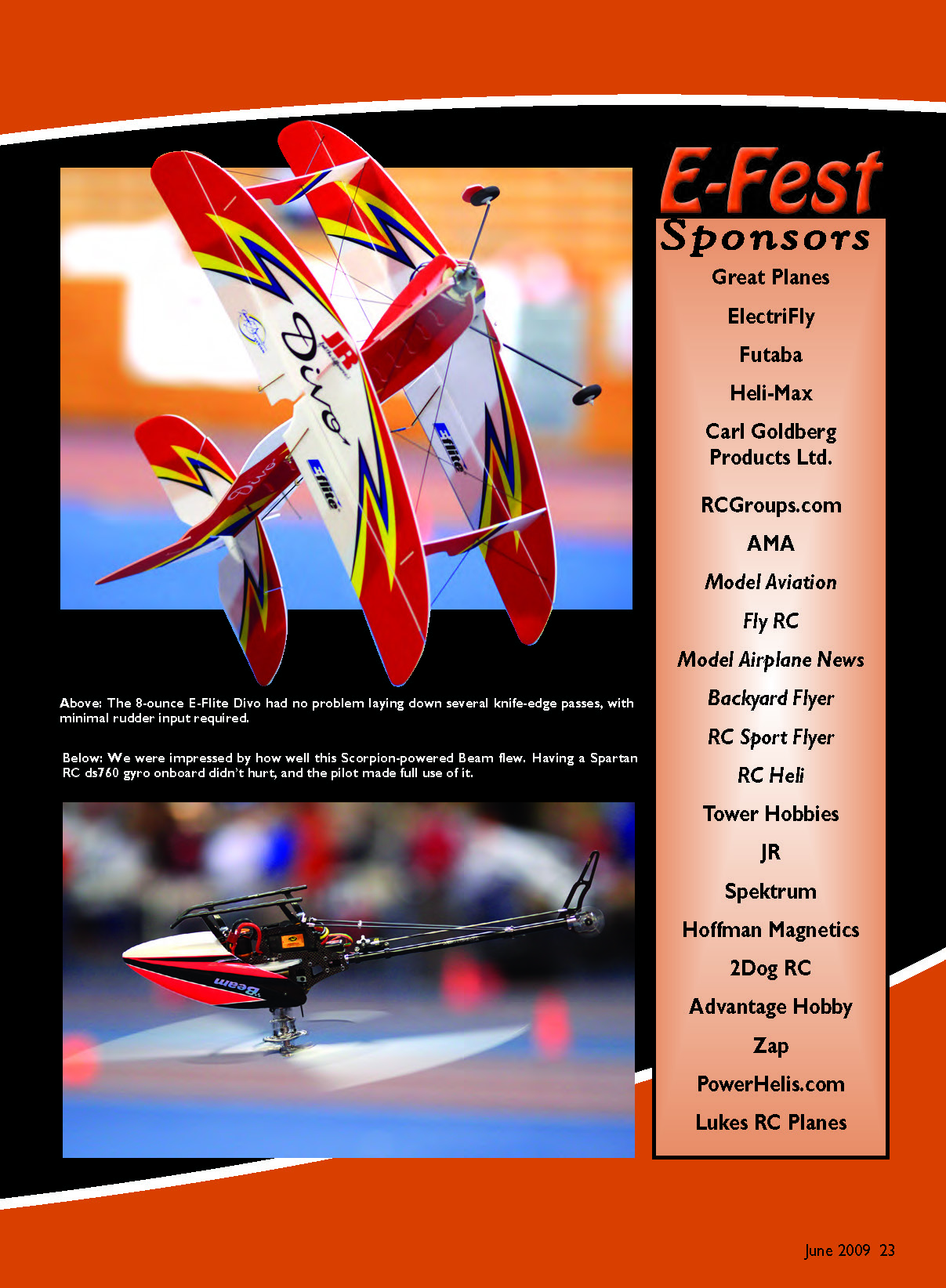
The Beam E4 from Advantage Hobby was a common sight, and the owners/pilots were not kind to them; those helicopters flipped, spun, and slid toward every point on the compass. They flew great.
Now that the Miniature Aircraft Furion is available from Tower Hobbies, more were seen at this event than ever. Some even incorporated the new, amazingly small Futaba GY520 gyro system.
The 200- to 250-class machines fit in nicely with the short flightline that the helicopter pilots shared with the 3-D airplane pilots. Even the Gaui 100 helicopter proved to be a venerable 3-D performer that showed little of the squirrelly behavior often associated with machines of this size. And some of the new models were even smaller.
Heli-Max debuted a new line of micro helicopters, and the first to be released is the Novus: a coaxial, palm-size machine with handsome looks and a smart electronics system. It was available as an RTF that includes a 2.4 GHz radio and a 400 mAh, 3.7-volt Li-Poly battery. Later releases in the line were promised to include a single-axle, fixed-pitch helicopter and even a 3-D-capable, collective-pitch version.
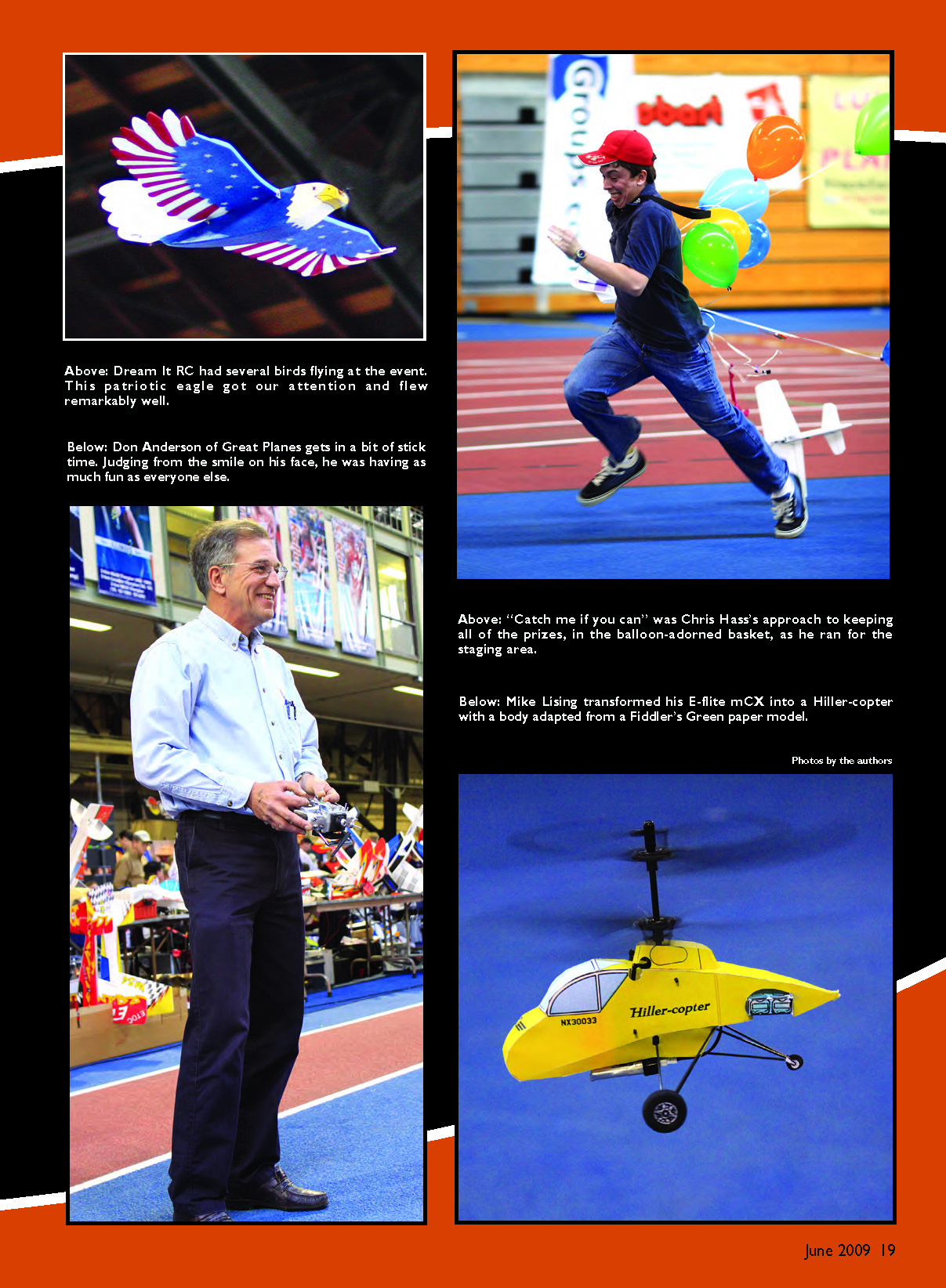
In an activity dominated by ARFs, it was nice to see a few models decked out in unique scale fashion. Mike Lising came to E-Fest last year with a Fiddler's Green–covered E-Sky Honey Bee that convincingly pulled off the look of a heavy-lifting Sikorsky S-55. Mike returned this year with an mCX dressed up with a Hiller body, but his heavy metal was a Super Cobra finished in Forest Service colors. It had a Mini Titan body and mechanics from Thunder Tiger.
When it came to the final showdown—the helicopter Smackdown—the evening did not disappoint, even though the attrition rate seemed a bit high. Five of the nine pilots earned a DNF (Did Not Finish), so only four fliers were eligible to win the $500 check.
I was glad to see that Kyle Stacy won by popularity measured with applause. That kid practiced diligently all day; when he wasn't standing at the flightline, he was hooked into the laptop, burning up the virtual electrons on the flight simulator. His dad, Ray (a darn good helicopter pilot himself), was right beside Kyle, typically fixing something. They make a great pair.
Although this account has focused mostly on the hotshots of the helicopter scene, at the flightline I observed camaraderie among pilots at all skill levels. Those who simply wanted to hover and get familiar with the indoor surroundings were made comfortable at either end of the flightline, while the active 3-D fliers were positioned in the middle.
It was considerate of the event staff to break up the day with helicopter-only times. This permitted spectators to get a better idea of the spectrum of RC helicopters that the event had to offer.
Michael Ramsey [email protected]
Sources:
- E-Fest — www.gpe-fest.com
Transcribed from original scans by AI. Minor OCR errors may remain.

