
GREAT PLANES ESCAPADE MX GP/EP ARF
Terry Dunn [email protected]
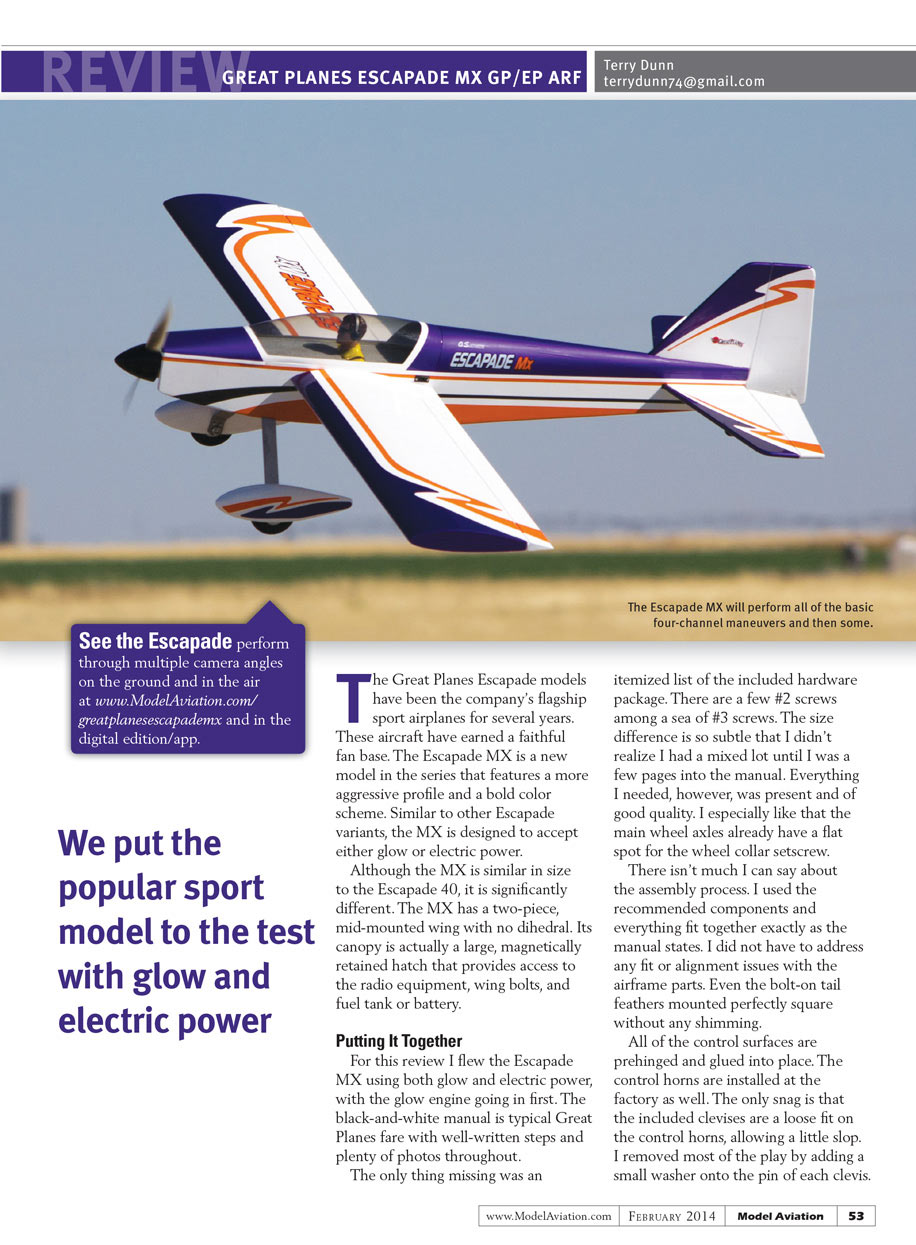
The Great Planes Escapade models have been the company's flagship sport airplanes for several years. These aircraft have earned a faithful fan base. The Escapade MX is a new model in the series that features a more aggressive profile and a bold color scheme. Similar to other Escapade variants, the MX is designed to accept either glow or electric power.
Although the MX is similar in size to the Escapade 40, it is significantly different. The MX has a two-piece, mid-mounted wing with no dihedral. Its canopy is actually a large, magnetically retained hatch that provides access to the radio equipment, wing bolts, and fuel tank or battery.
Putting It Together
For this review I flew the Escapade MX using both glow and electric power, with the glow engine going in first. The black-and-white manual is typical Great Planes fare with well-written steps and plenty of photos throughout.
The only thing missing was an itemized list of the included hardware package. There are a few #2 screws among a sea of #3 screws. The size difference is so subtle that I didn't realize I had a mixed lot until I was a few pages into the manual. Everything I needed, however, was present and of good quality. I especially like that the main wheel axles already have a flat spot for the wheel collar setscrew.
There isn't much I can say about the assembly process. I used the recommended components and everything fit together exactly as the manual states. I did not have to address any fit or alignment issues with the airframe parts at all. Even the bolt-on tail feathers mounted perfectly square without any shimming.
All of the control surfaces are pre-hinged and glued into place. The control horns are installed at the factory as well. The only snag is that the included clevises are a loose fit on the control horns, allowing a little slop. I removed most of the play by adding a small washer onto the pin of each clevis.
Great Planes suggests using a 6-inch extension on each aileron servo in addition to a 6-inch Y extension to join the pair. The kit includes heat-shrink tubing to secure the servo plugs to their respective extensions. That's a nice touch. I omitted the Y extension and utilized the flaperon feature on my Futaba 7C radio instead. This method reduced wire clutter in the fuselage and later proved useful for tuning the landing characteristics of the Escapade.
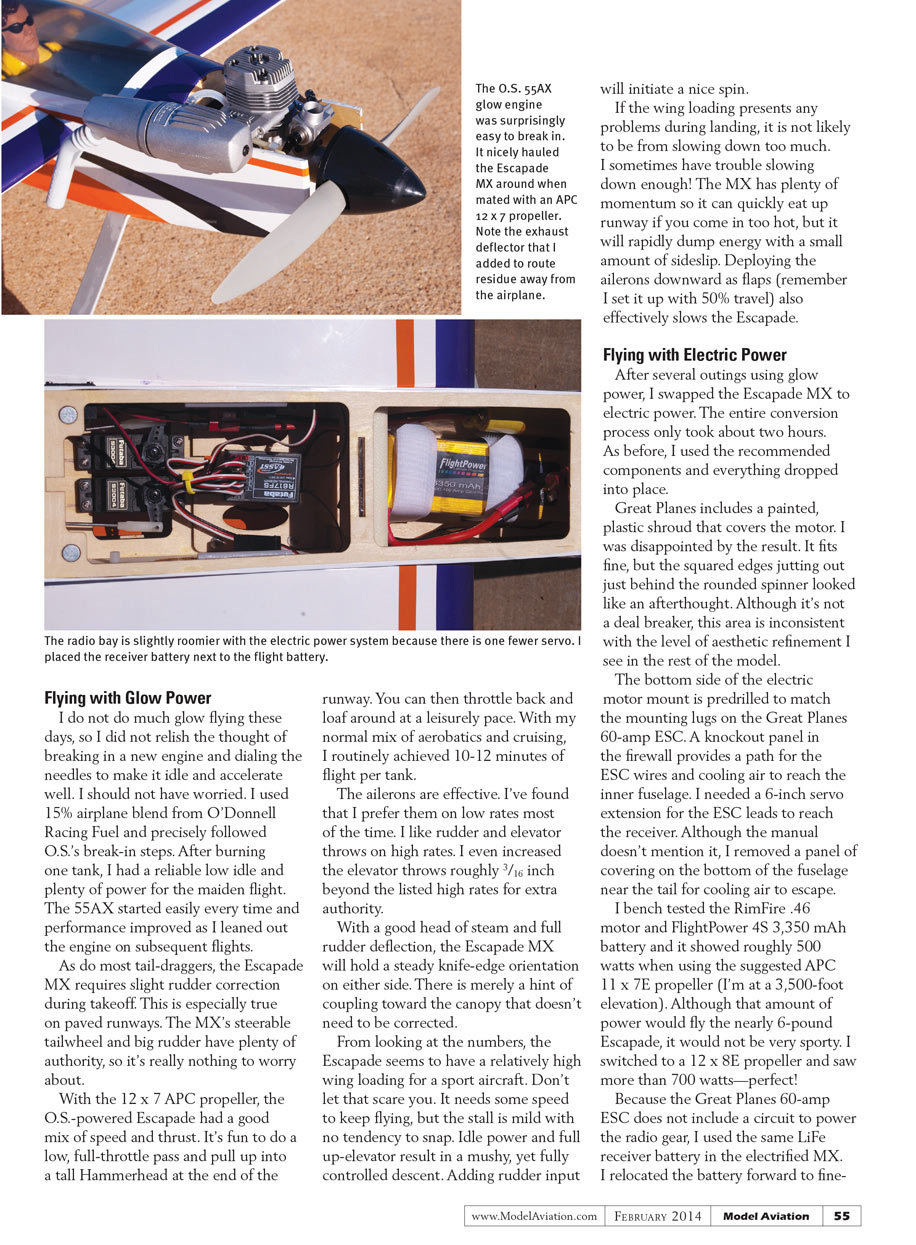
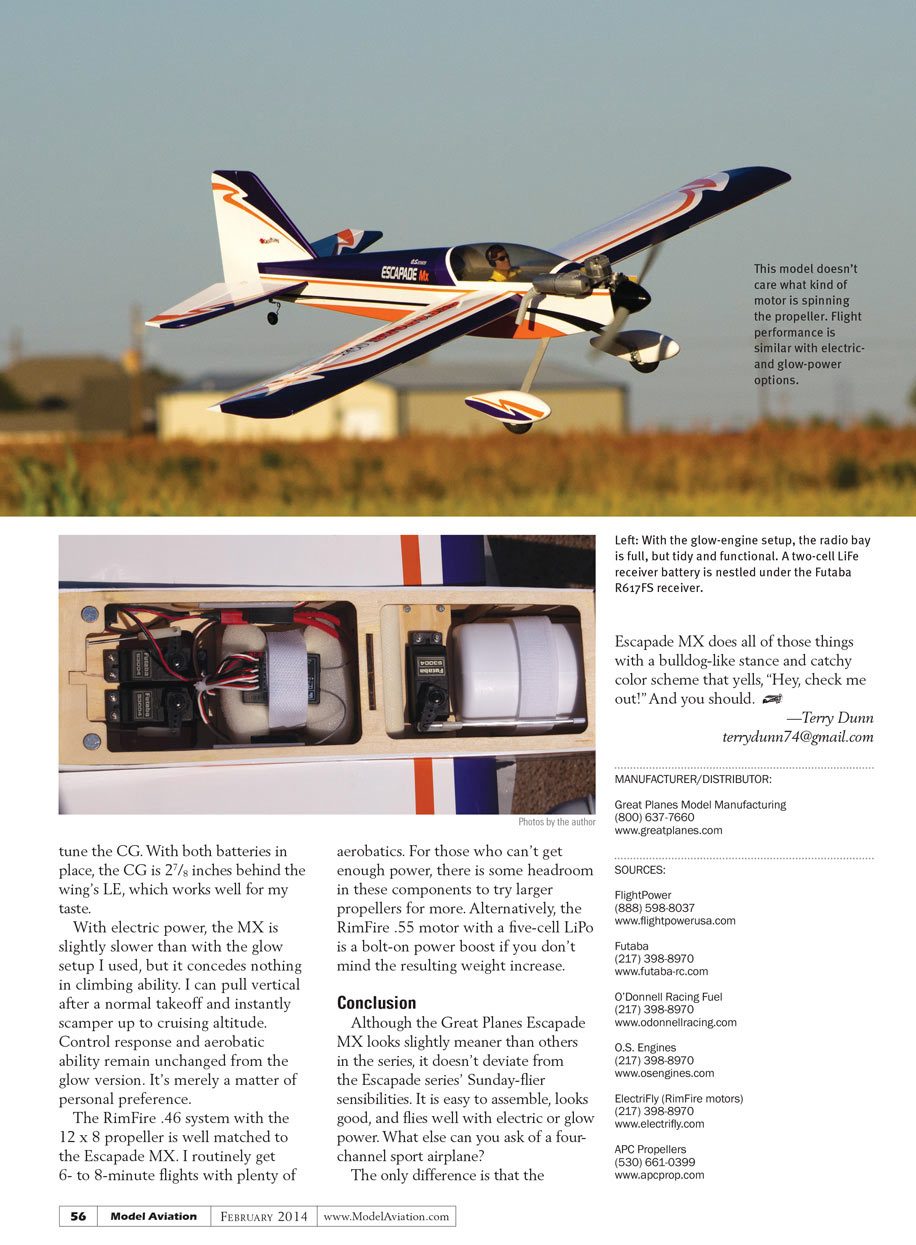
I placed a Futaba R617FS receiver on top of my foam-wrapped receiver battery—a 6.6-volt 1,100 mAh LiFe pack. The pair is fastened with a hook-and-loop strap to a screw-down plate in the radio compartment. This removable plate makes it easy to stash surplus servo wire under the servo tray for a tidy setup. All of the radio gear fits nicely, but the receiver and battery impede access to the thumb screws, which secure the wings to the fuselage.
One of the Escapade’s more impressive features is the pair of painted fiberglass wheel pants. They are by far the easiest-to-mount wheel pants I’ve ever used. The blind nuts inside the pants were perfectly aligned with the predrilled bolt holes in the landing gear struts. I only had to slip each pant over a main wheel and secure it into place with two screws. It took me less than five minutes to install both wheel pants and they dress up the airplane.
The Escapade MX includes a preassembled 270 cc (approximately 9 fluid ounces) fuel tank that sits on a tray forward of the wing spar. The tank is clearly visible with the canopy removed. It is completely opaque, however, so you cannot see the fuel level.
I installed the O.S. 55AX engine recommended in the manual. An adjustable nylon engine mount is included and mine mated precisely with the blind nuts in the firewall.
The manual instructs you to drill the motor mounting holes in the nylon with a 9/16-inch drill bit before tapping the holes for 6-32 threads. Don’t do it! The 9/16 inch is actually the proper pilot hole for 8-32 threads and is too large for 6-32 threads. Use a #36 drill bit instead. I figured all of this out too late.
The problem was easily solved by using longer 6-32 bolts with locknuts on the bottom side of the engine beams.
The O.S. engine’s muffler sits slightly higher than the top of the wing. I was concerned that exhaust residue would coat the starboard wing panel and potentially seep under the canopy and into the radio compartment. To mitigate this possibility, I installed a Hobbico exhaust deflector and aimed it downward.
The Escapade MX’s throttle servo is mounted in a removable tray directly behind the fuel tank. Although I predrilled the mounting holes for the tray, the mating hardwood beams split when I inserted the mounting screws. I added a few small dabs of five-minute epoxy to make sure that the tray stayed put.
I spent two relaxed evenings assembling the Escapade MX for glow power. My completed model weighed 5.5 pounds and balanced exactly on the suggested CG location with an empty fuel tank. I set up the control throws per the manual and headed to the flying field.
Flying with Glow Power
I do not do much glow flying these days, so I did not relish the thought of breaking in a new engine and dialing the needles to make it idle and accelerate well. I should not have worried. I used 15% airplane blend from O'Donnell Racing Fuel and precisely followed O.S.'s break-in steps. After burning one tank, I had a reliable low idle and plenty of power for the maiden flight.
The 55AX started easily every time and performance improved as I leaned out the engine on subsequent flights.
As do most taildraggers, the Escapade MX requires slight rudder correction during takeoff. This is especially true on paved runways. The MX's steerable tailwheel and big rudder have plenty of authority, so it's really nothing to worry about.
With the 12 x 7 APC propeller, the O.S.-powered Escapade had a good mix of speed and thrust. It's fun to do a low, full-throttle pass and pull up into a tall Hammerhead at the end of the runway. You can then throttle back and loaf around at a leisurely pace. With my normal mix of aerobatics and cruising, I routinely achieved 10–12 minutes of flight per tank.
The ailerons are effective. I've found that I prefer them on low rates most of the time. I like rudder and elevator throws on high rates. I even increased the elevator throws roughly 3/16 inch beyond the listed high rates for extra authority.
With a good head of steam and full rudder deflection, the Escapade MX will hold a steady knife-edge orientation on either side. There is merely a hint of coupling toward the canopy that doesn't need to be corrected.
From looking at the numbers, the Escapade seems to have a relatively high wing loading for a sport aircraft. Don't let that scare you. It needs some speed to keep flying, but the stall is mild with no tendency to snap. Idle power and full up-elevator result in a mushy, yet fully controlled descent. Adding rudder input will initiate a nice spin.
If the wing loading presents any problems during landing, it is not likely to be from slowing down too much. I sometimes have trouble slowing down enough! The MX has plenty of momentum so it can quickly eat up runway if you come in too hot, but it will rapidly dump energy with a small amount of sideslip. Deploying the ailerons downward as flaps (remember I set it up with 50% travel) also effectively slows the Escapade.
Flying with Electric Power
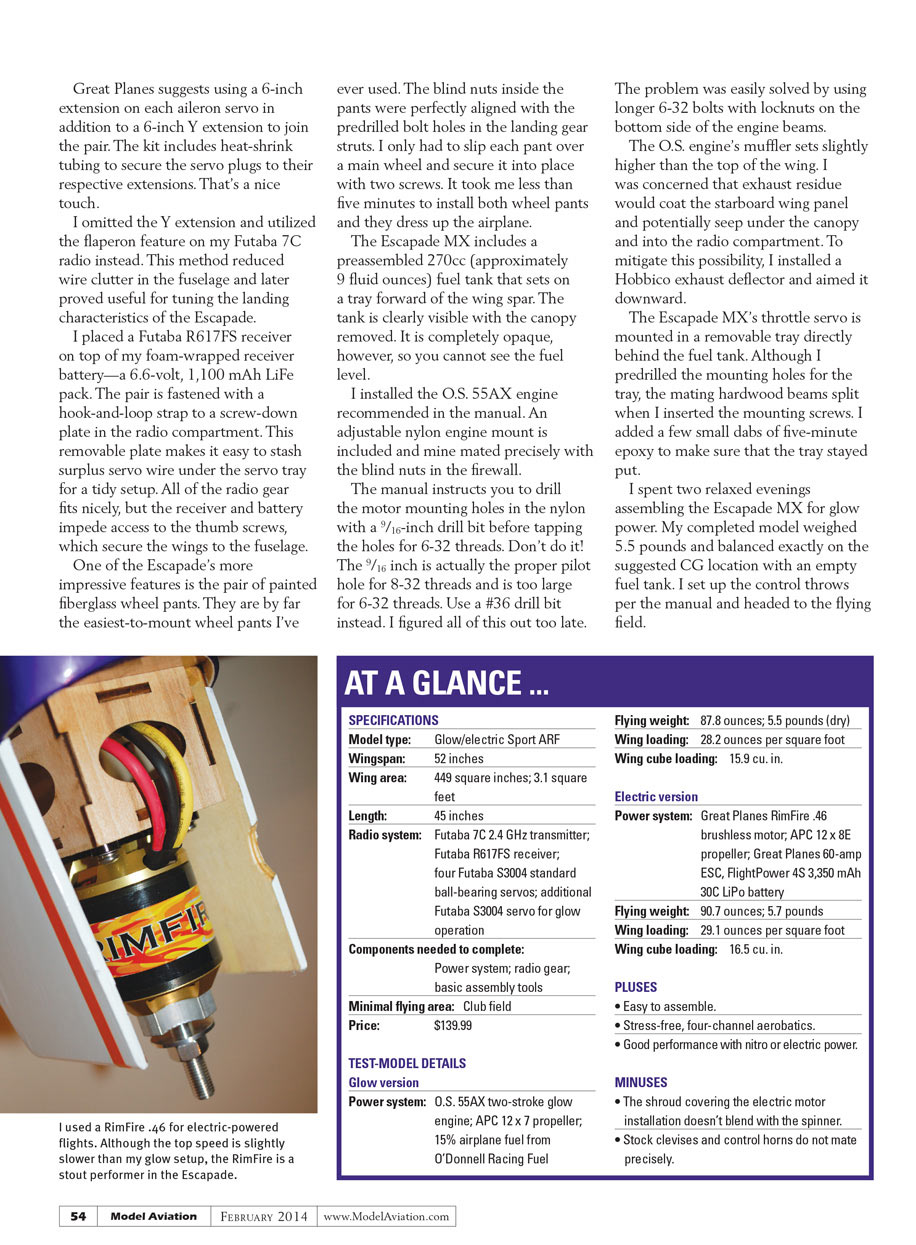
After several outings using glow power, I swapped the Escapade MX to electric power. The entire conversion process only took about two hours. As before, I used the recommended components and everything dropped into place.
Great Planes includes a painted, plastic shroud that covers the motor. I was disappointed by the result. It fits fine, but the squared edges jutting out just behind the rounded spinner looked like an afterthought. Although it's not a deal breaker, this area is inconsistent with the level of aesthetic refinement I see in the rest of the model.
The bottom side of the electric motor mount is predrilled to match the mounting lugs on the Great Planes 60-amp ESC. A knockout panel in the firewall provides a path for the ESC wires and cooling air to reach the inner fuselage. I needed a 6-inch servo extension for the ESC leads to reach the receiver. Although the manual doesn't mention it, I removed a panel of covering on the bottom of the fuselage near the tail for cooling air to escape.
I bench-tested the RimFire .46 motor and FlightPower 4S 3,350 mAh battery and it showed roughly 500 watts when using the suggested APC 11 x 7E propeller (I'm at a 3,500-foot elevation). Although that amount of power would fully fly the nearly 6-pound Escapade, it would not be very sporty. I switched to a 12 x 8E propeller and saw more than 700 watts — perfect!
Because the Great Planes 60-amp ESC does not include a circuit to power the radio gear, I used the same LiFe receiver battery in the electrified MX. I relocated the battery forward to fine-tune the CG.
I needed to tune the CG. With both batteries in place, the CG is 2 7/8 inches behind the wing's leading edge, which works well for my taste.
With electric power, the MX is slightly slower than with the glow setup I used, but it concedes nothing in climbing ability. I can pull vertical after a normal takeoff and instantly scamper up to cruising altitude. Control response and aerobatic ability remain unchanged from the glow version. It's merely a matter of personal preference.
The RimFire .46 system with the 12 x 8 propeller is well matched to the Escapade MX. I routinely get 6–8 minute flights with plenty of aerobatics. For those who can't get enough power, there is some headroom in these components to try larger propellers for more. Alternatively, the RimFire .55 motor with a five-cell LiPo is a bolt-on power boost if you don't mind the resulting weight increase.
Conclusion
Although the Great Planes Escapade MX looks slightly meaner than others in the series, it doesn't deviate from the Escapade series' Sunday-flyer sensibilities. It is easy to assemble, looks good, and flies well with electric or glow power. What else can you ask of a four-channel sport airplane?
The only difference is that the shroud covering the electric motor installation doesn't blend with the spinner.
The Escapade MX does all of those things with a bulldog-like stance and catchy color scheme that yells, "Hey, check me out!" And you should.
—Terry Dunn [email protected]
MANUFACTURER/DISTRIBUTOR
- Great Planes Model Manufacturing (800) 637-7660 www.greatplanes.com
SOURCES
- FlightPower (888) 598-8037 www.flightpowerusa.com
- Futaba (217) 398-8970 www.futaba-rc.com
- O'Donnell Racing Fuel (217) 398-8970 www.odonnellracing.com
- O.S. Engines (217) 398-8970 www.osengines.com
- ElectriFly (RimFire motors) (217) 398-8970 www.electrifly.com
- APC Propellers (530) 661-0399 www.apcprop.com
Transcribed from original scans by AI. Minor OCR errors may remain.

