
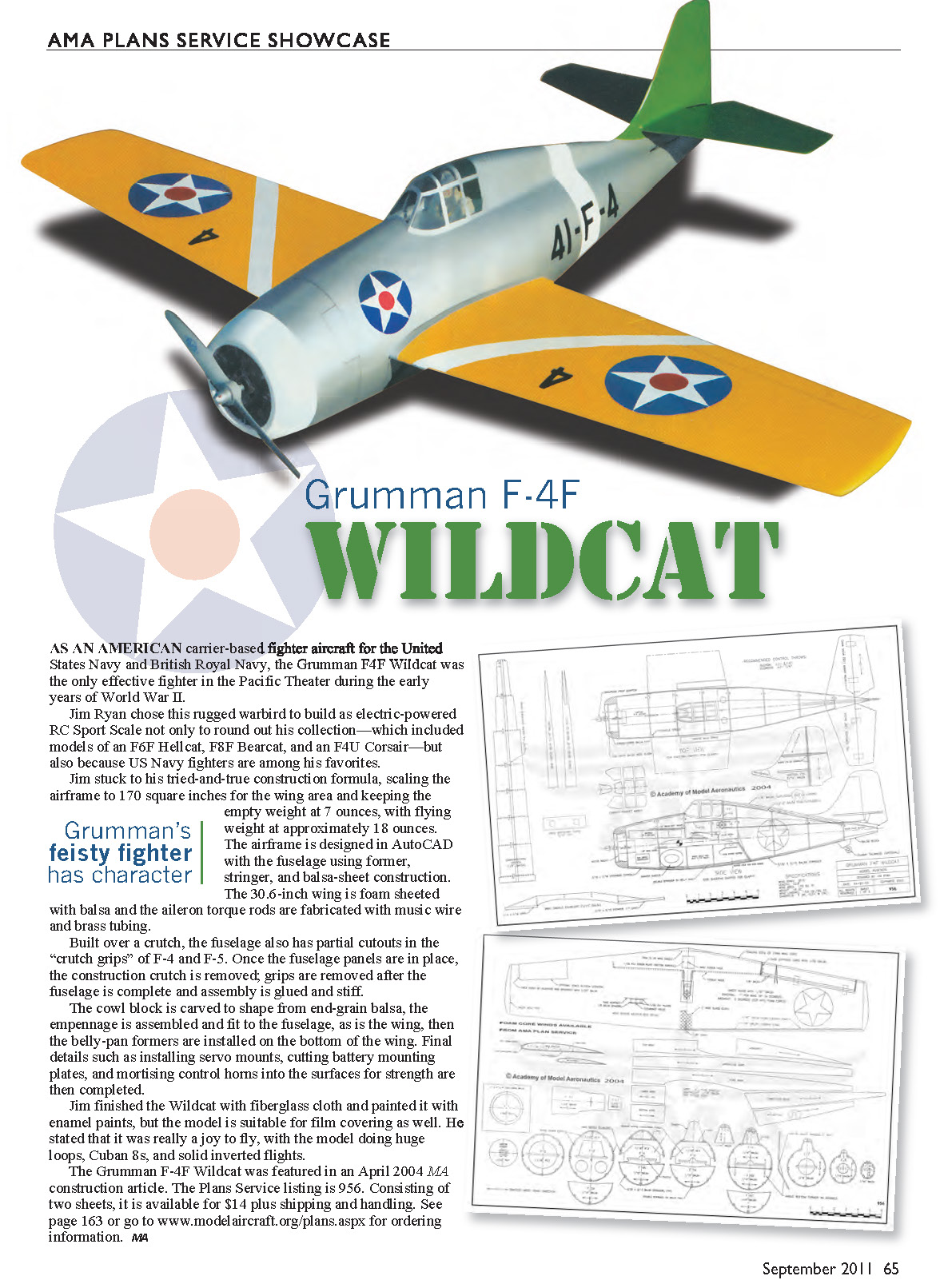
Grumman F4F Wildcat
Overview
As an American carrier-based fighter for the United States Navy and British Royal Navy, the Grumman F4F Wildcat was the only effective fighter in the Pacific Theater during the early years of World War II.
Jim Ryan's RC Sport Scale Wildcat
Jim Ryan chose this rugged warbird to build as an electric-powered RC Sport Scale model to round out his collection—which already included an F6F Hellcat, F8F Bearcat, and F4U Corsair—and because U.S. Navy fighters are among his favorites.
He scaled the airframe to a wing area of 170 square inches and kept the empty weight at 7 ounces, with a flying weight of approximately 18 ounces.
Construction
The airframe was designed in AutoCAD. Major construction details:
- Fuselage: built with formers, stringers, and balsa-sheet construction.
- Wing: 30.6-inch span, foam-sheeted with balsa.
- Aileron linkages: torque rods fabricated from music wire and brass tubing.
- Built over a crutch: the fuselage includes partial cutouts in the “crutch grips” at former positions F‑4 and F‑5. Once fuselage panels are in place, the construction crutch is removed; grips are removed after the fuselage is complete and the assembly is glued and allowed to set.
- Cowl: carved to shape from end-grain balsa.
- Empennage: assembled and fitted to the fuselage; the wing is likewise fitted.
- Belly-pan formers: installed on the bottom of the wing.
- Final details: install servo mounts, cut battery mounting plates, and mortise control horns into the surfaces for strength.
Finishing and Flight
Jim finished the Wildcat with fiberglass cloth and enamel paint, though the model is also suitable for film covering. He reported that it was a joy to fly, performing large loops, Cuban eights, and solid inverted flight.
Plans and Ordering
- Featured in an April 2004 Model Aviation construction article.
- Plans Service listing: 956.
- Consists of two sheets.
- Price: $14 plus shipping and handling.
- Ordering: see page 163 of the magazine or visit www.modelaircraft.org/plans.aspx for information.
Transcribed from original scans by AI. Minor OCR errors may remain.

