
GRUMMAN GOOSE
by Paul Kohlmann
In the world of aviation, icons can be found to represent each category of aircraft. For civil aviation there are the ubiquitous J-3 Cubs and Cessna high-wing aircraft, while for warbirds the P-51 Mustang is a standout.
In the RC world we often gravitate toward these iconic types, perhaps because the full-scale designs were so well developed that they tend to retain their successful attributes when scaled down for our use.
In the case of the flying boat, the Grumman Goose is one of these icons. Starting life in 1936, the first Goose was built to transport wealthy businessmen from Long Island, New York, to New York City.
By the onset of World War II, these "flying yachts" were serving more pedestrian roles with commuter airlines, the U.S. Navy, and the Coast Guard. Gooses, as Grumman called them, were flown by many nations during the war, including Japan.
Grumman stopped production in 1945 after 345 were made, but the Goose lives on. The Goose has been a staple of island-hopping, whether that is along the rugged coast of Alaska or the sunny Caribbean.
The type is so well loved that in 2007 Antilles Seaplanes announced it would begin building new airframes to shore up the dwindling number of originals. Familiarity and longevity are critical factors in the creation of an icon, but a little limelight helps.
Hollywood has been kind, giving the Goose a central role in the TV cult classic Tales of the Gold Monkey, a cameo in the opening of Fantasy Island, and many other appearances.
Last fall I heard that MA editor Jay Smith was looking for a Goose design in the 48-inch range to meet a demand from AMA's Plans Service customers. Jumping at the chance to model an icon, I bumped the wingspan to 49 inches so that our Goose would settle in at an even 1/12 scale.
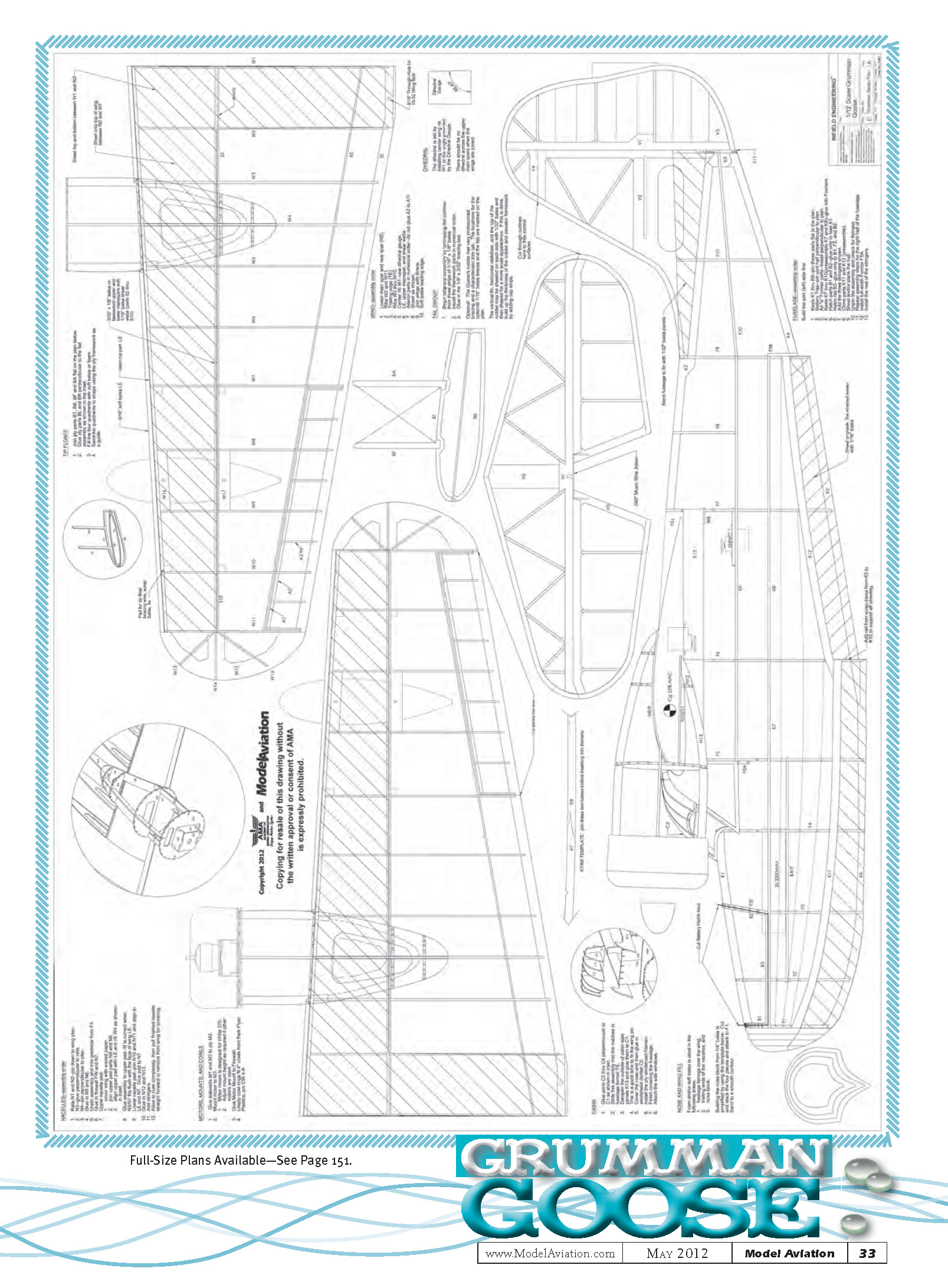
No primary article text appears on this page beyond photo captions and images. Full-size plans available—see page 151.
Design
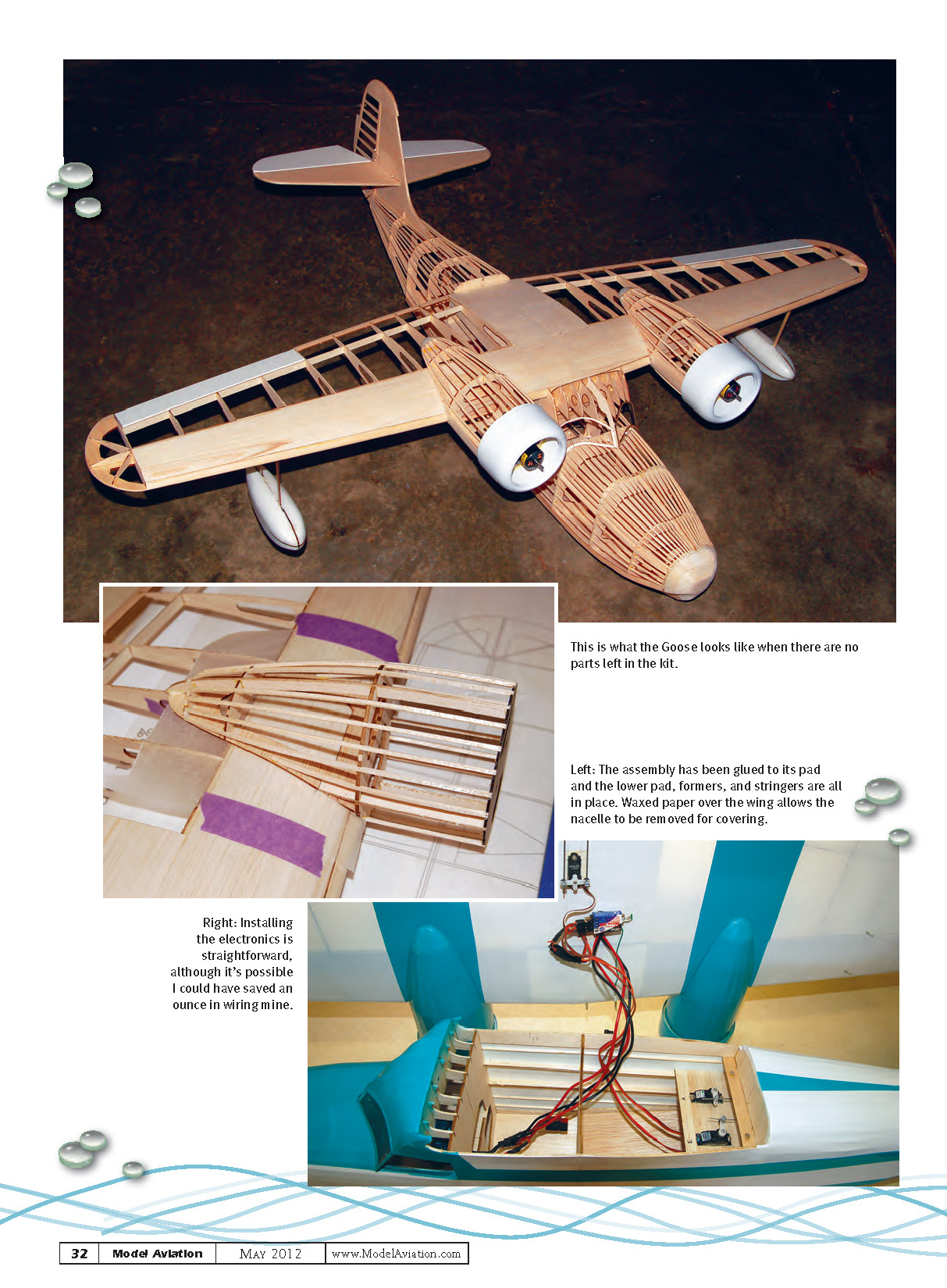
I'm partial to the classic stick-and-tissue genre, and this struck me as the best way to produce a lightweight aircraft that would come off the water easily. The design needed to build quickly and a simple, open structure supports that goal.
After studying photos and three-views, the design took root in SolidWorks CAD. The Goose has such great lines, there was no need to depart from them. I created a solid rendering by building a wireframe over a three-view drawing.
The rendering was sent to the virtual machine shop to be reduced to a framework. The power of CAD can be seen here: SolidWorks was able to calculate weight and CG, and configurations for hatches and such could be quickly tested.
- Type: RC scale model
- Skill level: Intermediate builder, intermediate pilot
- Wingspan: 49 inches
- Wing area: 396 square inches
- Length: 39 3/8 inches
- Weight: 34 to 40 ounces
- Power: Two E-flite Power 370, 1360 Kv motors; two 20- to 25-amp ESCs
- Construction: Balsa and light plywood
- Covering/finish: Heat-shrink film with painted trim and waterslide decals
- Propeller: Two APC 8 x 6
For those who are interested in amphibious aircraft, this is a great model to build and fly. To see a short video of the Grumman Goose flying from water, check the Online Features section at www.ModelAviation.com.
By the time I get a design reduced to a cut file that a CNC laser can read, I'm itching to build. So let's go!
Construction
The first step is cutting forms for the three-ply laminated tail-group outlines. I spray-tacked paper cutouts onto 1-inch hard foam and then cut the foam with a scroll saw.
Soften 1/16-inch balsa strip stock in water overnight, then pin one strip tightly against each form. Add two more layers of balsa bonded with carpentry glue to complete each outline. Packing tape between the template and the balsa will keep the wood from sticking to the forms. Let the outlines cure completely and then pin them in place over the plans.
Glue in the 1/8-inch laser-cut tail parts in numerical order, then add the 1/8 x 3/32-inch bracing. Sand the parts, then cut through the outlines to free the rudder and elevators. Although the tail group is built lightly, the laminated outline provides for a strong assembly.
The horizontal stabilizer and vertical fin can be sheeted with 1/32-inch balsa to provide a more scale-like appearance. I went this route to duplicate the characteristic ribbing and trim tab on the Goose's rudder.
To prepare the hinges, bevel the hinge lines to allow ample elevator and rudder deflection and then install CA hinges. To keep the exposed linkage to the high-mounted stabilizer short, use a Sullivan rod to actuate a link silver-soldered to the elevator joiner rod.
Wing
The wing is a conventional open structure with a sheeted upper leading edge and center section. The main spar is built from 1/8 x 3/32 balsa or basswood (depending on your flying skills). The upper and lower main spar are constructed from full vertical-grain shear webbing.
Pin down the lower main spar and the rear spar R5, then glue in ribs W2 and W11. With these parts aligned, glue in the trailing edge, ribs W3 through W10, the leading edge, and then the upper main spar. Install the laser-cut shear webs. The angle of center rib W1 determines the dihedral, so it is glued in last at an angle using a gauge.
Begin the ailerons by gluing doubler A1 to the back of the rear spar with the wing still pinned on top of the plans. Pin aileron LE A2 into place but do not glue. Glue in riblets A3—they are all the same. Build the wingtip by gluing W12 through W15 in order.
I prefer to install the 1/32-inch balsa upper sheeting while the wing is pinned down. Dampen the outer surface lightly and it curves into place for gluing. Once cured, unpin the wing, flip it over, and sheet the lower center section. Glue in the plywood hard points for the wing floats and bracing wires.
Sand the faces of the wing roots flat and fit the plywood dihedral brace. After everything is aligned, glue in the brace and join the wings. The Goose had no dihedral, so the wing will be flat across the upper main spars.
Glue soft 3/16-inch balsa to the face of the leading edge and sand to shape. Trim the leading edge away from the nacelle footings as shown on the plans. Complete the wing’s framework by sanding it with a long block.
After the wing is sanded to shape, cut the ailerons free by slicing through the trailing edge. Individual aileron servos can be used, but to avoid exposed linkages I used a center-mounted servo and torque tubes. The torque tubes were made from .060 music wire then epoxied into 1/8-inch thin-wall aluminum tubing.
The wing floats are built from foam or balsa fill glued over a laser-cut light-plywood framework. Sand the excess fill to shape using the framework as a template. Eyes for the bracing wires are included in the struts.
Fuselage
The fuselage is constructed using the half-shell method. Begin by pinning keels K1 through K6 over the plans. Add the “a” or port former halves, working from nose to tail.
The battery tray is locked into place by formers F2 through F5. Formers B1 and B2 are part of the battery hatch and should be glued only to keel K1 at this time.
After all of the port formers are in place, glue in side keels K7 through K10; note that K7/8 is a longeron made by preassembling parts K7 and K8.
Glue the battery hatch side rail B3 to formers B1, F2, and B2, but be careful not to get glue on K7 or the other formers. Build up the chine by gluing in the three stringers then adding parts K11 and K12. Dampening the stringers with water before gluing will relieve stress in the assembly.
Attach the side wall K13s. Add enough additional stringers to give some structural integrity when the shell is unpinned.
The hull is covered by sheeting the rear sections and planking the bow. The sheeted areas are simple rectangles. The planked area is small and the process goes quickly if the planks are soaked in advance to soften them.
Sheeting the shell while it is pinned down ensures the assembly will be straight when freed from the board. I debated whether to fiberglass the hull for added durability, but decided to seal it with water-based polyurethane.
The starboard half of the fuselage goes quicker. Simply unpin and repeat the steps taken so far. The servo tray can be loaded with the rudder and elevator servos and glued in now, as can partial former F5A and the wing-bolt pad. Add any remaining stringers and move on to the cockpit.
Start the cockpit by gluing ribs C2 through C4 to plywood former C1. After it is cured, slide this assembly into F5's notches. Wet the outside of each sidewall K11, bend them into place, and glue them to C1.
Attach center rib C5 and the windshield frames to complete the structure. Covering the area under the windshield first is advisable. Now that the cockpit is done, it's a good time to fit the wing pin and wing bolts.
A battery hatch is designed into the upper bow. To access it, carefully cut through keel K1 and the hatch stringers between formers F1 and B1, and between F3 and B2. This step can be omitted; the battery can be accessed by removing the wing if a more watertight structure is desired.
The nose is made from soft balsa and sanded to shape. Sand the fuselage lightly and it is ready to cover.
Nacelles and Motors
The nacelles are designed to wrap tightly around the wing and to align themselves. Start by preassembling the upper half parts N1 through N6 over the plans. Unpin this assembly and glue in the plywood firewall and N7. Remove and discard the pad at the bottom of N4.
Join upper pad parts N8 and N9. Once dry, pin this pad to the wing with the front edge aligned to the leading edge. Waxed paper under the pad will prevent premature gluing of the nacelle to the wing; dampening the outside of N8/9 will help it match the wing's curvature.
Fit the nacelle assembly to the wing with bulkhead N7 flush against the leading edge and the three nacelle keels engaging the notches in N8/9. Glue them together when correctly positioned. Add bottom pad N10/11 and parts N12 and N13. Fill in the stringers to lock the pads into position.
When everything is completely cured, pull the nacelles straight forward to remove them for covering. Use soft balsa or foam to fill the aft ends. Assemble the motor mounts from 1/8-inch balsa sides and plywood face. Attach them to the firewalls and the nacelles are complete.
Electronics
This Goose flew on a Hitec Micro 05S radio. I harvested the servos from a recently deceased ParkZone T-28. Two E-flite 370, 1360 Kv motors and 20-amp ESCs powered APC 8 x 6 propellers.
As is common with twins, the port motor turned in reverse to neutralize torque factors. This combination produced about 350 watts on a 2200 mAh, three-cell battery.
Finishing
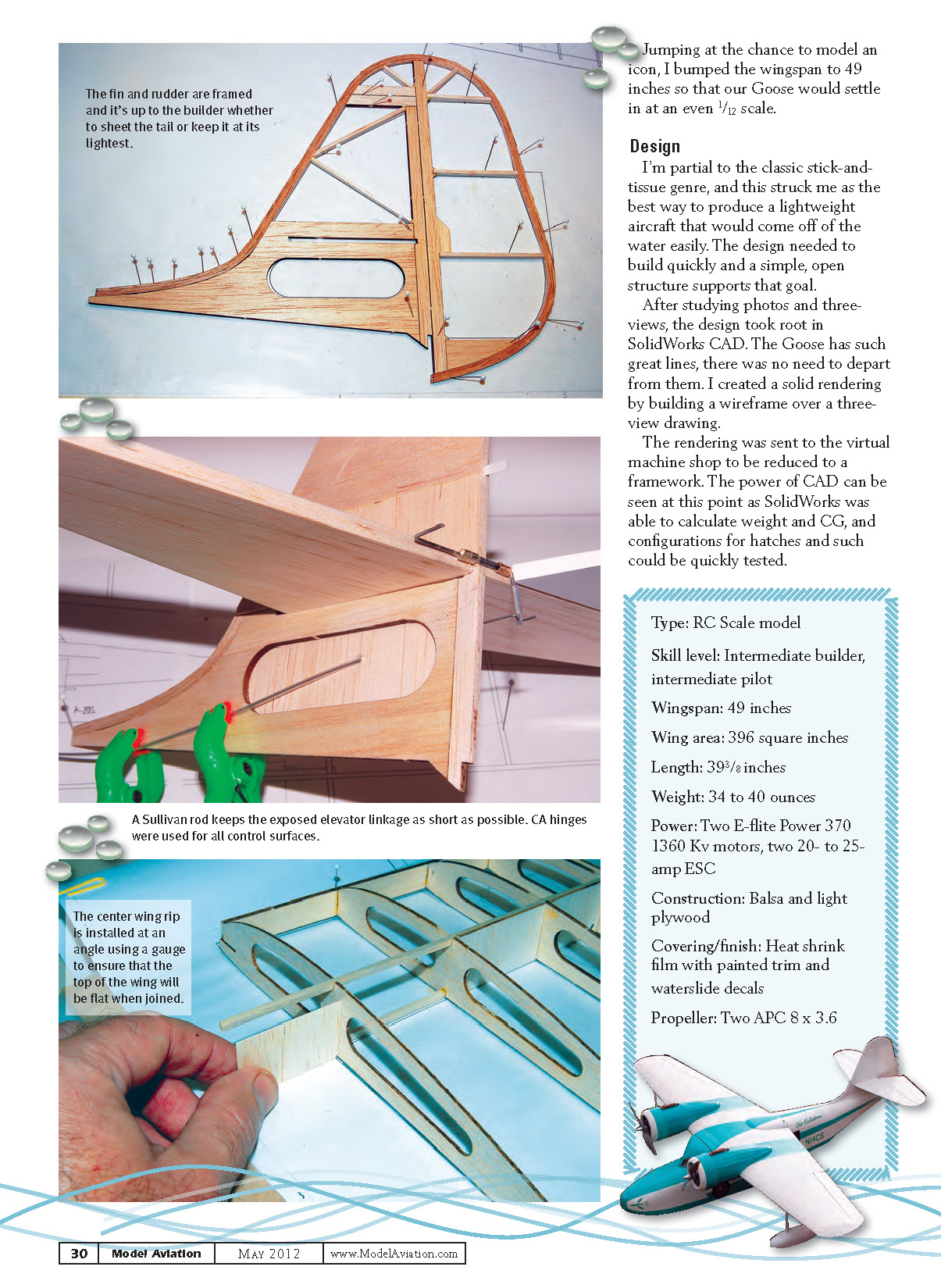
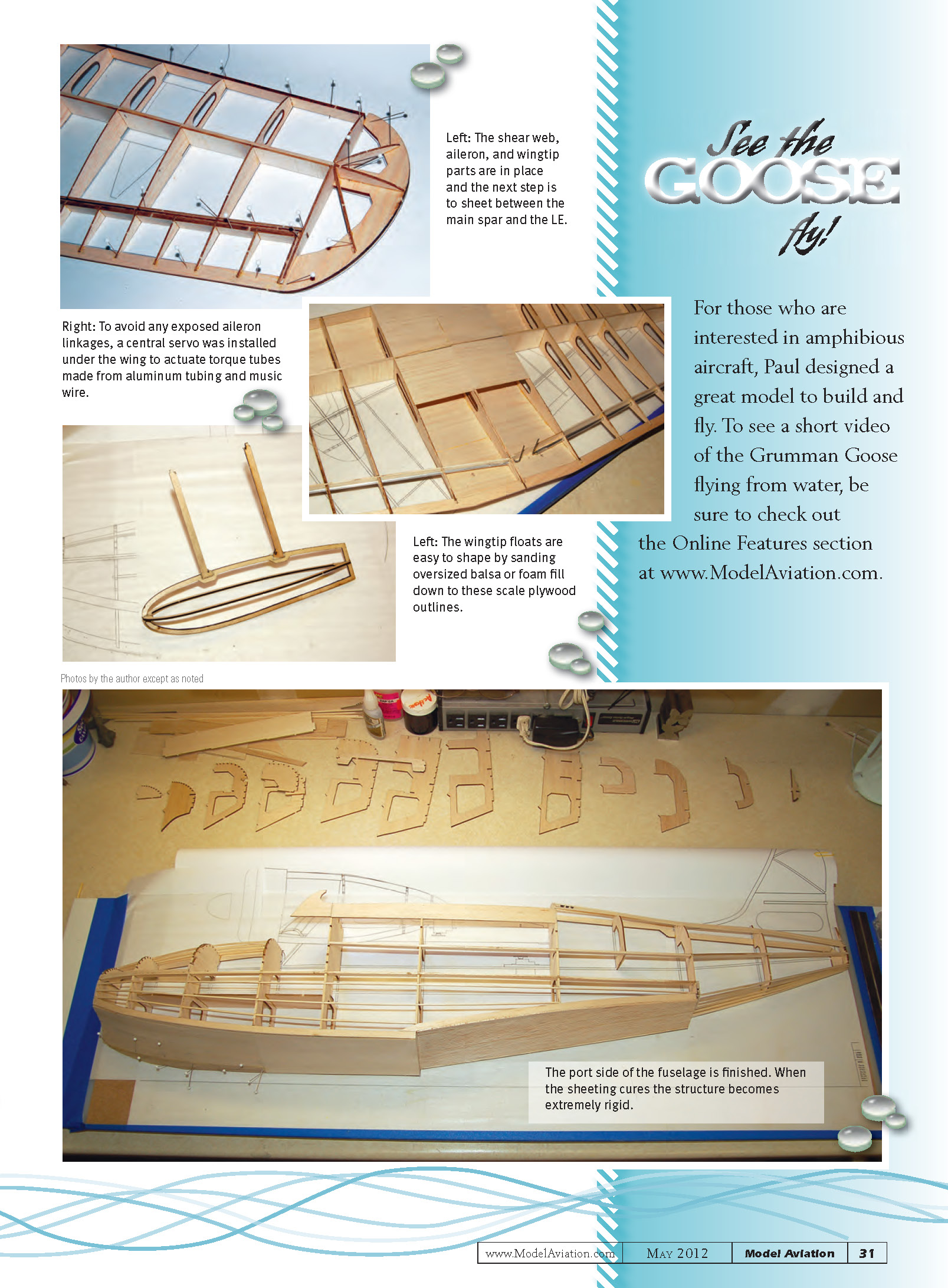
Choosing a motif for your Goose can be a challenging task. There are enough fantastic military, commercial, and private schemes to satisfy anyone’s taste. I wanted something simple using the Oracote covering I had in my box. The teal-and-white paint scheme from Catalina Airlines of the 1970s fit the bill.
After covering, the tail was assembled by locking the fin into its notch and sliding the horizontal stabilizer through its slot in the fin. Control surfaces were mounted with CA hinges. The nacelles were epoxied onto the wing and the gaps sealed with small beads of clear silicone. After mounting the floats, they were rigged with bracing wire made from Kevlar fishing line.
I limited the details to the horizontal stabilizer struts, a pilot, and the engine exhausts, but a builder could certainly go further. I made waterslide decals for the logos, passenger windows, and a few other items.
The cowlings are vacuum-formed parts from Park Flyer Plastics. The dummy motor is a laminated photograph filling the open cowling.
Flight Report
The prototype weighed 37 ounces with a wing loading of only about 13 ounces per square foot. The CG was set to 25% mean aerodynamic chord and then the Goose was prepared for a dry maiden flight.
The initial plan was to hand-launch it, but I thought I’d see if the Goose would scoot over the wet grass on the baseball field. Scoot it did—and 6 feet later the aircraft was airborne!
The Goose climbed out with authority, and after some down trim it was docile. The 370 motors provided plenty of power for non-scale flight but the low wing loading and high drag from the fat fuselage let the aircraft slow to a crawl.
For most of the flight, the Goose looked like the full-scale aircraft, flying low and slow, but the best part was the landing. After riding out the ground effect, it kissed the grass with a soft shushing sound, giving the impression that the lawn had turned to water.
Next, I let the Goose loose on the lake. Although there was only a steady 5 mph wind, there was more wind chop than I had hoped for—particularly since I had never flown a flying boat from water before.
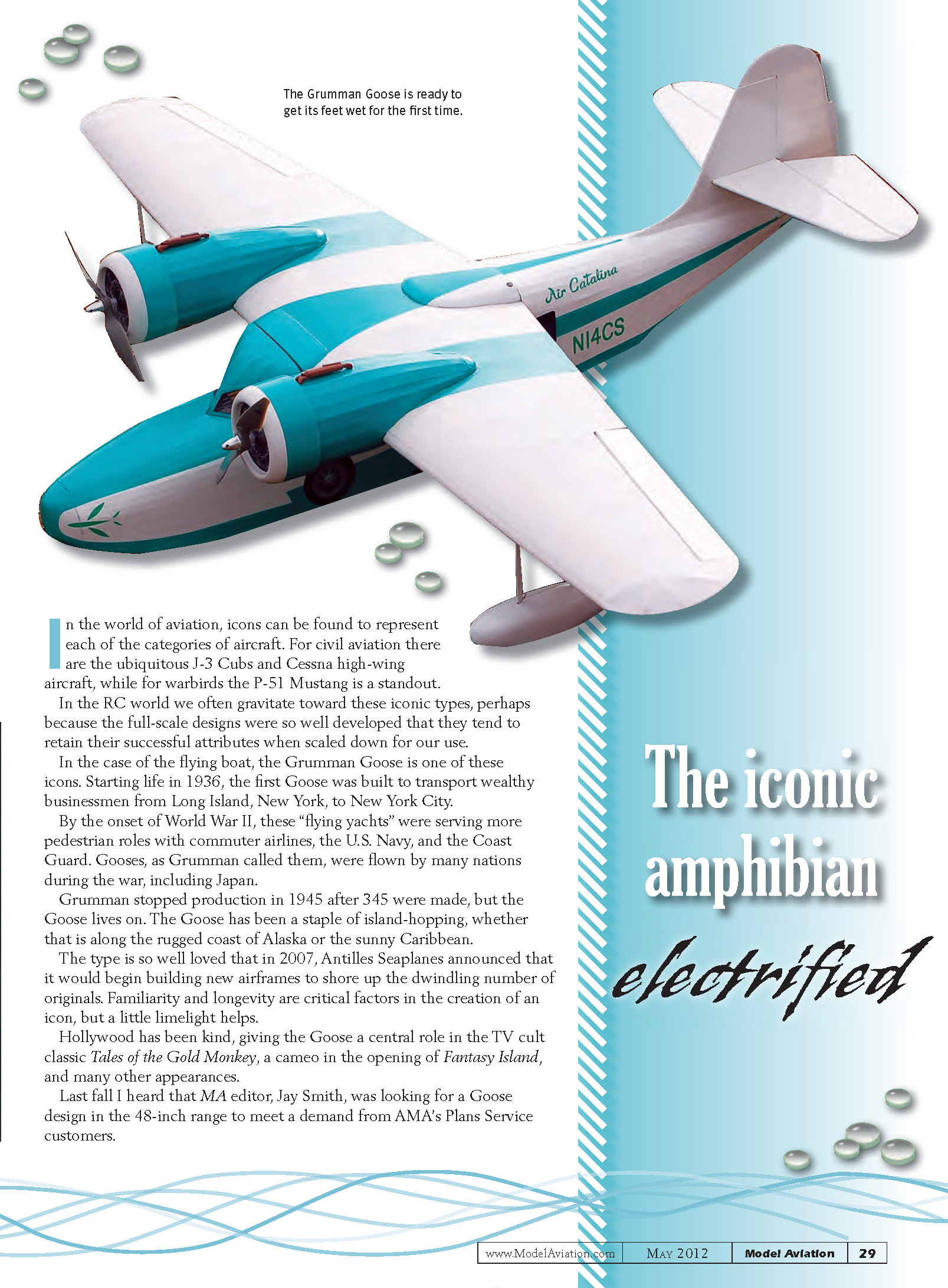
Nevertheless, the Goose pushed off. Its big tail kept it tracking straight into the wind. It rode high in the water, taking the small waves well. The first attempt ended in a pirouette after I sank the left tip float before liftoff.
The next four attempts were textbook flights, after I learned to play with the rudder and aileron together to get the Goose off the tip floats during the run-up. The model is quite responsive to the rudder, making it easy to line up.
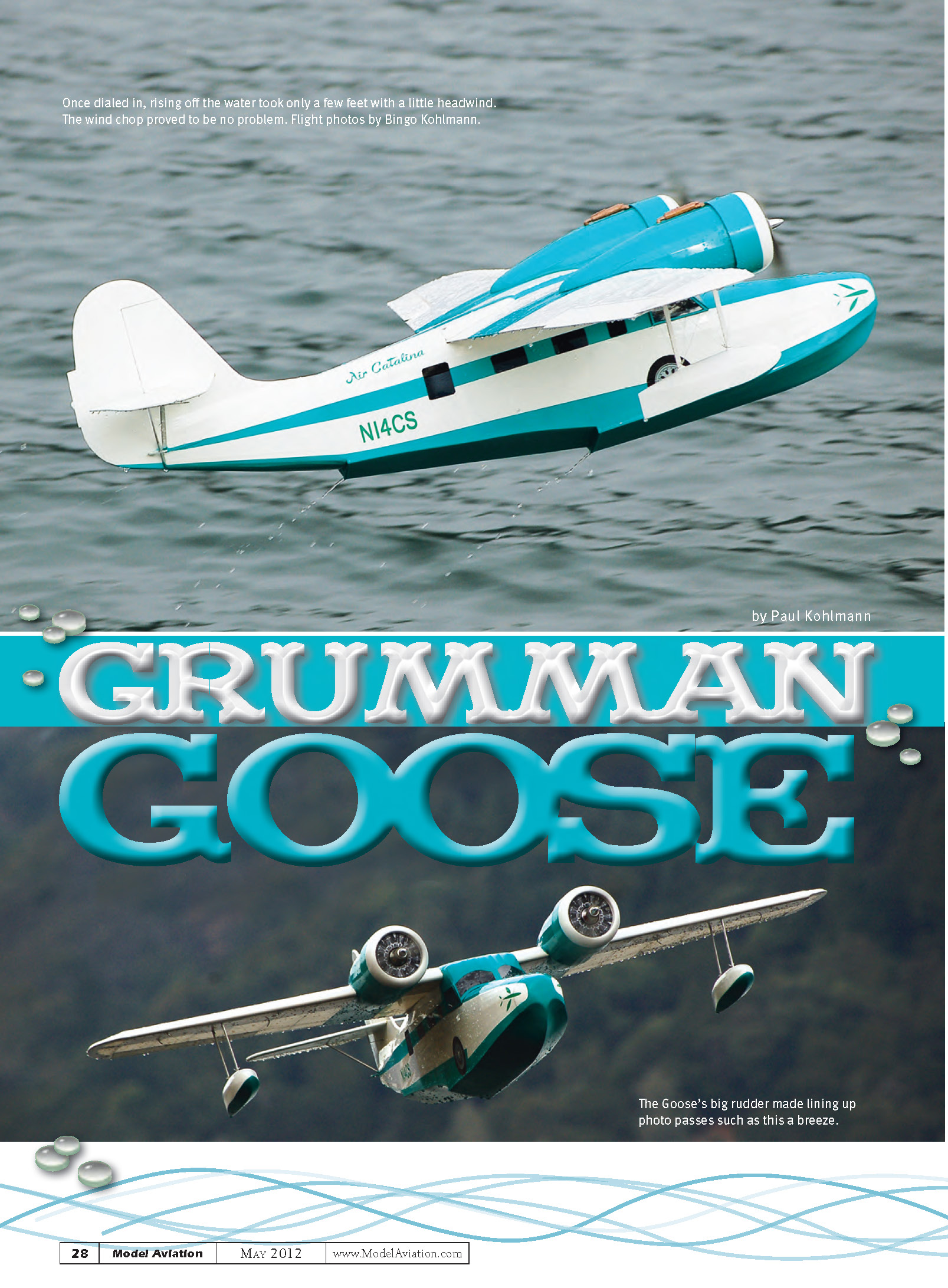
After the routine was set, the Goose popped off the water within a few feet and then majestically climbed away, leaving a trail of water droplets behind.
The learning curve for landing was similar. I discovered after coming in a little too hot that water is bouncier than grass. Although a splash-and-go would have been prudent, I forced the Goose back down, resulting in a spectacular geyser. After applying more patience, the next three were a piece of cake.
Conclusion
There is plenty of information here, but don’t let it scare you away from adding a legend to your hangar. This build goes quickly, thanks to a laser-cut kit, and no specialized construction techniques are required. Additionally, the power system is economical and the flying characteristics are docile.
If you have wanted to become amphibious, this Goose is a great way to go!
—Paul Kohlmann [email protected]
SOURCES
- Manzano Laser Works
(505) 286-2640 www.manzanolaser.com
- E-flite
(800) 338-4639 www.e-flite.com
- Hitec RCD
(858) 748-6948 www.hitecrcd.com
- Park Flyer Plastics
(817) 233-1215 www.parkflyerplastics.com
Transcribed from original scans by AI. Minor OCR errors may remain.

