

Guide to Member Services
Academy of Model Aeronautics, 5161 E. Memorial Dr., Muncie IN 47302
(765) 287-1256 www.modelaircraft.org Fax: (765) 289-4248
Use our toll-free Membership Assistance Hotline for questions concerning your membership 8 a.m. to 5 p.m. (Eastern Standard Time*) Monday through Friday.
(800) I FLY AMA (435-9262) or (765) 287-1256 Fax: (765) 741-0057
Communicate with your Academy 24 hours a day, seven days a week! Voice mail available on most extensions.
MEMBERSHIP SERVICES (765) 287-1256 EXT
- Address changes .................................................. 297
- Membership records/questions .......................... 292
- Club records ..................................................... 291
- Plans services .................................................. 212
- Safety Code questions ................................... 250
- Merchandising/Supply & Service ..................... 212
Insurance Matters (765) 287-1256 EXT
- Claims, filing & status .................................... 252
- Problems & questions ..................................... 251
- Legal questions & issues ................................ 250
- Turbo jet waiver ............................................. 251
- Large aircraft inspections ............................... 251
COMPETITION SERVICES (765) 287-1256 EXT
- AMA Sanctions ................................................ 235
- AMA/FAI rulebooks, questions ....................... 230
- AMA/FAI rulebooks, ordering .......................... 212
- Contest Calendar ........................................... 234 or 235
- Contest Director Application/testing ............ 234
- Contest Board matters .................................. 230
- Frequency issues ............................................ 230
- Sound issues .................................................. 230
- Team programs .............................................. 204
- Technical questions ....................................... 230
PROGRAMS & ACTIVITIES (765) 287-1256 EXT
- Adopt-a-School ................................................ 271
- Education support/classroom materials .......... 274
- FAA Liaison ........................................................ 270
- Flying site support ........................................... 270
- Intro-Pilot program ....................................... 291
- Leader Club program ....................................... 270
- Mall Show materials ......................................... 272
- Scholarship program ....................................... 274
- Youth program ideas ....................................... 274
- AMA Convention ............................................... 270
PUBLICATIONS EXT
- Model Aviation (765) 287-1256 .......................... 224
- Magazine back issues (765) 287-1256 ............... 296
- Magazine article reprints (765) 287-1256 ........ 506
- Magazine advertising (888) 829-4060 ..................
- Magazine account questions (765) 287-1256 ....... 261
National Newsletter (765) 287-1256 213 Cloud 9 newsletter (765) 289-4236
NATIONAL MODEL AVIATION MUSEUM & LEE RENAUD MEMORIAL LIBRARY
(765) 289-4236
Editorial offices telephone: (765) 287-1256, ext. 224 (8 a.m.-5 p.m. weekdays). Fax: (765) Use this number for further information on content of magazine articles and to request AutI
Want to place a display or classified advertisement in Model Aviation? Contact Airborne Media, 5655 David Place, Fairfield OH 45014 (888) 829-4060 or (513) 829-4060, Fax: (513) 829-4065, E-mail: [email protected]
* Indiana does not observe Daylight Savings Time
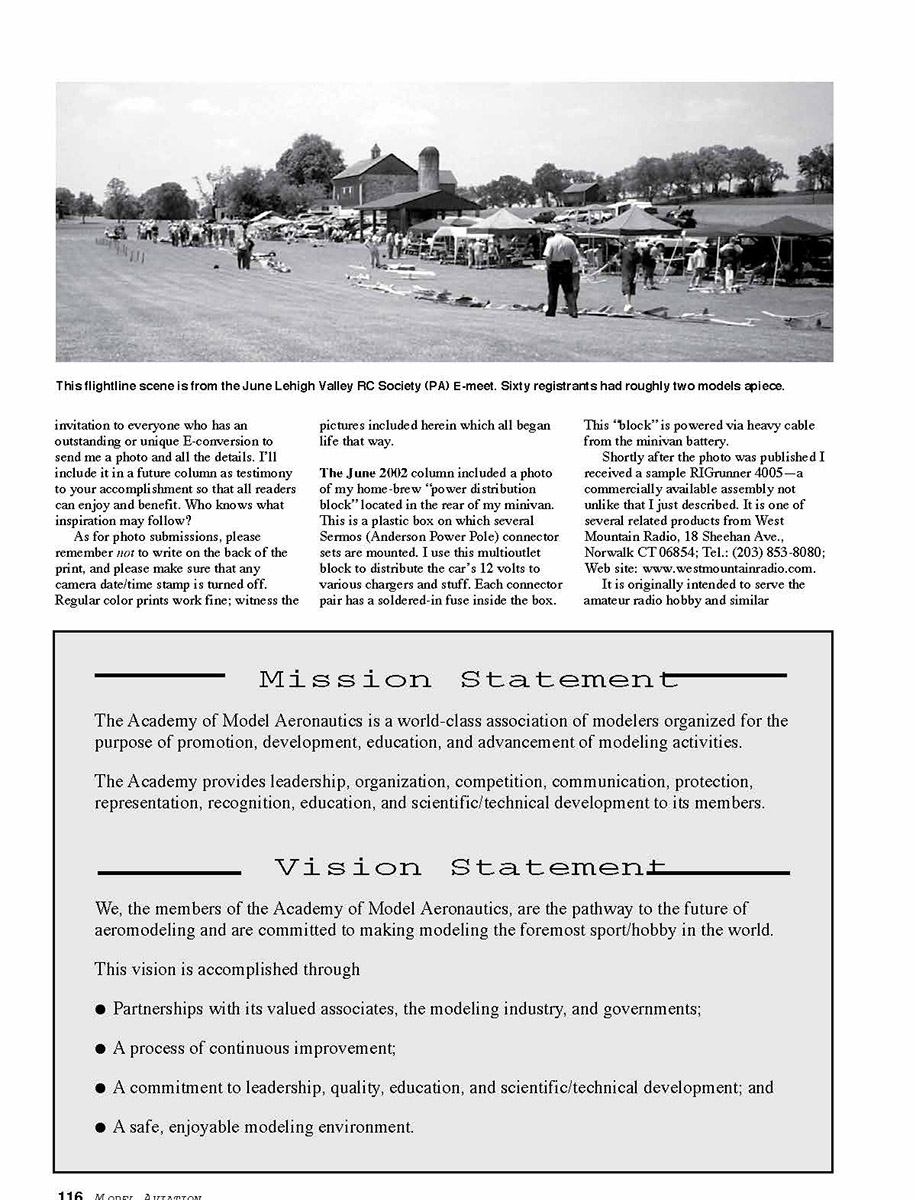
invitation to everyone who has an outstanding or unique E-conversion to send me a photo and all the details. I'll include it in a future column as testimony to your accomplishment so that all readers can enjoy and benefit. Who knows what inspiration may follow?
As for photo submissions, please remember not to write on the back of the print, and please make sure that any camera date/time stamp is turned off. Regular color prints work fine; witness the pictures included herein which all began life that way.
The June 2002 column included a photo of my home-brew "power distribution block" located in the rear of my minivan. This is a plastic box on which several Sermos (Anderson Power Pole) connector sets are mounted. I use this multioutlet block to distribute the car's 12 volts to various chargers and stuff. Each connector pair has a soldered-in fuse inside the box.
This "block" is powered via heavy cable from the minivan battery.
Shortly after the photo was published I received a sample RIGrunner 4005 — a commercially available assembly not unlike that I just described. It is one of several related products from West Mountain Radio, 18 Sheehan Ave., Norwalk CT 06854; Tel.: (203) 853-8080; Web site: www.westmountainradio.com.
It is originally intended to serve the amateur radio hobby and similar applications where multiple radios and related items ("rigs") are powered from the car's battery. The RIGrunner accepts a 12-volt input on one terminal set then distributes that supply to multiple other outputs. All connections are made with Anderson Power Poles. As is visible in the photo, each connector pair has a convenient plugable fuse associated with it.
The RIGrunner is very well made (yeah, I looked inside!) and should serve the E-aero modeler well. It is available in several versions, including larger and "intelligent" versions. This is a simple, neat, safe way to easily hook up multiple chargers and such to your auto or separate field battery (I never did like sticking those common on-plane charger clips onto those typically yucky battery terminals anyway!).
The people at West Mountain Radio fly Electric in addition to their ham-radio pursuits; you can't ask for a better fit than that. I encourage those interested to check out the supplier for more info.
The Skeeter Hawk is a 28-inch, all-sheet-balsa kit by Northeast Aero Design, 380 Daleville Rd., Willington CT 06279; Tel.: (860) 429-0216; E-mail: [email protected]. Mine weighs in at 3.2 ounces, beating the advertised weight of 3.5 ounces, and that includes a "forbidden" paint job!
Legend has it that the Skeeter Hawk was originally hatched in a swamp in northeast Connecticut, but mine came about on my workbench in quick fashion. The kit is excellent in that the laser cutting is highly accurate, and the bits and pieces just fall into place.
The design has some similarity to the DJ Aerotech Roadkill Series, and aero-motivation is provided by a DJ Aerotech MFS-1 motor/gear set. Juice is supplied by seven 50 mAh Ni-Cds or larger NiMH cells. Now to the forbidden part — paint job!
The kit instructions are emphatic about using a pencil: Masking pens are recommended, but I wanted to try something different. I dug out a "bad" piece of 1/32 x 3 x 36-inch balsa — the sort of thing that comes with assorted purchase as a self-respecting E-aero modeler would actually use for anything. I estimated that this sheet had approximately the same total surface area as my Hawk.
I spray-painted the sheet balsa (both sides) with Krylon® Fluorescent Yellow. I did not "pour" it on; I dusted the wood for complete, light coverage on both sides, and I weighed the piece before and after.
It seemed clear from this experiment that the Hawk would be only slightly heavier with this paint, so I "dusted" the Hawk and picked up approximately 0.15 ounce in the process. It looks much better and has at least some protection on all wood surfaces — good when flying in rainstorms and such!
I offer all this because I've read advisories and paintings so many times that I finally got impatient with all and wanted to "just do it." The outcome is that this Hawk flies great! Please note that this is one example using one paint product (Ultrahyde), and your results may vary!
The July, August, and September columns included beginner-level discussion intended to continue for many months. (The thread was interrupted in the October column.) The idea is to help fill in the blanks that E-beginners often face, i.e., those simple E-things that are often taken for granted once one gains a bit of related experience.
Most of the discussion so far has related to motor batteries. But our motor batteries are often really our "everything" batteries because they are routinely used to power the onboard RC stuff as well. Specifically, motor batteries of six to 10 or 12 cells can also be pressed into supplying operating power to the receiver and servos. This is where the word "BEC" comes into use.
BEC stands for Battery Eliminator Circuit. Typically, this is some additional electronics included as part of the Electronic Speed Control (ESC) that "taps off" the available motor-battery supply and provides radio power. Many ESCs on the market include this BEC feature, and you need to select the proper ESC for your application.
The classic onboard radio power supply is four Ni-Cads supplying 4.8 nominal volts to run the receiver and the associated servos. A BEC eliminates such a battery. Basically, the (necessarily) higher motor-battery voltage is applied to an electronic voltage regulator that is part of the BEC function. The regulator puts out a nominal five volts to substitute for the radio battery—a real weight savings that is often important in smaller airplanes.
Clearly, the motor-battery voltage must be somewhat greater than five volts to provide the regulated five volts. Also, each ESC has some upper cell count specification for BEC operation. Every ESC/BEC instruction sheet should provide this basic information (and other related advisories as well).
The reason for an "upper cell count" is that the "unused volts" (the difference between the motor-battery voltage and the five-volt output) can result in considerable heating of the ESC. An ESC may be specified for use up to 16 cells for motor control but limited to 10 cells for the BEC function. This means you can use this example ESC with a 16-cell motor-battery system, but then you must use the conventional separate radio battery.
When the BEC function is in use, power from the ESC regulator is supplied to the receiver and servos via a cable from the ESC to the radio system. I know of two ways this is accomplished.
The simplest is with a single three-wire cable from the ESC plugged into the "throttle" channel of the receiver (like a servo cable). This cable carries the five-volt power from the BEC to the receiver and the throttle-control signal from the receiver to the ESC electronics. Think of it as a two-way street: Thus when the motor power supply is switched on, the onboard radio is powered up.
Another approach is for the ESC to have two cables to do this same job. One is connected to the receiver with the channel output for motor-speed ("the throttle") control, and the other carries the five-volt supply for the radio stuff. As such, it can be used or not. If it is used, it can first be routed through the conventional radio power switch as would be the case when using the conventional radio battery. In any case, it ultimately goes to the normal receiver-battery connector.
A good BEC circuit does more than supply five volts to the radio. One other BEC responsibility is knowing when to quit. By that I mean that most BECs monitor the voltage of the motor battery so that if it gets too low during flight to safely power the radio, the circuit will interrupt motor operation to preserve power for the radio. This is a very important safety matter!
But there's more. A really good BEC might have a program made to motor-cutoff voltage — a feature that can't be promoted enough (I look forward to the day when "ESCs" offer it). Now we are past flight safety into battery care, as follows.
Batteries, or more likely some cell or cells within a battery, are most easily damaged as the result of "reverse charge" that can occur during deep motor-battery rundown. This is a topic in itself, and I'm asking that you simply accept this thought for now.
Some ESC/BECs offer the ability to program (at least to some degree) at what battery voltage the automatic motor cutoff will happen. The idea is to not let the battery voltage get so low (deep discharge) that, while still adequate for safe radio operation, cell damage might occur.
There may be other examples, but some ESCs that I own have this feature as seen in Castle Creations products. (A more elaborate discussion of this basic idea is part of the "Sport Speed Control" feature in the 999 and 1099 issues.)
Thus ends one more RC Electrics column. Please include an SASE with any correspondence for which you'd like a reply. Everyone sending one gets one! And no, I don't use E-mail for this purpose!
Many happy, quiet, and safe E-birding, everyone! WJ
Transcribed from original scans by AI. Minor OCR errors may remain.

