
Guillow's PC-6 Porter
Don DeLoach
A name familiar with balsa model lovers for generations, the Guillow's company has been making kits in Wakefield, Massachusetts, for more than 80 years, dating back to 1926.
Little has changed at Guillow's in those years. The company's kits have always been (and continue to be) balsa and tissue, as were the Guillow's kits that Depression-era kids experienced. Plastic propellers and vacuum-formed spinners and canopies were upgrades in the 1960s and 1970s, but since then little has changed—until now.
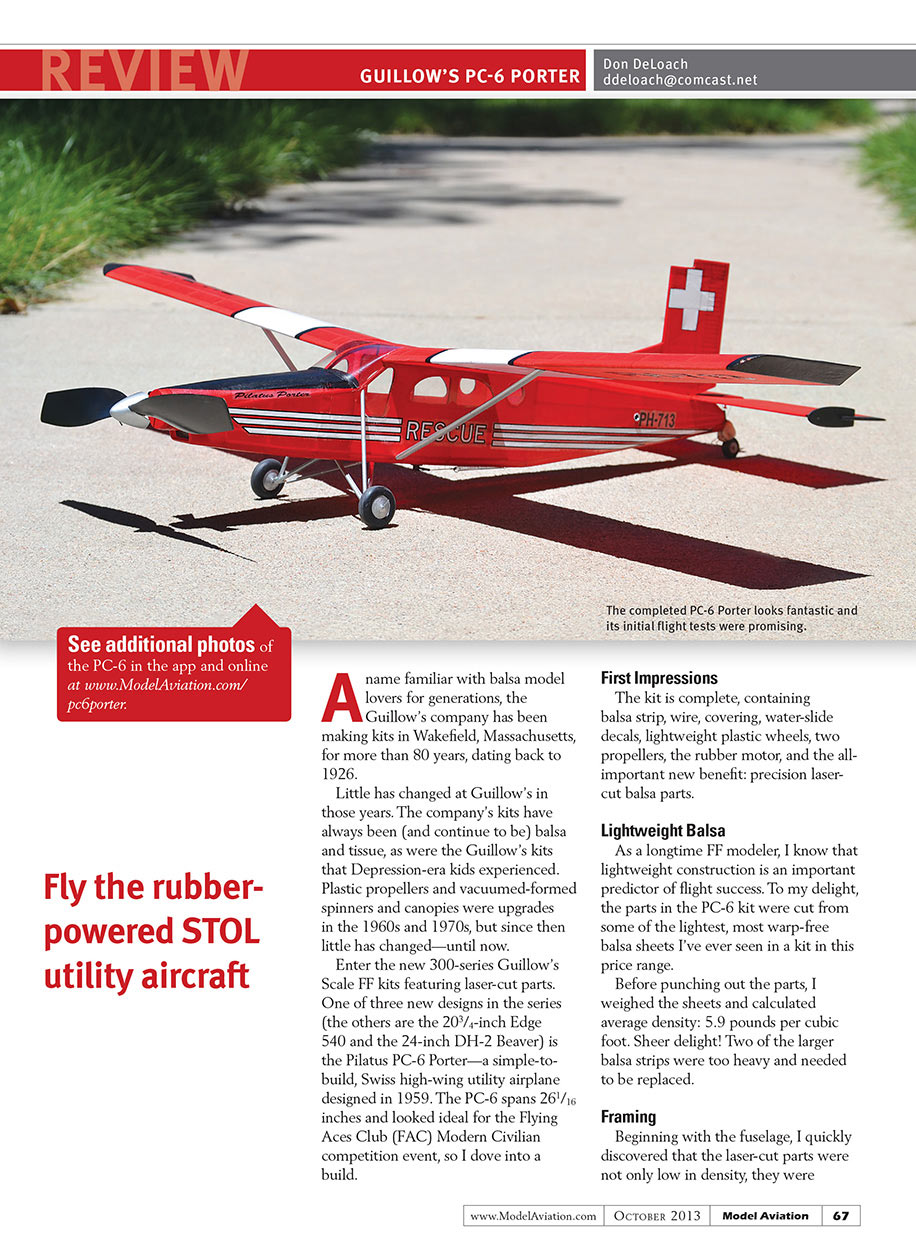
Enter the new 300-series Guillow's Scale FF kits featuring laser-cut parts. One of three new designs in the series (the others are the 20 3/4-inch Edge 540 and the 24-inch DH-2 Beaver) is the Pilatus PC-6 Porter—a simple-to-build, Swiss high-wing utility airplane designed in 1959. The PC-6 spans 26 1/16 inches and looked ideal for the Flying Aces Club (FAC) Modern Civilian competition event, so I dove into a build.
First Impressions
The kit is complete, containing balsa strip, wire, covering, water-slide decals, lightweight plastic wheels, two propellers, the rubber motor, and the all-important new benefit: precision laser-cut balsa parts.
Lightweight Balsa
As a longtime FF modeler, I know that lightweight construction is an important predictor of flight success. To my delight, the parts in the PC-6 kit were cut from some of the lightest, most warp-free balsa sheets I've ever seen in a kit in this price range.
Before punching out the parts, I weighed the sheets and calculated average density: 5.9 pounds per cubic foot. Sheer delight! Two of the larger balsa strips were too heavy and needed to be replaced.
Framing
Beginning with the fuselage, I quickly discovered that the laser-cut parts were not only low in density, they were accurate. The half-shell fuselage went together in a couple of hours. With the stringer notches aligned, the frame weighed 6 grams without landing gear. One important modification I decided on was to move the rear motor hook back one bay because the model has a long nose moment.
Next, I constructed the wing halves. Again, the parts were nearly perfectly aligned and had excellent fit. I think the wing spar arrangement (three 1/16-inch square ones on top, one 1/8-inch square on bottom) was slightly overdone, but the wings still weighed a mere 7 grams for the pair.
The horizontal and vertical stabilizer plans showed true-to-scale hinged elevator and rudder, which would be great for a conversion to micro RC, but because I was building a FF version, again, lightweight is king. So I omitted the hinge members and slightly modified the internal structure to suit my tastes.
Cowl and Propeller
An accurate, vacuum-formed nose cowl was included in the kit. This saved much fabrication time and it looks scale-like. The drawback, however, is substantial. The cowl is designed to accept a 1/4-inch-diameter removable nose button—much too small to accommodate a reasonable rubber motor.
I easily modified the cowl by cutting it back roughly 1/8 inch and added a 1/8-inch balsa sheet internal backer ring, then a 1/32-inch, round plywood face over the front. This allowed me to create a standard, removable 5/8-inch nose block and use a longer, fatter rubber motor and a removable blast tube for winding.
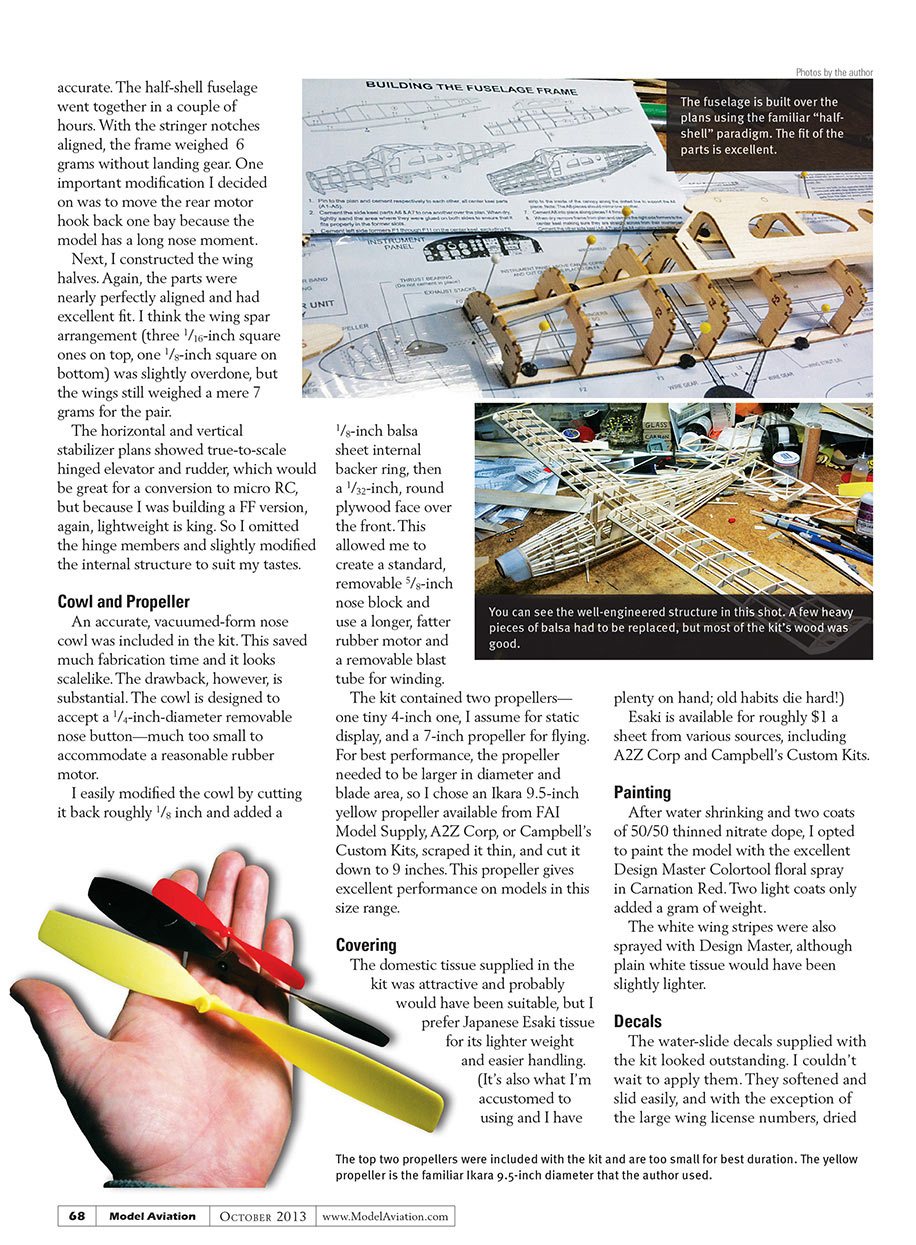
The kit contained two propellers—one tiny 4-inch one, I assume for static display, and a 7-inch propeller for flying. For best performance, the propeller needed to be larger in diameter and blade area, so I chose an Ikara 9.5-inch yellow propeller available from FAI Model Supply, A2Z Corp., or Campbell's Custom Kits, scraped it thin, and cut it down to 9 inches. This propeller gives excellent performance on models in this size range.
Covering
The domestic tissue supplied in the kit was attractive and probably would have been suitable, but I prefer Japanese Esaki tissue for its lighter weight and easier handling. (It's also what I'm accustomed to using and I have plenty on hand; old habits die hard!)
Esaki is available for roughly $1 a sheet from various sources, including A2Z Corp and Campbell's Custom Kits.
Painting
After water shrinking and two coats of 50/50 thinned nitrate dope, I opted to paint the model with the excellent Design Master Colortool floral spray in Carnation Red. Two light coats only added a gram of weight.
The white wing stripes were also sprayed with Design Master, although plain white tissue would have been slightly lighter.
Decals
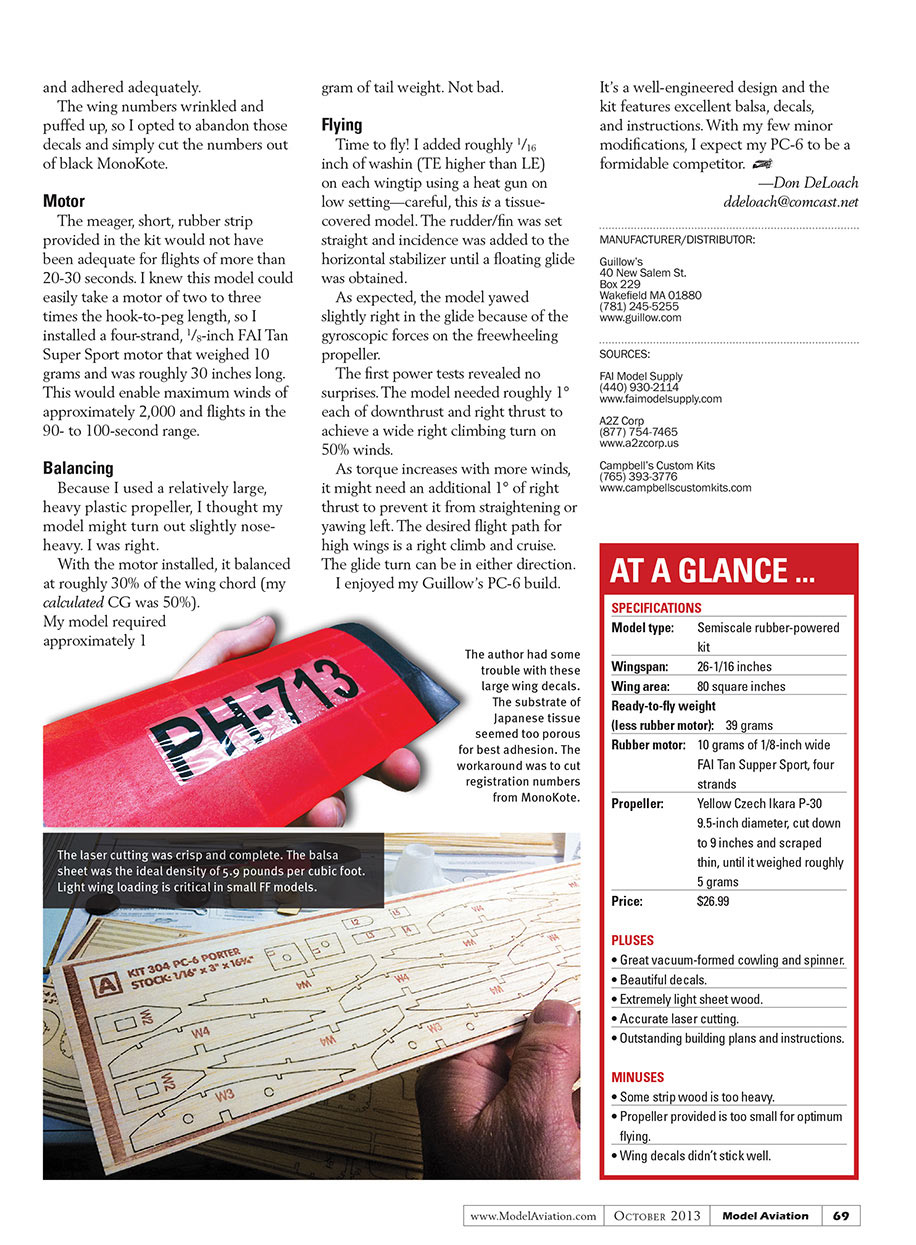
The water-slide decals supplied with the kit looked outstanding. I couldn't wait to apply them. They softened and slid easily, and with the exception of the large wing license numbers, dried plenty on hand and adhered adequately.
Motor
The meager, short, rubber strip provided in the kit would not have been adequate for flights of more than 20–30 seconds. I knew this model could easily take a motor of two to three times the hook-to-peg length, so I installed a four-strand, 1/8-inch FAI Tan Super Sport motor that weighed 10 grams and was roughly 30 inches long. This would enable maximum winds of approximately 2,000 and flights in the 90- to 100-second range.
Balancing
Because I used a relatively large, heavy plastic propeller, I thought my model might turn out slightly nose-heavy. I was right.
With the motor installed, it balanced at roughly 30% of the wing chord (my calculated CG was 50%). My model required approximately 1 gram of tail weight. Not bad.
Flying
Time to fly! I added roughly 1/16 inch of washin (TE higher than LE) on each wingtip using a heat gun on low setting—careful, this is a tissue-covered model. The rudder/fin was set straight and incidence was added to the horizontal stabilizer until a floating glide was obtained.
As expected, the model yawed slightly right in the glide because of the gyroscopic forces on the freewheeling propeller.
The first power tests revealed no surprises. The model needed roughly 1° each of downthrust and right thrust to achieve a wide right climbing turn on 50% winds.
As torque increases with more winds, it might need an additional 1° of right thrust to prevent it from straightening or yawing left. The desired flight path for high wings is a right climb and cruise. The glide turn can be in either direction.
I enjoyed my Guillow’s PC-6 build.
It’s a well-engineered design and the kit features excellent balsa, decals, and instructions. With my few minor modifications, I expect my PC-6 to be a formidable competitor.
—Don DeLoach [email protected]
MANUFACTURER/DISTRIBUTOR: Guillow’s 40 New Salem St. Box 229 Wakefield MA 01880 (781) 245-5255 www.guillow.com
SOURCES: FAI Model Supply (440) 930-2114 www.faimodelsupply.com
A2Z Corp (877) 754-7465 www.a2zcorp.us
Campbell’s Custom Kits (765) 393-3776 www.campbellscustomkits.com
Transcribed from original scans by AI. Minor OCR errors may remain.

