
2005 Model Aviation Hall of Fame Inductees
Established in 1969, the Model Aviation Hall of Fame honors those men and women who have made significant contributions to the sport of aeromodeling.
The list of members is long and distinguished. These people have contributed to model aviation through volunteer or administrative activities, product development, competition performance, or a variety of combinations of activities.
The Hall of Fame Selection Committee is composed of past AMA presidents and one Hall of Fame member selected from each of the 11 districts by the respective vice presidents.
Each year, a new class is inducted into the Model Aviation Hall of Fame and the winners are announced in Model Aviation. Anyone may submit a Hall of Fame nomination form. For a nomination form or further information, contact Jackie Shalberg at (765) 287-1256, ext. 511, or find the current form online at www.modelaircraft.org/PDF-files/152.pdf.
The committee has selected the following people for the 2005 Model Aviation Hall of Fame.
Reginald Denny
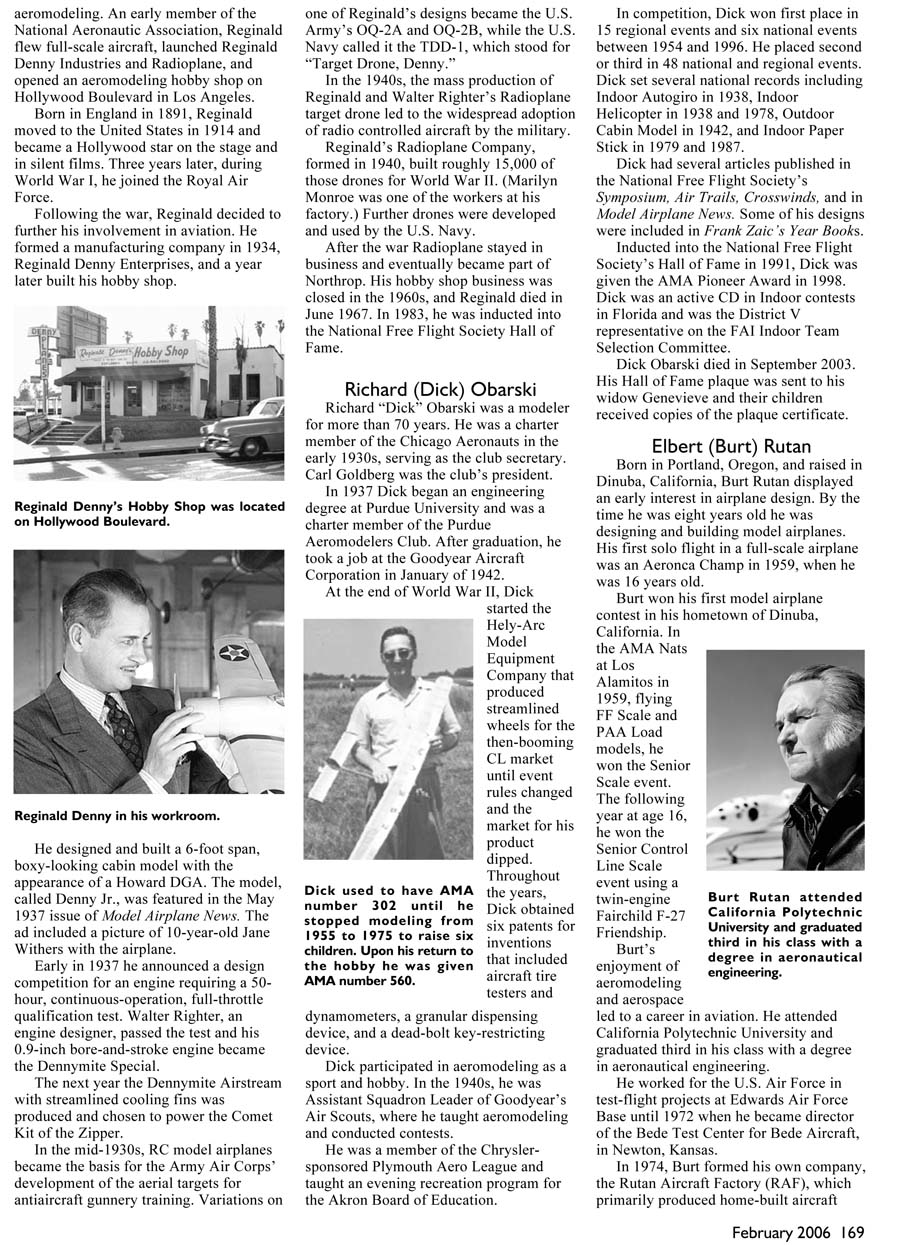
A famous actor on screen and stage, Reginald Denny starred in more than 200 films and plays, including China Clipper. He sang baritone as a member of the Bandman Opera Company, and while enlisted in the Royal Air Force he was the brigade heavyweight-boxing champion.
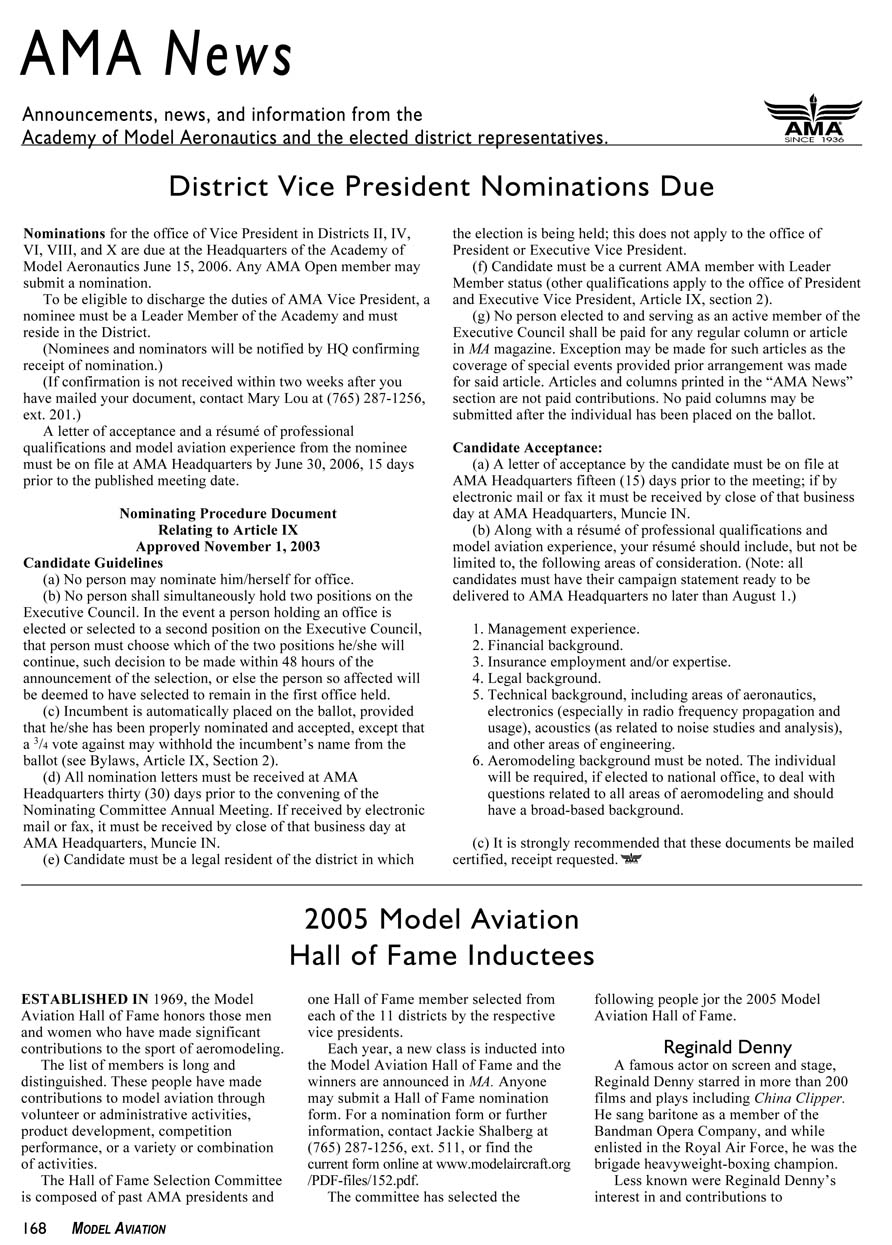
Less known were Reginald Denny's interest in and contributions to aeromodeling. An early member of the National Aeronautic Association, Reginald flew full‑scale aircraft, launched Reginald Denny Enterprises and Radioplane, and opened an aeromodeling hobby shop on Hollywood Boulevard in Los Angeles.
Born in England in 1891, Reginald moved to the United States in 1914 and became a Hollywood star on the stage and in silent films. Three years later, during World War I, he joined the Royal Air Force.
Following the war, Reginald decided to further his involvement in aviation. He formed a manufacturing company in 1934, Reginald Denny Enterprises, and a year later built his hobby shop.
He designed and built a 6‑foot‑span, boxy-looking cabin model with the appearance of a Howard DGA. The model, called Denny Jr., was featured in the May 1937 issue of Model Airplane News. The ad included a picture of 10‑year‑old Jane Withers with the airplane.
Early in 1937 he announced a design competition for an engine requiring a 50‑hour continuous‑operation, full‑throttle qualification test. Walter Righter, an engine designer, passed the test and his 0.9‑inch bore‑and‑stroke engine became the Dennymite Special.
The next year the Dennymite Airstream, with streamlined cooling fins, was produced and chosen to power the Comet kit called the Zipper.
In the mid‑1930s, RC model airplanes became the basis for the Army Air Corps’ development of aerial targets for antiaircraft gunnery training. Variations on one of Reginald’s designs became the U.S. Army’s OQ‑2A and OQ‑2B, while the U.S. Navy called it the TDD‑1, which stood for "Target Drone, Denny."
In the 1940s, the mass production of Reginald and Walter Righter’s Radioplane target drone led to the widespread adoption of radio‑controlled aircraft by the military. Reginald’s Radioplane Company, formed in 1940, built roughly 15,000 of those drones for World War II. (Marilyn Monroe was one of the workers at his factory.) Further drones were developed and used by the U.S. Navy.
After the war Radioplane stayed in business and eventually became part of Northrop. His hobby shop business was closed in the 1960s, and Reginald died in June 1967. In 1983 he was inducted into the National Free Flight Society Hall of Fame.
Richard (Dick) Obarski
Richard “Dick” Obarski was a modeler for more than 70 years. He was a charter member of the Chicago Aeronauts in the early 1930s, serving as the club secretary; Carl Goldberg was the club’s president.
In 1937 Dick began an engineering degree at Purdue University and was a charter member of the Purdue Aeromodelers Club. After graduation, he took a job at the Goodyear Aircraft Corporation in January 1942.
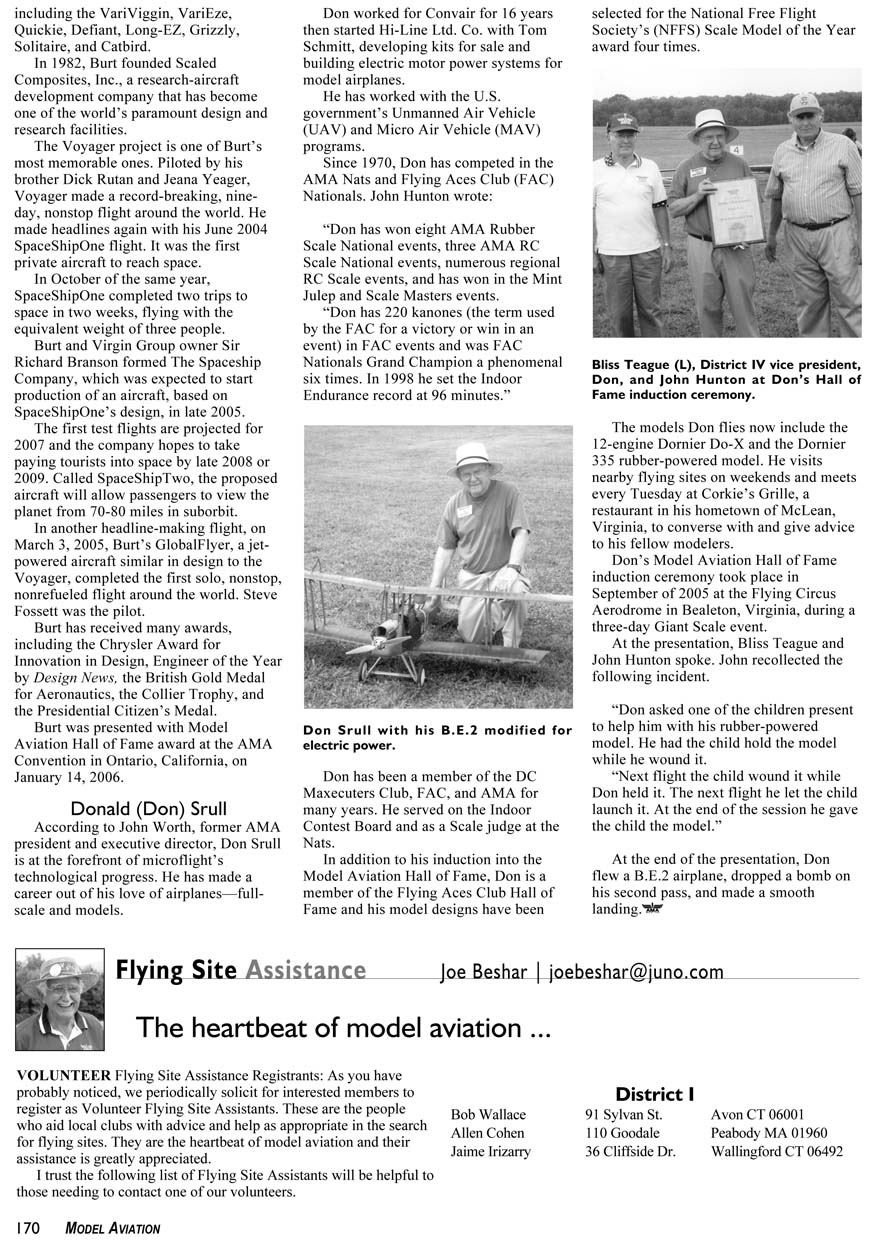
At the end of World War II, Dick started the Hely‑Arc Model Equipment Company, which produced streamlined wheels for the then‑booming CL (control‑line) market until event rules changed and the market for his product dipped.
Throughout the years, Dick obtained six patents for inventions that included aircraft tire testers and dynamometers, a granular dispensing device, and a dead‑bolt key‑restricting device.
Dick participated in aeromodeling as a sport and hobby. In the 1940s, he was Assistant Squadron Leader of Goodyear’s Air Scouts, where he taught aeromodeling and conducted contests. He was a member of the Chrysler‑sponsored Plymouth Aero League and taught an evening recreation program for the Akron Board of Education.
In competition, Dick won first place in 15 regional events and six national events between 1954 and 1996. He placed second or third in 48 national and regional events. Dick set several national records including Indoor Autogiro in 1938; Indoor Helicopter in 1938 and 1978; Outdoor Cabin Model in 1942; and Indoor Paper Stick in 1979 and 1987.
Dick had several articles published in the National Free Flight Society’s Symposium, Air Trails, Crosswinds, and Model Airplane News. Some of his designs were included in Frank Zaic’s Year Books.
Inducted into the National Free Flight Society’s Hall of Fame in 1991, Dick was given the AMA Pioneer Award in 1998. Dick was an active contest director in indoor contests in Florida and was the District V representative on the FAI Indoor Team Selection Committee.
Dick Obarski died in September 2003. His Hall of Fame plaque was sent to his widow, Genevieve, and their children received copies of the plaque certificate.
Elbert (Burt) Rutan
Born in Portland, Oregon, and raised in Dinuba, California, Burt Rutan displayed an early interest in airplane design. By the time he was eight years old he was designing and building model airplanes. His first solo flight in a full‑scale airplane was in an Aeronca Champ in 1959, when he was 16 years old.
Burt won his first model airplane contest in his hometown of Dinuba, California. At the AMA Nats at Los Alamitos in 1959, flying free-flight scale and PAA Load models, he won the Senior Scale event. The following year, at age 16, he won the Senior Control Line Scale event using a twin‑engine Fairchild F‑27 Friendship.
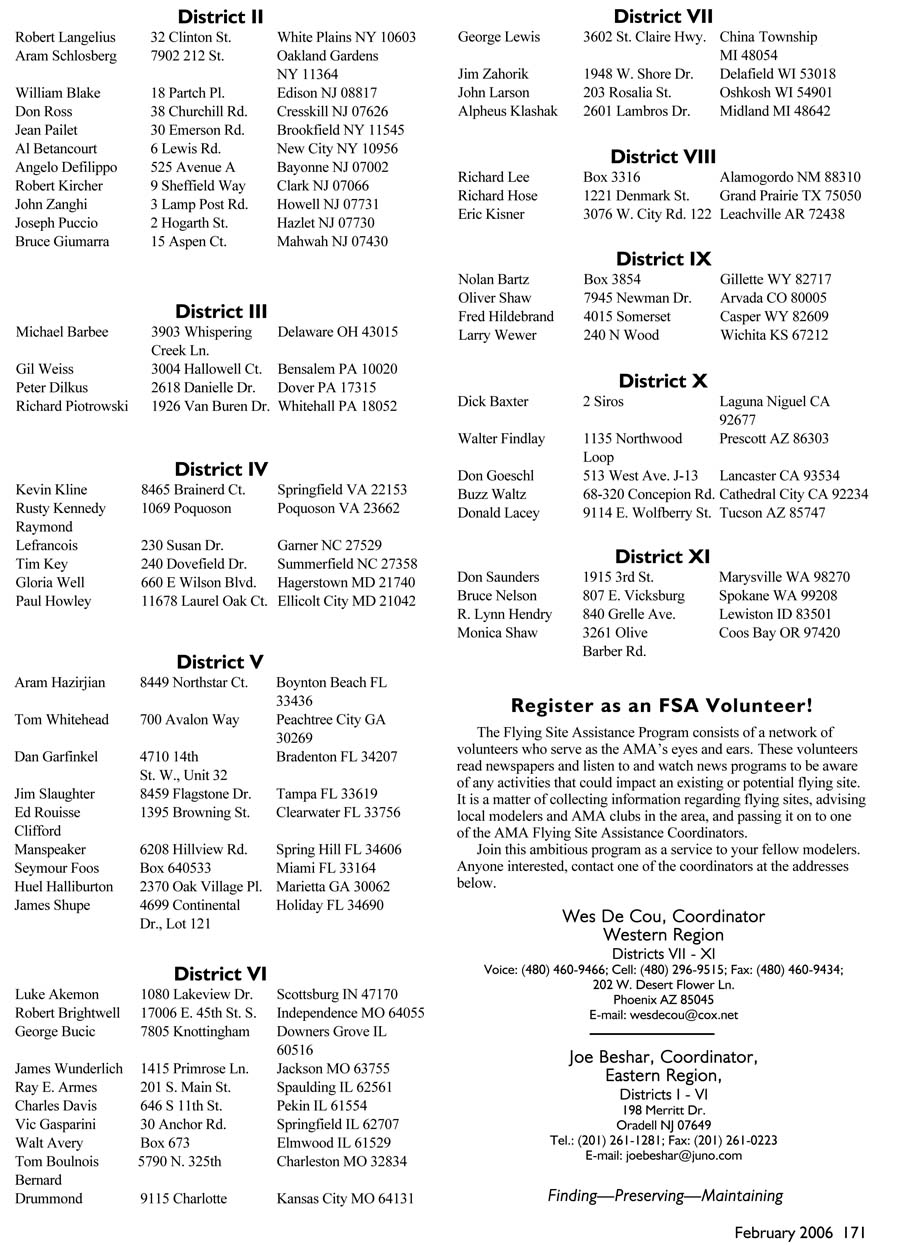
Burt’s enjoyment of aeromodeling and aerospace led to a career in aviation. He attended California Polytechnic State University and graduated third in his class with a degree in aeronautical engineering.
He worked for the U.S. Air Force on test‑flight projects at Edwards Air Force Base until 1972 when he became director of the Bede Test Center for Bede Aircraft in Newton, Kansas.
In 1974, Burt formed his own company, the Rutan Aircraft Factory (RAF), which primarily produced home‑built aircraft.
Donald (Don) Srull
According to John Worth, former AMA president and executive director, Don Srull is at the forefront of microflight technology. He has made a career out of his love of airplanes—both full‑scale and models.
Don worked for Convair for 16 years, then started Hi‑Line Ltd. Co. with Tom Schmitt, developing kits for sale and building electric motor power systems for model airplanes. He has worked with the U.S. government's Unmanned Air Vehicle (UAV) and Micro Air Vehicle (MAV) programs.
Since 1970, Don has competed in the AMA Nats and Flying Aces Club (FAC) Nationals. John Hunton wrote:
"Don has won eight AMA Rubber Scale National events, three AMA RC Scale National events, numerous regional RC Scale events, and has won in the Mint Julep and Scale Masters events.
Don has 220 kanones (the term used by the FAC for a victory or win in an event) in FAC events and was FAC Nationals Grand Champion a phenomenal six times. In 1998 he set the Indoor Endurance record at 96 minutes."
Don has been a member of the DC Maxecuters Club, the FAC, and the AMA for many years. He served on the Indoor Contest Board and as a scale judge at the Nats.
In addition to his induction into the Model Aviation Hall of Fame, Don is a member of the Flying Aces Club Hall of Fame and his model designs have been selected for the National Free Flight Society's (NFFS) Scale Model of the Year award four times.
The models Don flies now include a 12‑engine Dornier Do‑X and the Dornier 335 rubber‑powered model. He visits nearby flying sites on weekends and meets every Tuesday at Corkie's Grille, a restaurant in his hometown of McLean, Virginia, to converse with and give advice to his fellow modelers.
Don's Model Aviation Hall of Fame induction ceremony took place in September 2005 at the Flying Circus Aerodrome in Bealeton, Virginia, during a three‑day Giant Scale event. At the presentation, Bliss Teague and John Hunton spoke. John recollected the following incident:
"Don asked one of the children present to help him with his rubber‑powered model. He had the child hold the model while he wound it.
Next flight the child wound it while Don held it. The next flight he let the child launch it. At the end of the session he gave the child the model."
At the end of the presentation, Don flew a B.E.2 airplane, dropped a bomb on his second pass, and made a smooth landing.
Transcribed from original scans by AI. Minor OCR errors may remain.

