
Harold deBolt remembered
Bob Angel [email protected]
Harold deBolt, who passed away in 2005, was known as Hal, or in later years as "Pappy" deBolt. I never met him, but neither did I meet Charlton Heston. Still, I feel as though I knew them both.
Hal was in his prime after World War II when I started flying CL. He was out of the Navy and CL was in its heyday. deBolt designs, kits, and the DMECO brand name were well known to local club members. At that time, I'd have assumed that CL was Hal's only interest, but that would have been a short-sighted assumption.
Prominently listed at the top of the official AMA deBolt biography is "Modeler, Designer, Manufacturer, Author, Competitor, and Contest Director." His activities under any one of those headings would constitute as much or more than most modelers achieve in a lifetime.
The deBolt CL designs and kits I remember best are the Speed Wagon and Stunt Wagon series, the Biplane, Sport Wing, and All American Stunt series. But those of you who flew early RC probably best remember the Live Wire and all of its derivatives.
In addition to being a superior modeler and contestant, Hal was a good businessman. He'd typically develop a model, win a series of events and/or championships, and then kit it. That basic model served to spawn a series of kits and sizes to suit most of the popular engines available. He used variations of the original name for those kits so the heritage was evident.
One of my flying buddies, Dick Fischer, met Hal on one occasion and was impressed with his down-to-earth attitude and graciousness. Dick was on a business trip to Buffalo, New York, and called Hal, who invited Dick to his home for an enjoyable evening. He displayed and discussed his many current models, then concluded with a trip to an "archives" room, where many formerly flown models hung from the ceiling. Dick said it was a glimpse into modeling history.
Dick enjoyed Hal's description of his approach to weekend flying, even when not at a contest. Hal said that, as a modeling professional, he felt it was important to look as though he always knew what he was doing. Before heading to the field, he'd fuel up his engine(s) and choke and flip them through a few times so that he could later get a one- or two-flip engine start.
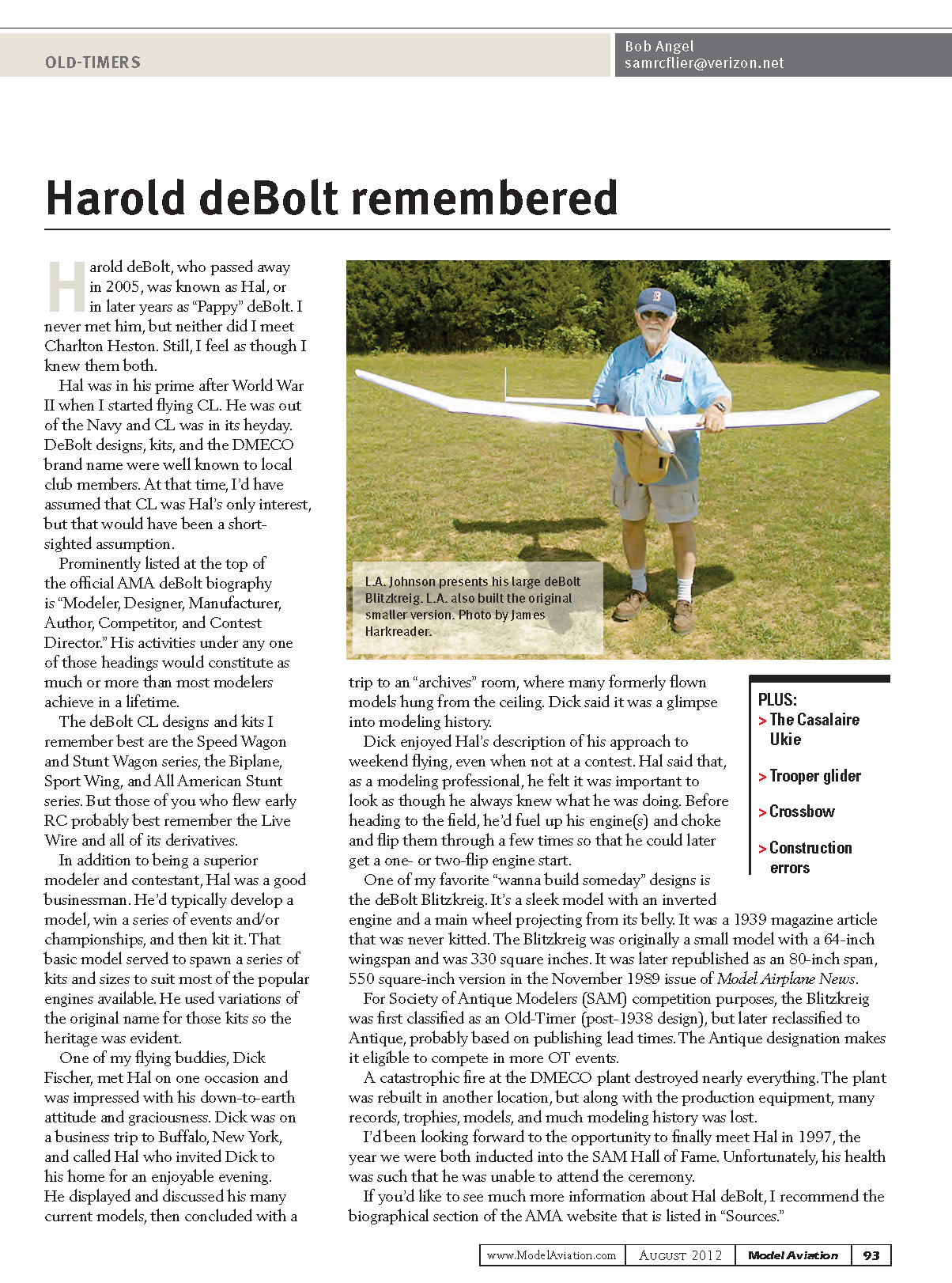
One of my favorite "want-to-build-someday" designs is the deBolt Blitzkrieg. It's a sleek model with an inverted engine and a main wheel projecting from its belly. It was a 1939 magazine article that was never kitted. The Blitzkrieg was originally a small model with a 64-inch wingspan and about 330 square inches of wing area. It was later republished as an 80-inch-span, 550 square-inch version in the November 1989 issue of Model Airplane News.
For Society of Antique Modelers (SAM) competition purposes, the Blitzkrieg was first classified as an Old-Timer (post-1938 design), but later reclassified to Antique, probably based on publishing lead times. The Antique designation makes it eligible to compete in more OT events.
A catastrophic fire at the DMECO plant destroyed nearly everything. The plant was rebuilt in another location, but along with the production equipment many records, trophies, models, and much modeling history were lost.
I'd been looking forward to the opportunity to finally meet Hal in 1997, the year we were both inducted into the SAM Hall of Fame. Unfortunately, his health was such that he was unable to attend the ceremony.
If you'd like to see much more information about Hal deBolt, I recommend the biographical section of the AMA website listed in "Sources."
Anecdotes
Later, he learned that you are supposed to just stand the fuselage sides up and connect the crosspieces. He'd been using four unneeded full-length sticks on that top view.
Early modelers often carved their own propellers, especially for rubber models. Mike Myers and Dave Harding shared on the Internet their embarrassing experiences with propeller carving, so I hope they don't mind broader notoriety.
I forget who did which, but one of them got to the point of actually launching his model, only to find the propeller was pitched backward. It flew backward just a short distance. That story was then topped by one in which the two blades were carved pitched in opposite directions.
Correction
The photo caption for Franny Brodigan's good-looking Cumulus model in the April 2012 issue of MA mentioned that the kit was produced by Harry Klarich. Harry's contact information didn't get listed in "Sources," so I'll correct that oversight.
SOURCES
- AMA History Program
www.modelaircraft.org/files/deBoltHaroldHal.pdf
- Casalaire/Collectaire museum
(408) 828-2810 [email protected]
- Collectair photo gallery
- Klarich Custom Kits
2301 Sonata Dr. Rancho Cordova, CA 95670 (916) 635-4588 [email protected] www.harryklarich.virtualempire.com
Transcribed from original scans by AI. Minor OCR errors may remain.

