



Horace Hagen
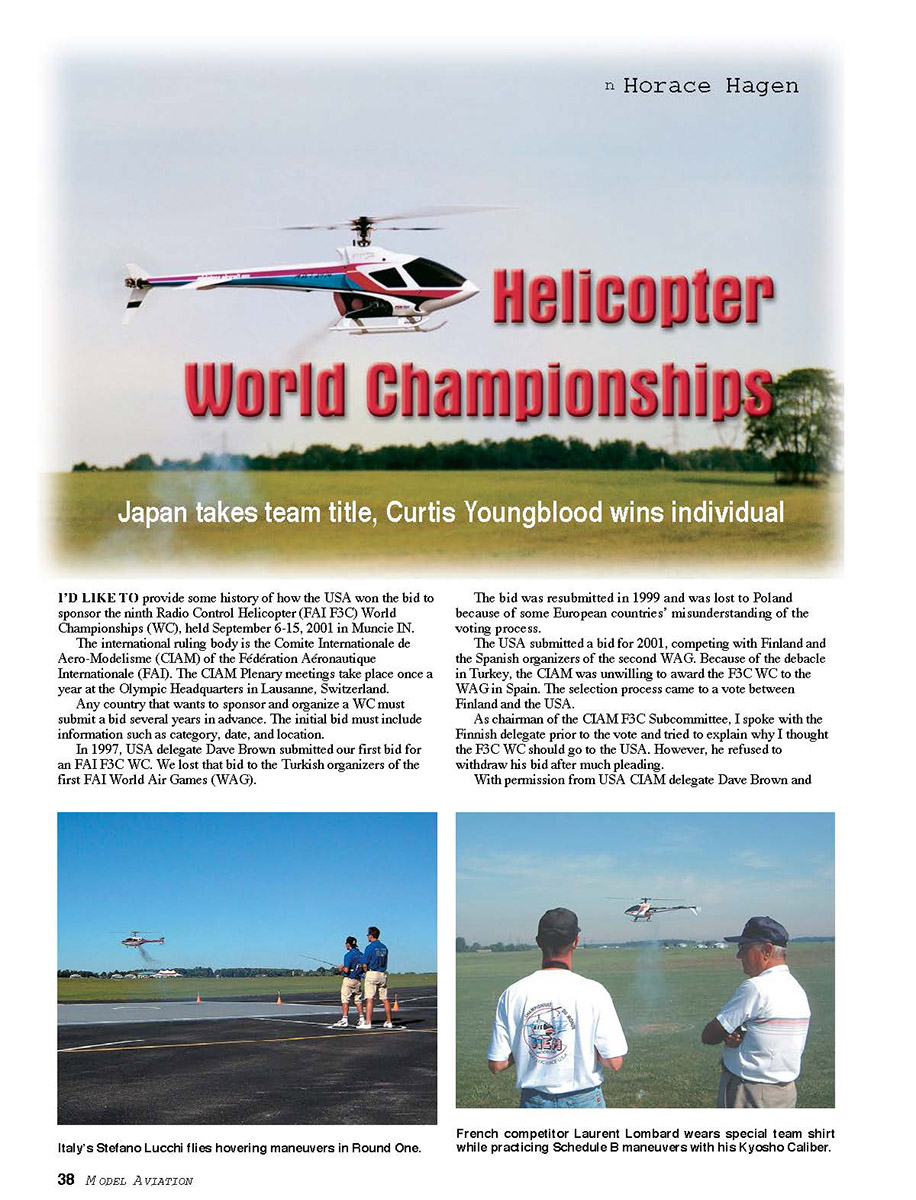
Helicopter World Championships
Japan takes team title, Curtis Youngblood wins individual
I'D LIKE TO provide some history of how the USA won the bid to sponsor the ninth Radio Control Helicopter (FAI F3C) World Championships (WC), held September 6-15, 2001 in Muncie IN.
The international ruling body is the Comite Internationale de Aero-Modelisme (CIAM) of the Federation Aeronautique Internationale (FAI). The CIAM Plenary meetings take place once a year at the Olympic Headquarters in Lausanne, Switzerland.
Any country that wants to sponsor and organize a WC must submit a bid several years in advance. The initial bid must include information such as category, date, and location.
In 1997, USA delegate Dave Brown submitted our first bid for an FAI F3C WC. We lost that bid to the Turkish organizers of the first FAI World Air Games (WAG).
The bid was resubmitted in 1999 and was lost to Poland because of some European countries' misunderstanding of the voting process.
The USA submitted a bid for 2001, competing with Finland and the Spanish organizers of the second WAG. Because of the debacle in Turkey, the CIAM was unwilling to award the F3C WC to the WAG in Spain. The selection process came to a vote between Finland and the USA.
As chairman of the CIAM F3C Subcommittee, I spoke with the Finnish delegate prior to the vote and tried to explain why I thought the F3C WC should go to the USA. However, he refused to withdraw his bid after much pleading.
With permission from USA CIAM delegate Dave Brown and CIAM President Sandy Pimenoff, I addressed the Plenary meeting just prior to the vote to make the following points:
- A country should not vote on a bid for an event in which it does not compete.
- We just had two consecutive F3C WCs in Europe.
- This is a world and not a continental championship.
- The F3C Subcommittee has always recommended rotating the WCs sequentially between Europe, the Americas, and Asia.
- If we are not careful, the Americas and Asia will always be outvoted by Europe.
To drive the latter point home, I suggested (tongue-in-cheek)
Poland offered to run the F3C WC by itself. The Polish organizers put a 100% effort into the event and did a great job.
I was dismayed when I learned a short time before the start of this WC that the International Radio Control Helicopter Association (IRCHA)—the official AMA Special Interest Group—wanted to run its annual Jamboree immediately before the WC. The IRCHA Jamboree has traditionally attracted a large number of participants and could have created conflicts with frequencies, practice fields, and lodging. We were able to persuade the IRCHA organizers to postpone the event until after the WC.
The 1999 F3C WC in Poland attracted 74 competitors and used only one flight line with five FAI judges. This resulted in four 14-hour days for the preliminary rounds. Everyone agreed that it was an unreasonable burden to place on the FAI judges.
Thus at the 2000 Technical Meeting, the F3C Subcommittee decided to use two flightlines at future WCs.
The 2001 F3C WC was the first to use two flightlines, which required two significantly separated flying areas to eliminate the possibility of overlapping.
AMA handled the overall organization of the 2001 F3C WC. Craig Bradley and assistant Contest Director Kevin Condell directed the actual competition. The IRCHA organization provided considerable support.
AMA's International Aeromodeling Center was selected for the competition site because of its very large area (1.5 x 1.0 miles).
Most teams arrived on or before Thursday, September 6. Sixty-nine competitors preregistered for the event but two canceled just prior to the start.
The southern entrance of the AMA property was designated for open practice, and many teams took advantage of that large grass area. Other teams chose to practice at alternate practice areas offered by the organizer.
The weather was bright and sunny with some wind. The AMA site looked really green because of all the rain during the preceding months.
Additional open practice was allowed onsite Friday, with a pilot team manager meeting scheduled for 7:30 p.m. During the meeting, several clarifications and reminders were made to the teams attending for the first time and to update the teams that had missed the last WC.
All previous WC Team Manager Meetings were conducted without pilots present, to limit the duration. The organizers of this WC decided to include the pilots. The following items were discussed:
- For an autorotation manner, a pilot should shut the engine off well before the model gets to the centerline.
- A model can only be repositioned prior to calling the start of the first maneuver.
- A model must be flown at eye level or above from start box to helipad.
- Rotation of a model in the start box is limited to 180° relative to the pilot.
- Only two people can be located at the start box.
- The team manager must remain in the designated area.
- Pilots who are not in the ready area must remain in the tent area.
- A model must come to a complete stop during stall turns.
- If part of a maneuver falls outside the 120° window, one point will be subtracted; if the end is called late, two points will be subtracted if part of the maneuver is outside.
- If a model is off-course by more than 90° during a loop, roll, or turn, a zero score will result.
The meeting lasted considerably longer than previous meetings but cleared up some misunderstandings.
Medical and transmitter processing was scheduled for 8 a.m. to 3 p.m. Saturday. The organizers decided to turn the official practice simultaneously, and this raised some concern among the pilots and FAI jury.
The organizers assured everyone that mobile-telephone communication between the processing area and practice sites would be used to prevent radio interference.
In addition, the organizer requested that the transmitters be brought in for processing at the end of each team's official practice time. Although no problems occurred, a certain amount of anxiety was created.
The F3C Subcommittee will recommend that separate days be used for processing and official practice at future WCs.
The 67 pilots were split into two Flight Groups (FGA and FGB). There will be 14 pilots in the flyoff rounds. FGA had 33 pilots, and FGB had 34.
For the official practice, each FGA was assigned to the flightline (FL) it would use for the first preliminary round. FGA would fly on FL-1, and FGB would fly on FL-2.
The opening ceremony took place between 5 and 6:15 p.m., and was followed by a welcome barbecue starting at 6:30. There was plenty of good food for everyone, and many interesting discussions took place.
Most of us left the barbecue at a reasonable hour to get some rest for the first round of competition the next day. The weather forecasters predicted rain for Sunday.
Sunday morning arrived amidst torrential rains. The first preliminary round could not be started until 12:30 p.m. With 34 pilots on FL-2, we estimated that the round could be completed just before dusk with minimal judges' breaks.
The last pilot flew in the rain and with marginal light. Because of the very high and gusty winds, the flight scores were very low. The contest officials and the pilots cooperated fully to get the first competition round completed before dusk.
At the end of the first round, we could only present the standings based on raw scores because the pilots had not yet flown in front of all judges. A quick look indicated that the judges on FL-2 were slightly tougher than those on FL-1.
Not surprisingly, the major shortcoming of using two flightlines became evident during the first round: the relative flying skill of all pilots could not be observed.
To make the competition as fair as possible, the organizer arranged the start orders so that each pilot was exposed equally to both flightlines. As a result, a pilot in FGA flew first on FL-1 during Round One, ninth on FL-2 during Round Two, 17th on FL-1 during Round Three, and 25th on FL-2 during Round Four.
The second preliminary round, on Monday, got off to a much better start, with plenty of sunshine but some wind.
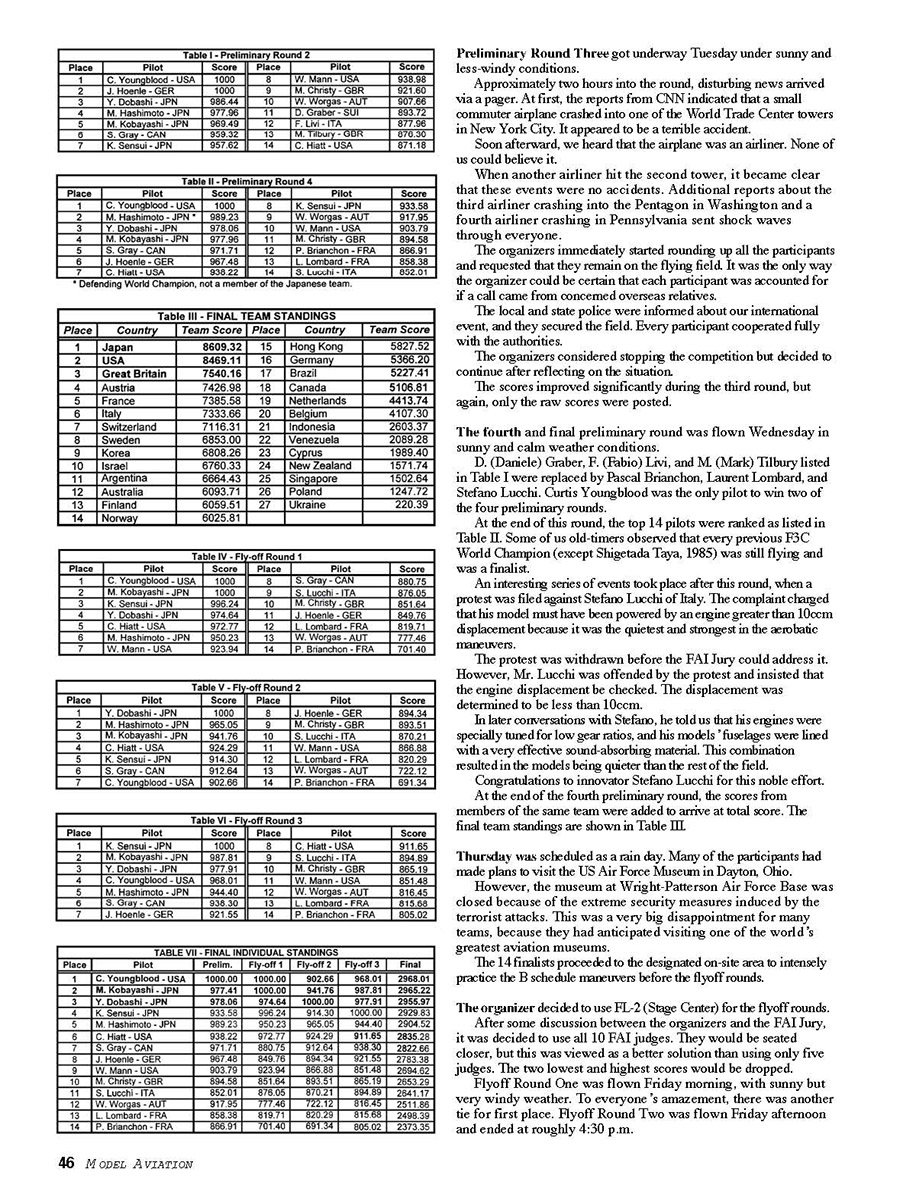
The scores were normalized after this round, and the top 14 pilots are listed in Table 1 (a complete list containing the standings of all pilots is on the AMA web site: www.modelaircraft.org).
The top 1,000 scores were awarded because Curtis Youngblood had the best flight in FGA, and Johann Hoenle had the best flight in FGB.
Based on these early results, it looked as though the teams to beat were Japan, USA, and Great Britain, in that order.
Preliminary Round Three got underway Tuesday under sunny and less-windy conditions.
Approximately two hours into the round, disturbing news arrived via a pager. At first, the reports from CNN indicated that a small commuter airplane crashed into one of the World Trade Center towers in New York City. It appeared to be a terrible accident.
Soon afterward, we heard that the airplane was an airliner. None of us could believe it.
When another airliner hit the second tower, it became clear that these events were no accidents. Additional reports about the third airliner crashing into the Pentagon in Washington and a fourth airliner crashing in Pennsylvania sent shock waves through everyone.
The organizers immediately started rounding up all the participants and requested that they remain on the flying field. It was the only way the organizer could be certain that each participant was accounted for if a call came from concerned overseas relatives.
The local and state police were informed about our international event, and they secured the field. Every participant cooperated fully with the authorities.
The organizers considered stopping the competition but decided to continue after reflecting on the situation.
The scores improved significantly during the third round, but again, only the raw scores were posted.
The fourth and final preliminary round was flown Wednesday in sunny and calm weather conditions.
D. (Daniele) Graber, F. (Fabio) Livi, and M. (Mark) Tilbury listed in Table I were replaced by Pascal Brianchon, Laurent Lombard, and Stefano Lucchi. Curtis Youngblood was the only pilot to win two of the four preliminary rounds.
At the end of this round, the top 14 pilots were ranked as listed in Table II. Some of us old-timers observed that every previous F3C World Champion (except Shigetada Taya, 1985) was still flying and was a finalist.
An interesting series of events took place after this round, when a protest was filed against Stefano Lucchi of Italy. The complaint charged that his model must have been powered by an engine greater than 10ccm displacement because it was the quietest and strongest in the aerobatic maneuvers.
The protest was withdrawn before the FAI Jury could address it. However, Mr. Lucchi was offended by the protest and insisted that the engine displacement be checked. The displacement was determined to be less than 10ccm.
In later conversations with Stefano, he told us that his engines were specially tuned for low gear ratios, and his models’ fuselages were lined with a very effective sound-absorbing material. This combination resulted in the models being quieter than the rest of the field.
Congratulations to innovator Stefano Lucchi for this noble effort.
At the end of the fourth preliminary round, the scores from members of the same team were added to arrive at total score. The final team standings are shown in Table III.
Thursday was scheduled as a rain day. Many of the participants had made plans to visit the US Air Force Museum in Dayton, Ohio.
However, the museum at Wright-Patterson Air Force Base was closed because of the extreme security measures induced by the terrorist attacks. This was a very big disappointment for many teams, because they had anticipated visiting one of the world’s greatest aviation museums.
The 14 finalists proceeded to the designated on-site area to intensely practice the B schedule maneuvers before the flyoff rounds.
The organizer decided to use FL-2 (Stage Center) for the flyoff rounds.
After some discussion between the organizers and the FAI Jury, it was decided to use all 10 FAI judges. They would be seated closer, but this was viewed as a better solution than using only five judges. The two lowest and highest scores would be dropped.
Flyoff Round One was flown Friday morning, with sunny but very windy weather. To everyone’s amazement, there was another tie for first place. Flyoff Round Two was flown Friday afternoon and ended at roughly 4:30 p.m.
The results after those rounds are displayed in Tables IV and V.
Flyoff Round Three was flown Saturday morning. As indicated, there was considerable repositioning going on during the three flyoff rounds. Each Japanese team member won one. The results for Flyoff Round Three are listed in Table VI.
The flying standard during the entire competition was very high, and the top scores were separated by less than 1%. We definitely need the new—and more difficult—F3C maneuver schedules that become effective January 1, 2002.
The final individual standings were posted Saturday afternoon and are listed in Table VII.
The final scores are based on the best three of four scores. The four scores are the normalized results of the preliminary rounds and the three flyoff rounds.
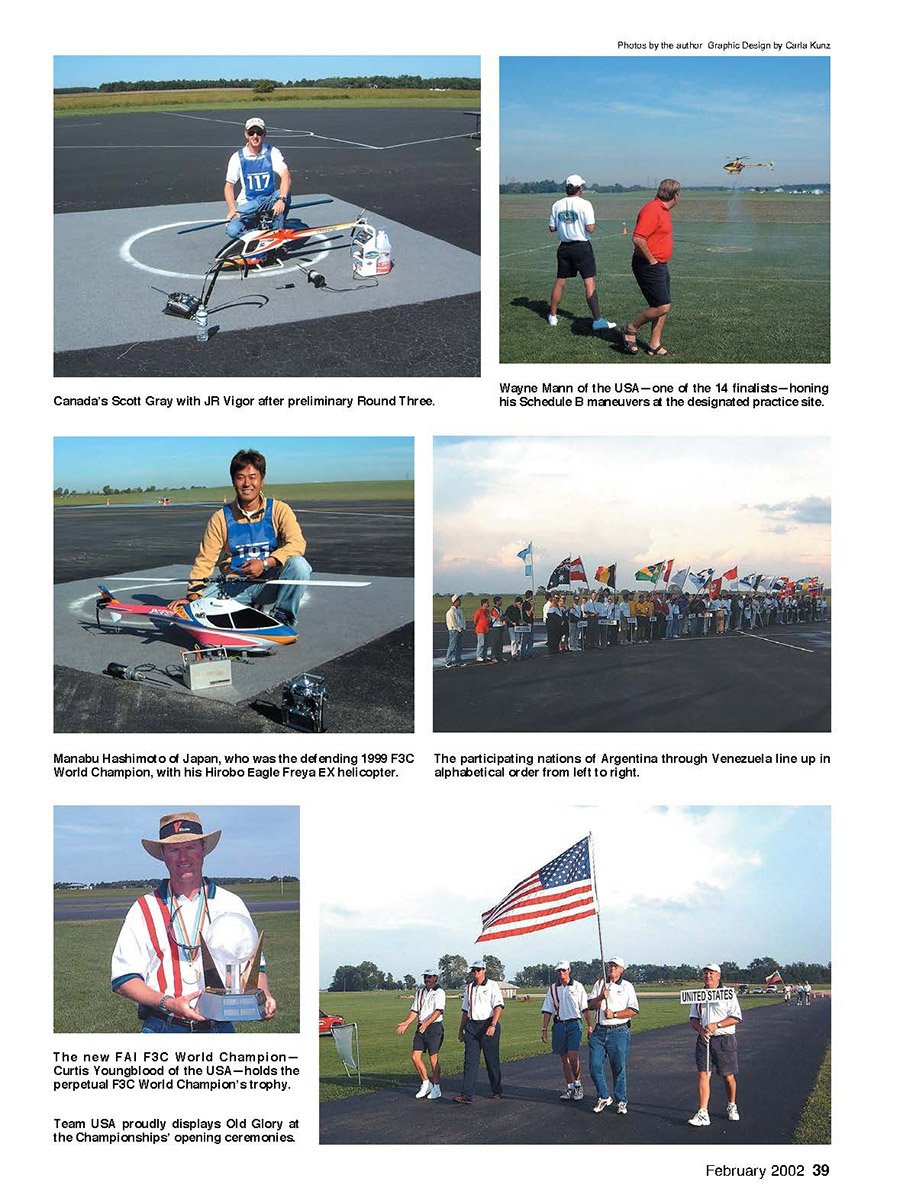
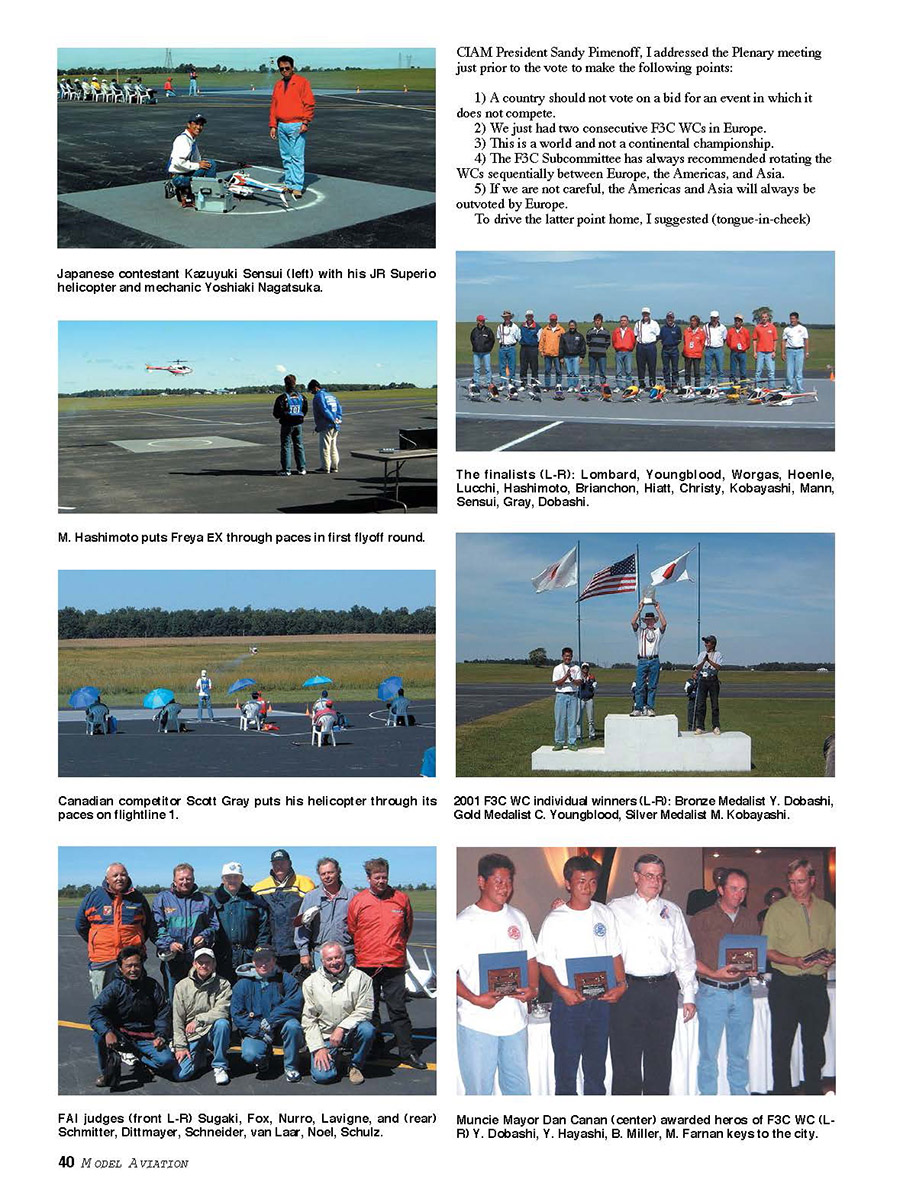
The main awards ceremony took place on the flying field. The individual FAI Bronze, Silver, and Gold Medals were presented to Yukihiro Dobashi of Japan, Minoru Kobayashi of Japan, and Curtis Youngblood of the USA respectively.
The perpetual F3C World Champion Trophy sponsored by the Japanese R/C magazine was presented to Curtis Youngblood.
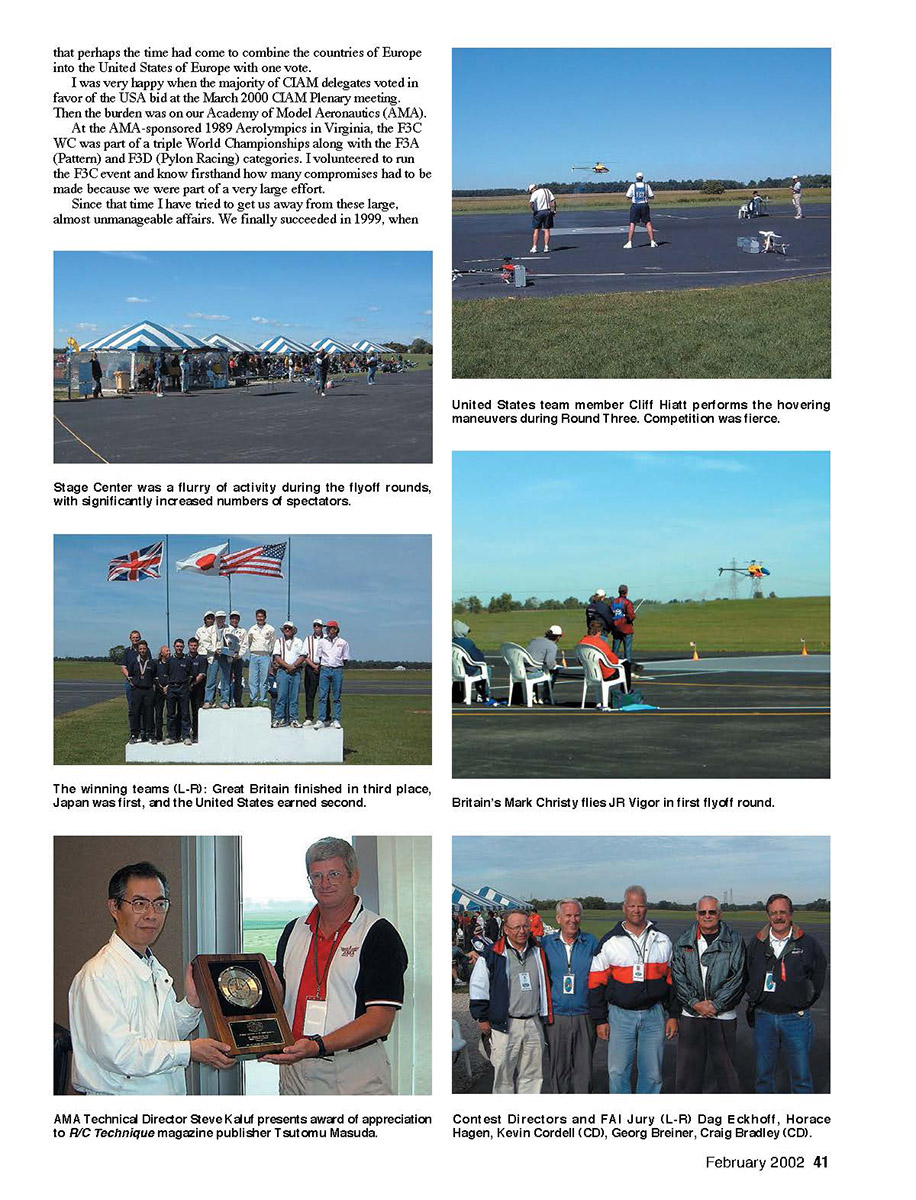
This was followed by the presentation of the FAI Bronze, Silver, and Gold Medals to team managers of the British, American, and Japanese teams respectively.
The perpetual F3C World Champion Team Trophy, also sponsored by R/C Japan, was presented to the first-place Japanese team.
Additional trophies and medals from the organizers were presented at the banquet. And the closing ceremony took place in the banquet hall of the Cardinal Hills Family Restaurant.
The main F3C World Championship experienced a number of firsts since Radio Control Helicopters became a world-class event in 1985. Most important was the use of two flightlines, which definitely improved the FAI judges' morale.
It allowed for more after-hours socializing among all participants, and had the side benefit of allowing us to start a round in the middle of the day after a heavy rain and still finish before dusk.
We had a record number of protests; one was withdrawn, and two were upheld in favor of the competitors.
Our F3C was the first to be held in the new AMA Headquarters building. The reigning F3C European Champion Ruediger Feil of Germany was unable to participate. The tragic events in New York City, Washington DC, and Pennsylvania almost stopped the Championships.
Yasuhiro Hayashi and Yukihiro Dobashi of Japan rescuing two children and four adults from drowning in a nearby reservoir.
Each of those four brave gentlemen received a special Key to the City of Muncie award from Mayor Dan Canan at the banquet.
Using two flightlines required the following additional resources:
- A very large area that could handle two simultaneous flightlines;
- Two transmitter impounds with associated manpower and frequency monitors;
- Two flightline directors;
- Double the support personnel; and
- 10 judges and their associated travel, lodging, and meal expenses.
The organizers did a masterful job of obtaining the necessary equipment and manpower. The AMA facility was very well suited for the contest. Most participants were in one of the show sites of the AMA property.
A competition this size can only be successful because of the hard work done by the staff of the Aeromodelling section (AMA) of the National Aeroclub (NAA) and many volunteers. IRCHA's help is also gratefully acknowledged.
We owe them all a big "thank you" for a job very well done. Following is a list of the key people and their functions:
- Steve Kaluf — AMA Technical Director and support staff, overall program
- Lisa Johnson — AMA administrative assistant, financials
- Liz Helms — AMA web site
- Dan Monroe — computer scoring
- Steve Herring — score collector, FL-1 and FL-2
- Craig Braley — Contest Director
- Steve Rhodes — Flightline Coordinator
- Dan Williams — transmitter impound
- Richard Sabin — timer
- Richie Sabin — score runner
- Matt Rohrk — overflight judge
Other volunteers included: Kevin Cordell — Contest Director (assistant), Tom Erb — Flightline Coordinator, Don and Naomi Griffin — transmitter impound, Nob Murakami — timer, Tom Johnson — score runner, and Ben Minor — overflight judge.
International jury members included: Dwight Shilling, Wendel Atkins, and Len Sabato.
Team managers and additional officials: Manfred Dittmayer — Austria; Phillip Noce — Canada; John Pekka Nurro — Finland; Jean Claude Lavigne — France; Tobias Schulz — Germany; Jeremy Fox — Great Britain; Ryokazu Sugiki — Japan; Frits Van Laar — Netherlands; Juerg Schneider — Switzerland; and Al Schneider — USA.
The Jury: George Breiner — Austria, Dag Eckhoff — Norway, and me (Jury President).
Transcribed from original scans by AI. Minor OCR errors may remain.

