
Horizon Hobby Blade Nano CP X
Greg Alderman
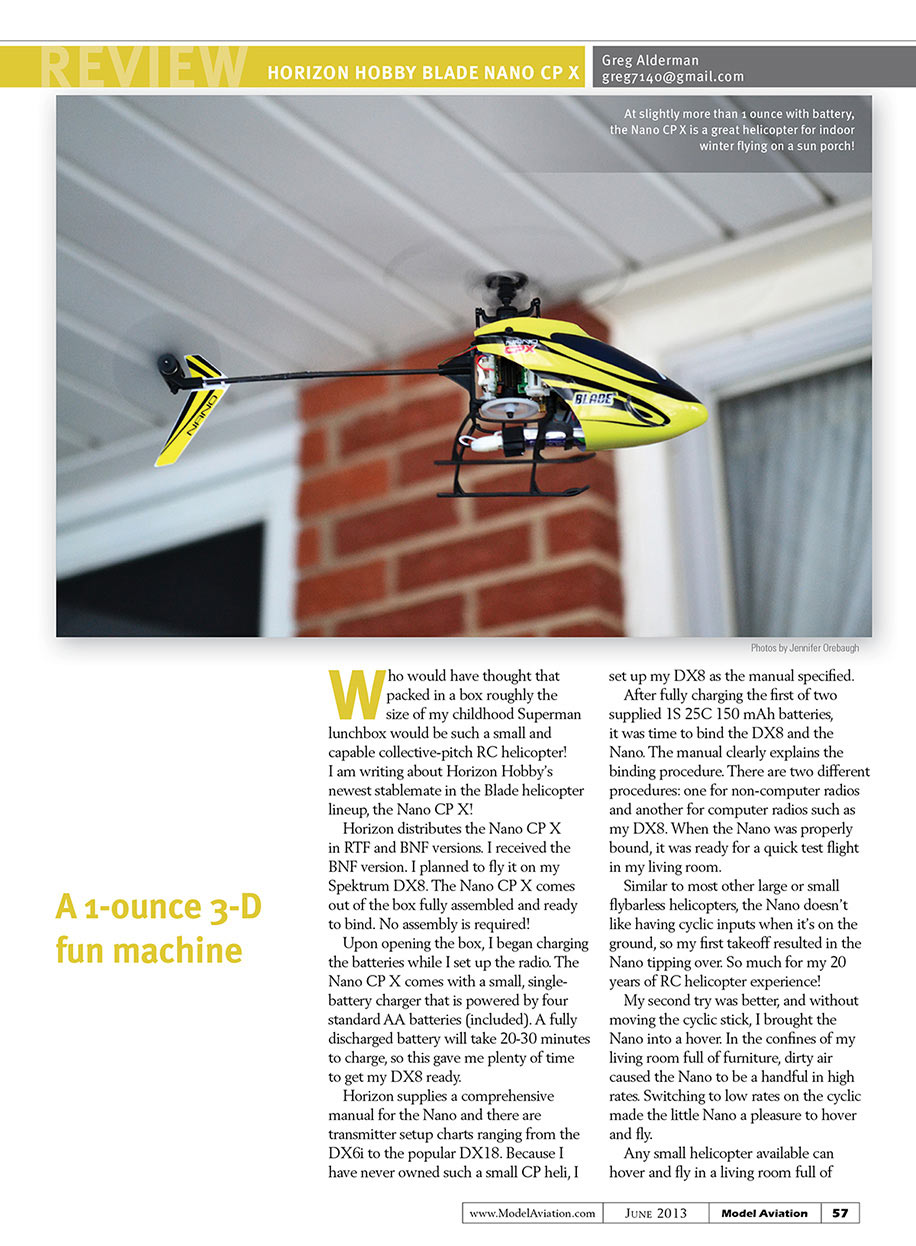
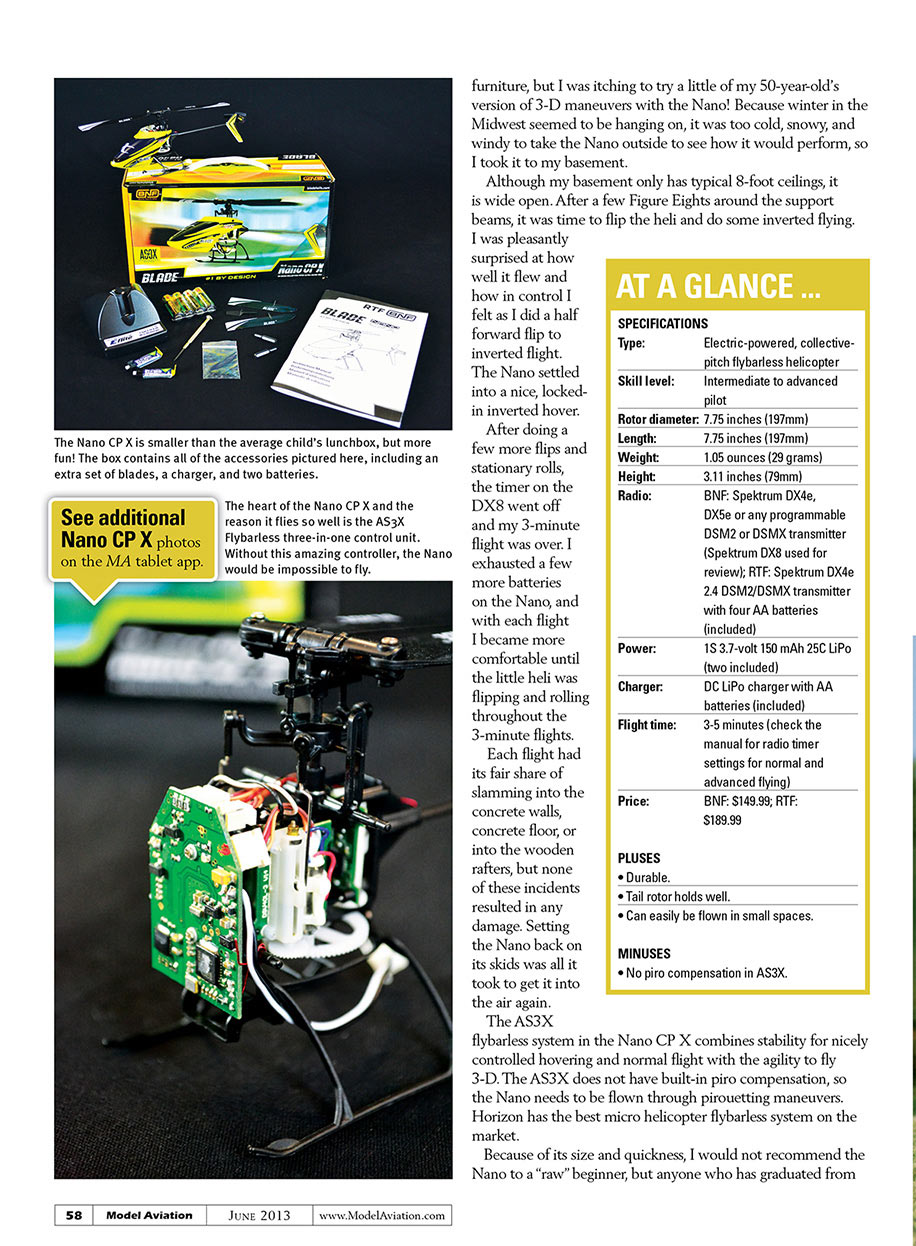
Who would have thought that packed in a box roughly the size of my childhood Superman lunchbox would be such a small and capable collective-pitch RC helicopter! I am writing about Horizon Hobby's newest stablemate in the Blade helicopter lineup, the Nano CP X!
Horizon distributes the Nano CP X in RTF and BNF versions. I received the BNF version. I planned to fly it on my Spektrum DX8. The Nano CP X comes out of the box fully assembled and ready to bind. No assembly is required!
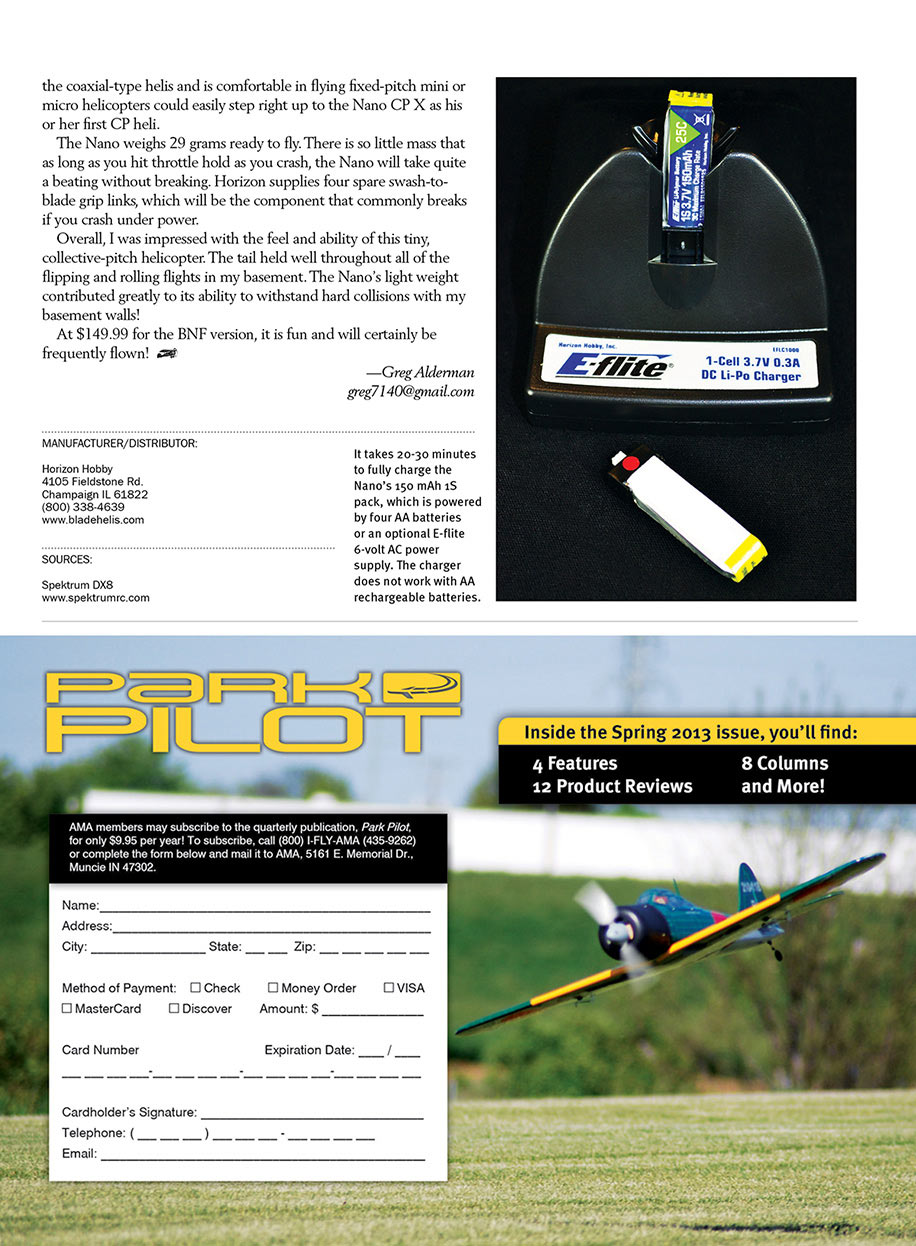
Upon opening the box, I began charging the batteries while I set up the radio. The Nano CP X comes with a small, single-battery charger that is powered by four standard AA batteries (included). A fully discharged battery will take 20–30 minutes to charge, so this gave me plenty of time to get my DX8 ready.
Horizon supplies a comprehensive manual for the Nano and there are transmitter setup charts ranging from the DX6i to the popular DX18. Because I have never owned such a small CP heli, I set up my DX8 as the manual specified.
After fully charging the first of two supplied 1S 25C 150 mAh batteries, it was time to bind the DX8 and the Nano. The manual clearly explains the binding procedure. There are two different procedures: one for non-computer radios and another for computer radios such as my DX8. When the Nano was properly bound, it was ready for a quick test flight in my living room.
Similar to most other larger or small flybarless helicopters, the Nano doesn't like having cyclic inputs when it's on the ground, so my first takeoff resulted in the Nano tipping over. So much for my 20 years of RC helicopter experience!
My second try was better, and without moving the cyclic stick, I brought the Nano into a hover. In the confines of my living room full of furniture, dirty air caused the Nano to be a handful in high rates. Switching to low rates on the cyclic made the little Nano a pleasure to hover and fly.
Any small helicopter available can hover and fly in a living room full of furniture, but I was itching to try a little of my 50-year-old's version of 3-D maneuvers with the Nano! Because winter in the Midwest seemed to be hanging on, it was too cold, snowy, and windy to take the Nano outside to see how it would perform, so I took it to my basement.
Although my basement only has typical 8-foot ceilings, it is wide open. After a few Figure Eights around the support beams, it was time to flip the heli and do some inverted flying. I was pleasantly surprised at how well it flew and how in control I felt as I did a half forward flip to inverted flight. The Nano settled into a nice, locked-in inverted hover.
After doing a few more flips and stationary rolls, the timer on the DX8 went off and my 3-minute flight was over. I exhausted a few more batteries on the Nano, and with each flight I became more comfortable until the little heli was flipping and rolling throughout the 3-minute flights.
Each flight had its fair share of slamming into the concrete walls, concrete floor, or into the wooden rafters, but none of these incidents resulted in any damage. Setting the Nano back on its skids was all it took to get it into the air again.
The AS3X flybarless system in the Nano CP X combines stability for nicely controlled hovering and normal flight with the agility to fly 3-D. The AS3X does not have built-in piro compensation, so the Nano needs to be flown through pirouetting maneuvers. Horizon has the best micro helicopter flybarless system on the market.
Because of its size and quickness, I would not recommend the Nano to a "raw" beginner, but anyone who has graduated from the coaxial-type helis and is comfortable in flying fixed-pitch mini or micro helicopters could easily step right up to the Nano CP X as his or her first CP heli.
The Nano weighs 29 grams ready to fly. There is so little mass that as long as you hit throttle hold as you crash, the Nano will take quite a beating without breaking. Horizon supplies four spare swash-to-blade grip links, which will be the component that commonly breaks if you crash under power.
Overall, I was impressed with the feel and ability of this tiny, collective-pitch helicopter. The tail held well throughout all of the flipping and rolling flights in my basement. The Nano’s light weight contributed greatly to its ability to withstand hard collisions with my basement walls!
At $149.99 for the BNF version, it is fun and will certainly be frequently flown!
—Greg Alderman [email protected]
MANUFACTURER/DISTRIBUTOR: Horizon Hobby 4105 Fieldstone Rd. Champaign IL 61822 (800) 338-4639 www.bladehelis.com
SOURCES: Spektrum DX8 www.spektrumrc.com
It takes 20–30 minutes to fully charge the Nano’s 150 mAh 1S pack, which is powered by four AA batteries or an optional E-flite 6-volt AC power supply. The charger does not work with AA rechargeable batteries.
Transcribed from original scans by AI. Minor OCR errors may remain.

