
Building Separable Wingtips
By Joe Beshar
An accurate, hassle-free method of segmenting aircraft components
One of my recent projects has been building a turbine-powered model of a full-scale aircraft designed by the Germans and scheduled to be flown in 1946. Construction of the first Messerschmitt P.1112 was halted during World War II by the invasion of US troops in April 1945.
I became interested in the P.1112 when I learned that shortly after the war its designer, Waldemar Voigt, found employment with Chance Vought in the U.S. It is no coincidence that the Navy F7U-1 Cutlass features the P.1112's wing design.
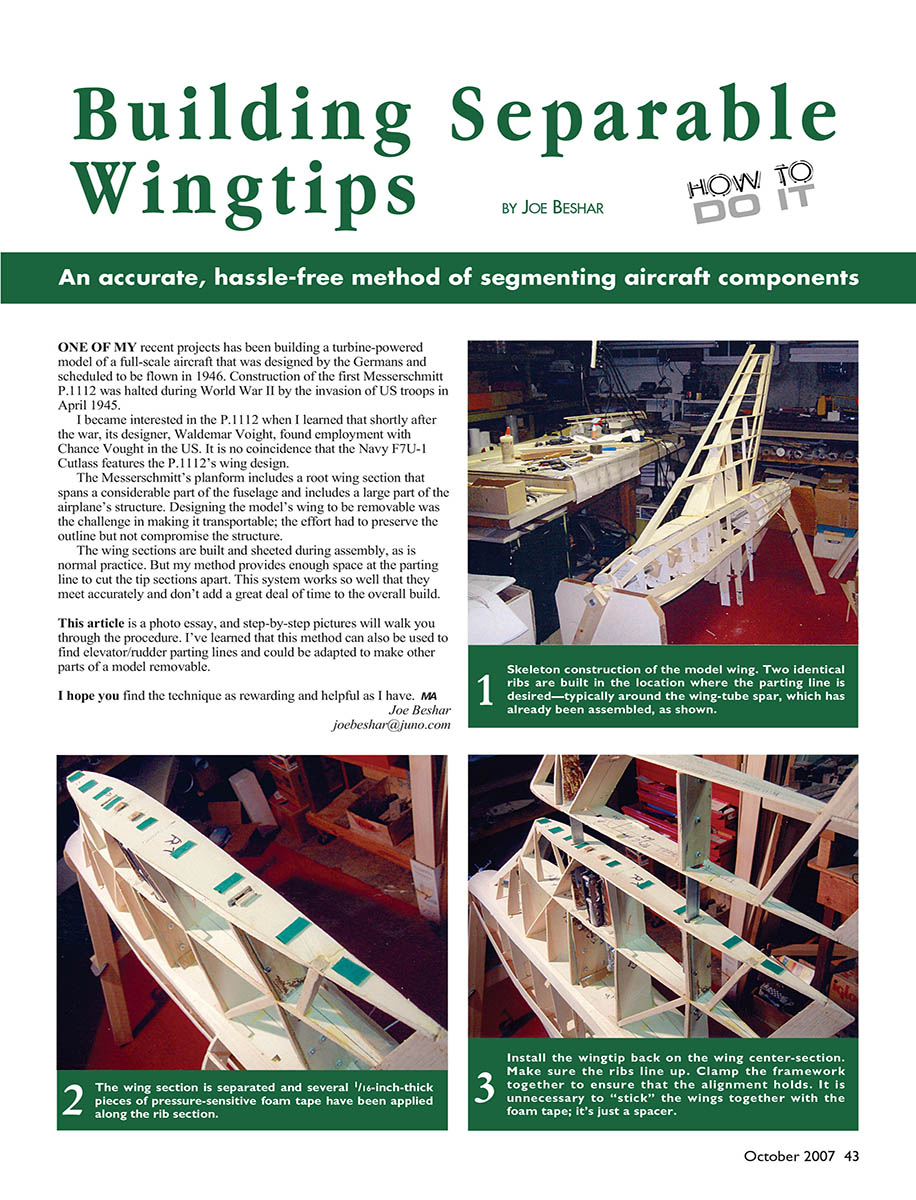
The Messerschmitt's planform includes a root wing section that spans a considerable part of the fuselage and contains a large portion of the airplane's structure. Designing the model's wing to be removable was the challenge in making it transportable; the effort had to preserve the outline without compromising the structure.
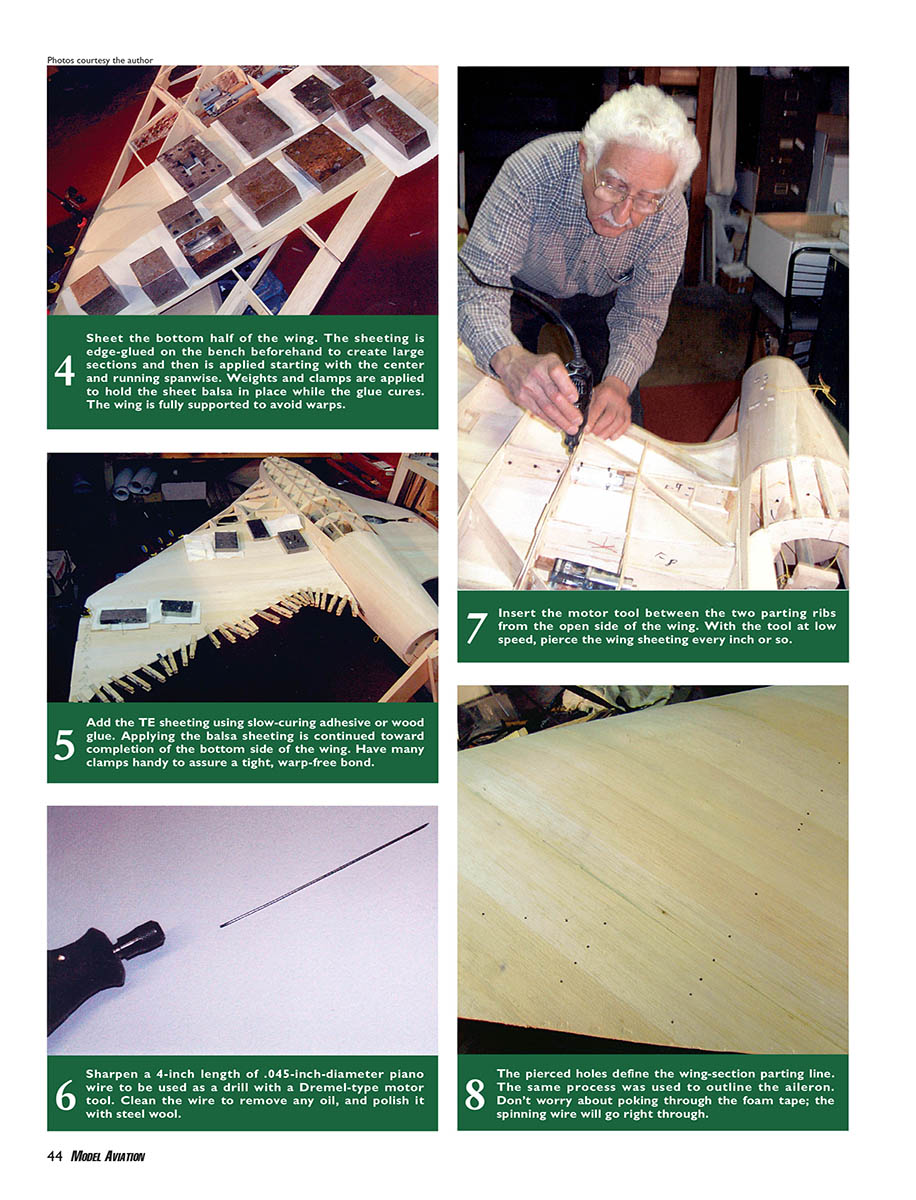
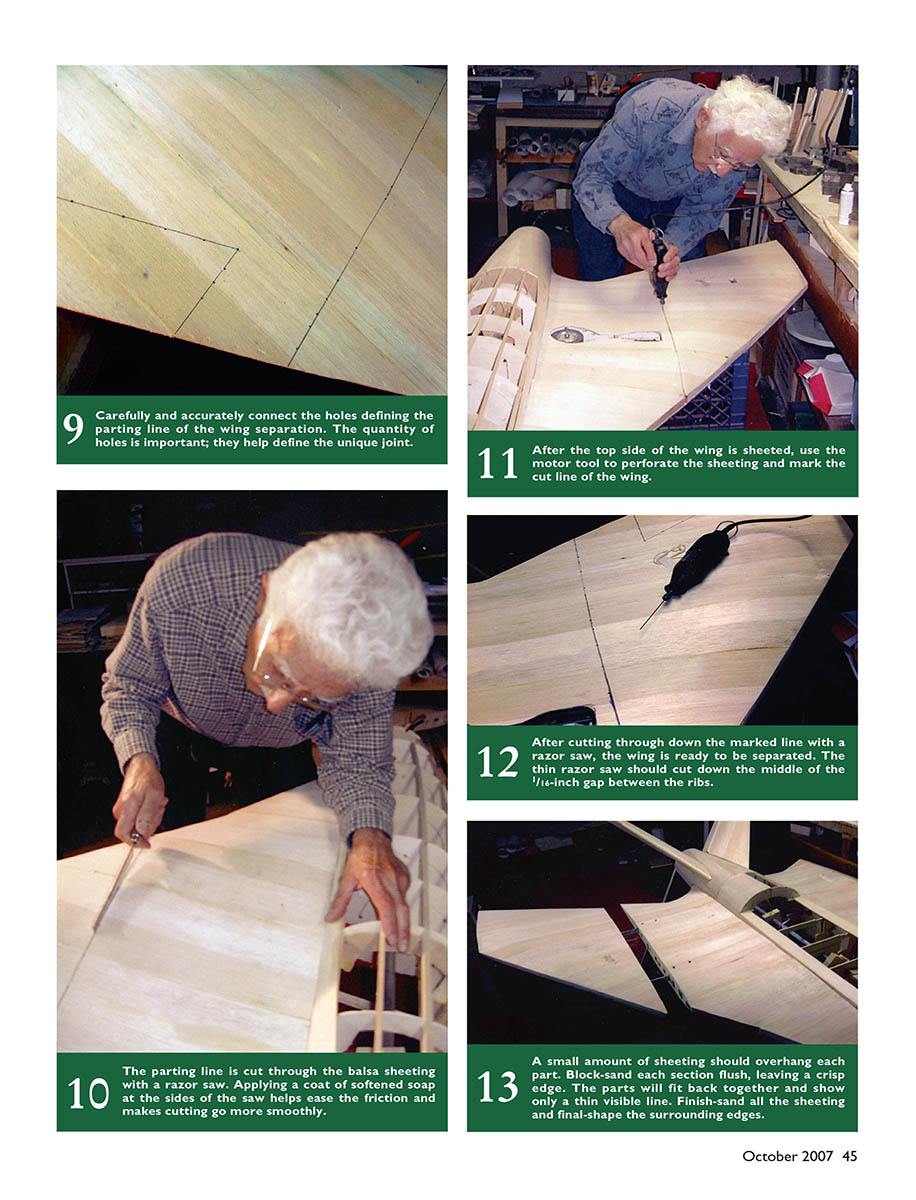
The wing sections are built and sheeted during assembly, as is normal practice. My method provides enough space at the parting line to cut the tip sections apart. This system works so well that the parts meet accurately and it doesn't add much time to the overall build.
This article is a photo essay; step-by-step pictures walk you through the procedure. I've learned that this method can also be used to find elevator/rudder parting lines and could be adapted to make other parts of a model removable. I hope you find the technique as rewarding and helpful as I have.
— Joe Beshar [email protected]
Procedure
- Sheet the bottom half of the wing. Edge-glue the sheeting on the bench beforehand to create large sections, then apply starting at the center and running spanwise. Use weights and clamps to hold the sheet balsa in place while the glue cures. Fully support the wing to avoid warps.
- Add the trailing-edge (TE) sheeting using a slow-curing adhesive or wood glue. Continue applying balsa sheeting toward completion of the bottom side of the wing. Have many clamps on hand to assure a tight, warp-free bond.
- Prepare a 4-inch length of .045-inch-diameter piano wire as a drill bit for a Dremel-type motor tool. Sharpen one end, clean the wire to remove any oil, and polish it with steel wool.
- Insert the motor tool (with the prepared wire) between the two parting ribs from the open side of the wing. With the tool at low speed, pierce the wing sheeting every inch or so.
- The pierced holes define the wing-section parting line. Use the same process to outline the aileron if needed. Don't worry about poking through foam tape; the spinning wire will go right through.
- Carefully and accurately connect the holes to define the continuous parting line for the wing separation. The number and placement of holes are important; they help define a unique, precise joint.
- Cut along the parting line through the balsa sheeting with a razor saw. Applying a coat of softened soap to the sides of the saw helps reduce friction and makes cutting go more smoothly.
- After the top side of the wing is sheeted, use the motor tool to perforate the top sheeting and mark the cut line of the wing.
- Cut down the marked line with a razor saw. The wing should now be ready to separate. The thin razor saw should cut down the middle of the 1/16-inch gap between the ribs.
- A small amount of sheeting should overhang each separated part. Block-sand each section flush, leaving a crisp edge. The parts will fit back together and show only a thin visible line. Finish-sand all sheeting and final-shape the surrounding edges.
Transcribed from original scans by AI. Minor OCR errors may remain.

