
Ship Model Aircraft Successfully
by Fred Randall
Tips for sending your large assembled treasures across the country
I was kidding—or perhaps I only thought I was. When MA editor Michael Ramsey expressed a desire to fly my Golden Era 60 Bipe (the subject of a February 2009 MA RC construction article), I replied by e-mail, “Fine … I’ll ship it and you can test fly it!” I hadn’t expected the reply I got.
“I double-dog dare ya!” he wrote.
I try to be a sensible person, but I took this as a challenge. I suppose it has something to do with my Celtic ancestry.
“I’m serious; where do you want it sent!?” I e-mailed back. So it began.
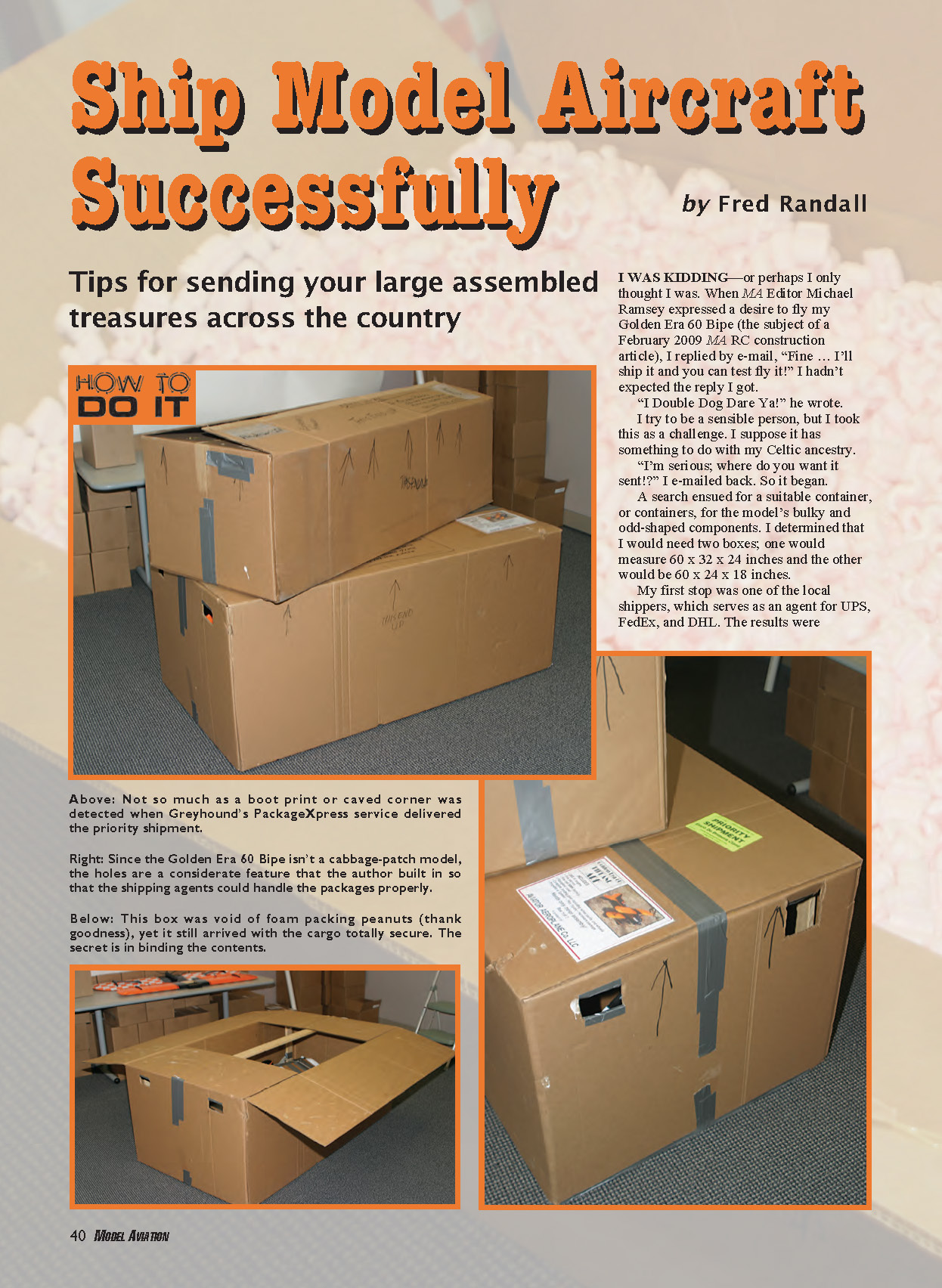
A search ensued for a suitable container, or containers, for the model’s bulky and odd-shaped components. I determined that I would need two boxes; one would measure 60 x 32 x 24 inches and the other would be 60 x 24 x 18 inches.
My first stop was one of the local shippers, which serves as an agent for UPS, FedEx, and DHL. The results were disappointing; it had no boxes big enough for the airplane’s parts.
Not only that, but the clerk informed me that neither UPS nor DHL nor FedEx handles packages that large. UPS would ship the smaller of the two boxes for $200—more than I wanted to pay. Besides, I wanted to keep the boxes together.
Now I had two problems: finding containers for the Golden Era and finding a shipper to take them to AMA Headquarters in Muncie, Indiana!
I searched the Internet and found a website proclaiming that it could box and ship almost anything. Prominently displayed on the home page was a picture of a 1/4-scale, maybe larger, Extra 300 fuselage, mounted on a wooden pallet and ready for shipping. Terrific!
It was Sunday, so I e-mailed the company, explaining my dilemma in detail. Monday morning, I received a phone call from a gentleman who represented the shipping company. He said he would be able to accommodate the biplane. Including pickup at my home, on-site crating, materials, labor, and transportation to Muncie, the cost would come to only $800.
I told him I'd check with “my people” and get back to him. The price was way more than I wanted to pay, and I gave up on that option. I got back on the Internet and looked for a source for containers.
After many telephone calls and e-mails, with less than encouraging results, I received a return e-mail from Custom Made Boxes in Des Moines, Iowa. I was informed that the company could provide custom-made, double-thick corrugated boxes for the model at a reasonable cost.
After a series of e-mails and telephone calls between Kim Weiler and me, I ordered the boxes. The cost, including shipping to Uxbridge, Massachusetts, was just less than $100.
While I waited for the boxes to arrive, I checked trucking companies, asking for the cost of shipping the packages to AMA Headquarters (a distance of 893.3 miles, according to MapQuest). I figured a weight of a bit less than 100 pounds for the two packages.
I received quotes that were in the neighborhood of $300 from all of the shippers, and I'd have to take the boxes to the terminal. All cited the cost of diesel fuel at well more than $4 per gallon as the reason for the high price.
I exchanged e-mails with Michael Ramsey, discussing the problem. One of his suggestions was to check with the Greyhound (bus lines) PackageXpress. I'll tell you more about this later.
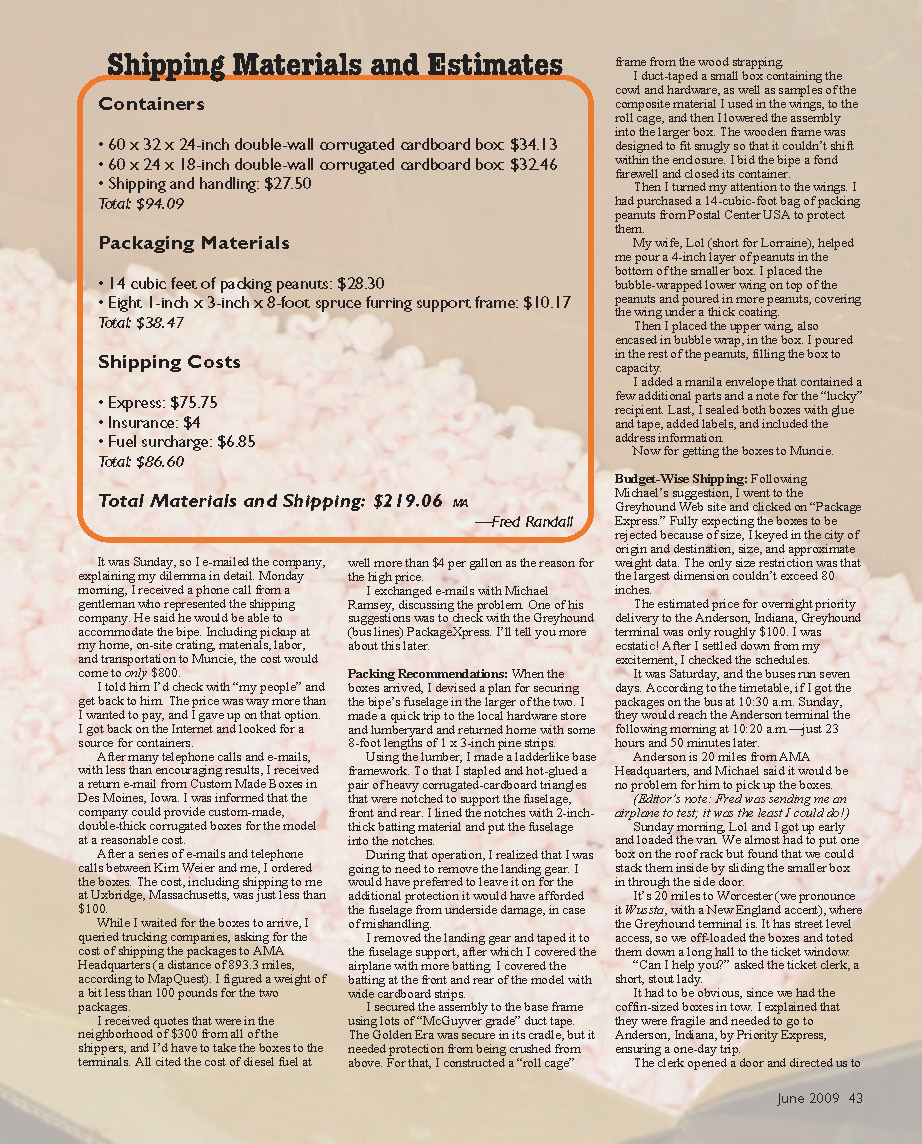
Shipping Materials and Estimates
Containers
- 60 x 32 x 24-inch double-wall corrugated cardboard box: $34.13
- 60 x 24 x 18-inch double-wall corrugated cardboard box: $32.46
- Shipping and handling: $27.50
Total: $94.09
Packaging Materials
- 14 cubic feet of packing peanuts: $28.30
- Eight 1-inch x 3-inch x 8-foot spruce furring support frames: $10.17
Total: $38.47
Shipping Costs
- Express: $75.75
- Insurance: $4.00
- Fuel surcharge: $6.85
Total: $86.60
Total Materials and Shipping: $219.06
Packing recommendations
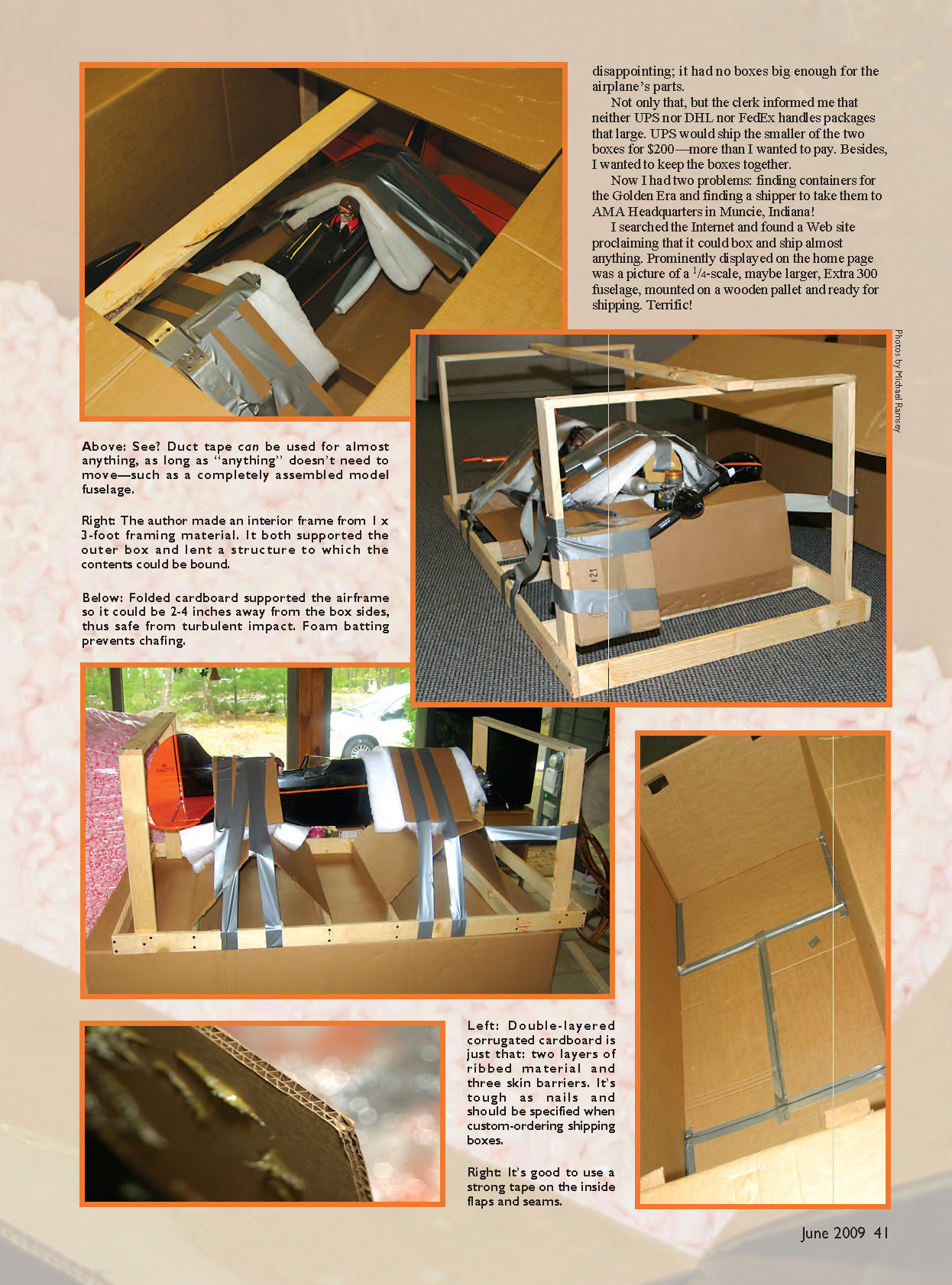
When the boxes arrived, I devised a plan for securing the biplane's fuselage in the larger of the two. I made a quick trip to the local hardware store and lumberyard and returned home with some 1 x 3-inch pine strips.
Using the lumber, I made a ladderlike base framework. To that I stapled and hot-glued a pair of heavy corrugated-cardboard end triangles that were notched to support the fuselage, front and rear. I lined the notches with 2-inch batting material and put the fuselage into the notches.
During that operation, I realized that I was going to need to remove the landing gear. I would have preferred to leave it on for the additional protection it would have afforded the fuselage from underside damage, in case of mishandling.
I removed the landing gear and taped it to the fuselage support, after which I covered the assembly with cardboard and secured it with strapping tape.
I duct-taped a small box containing the cowl and hardware, as well as samples of the composite material I used in the wings, to the roll cage, and then I lowered the assembly into the larger box. The wooden frame was designed to fit snugly so that it couldn't shift within the ends closure. I bid the biplane a fond farewell and closed its container.
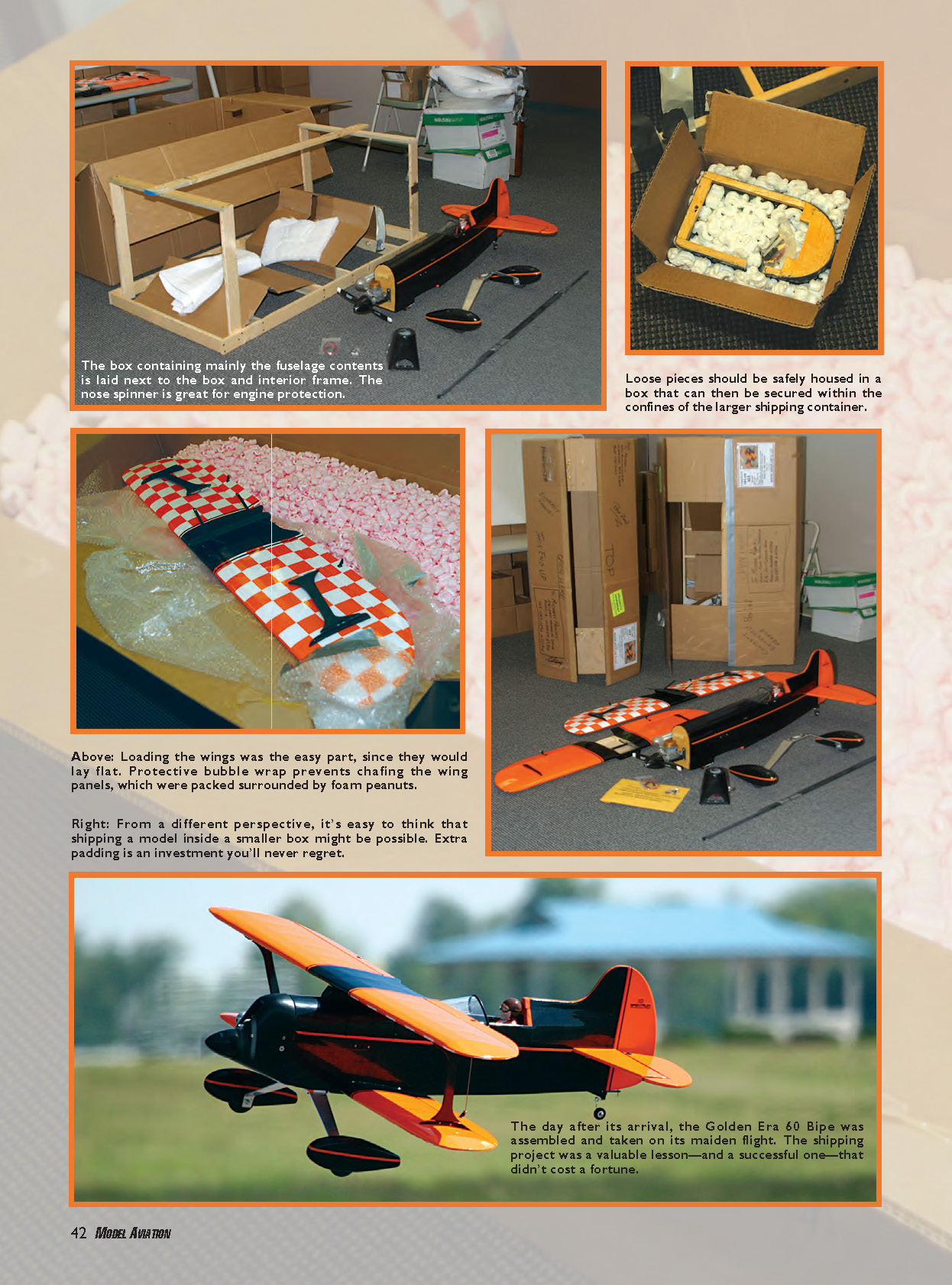
I then turned my attention to the wings. I had purchased a 14-cubic-foot bag of packing peanuts from Postal Center USA to protect them.
My wife, Lol (short for Lorraine), helped me pour a 4-inch layer of peanuts in the bottom of the smaller box. I placed the bubble-wrapped lower wing on top of the peanuts and poured in more peanuts, covering the wing under a thick coating.
Then I placed the upper wing, also encased in bubble wrap, in the box. I poured in the rest of the peanuts, filling the box to capacity.
I added a manila envelope that contained a few additional parts and a note for the “lucky” recipient. Last, I sealed both boxes with glue and tape, added labels, and included the address information.
Now for getting the boxes to Muncie.
Budget-wise shipping: Following Michael's suggestion, I went to the Greyhound website and clicked on "Package Express." Fully expecting the boxes to be rejected because of size, I keyed in the city of origin and destination, size, and approximate weight data. The only size restriction was that the largest dimension couldn't exceed 80 inches.
The estimated price for overnight priority delivery to the Anderson, Indiana, Greyhound terminal was only roughly $100. I was ecstatic! After I settled down from my excitement, I checked the schedules.
It was Saturday, and the buses run seven days. According to the timetable, if I got the packages on the bus at 10:30 a.m. Sunday, they would reach the Anderson terminal the following morning at 10:20 a.m.—just 23 hours and 50 minutes later.
Anderson is 20 miles from AMA Headquarters, and Michael said it would be no problem for him to pick up the boxes.
(Editor's note: Fred was sending me a plane to test; it was the least I could do.)
Sunday morning, Lol and I got up early and loaded the van. We almost had to put one box on the roof rack, but found that we could slide them inside by sliding the smaller box through the side door.
It is 20 miles to Worcester (we pronounce it Wus'ta, with a New England accent), where the Greyhound terminal is located. The terminal has street-level access, so we off-loaded the boxes and toted them down a long hall to the ticket window.
"Can I help you?" asked the ticket clerk, a short, stout woman.
I had to be obvious, since we had the coffin-sized boxes in tow. I explained that they were fragile and needed to go to Anderson, Indiana, by Priority Express. She looked at the boxes, shrugged, and said there would be no problem. She told us to bring the boxes inside.
Then a young man, who looked like he had had a rough night, entered and punched in for work. The lady told us that he was a new hire and that she would help him through the transaction.
"The contents are fragile and they must be in Anderson tomorrow!" I said again.
The man weighed the boxes on a portable electric scale and recorded them as 35 and 16 pounds. I was getting antsy, because it was almost 10:20 and the process was going at a snail's pace.
"The contents are fragile and they must be in Anderson tomorrow!" I reiterated.
I might as well have been talking to the tiled wall. The process crept along, until, at last, the clerk asked for my credit card. She swiped it, had me sign, said, "Thank you for using Greyhound!" and handed me a receipt.
Lol and I waited in the van outside the area where the buses offload and onload passengers, until a Greyhound arrived. After the people disembarked, a cart with the bipe boxes on it was trundled up. A large compartment was opened in the side of the bus, and it easily swallowed the boxes. The porter seemed to do his job with all possible care.
We waited for the bus to depart. I felt good on the way home, thinking that the model was in good hands.
Sunday passed, and Monday morning arrived. When the clock hit 10:45, I called the Anderson depot. A man with a curt attitude said that the boxes hadn't arrived. I was upset and asked where they might be. After a spate of verbal sparring, he gave me a number to call.
After the usual, "Your call is important to us ..." spiel, a woman answered. She asked for the order number. When I recited it to her, she said that the boxes weren't sent priority and that it could take anywhere between two and 10 days!
I am basically harmless but capable of a righteous rant when sufficiently agitated—and I was agitated! I explained to the poor woman in a less than polite tone that I had definitely requested priority shipping. Then I asked where the boxes were.
"We don't track non-priority shipments," she said apologetically.
If I was agitated before, I was now furious. I slammed the phone into the cradle with such force that the caller-ID box bounced off the side of the desk and clattered to the floor.
On the Internet, I located the telephone number of the Greyhound home office in Texas and dialed it. After the usual dose of elevator music, a woman with a pleasant voice and a Texas drawl answered.
Maintaining my cool, despite wanting to scream, I explained the situation.
She said softly, "Oh, you poor dear! I don't blame you for being upset. Unfortunately these things happen and what I suggest is to wait until 5:30 p.m. when the Anderson terminal reopens and call again. There's every chance your shipment will be there then. Is there anything else I can do for you?"
My mind raced; this wonderful, caring creature made me want to curl up in her lap and purr. I forced myself back to reality.
I called the Anderson terminal at 5:45 p.m. The same annoyed tone as before spilled from the telephone, and I was again propelled to high orbit. Almost before I could speak, he growled, "Not here," and hung up.
I was reminded of a recent conversation with a friend who had shipped auto parts to California via Greyhound. He said: "Took three weeks! I tried to get the location of my stuff, but nobody knew. I had just filed a claim with Greyhound when my contact in California called to tell me the box arrived and it was in good condition!"
I didn't know what to think. Had I made a huge mistake by sending my precious MA construction-article prototype by Greyhound? Exasperated beyond words, I got on the telephone with Michael Ramsey. He told me to calm down and that if anything happened to the airplane, it could be fixed.
"After all, we're modelers!" he said. "Handling little surprises is what we do!"
Somehow I felt better.
In the morning, Michael e-mailed me, reporting that the Golden Era Bipe was in Indianapolis and that, because the local bus service couldn't handle the packages' sizes, it would assign a courier service to deliver them directly to AMA Headquarters. Someone had finally read the "Priority Shipment" sticker on the box!
To my profound relief, the boxes arrived in perfect shape. Miracles do happen; all was well with the world again.
When the boxes were being prepared for shipping, a yellow "Priority Shipment" sticker was affixed to them as I requested. However, the new hire in Worcester made a mistake while checking in the packages; I was charged for standard (GLI) rather than priority (PPP) shipping, and the amount was $86.60.
I thought the lower price was because the combined weight was only half of what I had estimated using the website calculator. The result was that the Greyhound company's offices thought the shipment was GLI and handled my telephone queries accordingly. The people moving the packages saw the priority sticker and handled it appropriately.
As it turned out, the boxes arrived at AMA Headquarters the next day. That was one heck of a bargain!
Moral of the story
Maybe you will sell a model on eBay or need one shipped to a contest location. I'll fill you in on some things I've learned and advice you should take from my diary.
- Package the contents so that they can be stored at almost any angle. Even though the box might be marked "Top," the directions could be mistaken.
- Boxes with double-wall thickness are well worth the money. If you make your own boxes, line them with an extra layer of cardboard, attached with hot glue. Inside a rigid wood frame, the contents are less likely to endure a container collapse.
- Strap down loose items or store them inside an interior box. Untethered items could damage the other contents in the box.
- Protect the aircraft's finish against buffeting with soft material such as batting, polyethylene foam material, or bubble wrap. The airplane's outside points, such as the rudder, fin, and stabilizer, should be packed at least 1 inch from the container sides and shielded with a foam or soft cover in case the contents shift or the box is shocked.
- Ship with some lead time to allow for handling difficulties that can occur even with premium services.
Using Greyhound was a new experience, so tracking the shipment was more nerve-racking than it would have been otherwise. The employees did their jobs well—and at a price that no other professional carrier service was willing to offer.
I recommend this service, and I hope that this story will help you with any shipping dilemmas you might encounter.
Fred Randall [email protected]
Sources:
- Custom Made Boxes
(515) 309-6155 www.custommadeboxes.com
- Greyhound
(800) 739-5020 www.greyhound.com
- Postal Center USA
Transcribed from original scans by AI. Minor OCR errors may remain.

