
If It Flies...
Dean Pappas | [email protected]
Model aircraft and noise abatement
IF IT FLIES, I'm interested in it! It's always been that simple. This column is dedicated to the notion that there is a great deal of commonality throughout aeromodeling, so that fliers in one group, say CL Combat, will have something to offer, in technique or practice, to another group, such as those who are looking for their first building project after learning to fly with ARFs.
The approach we'd like to take is to try to answer questions and observations that come from you—yes, you. The assumption is that your questions will almost inevitably come from a variety of experience and skill levels in all facets of the hobby/sport, and that in answering them some useful cross-pollination between the far-flung corners of the hobby/sport might take place. Accidentally we might actually come up with a helpful answer.
I use the second-person "we" because I intend to pull information together from the great many experts I have met through the years. These experts range from FFers to turbine-jet fliers to kit designers, and they are all just "plane" crazy.
With your help, the questions and problems we work on will be as varied as the wonderful resources we have at hand. Until then I will fill in by discussing subjects I think deserve to be general knowledge. I hope that won't last too long!
The First Link
In the last installment I mentioned how the tuned-pipe exhaust for two-stroke engines has evolved from the groundbreaking but finicky and unreliable CL Speed setups pioneered by the late Bill Wisniewski into several different uses.
In one important application the tuned pipe is useful for creating quiet. Yes, quiet: that tacit quality that helps protect our flying sites and maybe our sense of hearing as well. Let's cover noise abatement for a bit in this installment.
Let's look at the big picture. Why would you want to make your model airplane quieter? Some things in life were not meant to be quiet. I can't imagine a quiet Top Fuel dragster, nor do the words "speedboat" and "quiet" go together. Monster trucks wouldn't be monsters without the roar, and I can't imagine an RC Pylon race or a CL Combat meet without the sound and fury. If you've never been to either of those two events, you must make the effort to get to one of each. Pylon, as was almost any form of racing, was created to be a spectator event, and CL Combat will make you feel like an ancient Roman watching gladiators. As I mentioned, some events just need the soundtrack that can only be provided by screaming engines! All those events have their fans, but, as with almost everything else, for everyone who thinks a Formula 1 engine revving 19,000 rpm is music, someone else thinks it is simply noise. The problem is not limited to model aviation. At nearby Englishtown Raceway Park, home of one of the big national-class drag races, there are those who endlessly try to put a stop to the racing. Fortunately good management at the track and some common sense on the part of the local courts maintains the status quo. Who builds a retirement home right next to an airport and a drag strip and then complains about the noise? Only a fool! Still, most model airfields have neighbors, and some of them prefer the quiet.
Everything we do when it comes to making our airplanes quiet as part of being good neighbors is aimed at satisfying a reasonable person. Maybe someday I'll tell you about the time I got thrown out of a local park for a noise complaint while flying a glider. For now let's limit ourselves to useful talk.
The Pareto Principle—Fix the Biggest Problem First
The sound quality that annoys the neighbors most is the "snarl" of the propeller tips. Sometimes you'll hear it called propeller howl or a "ripping" sound, but if it is there you'll know it. When it is absent, the airplane's sound is decidedly "softer."
This is a matter of opinion, but, noise meters and property-line noise ordinances notwithstanding, the goal of simply being a good neighbor is best served by getting rid of the propeller-tip snarl and fitting a half-decent muffler. Taking those steps ahead of time can help avoid the irritation that comes with angry neighbors. On to the technical stuff.
Propeller howl is caused by transonic airflow around the propeller tips. What's transonic? Depending on the blade shape and airfoil, the airflow around the propeller tip is faster than the propeller tip itself. Somewhere near six-tenths to three-quarters Mach, or the speed of sound, the local airflow will actually break the sound barrier because of the slightly greater distance it must travel to get around the propeller blade. These small sonic booms emanate from the propeller blade, and as the propeller whirls around an observer will hear the repeated beating of the sonic booms.
Drop that propeller-tip velocity slightly below the threshold of transonic behavior, and the noise changes dramatically. It drops in volume and changes sound quality. That's the "soft" sound we want.
Propeller-tip howl usually carries much farther than the noise coming from the muffler. This is true for most sport engines above a .30 or .35 size and for almost all high-rpm racing engines.
Where is the dividing line? It depends on the propeller, so the critical Mach number isn't a hard-and-fast number. It is likely somewhere between 0.60 and 0.75 times the speed of sound.
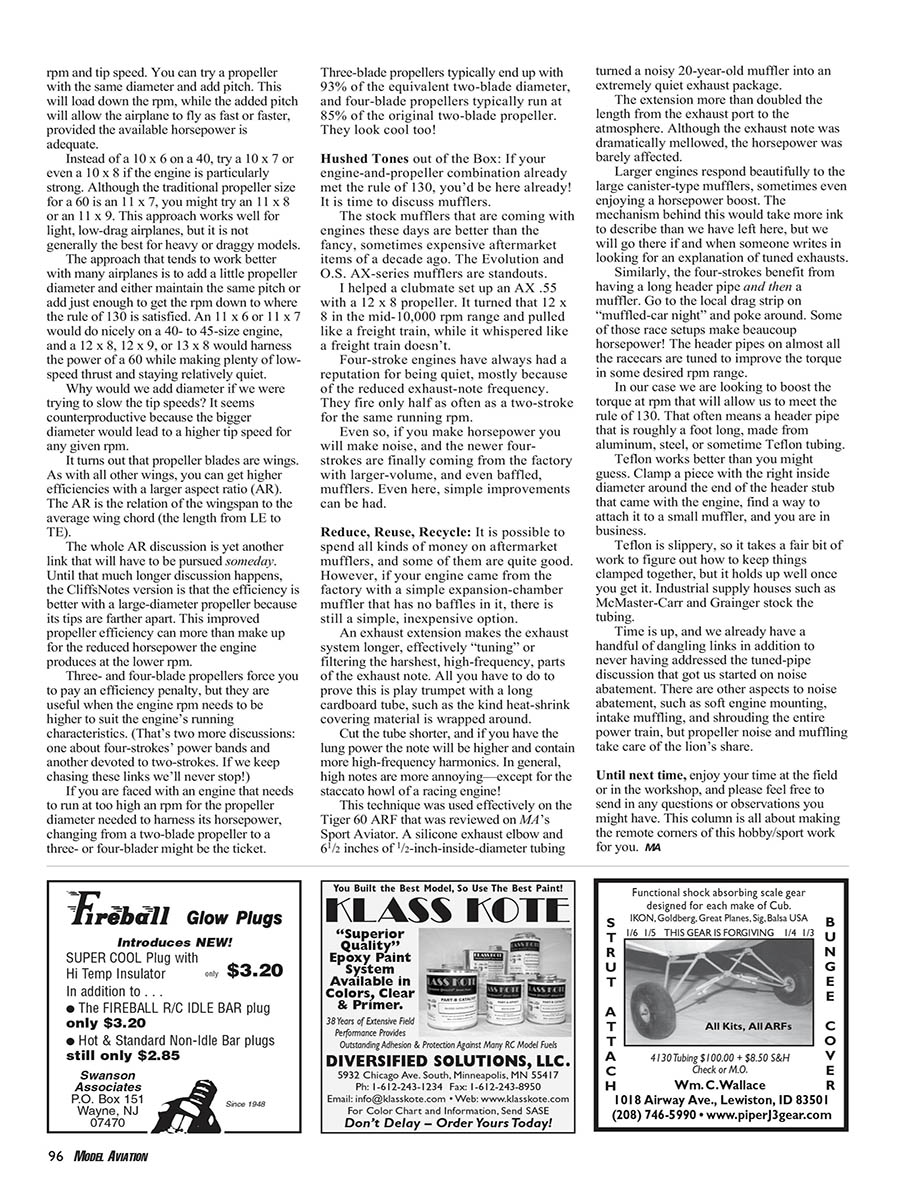
You could calculate the tip velocity and divide by the speed of sound and all that, but I know a simple method. I call it the rule of 130, and Ed Izzo first suggested it in the early 1980s.
Ed was the first AMA sound-reduction director and was credited with inventing the foam wing for model-airplane use more than 40 years ago. (There's a link we'll have to pursue in another installment.)
You multiply the propeller diameter in inches by the propeller rpm expressed in thousands, and compare the number to roughly 130:
- If the result is higher than about 140, the setup is usually loud.
- If it's less than about 130, the setup is typically extremely quiet.
Examples:
- A 12-inch-diameter propeller at 10,000 rpm: 12 × 10 = 120 — quiet.
- A 20-inch propeller at 7,000 rpm: 20 × 7 = 140 — likely loud unless throttled back a great deal.
It's time to pick a propeller that will fly at approximately the same airspeed as before the noise-reduction project while reducing the noise.
You can try a propeller with the same diameter and add pitch. This will load down the rpm, while the added pitch will allow the airplane to fly as fast or faster, provided the available horsepower is adequate.
- Instead of a 10 × 6 on a .40, try a 10 × 7 or even a 10 × 8 if the engine is particularly strong.
- Although the traditional prop size for a .60 is an 11 × 7, you might try an 11 × 8 or an 11 × 9.
This approach works well for light, low-drag airplanes, but it is not generally the best for heavy or draggy models.
The approach that tends to work better with many airplanes is to add a little propeller diameter and either maintain the same pitch or add just enough to get the rpm down to where the rule of 130 is satisfied. An 11 × 6 or 11 × 7 would do nicely on a .40–.45-size engine, and a 12 × 8, 12 × 9, or 13 × 8 would harness the power of a .60 while making plenty of low-speed thrust and staying relatively quiet.
Why would we add diameter if we were trying to slow the tip speeds? It seems counterproductive because the bigger diameter would lead to a higher tip speed for any given rpm.
It turns out that propeller blades are wings.
As with all other wings, you can get higher efficiencies with a larger aspect ratio (AR). The AR is the relation of the wingspan to the average wing chord (the length from leading edge to trailing edge).
The CliffsNotes version is that efficiency is better with a large-diameter propeller because its tips are farther apart. This improved propeller efficiency can more than make up for the reduced horsepower the engine produces at the lower rpm.
Three- and four-blade propellers force you to pay an efficiency penalty, but they are useful when the engine rpm needs to be higher to suit the engine's running characteristics.
If you are faced with an engine that needs to run at too high an rpm for the propeller diameter needed to harness its horsepower, changing from a two-blade propeller to a three- or four-blader might be the ticket.
- Three-blade propellers typically end up with about 93% of the equivalent two-blade diameter.
- Four-blade propellers typically run at about 85% of the original two-blade propeller.
They look cool too!
Hushed Tones out of the Box
If your engine-and-propeller combination already met the rule of 130, you'd be here already! It is time to discuss mufflers.
The stock mufflers that are coming with engines these days are better than the fancy, sometimes expensive aftermarket items of a decade ago. The Evolution and O.S. AX-series mufflers are standouts.
I helped a clubmate set up an AX .55 with a 12 × 8 propeller. It turned that 12 × 8 in the mid-10,000 rpm range and pulled like a freight train, while it whispered like a freight train doesn't.
Four-stroke engines have always had a reputation for being quiet, mostly because of the reduced exhaust-note frequency. They fire only half as often as a two-stroke for the same running rpm.
Even so, if you make horsepower you will make noise, and the newer four-strokes are finally coming from the factory with larger-volume, and even baffled, mufflers. Even here, simple improvements can be had.
Reduce, Reuse, Recycle
It is possible to spend all kinds of money on aftermarket mufflers, and some of them are quite good. However, if your engine came from the factory with a simple expansion-chamber muffler that has no baffles in it, there is still a simple, inexpensive option.
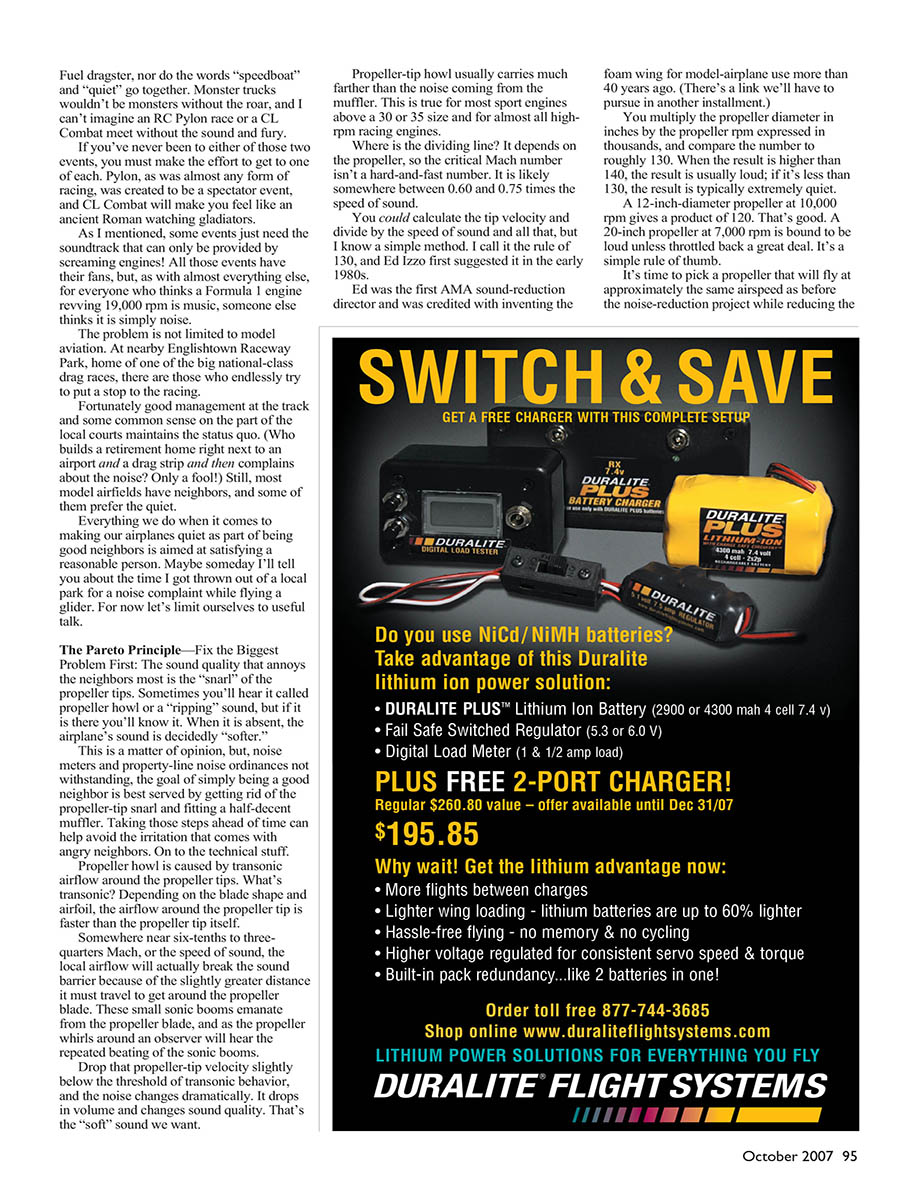
An exhaust extension makes the exhaust system longer, effectively "tuning" or filtering the harshest, high-frequency parts of the exhaust note. All you have to do to prove this is play trumpet with a long cardboard tube, such as the kind heat-shrink covering material is wrapped around.
Cut the tube shorter, and if you have the lung power the note will be higher and contain the higher-frequency harmonics. In general, high notes are more annoying—except for the staccato howl of a racing engine!
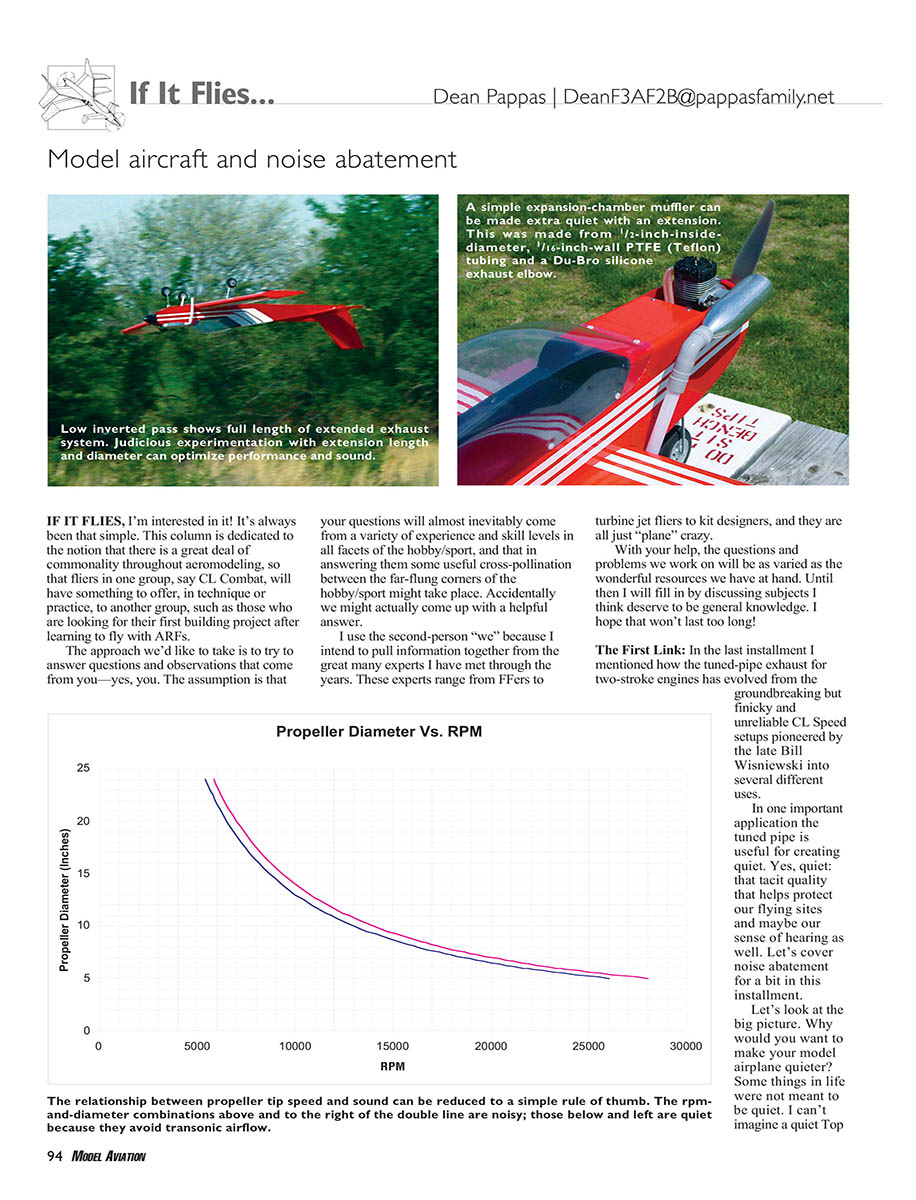
This technique was used effectively on the Tiger 60 ARF that was reviewed in MA's Sport Aviator. A silicone exhaust elbow and 6½ inches of 1/2-inch-inside-diameter tubing turned a noisy 20-year-old muffler into an extremely quiet exhaust package.
The extension more than doubled the length from the exhaust port to the atmosphere. Although the exhaust note was dramatically mellowed, the horsepower was barely affected.
Larger engines respond beautifully to the large canister-type mufflers, sometimes even enjoying a horsepower boost. The mechanical thinking behind this would take more ink to describe than we have left here, but we will go there if and when someone writes in looking for an explanation of tuned exhausts.
Similarly, four-strokes benefit from having a longer header pipe and then a muffler. Go to the local drag strip on "muffled-car night" and poke around. Some of those race setups make beaucoup horsepower! The header pipes on almost all the racecars are tuned to improve the torque in some desired rpm range. In our case we are looking to boost the torque at rpm that will allow us to meet the rule of 130. That often means a header pipe that is roughly a foot long, made from aluminum, steel, or sometimes Teflon tubing.
Teflon works better than you might guess. Clamp a piece with the right inside diameter around the end of the header stub that came with the engine, find a way to attach it to a small muffler, and you are in business.
Teflon is slippery, so it takes a fair bit of work to figure out how to lock the tubing in the clamped together, but it holds up well once you get it. Industrial supply houses such as McMaster-Carr and Grainger stock the tubing.
Time is up, and we already have a handful of dangling links in addition to never having addressed the tuned-pipe discussion that got us started on noise abatement. There are other aspects to noise abatement, such as:
- soft engine mounting,
- intake muffling, and
- shrouding the entire power train.
But propeller noise and muffling take care of the lion's share.
Until next time, enjoy your time at the field or in the workshop, and please feel free to send in any questions or observations you might have. This column is all about making the remote corners of this hobby/sport work for you.
MA
Transcribed from original scans by AI. Minor OCR errors may remain.

