
Sport modelers will find that this Ilyushin tank buster is armored for fun
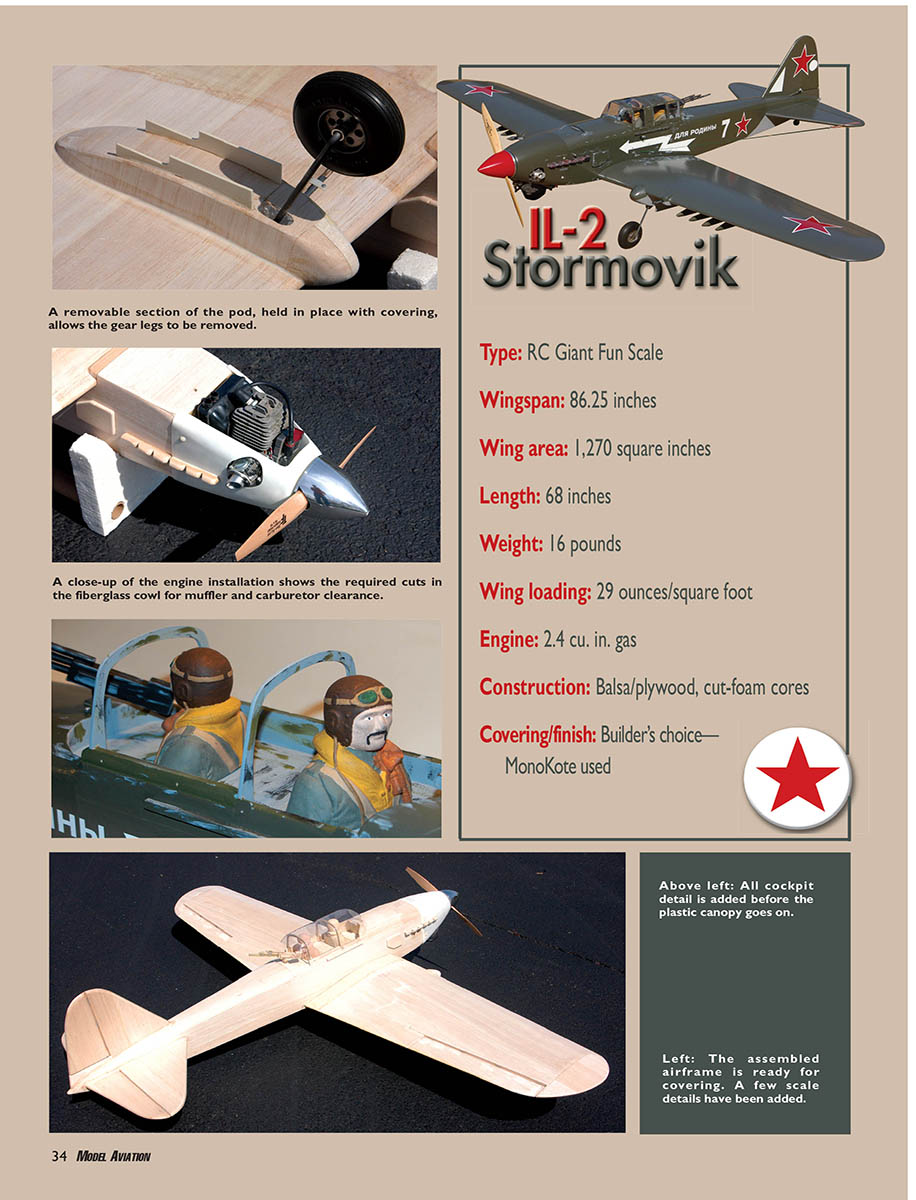
Easily recognized by World War II–airplane fans, this model is of the Russian Ilyushin Il-2 Stormovik ground-attack aircraft that worked so well during the war. More Stormoviks were built than any combat aircraft used by any other nation in the conflict.
The whole front half of the fuselage was built as an armored shell to protect the engine and the pilot; the later addition of a rear gunner made it even tougher. With cannons, machine guns, bombs, and rockets, the Stormovik was an effective machine.
Many design modifications were made during the Il-2’s production life, all improving its role as an attack weapon. It was said to be highly maneuverable for air-to-air combat, but few of the pilots were trained well enough to take advantage of its full capabilities.
Regardless of how well the aircraft did or didn’t do in real-world fighting, it makes an interesting and seldom-seen RC project. World War II fighters have always been popular with modelers, but some of us want something besides another Mustang, Thunderbolt, or Corsair.
I had always been aware of the variety of Russian fighters, and a few years ago I finally got around to designing a MiG-3; it was featured in the November 2004 MA. Now that I’ve done the MiG and the Stormovik, a future project may be one of the Soviet Yaks.
My RC version of the Stormovik stresses easy building and capable aerobatic performance with its thick airfoil and the "right" proportions, and there's enough scale detailing that can be added for the Fun Scale group.
This is not a true scale aircraft project; it's a good, practical sport/aerobatic machine that looks an awful lot like an Il-2. This airplane is scale enough that I believe it would be welcome at any warbird gathering, and casual sport fliers such as myself will find it easy to build and fly.
The Stormovik is fairly large. At 87 inches in wingspan, it has roughly 1,270 square inches of wing area. The prototype weighed 16 pounds dry, which gave it a wing loading of 29 ounces per square foot—not bad for a sorta-scale warbird that is intended to be flown in a lively and aerobatic manner.
I laid out the design at that wingspan and area because of the 2.4 cu. in. gas engine I planned to use. From experience with other airplanes I was confident that those numbers would result in the kind of performance I liked. There are many gas engines in this size range to choose from, or you could use a good-sized 1.8 or 2.1 cu. in. glow engine.
The construction uses hot-wire-cut foam wing cores, wingtip cores, fuselage top block cores, and tail-surface foam cores. I like working with foam and feel that this construction is quick, simple, economical, and reasonably light for these fun-scale projects.
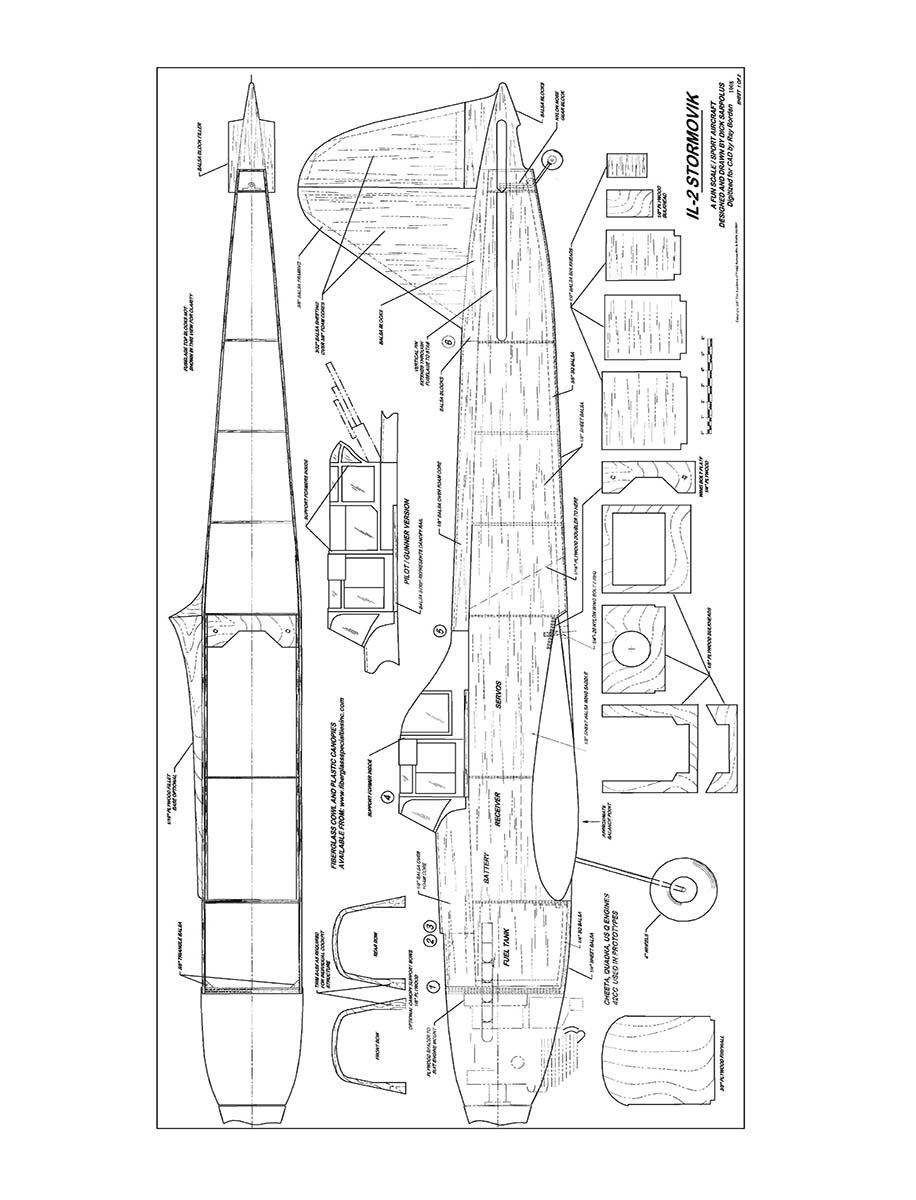
If you consider building this Stormovik, you'll want to know about a fiberglass cowl and plastic canopy. I made plugs for the two canopy styles: the pilot/gunner version and the pilot-only version. That was an interesting project in itself.
To make the plugs I used a center profile and several plywood bulkheads. I filled in the open spaces with urethane foam and then sanded the plugs to shape. To make the surface smooth and consistent I covered it with fiberglass cloth and epoxy, filled, sanded, and primed to the best of my ability.
I also made a plug for the fiberglass cowl. It's the same one that is used on my MiG-3, and that saved some time. The canopies and cowl are available from Fiberglass Specialties Inc. The company's contact information is at the end of the article.
Retractable landing gear is great in a World War II fighter model, but to keep the project simple I went with fixed gear bent from 1/4-inch music wire. It's easy and it works. The gear on the full-scale Stormovik folds up directly to the rear, not rotating, into a landing-gear fairing with the lower half of the wheel exposed after retraction.
A couple of nose-gear type units could be used, and Robart would probably have something in its large line of retracts that would work. But I like to keep the models light and uncomplicated for active sport flying, so I'll live with the fixed gear. I'll leave that upgrade to another modeler.
Even with some fun scale detailing added, my Stormovik, ready to fly without fuel, weighs 16 pounds. I went with iron-on MonoKote covering, mainly for light weight and no painting work.
My friend Lou McGuire built the single-pilot version of this model at the same time, and his is a bit heavier. The Stormoviks fly extremely well at these weights, so they would still perform okay for scale-type flying and heavier if you added scale details, a painted finish, and retractable landing gear. One of the MiG-3s weighed more than 20 pounds and flew fine.
IL-2 Stormovik - 2007/10
- Type: RC Giant Fun Scale
- Wingspan: 86.25 inches
- Wing area: 1,270 square inches
- Length: 68 inches
- Weight: 16 pounds
- Wing loading: 29 ounces/square foot
- Engine: 2.4 cu. in. gas
- Construction: Balsa/plywood, cut-foam cores
- Covering/finish: Builder's choice — MonoKote used
CONSTRUCTION
All the materials used are standard sizes of balsa and plywood. I've been buying my wood from Lone Star Balsa in Texas for many years and have always been pleased with the company's stuff.
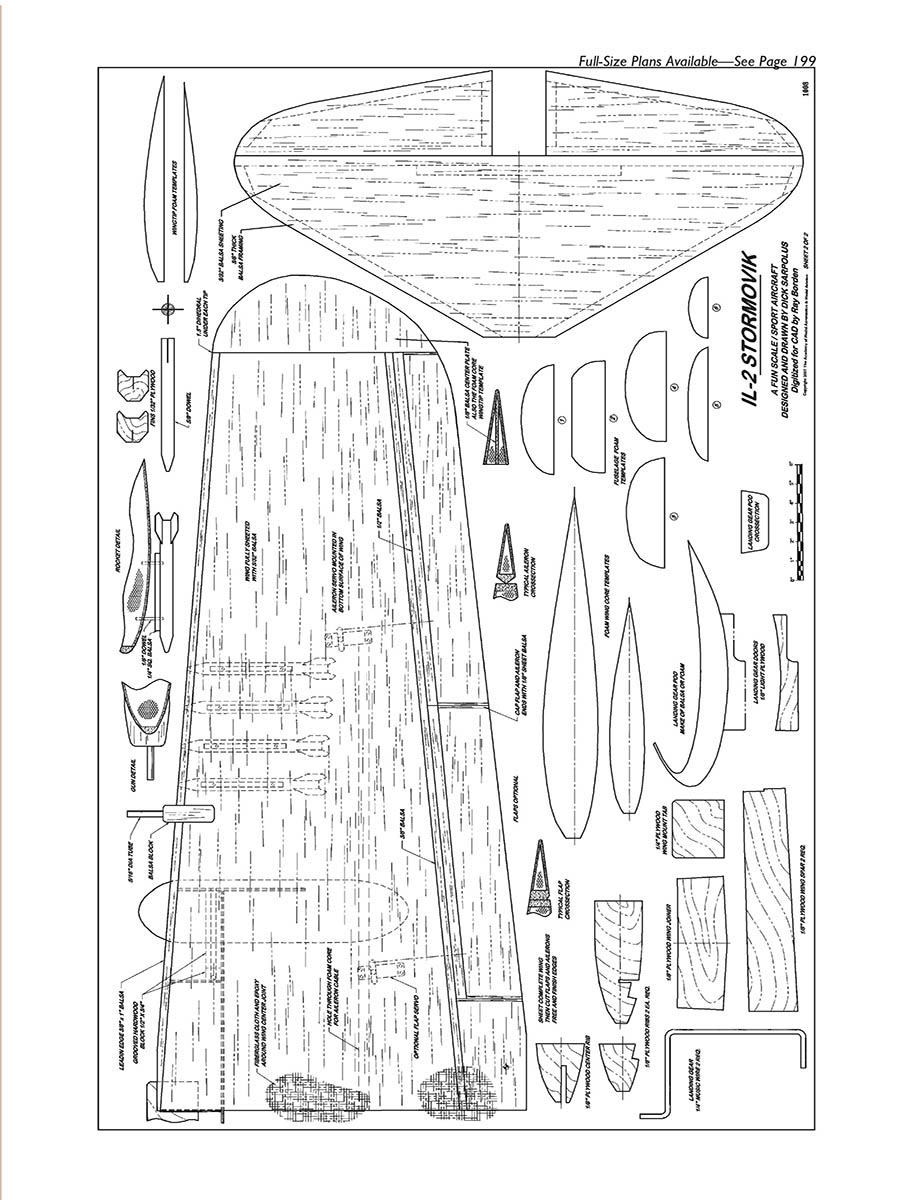
I cut the needed airframe parts from paper patterns and either cut up a second set of plans or traced the part outlines I needed and cut out the tracings. I draw around the patterns onto the balsa or plywood with a ballpoint pen, and I cut the parts out with my band saw or scroll saw.
I cut the grooved hardwood landing-gear blocks with my small Dremel table saw and use a K&S heavy-duty wire bender to form the 1/4-inch wire landing-gear pieces.
The template patterns for all the necessary foam-core parts are on the plans. I make my templates from 3/32 plywood. I do my cutting with a basic hot-wire box, nichrome wire, and a Variac power supply.
If you're not a foam-core scratch builder, maybe someone in your club can cut the foam for you or you can order all the necessary foam components from Robin's View Productions. If you want to try scratch-building a large airplane, the Stormovik is a reasonable one to try.
Wing
After you have the basic two wing panels, you have to cut them up to install the plywood landing-gear reinforcement pieces. I mark the cuts to be made on the foam and do the slicing on my band saw or by hand with a hacksaw blade. As the foam pieces come apart, I trim them for the landing-gear blocks and epoxy everything back together: the foam parts, plywood pieces, and landing-gear blocks.
The hardwood gear blocks should protrude 3/32 inch from the foam cores. I cut the sheeting to fit since it is contact-cemented to the foam wing cores. I sheet the wing with 3/32 balsa, edge-glued to obtain the necessary area. I use 3- or 4-inch-wide balsa, employing aliphatic resin glue because it's easy to handle and to sand for a smooth surface.
I get many questions about the wing sheeting. After sanding the edges for a good fit, tape the sheets together to get the width, flip the wood over, open the taped joint like a hinge over the edge of the workbench, and apply the glue one joint at a time. With the wood flat on the workbench, scrape the excess glue from the joint with a putty knife and weight the wood until the glue dries.
Take the masking tape off the joints and use the taped side as the outer surface of the sheeting because it's cleaner than the glued side. Block-sand the sheeting smooth before it's applied to the foam cores.
I've used Dave Brown Products Southern's Sorghum contact cement for years to put the balsa sheeting on the foam cores because it works and I trust it. There are other ways to do it, such as to thinly spread epoxy or spray contact cement.
Be sure to experiment on scrap foam if you use anything that isn't sold specifically for this purpose. Some contact cements can melt the foam.
The wingtips are also made from foam cores, and that method is easier than carving tips from large balsa blocks. Template patterns are provided for the upper and lower foam wingtip sections, which are glued to the balsa centerpiece, sheeted, and glued to the sheeted main wing panels.
Don't forget to burn the holes through the foam cores for the aileron extension cables before joining the wing panels with the plywood dihedral joint.
With the wing cores sheeted top and bottom, I sand the leading edge square, glue on an oversize balsa LE strip, and plane and sand it to shape. Afterward I cut the slot through the LE for the plywood wing mounting tab, which is glued in place after the wing has been fitted to the fuselage saddle.
I wrap the center-section joint with heavy fiberglass cloth and epoxy, scraping the excess adhesive off with a piece of cardboard and leaving enough to saturate the cloth. I cut the ailerons from the sheeted wing panels, trim them down to allow for the balsa edging, and sand them to shape. They're hinged along the centerline.
Flaps would be easy if you wanted them. I hinge the flaps along their lower edge, ensuring that they can drop way down. Cut recesses in the wing's lower surface and epoxy in plywood mounts for the aileron and flap servos.
Fuselage
I use firm to hard balsa for the two sides, edge-gluing and splicing to get the size that is needed. I used a hole saw to cut lightening holes in the plywood doublers. Glue on the plywood doublers, wing-saddle doublers, and lower rear edge strips to the two fuselage sides.
I believe in a thick firewall, so I epoxy a piece of 1/8 and a piece of 1/4 plywood together. With one fuselage side flat on the workbench, epoxy the firewall and the next three plywood bulkheads perpendicular to that side.
Glue the second side to those bulkheads; it is easy to align since the sides are parallel from the firewall to the wing TE position. I use triangle stock behind the firewall to reinforce its joint with the fuselage sides and insert several small screws through the sides into the firewall.
Add the plywood wing-bolt plate, and then pull the tail end together and install the rear bulkheads. Fit the top foam blocks to the fuselage structure. Sand them if necessary so that the top sheeting will be flush with the sides when it is added.
I use soft 1/8 balsa for the top sheeting, apply it to the foam blocks with contact cement, trim, and epoxy the top blocks in place. Don't add the bottom sheeting until the tail surface and tail-wheel pushrods have been installed.
Tail Surfaces and Final Assembly
The tail surfaces are made on a flat workbench. Cut the flat sheet foam cores to shape, add the balsa framing, apply the balsa sheeting with contact cement, sand all edges to shape, and slot for hinges.
Align the wing to the fuselage, making sure the wing mounting tab fits well into the fuselage bulkhead when the wing is seated to the fuselage. Drill and tap the plywood wing mounting plate for the two 1/4-20 nylon bolts that hold the wing in place.
With the wing mounted on the fuselage, add the horizontal stabilizer and align it with the wing. Add the vertical fin, perpendicular to the stabilizer.
I recess the control surfaces to accept 1/4 plywood mounting tabs for the nylon control horns going onto the ailerons, elevators, and rudder. Epoxy the plywood mounts in the surfaces and attach the nylon horns with self-tapping screws. I use 4-40 threaded rods and clevises for all the linkages.
On this Stormovik I used fiberglass-tube pushrods from the two elevator servos to the two elevators. The pushrods are straight, crossing over inside the fuselage. I shimmed one servo slightly higher than the other so the pushrods wouldn't rub.
I used separate composite flexible-tube pushrods for the rudder and tail-wheel steering linkages from the one rudder servo. An alternative is to have the tail-wheel wire extend up through the fuselage with a bend going into the rudder. Either method will work.
I made servo extension cables into a Y harness for the aileron servos in the wing, and another Y harness is needed for the two elevator servos. The 1800 mAh battery pack is wrapped in foam and positioned behind the fuel tank, along with the receiver.
The large K&S wire bender easily handles 1/4-inch wire to make the main landing-gear legs. The gear is retained in the grooved hardwood blocks with nylon straps and screws.
I shaped the landing-gear fairings from foam blocks, contact-cemented balsa sheeting over them, and used a balsa block for the rounded nose section that extends ahead of the wing. I cut the landing-gear doors from light plywood.
I glued the landing-gear fairings to the wing panels. Small sections allowing installation of the wire gear are held in place with the iron-on covering material. These scraps are easy to remove when necessary so you can take the landing gear out for rebending after those lousy landings.
One scale feature I didn't bother with was the wing-root fillets to the fuselage; I was lazy. The fillets would be a nice addition.
I used a B&B Specialties 16-ounce fuel tank for the gas engine, mounted with plenty of foam around it, behind the firewall. I have a plywood spacer pad behind the engine mount to provide room for the muffler ahead of the firewall.
Whatever engine is used will have its own mounting arrangement.
The fiberglass cowl is cut for engine, muffler, and carburetor clearance. I mount the cowl by overlapping it on the fuselage and using #6-32 nylon bolts to retain it.
I trimmed the plastic canopy to fit and put plywood tabs in the fuselage so the canopy could be held in place with approximately four small screws on each side. Balsa strips are added to the top fuselage sides in the canopy area for fit and alignment.
A balsa cockpit floor is installed, and the pilot and gunner figures are glued to the floor. Other cockpit detail could be added.
Gluing the canopy on and fairing it into the fuselage would be better for scale appearance. However, I like to be able to remove the canopy easily for replacement after a flip-over landing or other event that has done some damage.
I mask off and spray-paint all the canopy framing and armor-plate areas. Thin plastic glued on would also add realism to those features.
Finish
I'm sold on using iron-on coverings for these fun-scale sport airplanes. Lou and I applied MonoKote to our Stormoviks, and we sprayed the cowls and canopies with matching LustreKote paint.
Scale Details
I found Squadron/Signal Publications' Il-2 Stormovik in Action (aircraft number 155) extremely helpful in detailing our Stormoviks. Although I'm not a real scale modeler it was fun to make the rockets to mount below the wings, the machine guns, and the exhaust stacks; paint the pilot and gunner figures; do the canopy detailing; etc.
The Russian lettering on the sides of my airplane reads (I hope) "For the Motherland" and is typical of the slogans painted on Russian combat aircraft in World War II. The other markings and detailing were done not with scale authenticity in mind, but for an overall scale realism effect, and I'm happy with the results.
I enjoy flying this model through all the aerobatic maneuvers I can handle, and the low inverted passes are fun. The goal is fun!
MA
Dick Sarpolus [email protected]
Sources
- Fiberglass Specialties Inc.
- 15715 Ashmore Dr.
- Gilmore AR 72732
- (479) 359-2429
- www.fiberglassspecialtiesinc.com
- Lone Star Balsa
- 15 Industrial
- Lancaster TX 75134
- (972) 218-9663
- www.lonestar-models.com
- MonoKote/LustreKote: Great Planes Model Distributors
- Box 9021
- Champaign IL 61826
- (217) 398-6300
- www.top-flite.com
- Dave Brown Products
- 4560 Layhigh Rd.
- Hamilton OH 45013
- (513) 738-1576
- www.dbproducts.com
- K&S Engineering
- 6917 W. 59th St.
- Chicago IL 60638
- (773) 586-8503
- www.ksmetals.com
- B&B Specialties
- 14234 Cleveland Rd.
- Granger IN 46530
- (574) 277-0499
- www.bennettbuilt.com
Transcribed from original scans by AI. Minor OCR errors may remain.

