
Inaugural Multirotor Challenge
Innov8tive Designs hosts pilots, designers, and inventors in California
by Michael Heer
The inaugural Multirotor Challenge was held in Fallbrook, California, the weekend of March 23–24. The site for the event was the Palomar Fliers’ flying field, located off I-15, roughly an hour from downtown San Diego. It is a nice flying field and the Palomar Fliers were gracious hosts; they went out of their way to make us feel welcome.
The event organizers were Lucien Miller and his team from Innov8tive Designs. Lucien introduced his team members, discussed their responsibilities, and thanked them for their hard work before and during the event.
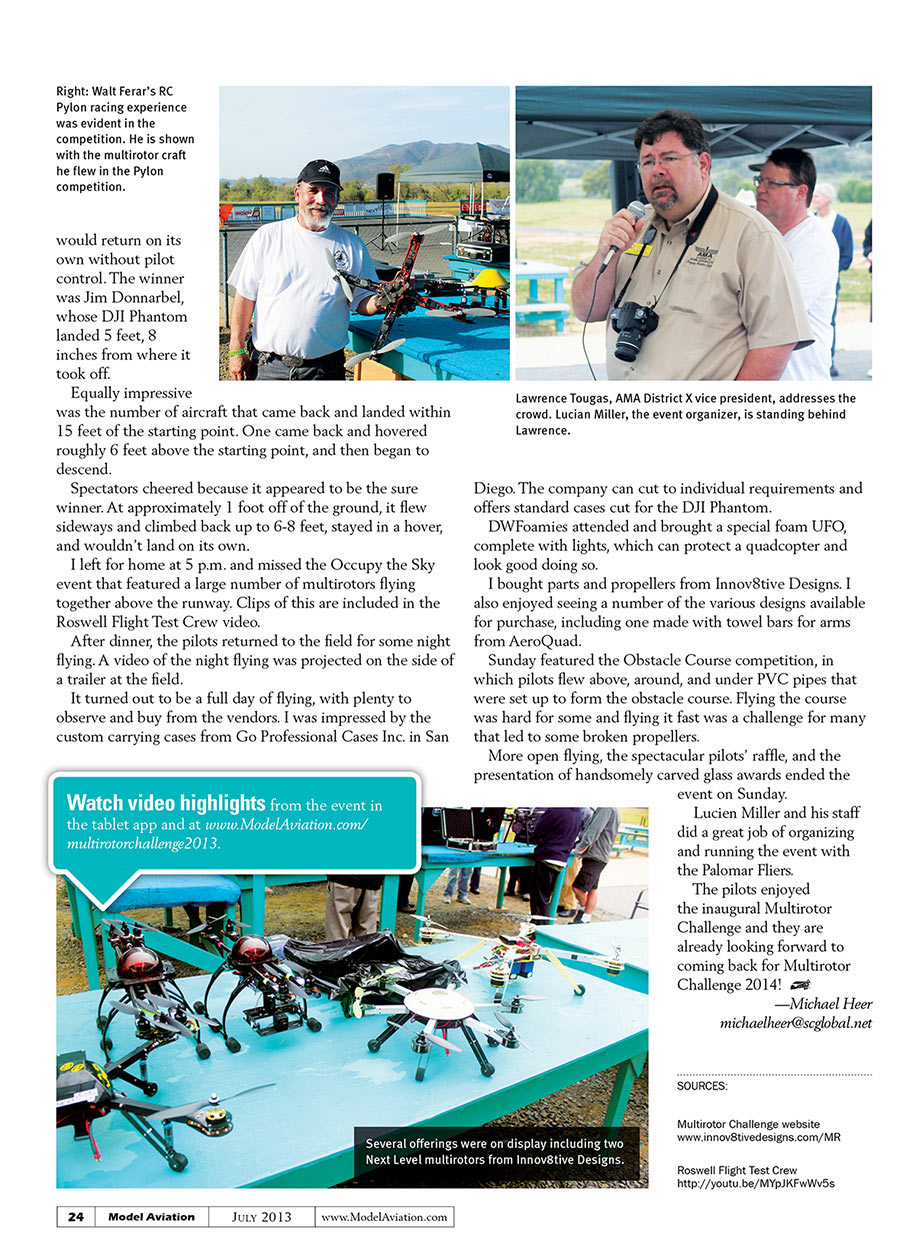
A number of vendors and supporters donated to the event, and the raffle boasted more than $10,000 worth of items for the pilots to win. Items including complete multirotor kits and related goodies were up for grabs. I was one of 63 registered pilots.
Weather and schedule
Saturday morning started out overcast with high cloud cover that burned off by mid-morning. A southwesterly breeze built throughout the day and became a factor in the early afternoon Pylon competition, but it was not an issue for general flying.
Saturday was slated for open flying all day with the exception of the noontime demonstrations. Many pilots took advantage of the open flying, and the Roswell Flight Test Crew, who flew down from Portland, Oregon, remained busy videotaping the event from the sky. The Roswell group posted a video of the event on YouTube; the link is listed in the Sources section at the end of the article.
Saturday competitions and demonstrations
Saturday’s first two challenges were lifting competitions: the Dead Lift event and the Controlled Lift competition.
- Dead Lift: The multirotor had to lift the weight load selected by the pilot from the ground to at least 5 feet, hold it there for 10 seconds, and then make a controlled landing.
- Controlled Lift: The multirotor lifted the weight, flew a controlled Figure 8 with the load, and finished with a controlled landing at the starting point.
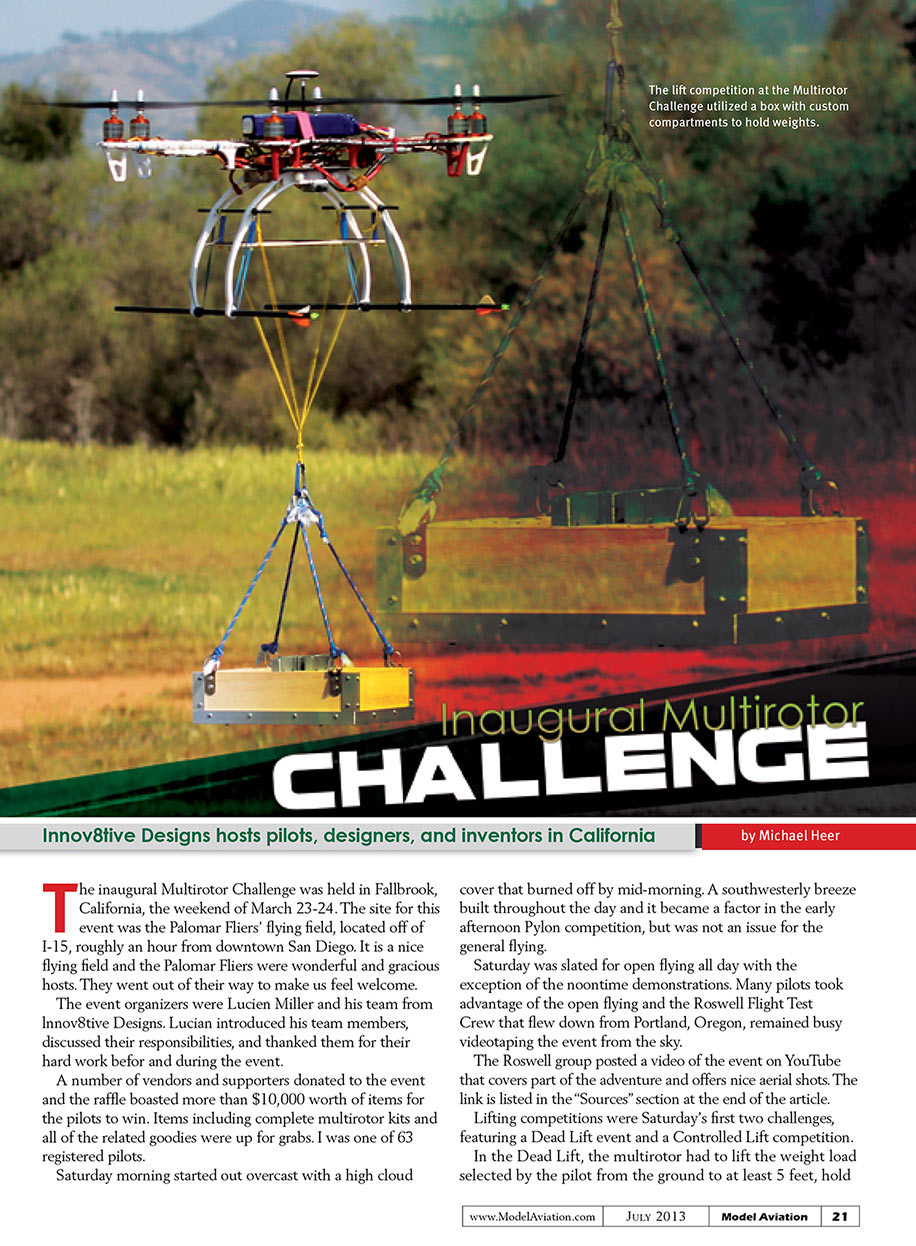
Both events awarded the heaviest load lifted, regardless of the multirotor’s weight. In that category, battery weight counted as payload. Second-prize awards considered the heaviest weight lifted with the battery counted as part of the multirotor’s weight. Lucien supplied larger aircraft with a special box with compartments for weights that was tied to the multirotor. Some contestants, including Ben Berry, added battery packs to increase the weight.
Ben flew a self-designed Micro Spider to win this part of the competition. Blue Sky RC sells the kit for this unit, made with 1/8-inch plywood; the company calls it the xRotor Spider Quad. The arms are the same size as the fuselage of a Slow Stick airplane; Ben’s were made of wood, but metal can also be used.
Pilots pushed their machines to lift as much weight as possible and eventually most found the point where they couldn’t lift off. Some tipped when trying to lift heavier loads, resulting in broken propellers.
Pilot demonstrations performed during lunch on Saturday included several highlights:
- An autonomous, programmed flight: one pilot moved the throttle up and then took his hands off the transmitter. The multirotor completed an autonomous flight that included a climb, several maneuvers, a Figure 8, and a return and landing near the takeoff point. The flight was completely autonomous after the initial throttle-up — impressive to many spectators who didn’t realize this was possible with “hobby-size” multirotors.
- A hand-launch demonstration: a multirotor was hand-launched with its propellers already spinning to show how the stabilization system quickly brought the aircraft into a controlled hover.
- Ben Berry’s aggressive flying: Ben’s Spider multirotors were equipped with ESCs that could change direction, enabling some impressive moves. ROC Battery sponsored an award decided by pilots and spectators, and Ben’s flying won.
Saturday afternoon featured two more competitions: the Pylon Race and Autonomous Spot Landing.
- Pylon Race: The afternoon breeze confirmed that typical multirotors are not optimized for Pylon Racing. Many pilots made wide turns when flying with the wind and had trouble turning back into it; the faster they flew, the wider the turns became. One pilot tried to race with a small micro multirotor and couldn’t overcome the wind, landing in “the Jungle,” an overgrown ravine at the edge of the field. Fortunately, the aircraft was found in working condition. Walt Ferar, an experienced RC Pylon competitor, performed well in the Pylon competition; his experience showed in his racing. Pilots need practice in both calm and windy conditions to learn how best to fly multirotors around pylons in fast, tight patterns. I expect much improvement from pilots who return next year.
- Autonomous Spot Landing: Pilots flew their multirotors up and out as Lucien directed, then activated the aircraft’s return-to-home button so it would return on its own without pilot control. The winner was Jim Donnarbel, whose DJI Phantom landed 5 feet, 8 inches from its takeoff point. Equally impressive was the number of aircraft that returned and landed within 15 feet of the starting point. One craft hovered roughly 6 feet above the starting point, descended to about 1 foot, then flew sideways, climbed back to 6–8 feet, hovered, and would not land on its own.
I left for home at 5 p.m. and missed the Occupy the Sky event that featured a large number of multirotors flying together above the runway. Clips of this are included in the Roswell Flight Test Crew video.
After dinner, pilots returned to the field for night flying. A video of the night flying was projected on the side of a trailer at the field.
Vendors and gear
It was a full day of flying with plenty to observe and buy from vendors.
- I was impressed by custom carrying cases from Go Professional Cases Inc. in San Diego. The company can cut to individual requirements and offers standard cases cut for the DJI Phantom.
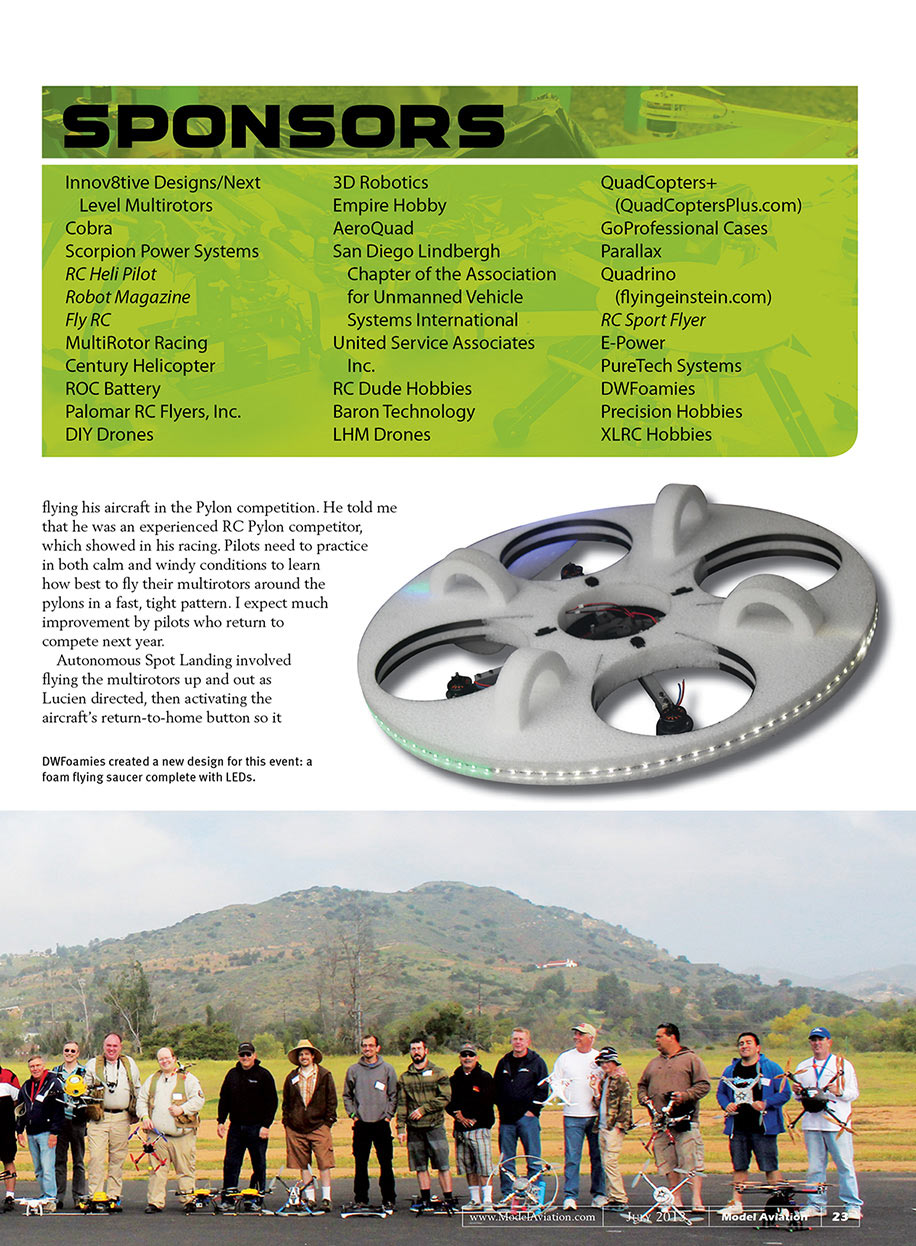
- DWFoamies attended and brought a special foam UFO complete with lights, which can protect a quadcopter while looking good.
- I bought parts and propellers from Innov8tive Designs.
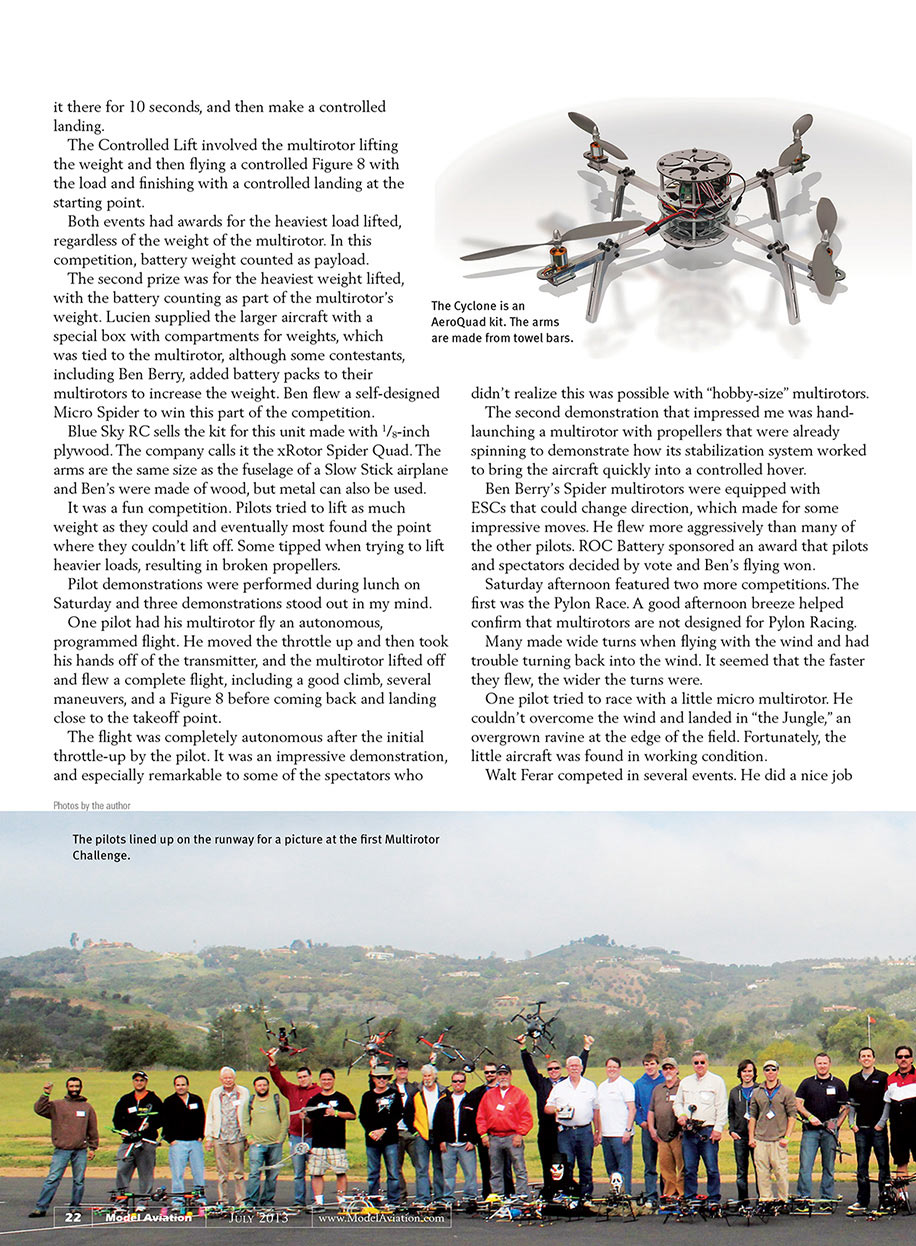
- I enjoyed seeing various designs available for purchase, including one made with towel bars for arms from AeroQuad.
Sunday events and awards
Sunday featured the Obstacle Course competition, in which pilots flew above, around, and under PVC pipes set up as the course. Flying the course was difficult for some, and flying it fast led to broken propellers for many.
More open flying, the spectacular pilots’ raffle, and the presentation of handsomely carved glass awards ended the event on Sunday. Lucien Miller and his staff did a great job of organizing and running the event with the Palomar Fliers.
The pilots enjoyed the inaugural Multirotor Challenge and are already looking forward to coming back for Multirotor Challenge 2014!
—Michael Heer [email protected]
SOURCES
- Multirotor Challenge website: www.innov8tivedesigns.com/MR
- Roswell Flight Test Crew video: http://youtu.be/MYpJKFwWv5s
Transcribed from original scans by AI. Minor OCR errors may remain.

