

Indoor Electric Development
Bob Wilder
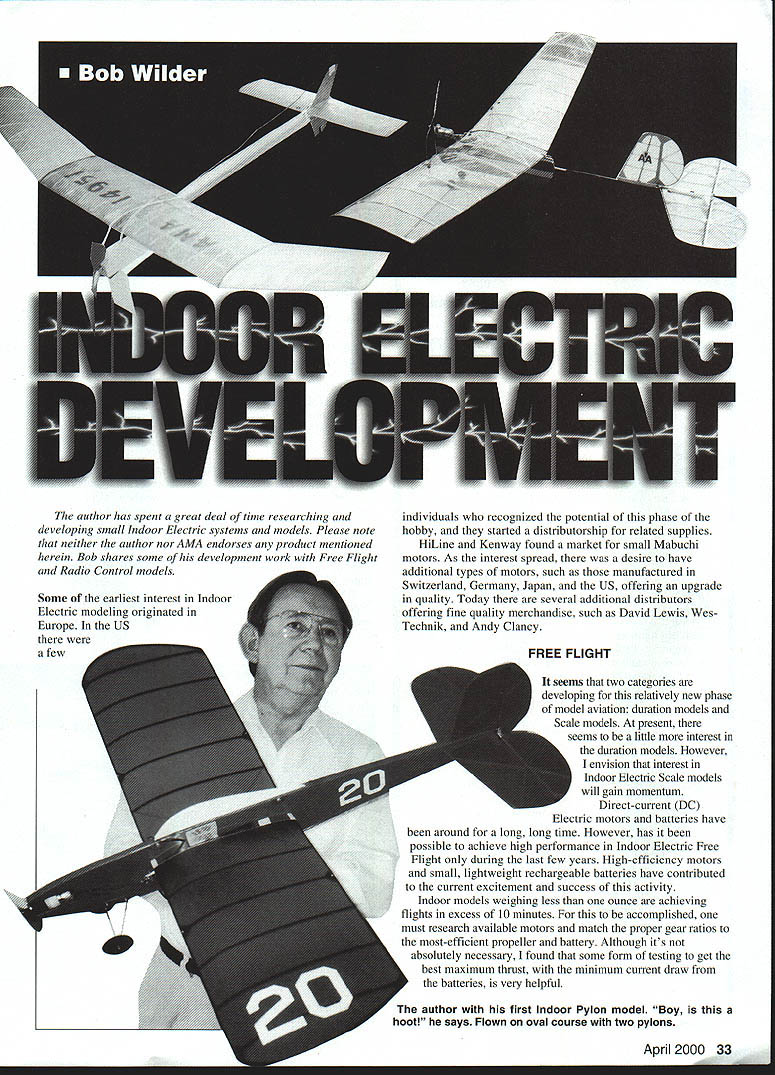
The author has spent a great deal of time researching and developing small indoor electric systems and models. Please note that neither the author nor AMA endorses any product mentioned herein. Bob shares some of his development work with free flight and radio control models.
Some of the earliest interest in indoor electric modeling originated in Europe. In the U.S. there were a few individuals who recognized the potential of this phase of the hobby, and they started distributorships for related supplies. Hiline and Kenway found a market for small Mabuchi motors. As the interest spread, there was a desire to have additional types of motors—such as those manufactured in Switzerland, Germany, Japan, and the U.S.—offering an upgrade in quality. Today there are several additional distributors offering fine-quality merchandise, such as David Lewis, Wes-Technik, and Andy Clancy.
Free Flight
It seems that two categories are developing for this relatively new phase of model aviation: duration models and scale models. At present, there seems to be a little more interest in the duration models. However, I envision that interest in indoor electric scale models will gain momentum.
Direct-current (DC) electric motors and batteries have been around for a long time. However, it has been possible to achieve high performance in indoor electric free flight only during the last few years. High-efficiency motors and small, lightweight rechargeable batteries have contributed to the current excitement and success of this activity.
Indoor models weighing less than one ounce are achieving flights in excess of ten minutes. For this to be accomplished, one must research available motors and match the proper gear ratios to the most-efficient propeller and battery. Although it's not absolutely necessary, I found that some form of testing to get the best maximum thrust with the minimum current draw from the batteries is very helpful.
For duration models, you might consider starting with something as simple as a P-24 indoor rubber model and modify it to accept a small electric motor with batteries or capacitors for power. For an indoor electric scale model, there is no limit to what one might pick; however, the size for the model suggests something on the order of a 16- or 18-inch wingspan. The wing loading on a scale model would probably be a little higher than a duration model, and therefore one should not expect the flight times to be as high as a lighter-wing-loading duration model.
One of the nice things about indoor electric scale models is that, generally speaking, performance should be predictable, repeatable, and reliable. For example, if you are limited to a low ceiling height, you can limit the performance of the model by limiting the charge in the battery, much as you would limit the number of turns put in a rubber model for the same situation.
Radio Control
Indoor electric seems to be really catching on. Not all park fliers can bring their models indoors, and not all indoor models can be flown in the park, but there is a good blend that can allow both, depending upon the wing loading and available flying site. Probably the most interest is in what one would call a "fun fly" model. There are also models that have a designated interest, such as scale models, duration models, pylon racers, acrobatic models, and helicopters. With many creative minds becoming interested in indoor electric RC, other types of events will follow.
Scale
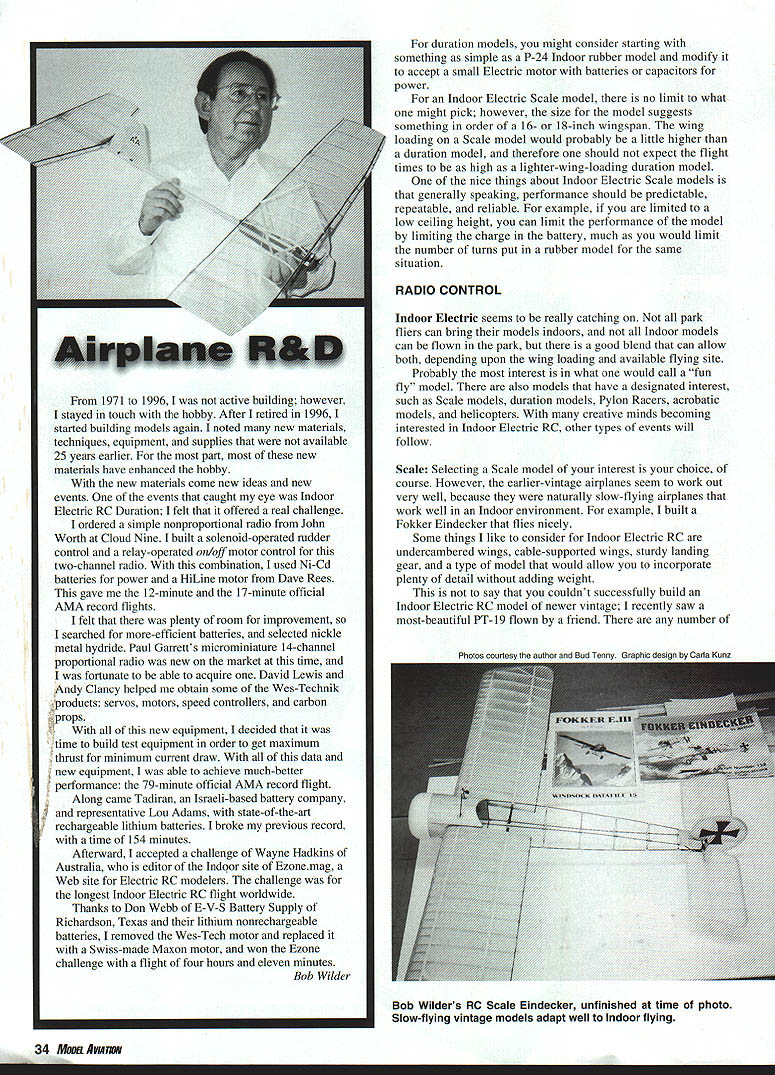
Selecting a scale model of your interest is your choice, of course. However, the earlier-vintage airplanes seem to work out very well because they were naturally slow-flying airplanes that work well in an indoor environment. For example, I built a Fokker Eindecker that flies nicely.
Some things I like to consider for indoor electric RC are unencumbered wings, cable-supported wings, sturdy landing gear, and a type of model that would allow you to incorporate plenty of detail without adding weight.
This is not to say that you couldn't successfully build an indoor electric RC model of newer vintage; I recently saw an almost-beautiful PT-19 flown by a friend. There are any number of World War II-or-later aircraft that would make wonderful selections for indoor flying.
Many modelers naturally build heavy outdoor airplanes; to successfully build and fly an indoor model, however, the model must be constructed much lighter. You must be very selective with your building materials in order to achieve a lightweight model.
For example, you must select very low-density balsa; heavy covering materials, such as those used on many outdoor airplanes, would not be practical. Models covered with colored Japanese tissue, using only one or two thin coats of clear paint, work well, as do very thin and light Mylar coverings.
I have also seen very successful CO2-powered RC scale models. Generally speaking, a CO2 motor with its cartridge may be lighter than an electric motor and its batteries. However, the run time of a CO2 motor is limited, and the power of the CO2 motor is not controllable (as with the speed control used on the electric). This is not to say that a CO2 approach is not practical; it is just another avenue.
Duration: At this time, the only official AMA event in the indoor RC category is Duration. The current rules are very limited and are in need of some updating and adjusting.
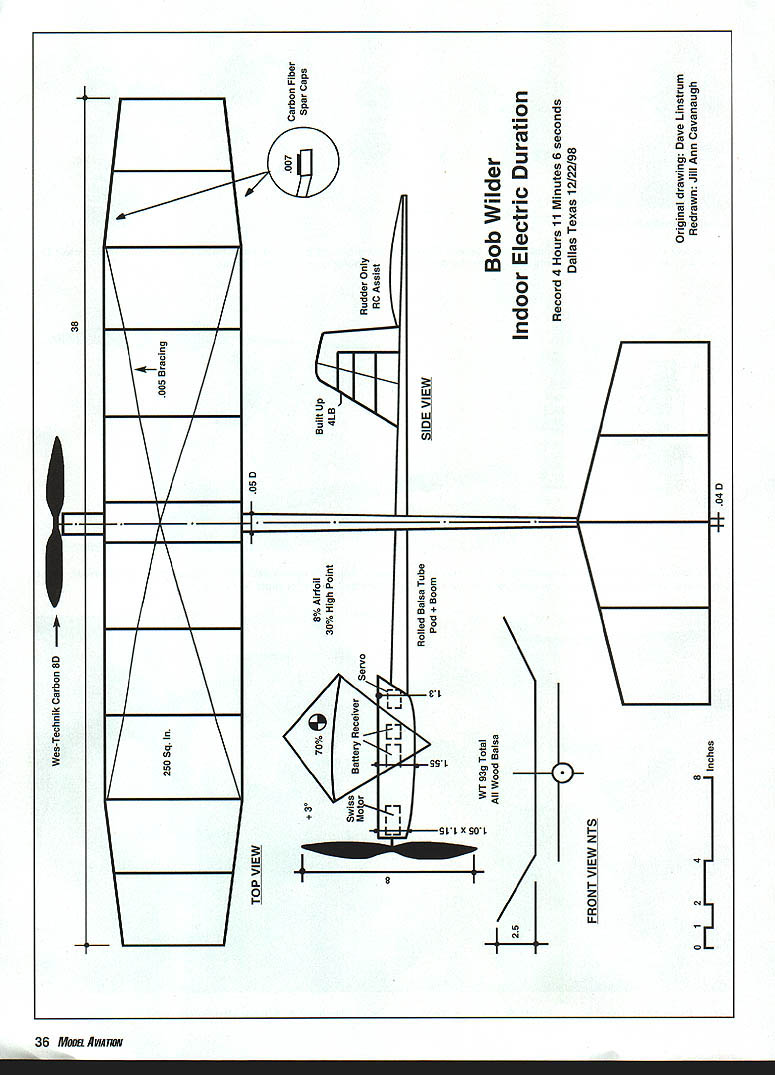
The rules have a very good safety concern by having a wing-loading specification. However, they have no rules or guidelines specifying power source (battery). I currently hold the AMA record for this event, with a flight time of more than two-and-a-half hours.
I have unofficially made a flight of more than four hours, but to me this is not very practical. If the rules established limits on the battery power source, that would make for much-more-reasonable (lower) flight times.
The overall weight of the model must be kept to an absolute minimum. As a guideline, I would suggest the total flying weight of the model not exceed 100 grams. The bottom line here is to have enough thrust to fly the airplane successfully (generally speaking, about 25% to 30% of the total weight of the airplane).
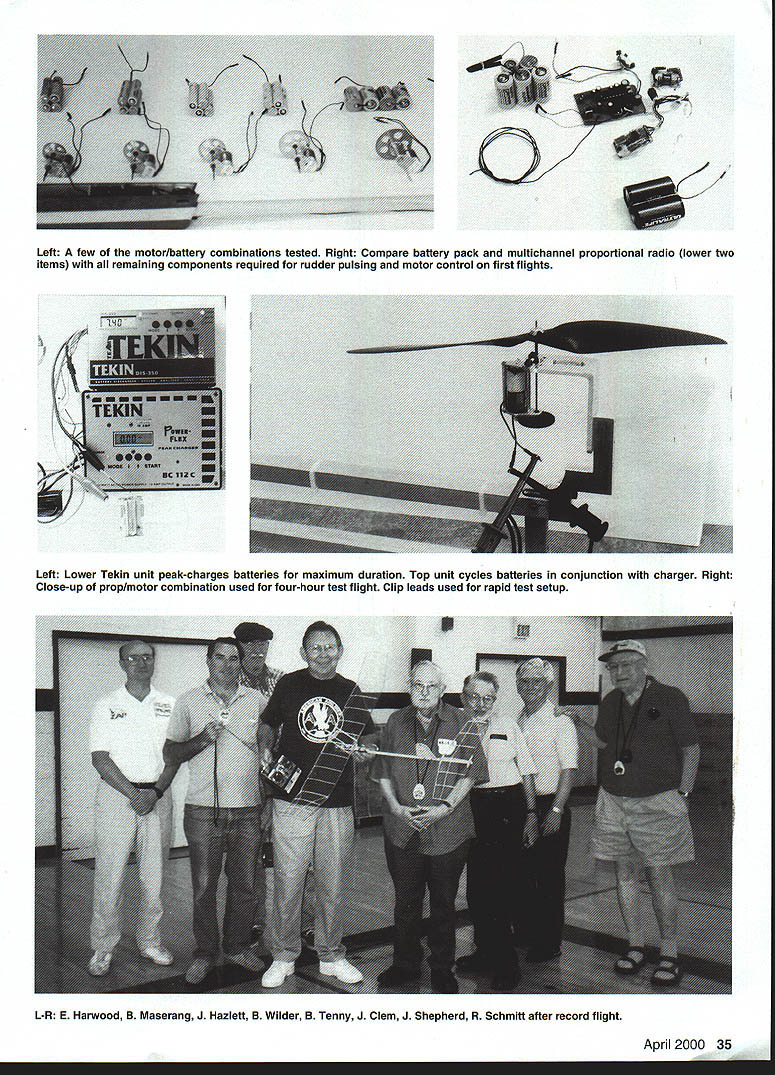
Your objective ought to be to obtain the required thrust with a minimum amount of current draw. In order to do this, I found it necessary to do a good deal of testing on combinations of different motors with different gear ratios and different propellers.
I found that it was only necessary to have two controls: rudder and speed control. Elevation or altitude was simply controlled by decrease or increase of motor speed.
Among other things, a larger building size does enhance the models' performance. The models can be flown in larger circles, which take less power to maintain altitude, and fewer control direction-change inputs are needed—each of which consumes power.
A common belief is that it is best to climb up, shut the motor down, and glide. I feel that this is a misconception. My theory is that it is best to never shut the motor off and just maintain altitude. The concept of shutting down the motor and gliding would apply to outdoor models where there are thermals, but there are few or no thermals in indoor activity.
There has been criticism of this event, with people saying they thought it would be very boring. When considering maximizing the performance of a duration model, a great deal of effort goes into testing, designing, and building before the model is ever flown; I found this to be very challenging.
When flying, be sure your transmitter has large-enough batteries for long-duration flights, and go to the bathroom before you begin!
Pylon Racing: Boy, this is a hoot! The few of us who have experienced this so far can hardly get enough.
We have some informal rules:
- Model should resemble original pylon racer.
- Model should have profile fuselage.
- Model must rise off ground (ROG).
- Race: 10 laps.
- Max battery pack: six 120 mAh Sanyo Ni-Cd cells.
- Max weight: one gram for every square inch of wing area.
We have had as many as four models in a race at one time, and this does get your attention! We fly an oval course with two pylons approximately 100 feet apart. The pilots stand just outside of the oval course, at about midfield.
Pylons can be made from many things, but the latest we have used are the five-foot-tall spongy brightly colored swimming pool "noodles." We mount them on small bases so that they will fall over easily if hit by a model.
Aerobatics: There are probably more indoor electric RC models that will fit into this category than all other types combined. This requires the combined skill of a good pilot and a well-designed model.
The designs can vary in shape and size—from large to small, from circles to flying wings to standard wing-and-tail airplanes, with rudder, elevator, ailerons, or twisting of the wings, or V-tail butterfly elevator flight controls. Some of these models can loop, roll, and fly inverted, hover, and land on a tabletop. Kits for models of this type can be ordered from distributors or from the Internet. Hopefully someday soon your local hobby shop will be carrying designs of these types.
Many of the aerobatic models are constructed from carbon-fiber rods and tubes and are covered with thin Mylar. The motors used on these models generally have a higher thrust-to-weight ratio than most other indoor RC models.
Payload/Cargo: I have yet to see an indoor RC model of this type; however, there is plenty of room for such an activity.
We currently are planning a contest that includes competition of this sort, with simple rules that state the winner is determined by the largest percentage of weight lifted versus the dry model weight. The model must ROG and make a safe takeoff and landing.
Since there is virtually no experience in this event, there will certainly be changes and modification as we learn more. Designing and building successful models of this type would require a good deal of thought and engineering.
This reminds me of the old days when Pan American Airways sponsored what was then called a Clipper Cargo event; it required a very strong, lightweight model capable of lifting very heavy cargo.
Helicopters
When I first saw information on indoor electric RC helicopters on the Internet, I was blown away. The pictures I saw were of models that were being designed and flown in Europe. The individuals who design and build helicopters of this type are very talented. This is not something that one would recommend for beginners. I look forward to seeing more and more about this activity as information becomes available.
Blimps
Again, this is a subject about which I have seen information on the Internet. Indoor electric RC blimps can range in size from three feet long up to 15 feet and beyond. The small ones can actually be successfully flown in your living room. Large blimps cannot normally be transported while inflated, so portable helium tanks are required.
Many professional sports employ these blimps to fly at halftime for the entertainment of the crowd. Some of these dispense small gifts, coupons, and prizes.
Varying the speeds of the different motors on board controls some of these blimps. The more-advanced versions also rotate the motors about an arc for better maneuverability and control.
Kits and plans are available from mail-order sources, and again, I hope we can soon purchase such items from our local hobby shops.
Equipment
Small, Lightweight DC Motors
There are two categories: coreless motors and permanent-magnet motors.
It has been documented many times with testing that coreless motors generally outperform permanent-magnet motors. However, there are some disadvantages of coreless motors compared to their rival.
Coreless motors generally are more expensive, and because of their design nature, they are not as rugged. But it is my opinion that coreless motors outperform permanent-magnet motors to such a degree that the positives offset the negatives. Based on all of my testing, I prefer the coreless.
One of the first in the hobby industry to introduce coreless motors was Wes-Technik in Germany. There were a couple of distributorships set up in the U.S. to carry these products: David Lewis and Andy Clancy. The coreless motors they sold included the DC 1, DC 5, and DC 6. These motors were manufactured in Japan.
They also sold the DC 1717. MicroMo Electronics manufactured this motor.
MicroMo Electronics has a facility that designs, manufactures, and distributes coreless motors. Their inventory consists of a large variety of physical sizes and voltage ranges. They have a technical program that can help you in selecting the correct motor for your application.
Maxon Precision Motors, a Swiss company, also manufactures a large variety of coreless motors. They have a distributorship located in Burlingame, California. I have found that their engineering department in California has been very helpful in answering my many questions and offering good suggestions. Maxon helped me select the motor that I used on my indoor electric RC endurance flight on December 22, 1998—four hours, 11 minutes, and six seconds.
Mabuchi Motors is one of the world's largest manufacturers of permanent-magnet DC motors. They make a broad range of sizes of inexpensive motors used in many applications, such as children's toys and hobby-related items. For example, many ARF (Almost Ready to Fly) model airplanes have Mabuchi motors.
Batteries
There are approximately four types of batteries used in the model aviation field. By far the most popular is the rechargeable nickel-cadmium (Ni-Cd) battery; nickel-metal-hydride (NiMH) batteries are also relatively popular.
One of the advantages of nickel-metal-hydride is that the amp-hour rating is at least twice that of the Ni-Cd for the same-size battery. One of the disadvantages of NiMH is that they are not available in as many sizes as Ni-Cds.
Another battery type is rechargeable lithium. Generally speaking, this battery has four times the mAh rating as the same-size Ni-Cd. Rechargeable lithium batteries are available in only limited sizes, and they are higher-priced than most Ni-Cds. One drawback is that they will not deliver a high current demand.
Nonrechargeable lithium batteries are available in many sizes. They are expensive and the fact that they are not rechargeable makes them less desirable. They have the highest mAh rating—about six times that of the standard Ni-Cd. Each cell is generally rated at three volts. Again, these batteries cannot deliver a very high current draw. This happens to be the type of battery that I used to achieve my indoor flight in excess of four hours.
Ni-Cd batteries, being by far the most popular, are available in a wide range of shapes, sizes, and mAh ratings. There are many manufacturers of Ni-Cd batteries; the most popular is Sanyo.
Battery Chargers
The importance of making the right choice when selecting a battery charger is often overlooked. There is a wide range of features, and this sometimes makes it confusing.
Consider:
- Do you want to power your charger with alternating current (AC), direct current (DC), or a combination?
- Do you wish for your charger to have a peak-charge automatic shutoff?
- How many cells do you desire to charge at one time?
- What is the maximum and minimum rate (amps) at which you will be charging your batteries?
- Should your charger have a voltmeter or an ammeter display?
- Should it have the capabilities of a trickle charge?
- Can you adjust the current?
- Does it have a discharger?
All of these factors should be considered when selecting a charger. Too often, a modeler purchases a charger only to find out later that the charge rate cannot be adjusted low enough for small batteries. And if the charger does not have an auto cutoff and the user forgets to turn off the charger, the batteries can overheat.
I am not advocating that all of these features are necessary. It all depends upon size of batteries, number of batteries, and many other factors. I just wanted to point out these available features.
Radio Receivers
One of the most important components is the radio receiver, available through your local hobby dealer. Choose an appropriate size and number of channels for your model's control requirements.
Speed Controllers
Speed controllers are available in several sizes and shapes, with different features. Generally speaking, larger units are designed for higher amperage.
Speed controllers offer many options, such as Battery Eliminator Circuit (BEC), which means you only need one battery for the motor and the radio/servos. On most controllers of this type, there is a feature called low-voltage cutoff. As the voltage drops while operating the motor, the low-voltage cutoff is designed to cut off the motor and still leave enough power to operate the radio.
Some speed controllers have a brake unit that will stop the propeller from freewheeling when you throttle to a stop and will allow the propeller to fold.
Some units have a safety start—a very good feature. This will prevent the motor from coming on accidentally if the throttle lever on the transmitter was unknowingly advanced. The motor will only come on after the speed controller has "seen" a command for a zero-throttle position for four or five seconds. Only after that will the speed controller respond to commands.
One of the main things to consider when selecting a speed controller is to be sure that its rated current capacity is within the range in which you will operate your motor. Some controllers also have protection for a high current draw in the event of a malfunction.
Materials
In selecting your building products such as balsa and covering material, the key is to keep minimum weight in mind. However, you do not want to make the model so lightweight that it becomes fragile; structural strength is also important. Try to have a good balance of structure and weight.
Flying Sites
We have discovered indoor soccer fields. They seem to be gaining in popularity; in the Dallas–Fort Worth area, there are six or seven such facilities, and we have flown in three of them.
These buildings are about 200 feet long and 100 feet wide, with ceiling heights of approximately 30 feet. The floors are nicely carpeted for athletic activities. The four walls consist of netting similar to volleyball-court netting.
To acquire the use of a facility of this type, one must expect to pay some nominal fee. So far, we have been able to negotiate a fee of approximately $100 for a four-hour session. Although we would not be able to fly at this cost every week, we have found that if enough fliers get together and chip in $5 or $10 apiece, the cost is covered.
On many occasions, we have flown on standard high-school and recreation-center basketball courts, and this does work. However, the soccer fields offer much more open space. Basketball courts are generally easier to obtain and, in our case, there is no cost to use these facilities.
Bob Wilder 1005 Hidden Oaks Ct. Colleyville, TX 76034 [email protected]
Editor's note: To repeat, neither the author nor AMA expresses or implies endorsement of the products mentioned here; the following list is provided for informational purposes only.
Sources
WES-Technik www.idnet.de/homepage/scholl/index.htm
Todd's Models Todd Long Box 827 Snoqualmie, WA 98065 (425) 888-8530 www.toddsmodels.com [email protected]
David Lewis 4027 Rocky River 26 Cleveland, OH 44135-1147 (216) 251-2517 [email protected]
FMA Direct 9607 Dr. Perry Rd., Unit 109 Jamsville, MD 21754 (301) 831-8985 www.fmadirect.com [email protected]
Hitec RCD Inc. 12115 Paine St. Poway, CA 92064 (858) 748-6948 [email protected]
Peck-Polymers Box 710399 Santee, CA 92072
Sky Hooks & Riggings Tom McCann 2206 Towne Blvd. Oakville, Ontario L6H 5H4 Canada (905) 257-2101 Fax: (905) 257-0168 [email protected] www.indoorrc.com
Transcribed from original scans by AI. Minor OCR errors may remain.

