

Indoor World Championships
by Martin Dilly
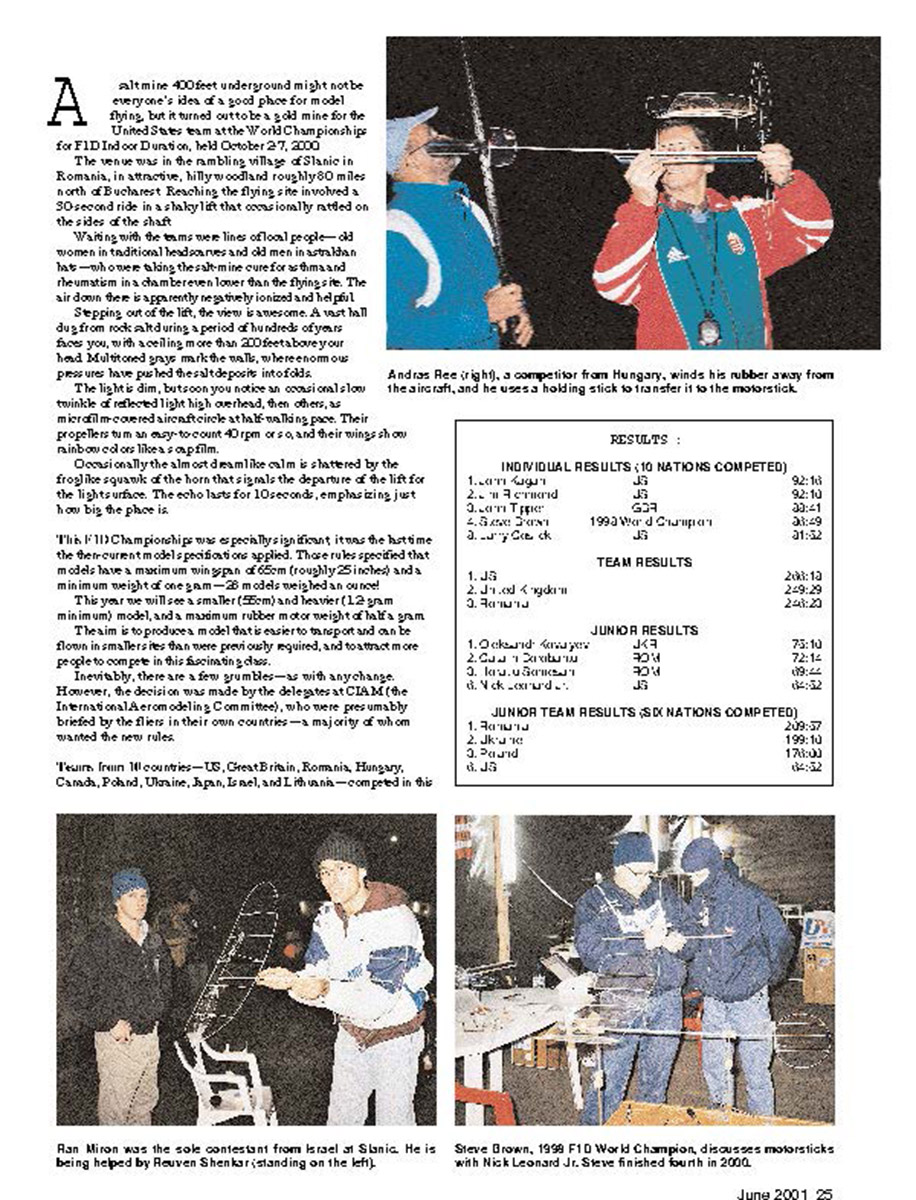
A saltmine 400 feet underground might not be everyone's idea of a good place for model flying, but it turned out to be a godsend for the United States team at the World Championships for F1D Indoor Duration, held October 27, 2000. The venue was in the rambling village of Slănic in Romania, an attractive, hilly woodland roughly 80 miles north of Bucharest. Reaching the flying site involved a 30-second ride in a shaky lift that occasionally rattled on the sides of the shaft. Waiting with the teams were lines of local people—old women in traditional headscarves and old men in straw hats—who were taking the salt-mine cure for asthma and rheumatism in a chamber even lower than the flying site. The air down there is apparently negatively ionized and helpful.
Stepping out of the lift, the view is awesome. A vast hall dug from rock and lifted over a period of hundreds of years faces you, with a ceiling more than 200 feet above your head. Multicolored gypsum marks the walls, where enormous pressures have pushed the salt deposits into folds. The light is dim, but soon you notice an occasional low twinkle of reflected light high overhead, then others, a mirror-like colored aircraft circling at half-walking pace. Their propellers turn an easy-to-count 40 rpm or so, and their wings show rainbow-colored lines as per film. Occasionally the almost dreamlike calm is shattered by the frog-like squawk of the horn that signals the departure of the lift for the light surface. The echo lasts for 10 seconds, emphasizing just how big the place is.
Rules and changes
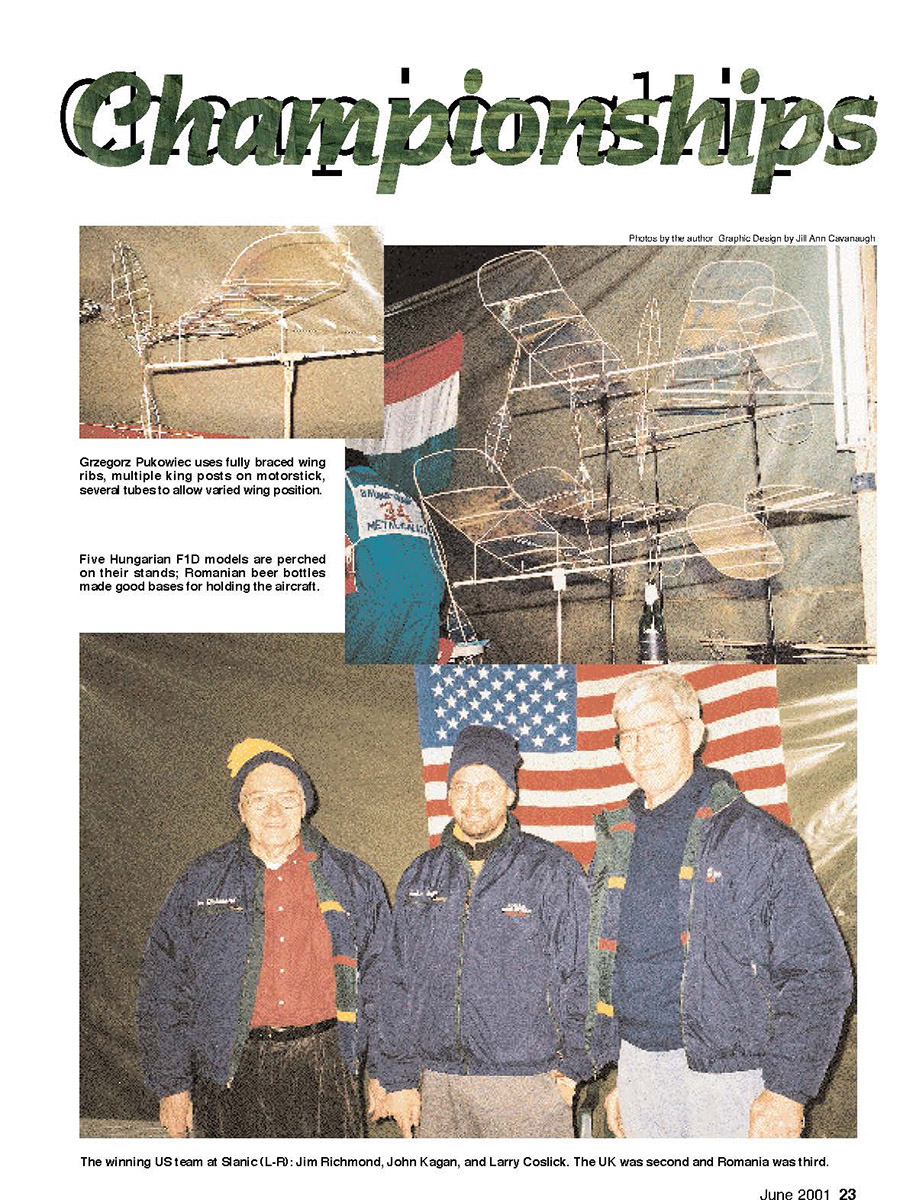
The F1D Championships were specially significant this year because the current model specifications applied. These rules specified that models have a maximum wingspan of 65 cm (roughly 25 inches) and a minimum weight of one gram—28 models weighed an ounce! This year we will see a smaller (55 cm) and heavier (12 gram minimum) model, and a maximum rubber motor weight of half a gram. The aim is to produce a model that is easier to transport and can be flown in smaller sites than were previously required, and to attract more people to compete in this fascinating class. Inevitably, there are a few grumbles—as with any change. However, the decision was made by the delegates of CIAM (the International Aeromodelling Committee), who were presumably briefed by the fliers in their own countries—a majority of whom wanted the new rules.
Teams and conditions
Teams from 10 countries competed in this championship:
- United States
- Great Britain
- Romania
- Hungary
- Canada
- Poland
- Ukraine
- Japan
- Israel
- Lithuania
The organizers provided the group's smart, warm jackets. Everyone had been warned to wear warm clothing, since the temperature stays at a constant 54°F in the mine. It was good advice.
Hazards other than the low temperature awaited: the walls of the hall were rough with stalagmite that had formed after they were originally cut; they acted like Velcro on any models that touched them. Sometimes fliers could see a trapped model that was roughly 150 feet up by carefully nudging it with the nylon line tightened by a hydrogen balloon—but often a model would obstinately reattach itself. The technique of wall corralling was important for centering the circling models. At Slănic, the top 70 feet of the walls tapered before reaching a flat ceiling, which is roughly 35 feet wide between wooden catwalks. Trimming for a tight circle was essential.
Techniques and equipment
It was quite an education to see a master such as Jim Richmond slide the balloon line into the gap of maybe five inches between the rotating propeller and the wing leading edge, then carefully nudge the almost transparent filament into a better circle while it flew 150 feet overhead. As did many teams, the US group used high-performance techniques and careful steering.
The two (unnamed) spent most of one night repairing and rebracing enough parts to make a flyable airplane after a disheartening second day with no score to show at the end of it.
Nick finished with a couple of respectable flights. It’s a shame a full US Junior team could not be fielded to back him up.
Most of the models had wings braced with .001-inch nichrome wire. This makes transport a delicate problem, since each wing and its bracing is a deep item to load in the box, and most fliers bring four or more models to a contest.
Canada’s Ed Liem and others employed one solution: they hinged the triangular cabane above the wing center-section, to which the upper bracing wires run, with minute strips of Japanese tissue, so they could fold it flat. The wires run through tubes rolled from tissue and are attached to the cabane. Erecting the wing is similar to putting up the masts of a model ship in a bottle; it takes tweezers, good eyesight, and an ability to exist without breathing. However, it allows several wings to be stored one above another in much less space, with less risk of damage.
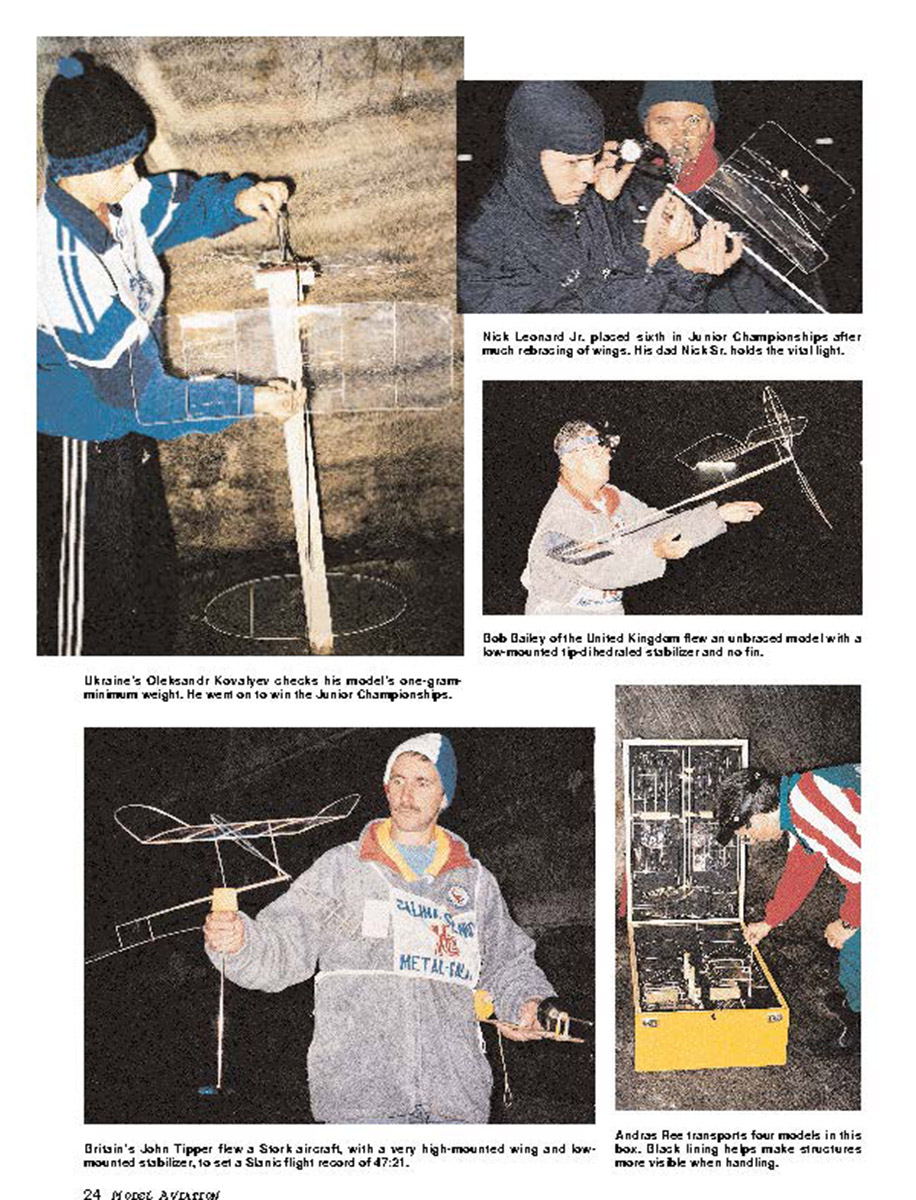
The British had another approach: unbraced wings. Using a deep leading and trailing edge, with roughly four times the wood cross-section of a braced wing, or boron filament reinforcement on smaller-depth wood to keep the drag down allows four or more wings to be packed into a box that fits easily into an overhead cabin locker.
The British models also differed aerodynamically; most were based on Bernard Hunt’s Stork design, employing a very high-mounted wing and a stabilizer set on a subpylon behind the rear tailboom. This keeps the stabilizer out of the wing downwash so it can contribute more lift, helped by a rearward center of gravity.
British team member John Tipper flew a model with no fin, but he dihedraled tips to his low-mounted stabilizer. Boron filament reinforced the inner ribs of the propeller to protect them during balloon steering, and it all came together for John in the final round. The model climbed to just below the roof on one arm of the L-shaped hall and centered there, then it drifted toward the other arm of the L and reentered. It finally landed at a time of 47:21, with only 175 turns left on the motor from the 2,500 turns wound on. This flight set a new record for Slănic, gave John the individual high-time award for the Championships, and pulled the UK into the team Silver Medal position. The United States team took the Gold.
John Kagan won the individual Gold Medal and Jim Richmond won the Silver.
Martin Dilly 20 Links Rd. West Wickham Kent BR4 0QW
Transcribed from original scans by AI. Minor OCR errors may remain.

