
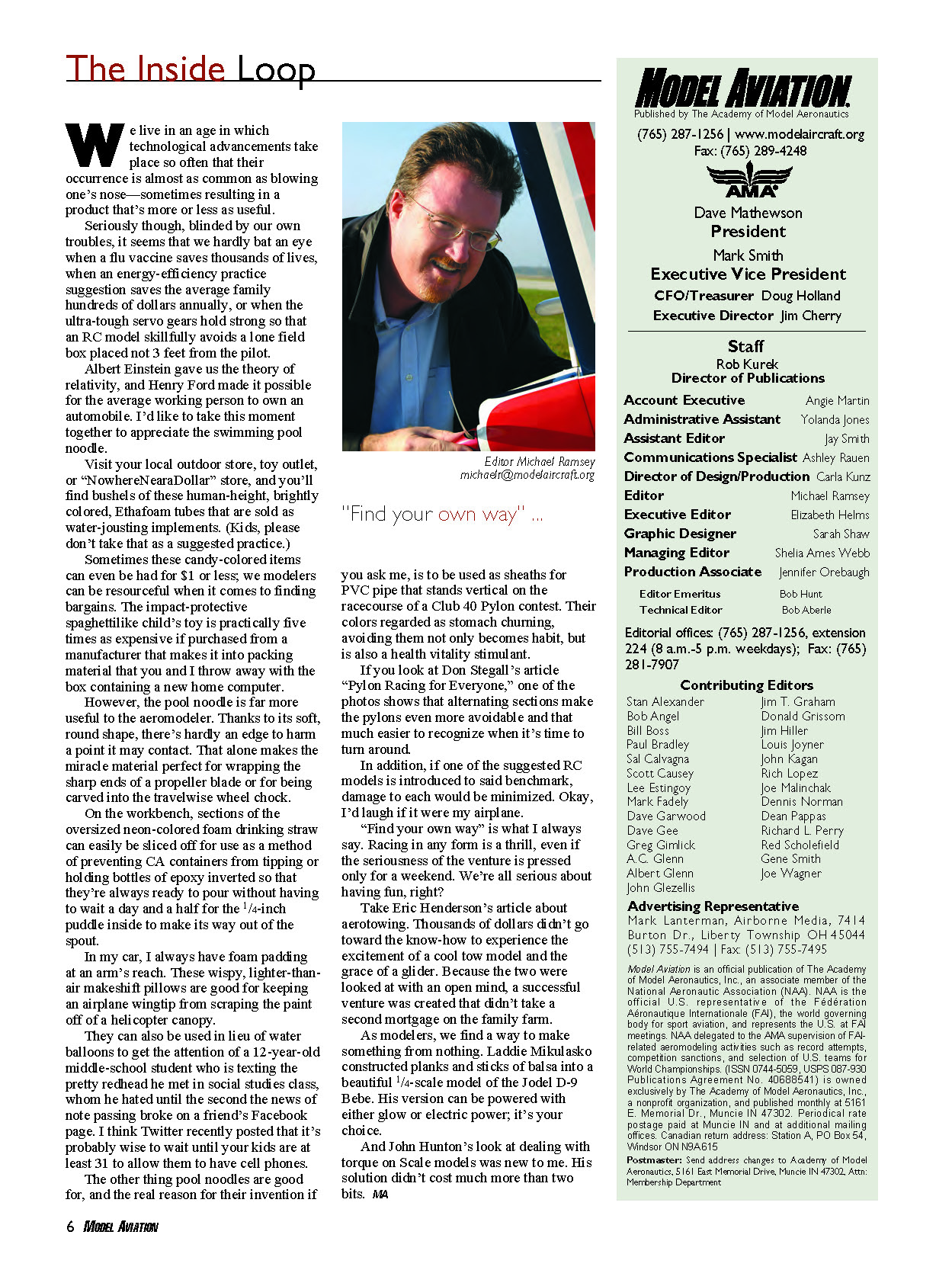
The Inside Loop - 2009/10
Technological advances
We live in an age in which technological advancements take place so often that their occurrence is almost as common as blowing one's nose—sometimes resulting in a product that's more or less as useful.
Seriously though, blinded by our own troubles, it seems that we hardly bat an eye when a flu vaccine saves thousands of lives, when an energy-efficiency suggestion saves the average family hundreds of dollars annually, or when ultra-tough servo gears hold strong so that an RC model skillfully avoids a lone field box placed not three feet from the pilot.
Albert Einstein gave us the theory of relativity, and Henry Ford made it possible for the average working person to own an automobile. I'd like to take this moment together to appreciate the swimming pool noodle.
The swimming pool noodle
Visit your local outdoor store, toy outlet, or dollar store, and you'll find bushels of these human-height, brightly colored Ethafoam tubes that are sold as water-jousting implements. (Kids, please don't take that as a suggested practice.)
Sometimes these candy-colored items can even be had for $1 or less; we modelers can be resourceful when it comes to finding bargains. The impact-protective, spaghetti-like child's toy is practically five times as expensive if purchased from a manufacturer that makes it into packing material you and I throw away with the box containing a new home computer.
However, the pool noodle is far more useful to the aeromodeler. Thanks to its soft, round shape, there's hardly an edge to harm a point it may contact. That alone makes the miracle material perfect for wrapping the sharp ends of a propeller blade or for being carved into a travelwise wheel chock.
Practical uses for pool noodles on the workbench and in the field include:
- Slicing off sections to prevent CA containers from tipping.
- Holding bottles of epoxy inverted so they're always ready to pour without having to wait a day and a half for the 1/4-inch puddle inside to make its way out of the spout.
- Padding in the car to keep an airplane wingtip from scraping paint off a helicopter canopy.
- Makeshift cushions or gentle nudges—useful, for example, to get the attention of a distracted middle-schooler (though perhaps wait until they're older before giving them a cell phone).
The other thing pool noodles are good for, and the real reason for their invention if you ask me, is to be used as sheaths for PVC pipe that stands vertical on the racecourse of a Club 40 pylon contest. Their stomach-churning colors make avoiding them not only habit, but also a helpful visual stimulant.
If you look at Don Stegall's article "Pylon Racing for Everyone," one of the photos shows that alternating sections make the pylons even easier to recognize and avoid when it's time to turn around. In addition, if one of the suggested RC models strikes such a pylon, damage to each would be minimized.
Racing and aerotowing
"Find your own way" is what I always say. Racing in any form is a thrill, even if the seriousness of the venture is pressed only for a weekend. We're all serious about having fun, right?
Take Eric Henderson's article about aerotowing. It didn't take thousands of dollars to gain the know-how to experience the excitement of a cool tow model and the grace of a glider. Because the two were built with an open mind, successful ventures were created that didn't take a second mortgage on the family farm.
Model building highlights
As modelers, we find a way to make something from nothing. Laddie Mikulasko constructed planks and sticks of balsa into a beautiful 1/4-scale model of the Jodel D-9 Bébé. His version can be powered with either glow or electric power—it's your choice.
John Hunton's look at dealing with torque on scale models was new to me. His solution didn't cost much more than two bits.
Transcribed from original scans by AI. Minor OCR errors may remain.

