
Interview With a World Champion
BY BRIAN CLEMMONS
MODEL AVIATION, December 1987, Volume 13, Number 12: Ron Chidgey reported from Avignon, France, about the 15th F3A World Championships.
Team USA in 1987 included Tony Frackowiak; Chip Hyde (on the team for the first time); Steve Helms, aka "Mr. Futaba"; and Dave Brown, AMA's president from 1996 to 2007, as manager. Among others, Dean Pappas, MA's "If It Flies ..." columnist, attended.
The US team finished fourth that year. Hanno Prettner won the individual title using an early JR PCM radio.
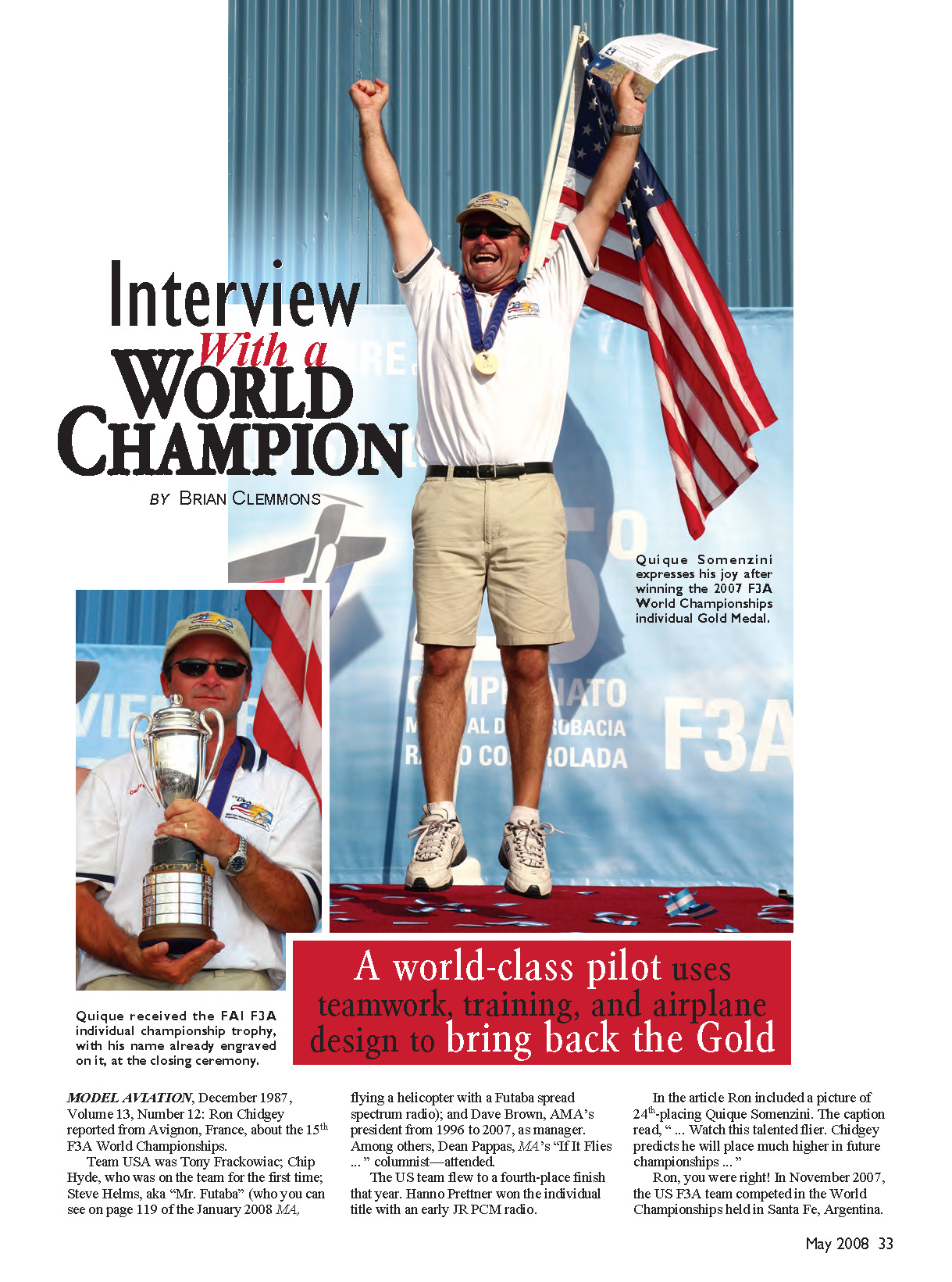
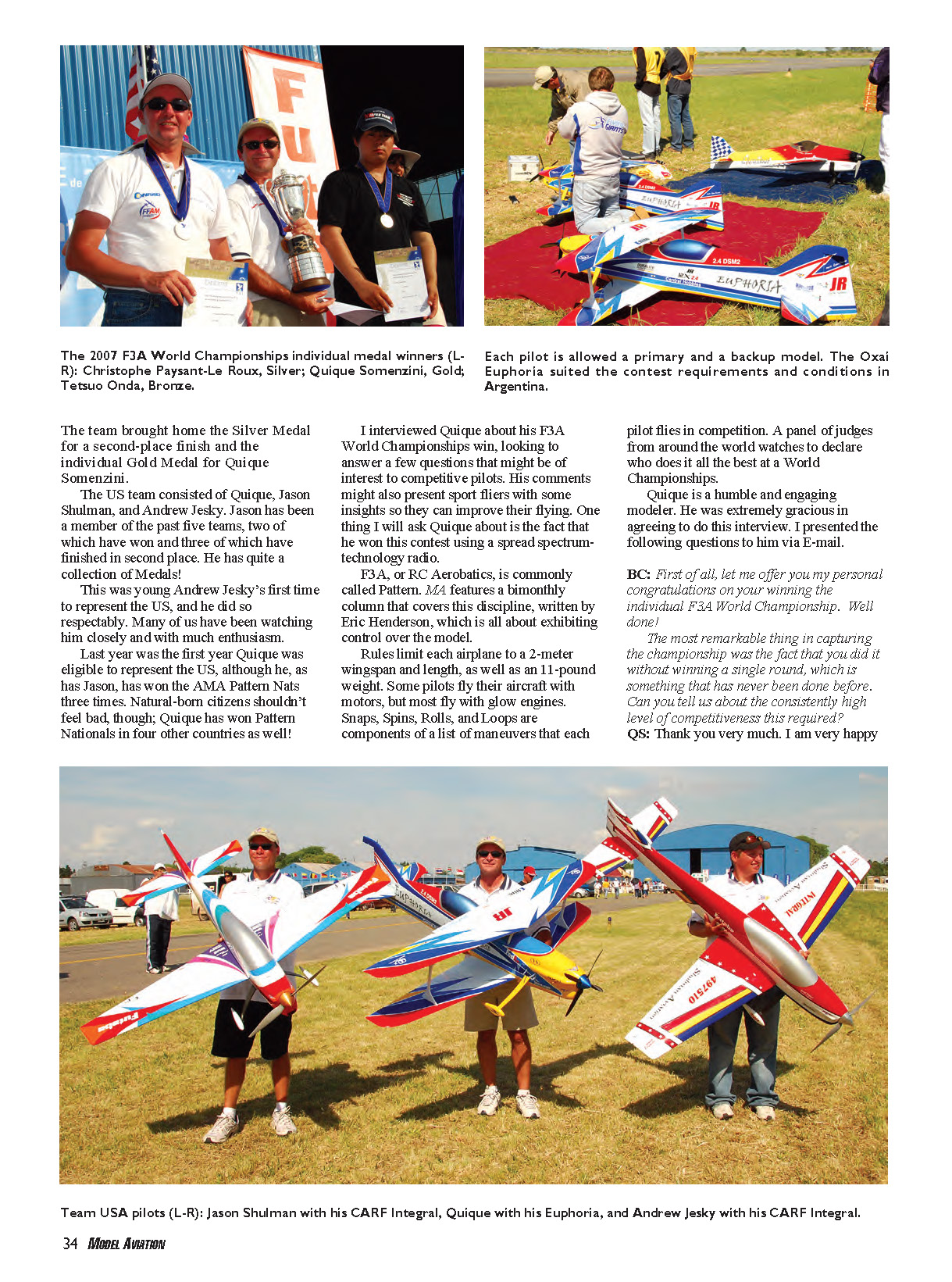
Ron Chidgey included a picture of 24th-placing Quique Somenzini with the caption, "... Watch this talented flier. Chidgey predicts he will place much higher in future championships ... " Ron was right. In November 2007, the US F3A team competed in the World Championships held in Santa Fe, Argentina, and Quique received the FAI F3A individual championship trophy at the closing ceremony.
Introduction
A world-class pilot uses teamwork, training, and airplane design to bring back the Gold. I interviewed Quique Somenzini about his F3A World Championship win to answer questions of interest to competitive pilots and to offer insights for sport fliers who want to improve. F3A (RC Aerobatics, commonly called Pattern) focuses on exhibiting control over the model. Rules limit each airplane to a 2-meter wingspan and length and an 11-pound weight. Most pilots fly glow engines. Snaps, spins, rolls, and loops are components of the maneuvers each pilot flies in competition, and a panel of international judges determines the winners.
Quique is a humble and engaging modeler and very graciously agreed to this interview. His responses were provided via e-mail.
Interview
BC: First of all, let me offer you my personal congratulations on your winning the individual F3A World Championship. Well done! The most remarkable thing in capturing the championship was the fact that you did it without winning a single round, which is something that has never been done before. Can you tell us about the consistently high level of competitiveness this required?
QS: Thank you very much. I am very happy and proud to represent the US. I think the key to winning this championship was consistency. I tried to fly steady and keep a high average in every round instead of trying to win any single round. In Argentina the wind and weather changed from day to day, so being able to adapt and deliver the same quality of flying in different conditions was very important.
I practice a lot and I work with my team to get the airplane setup right for a variety of conditions. We prepare several models and tune them so they feel the same in different winds. Having reliable equipment and a good team behind you helps reduce variables and allows you to concentrate on flying smoothly and precisely.
To be honest, I never thought a world championship could be won without winning a single round, but I knew the only way to do it was by being steady and scoring consistently high. Fantastic flyers like my teammate Jason Shulman, Frenchman Christophe Paysant-Le Roux, and Japanese pilot Tetsuo Onda all won a round, but I was very close to 1000 points in some rounds and delivered in the important final rounds. That consistency was the key to this result. The bottom line was reaching what I sought for so many years, and on top of that I got something unique that makes me smile even more.
BC: What was it like, for you personally, winning in Argentina?
QS: It was a dream come true. This was my first time on the USA team and I am very happy and honored by how we all worked together, united with a common target. This team environment helped each of us perform at our best.
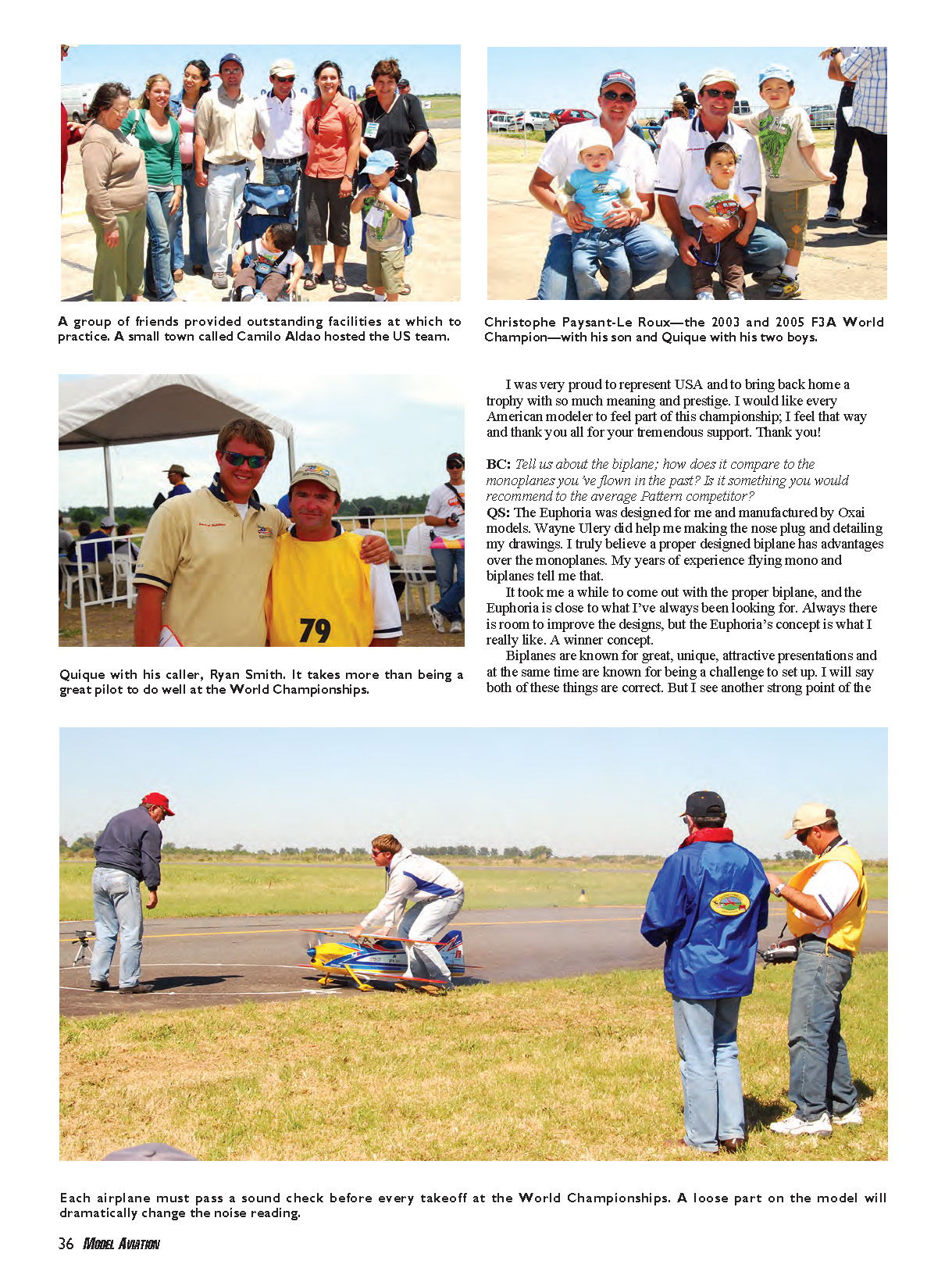
I felt extraordinary support from my teammates. We had great practice together before the contest — a true team practice. All this teamwork was reflected later during the contest, both as a team performance and individually. I felt they were true supporters of my individual win. To all of them go my very special thanks.
As a team result we were very close to winning. We were first after raw scores and 8 points back in second place after TBL — a very good result — and without question we will be contenders for first place in 2009.
As you know, Argentina is my home country. Going back, competing, and winning there was a very special feeling. I must thank all my Argentine friends for the extraordinary support they gave me during the contest; it was magic and special. I was very proud to represent the USA and to bring back a trophy with so much meaning and prestige. I would like every American modeler to feel part of this championship; I feel that way and thank you all for your tremendous support.
BC: Tell us about the biplane; how does it compare to the monoplanes you've flown in the past? Is it something you would recommend to the average Pattern competitor?
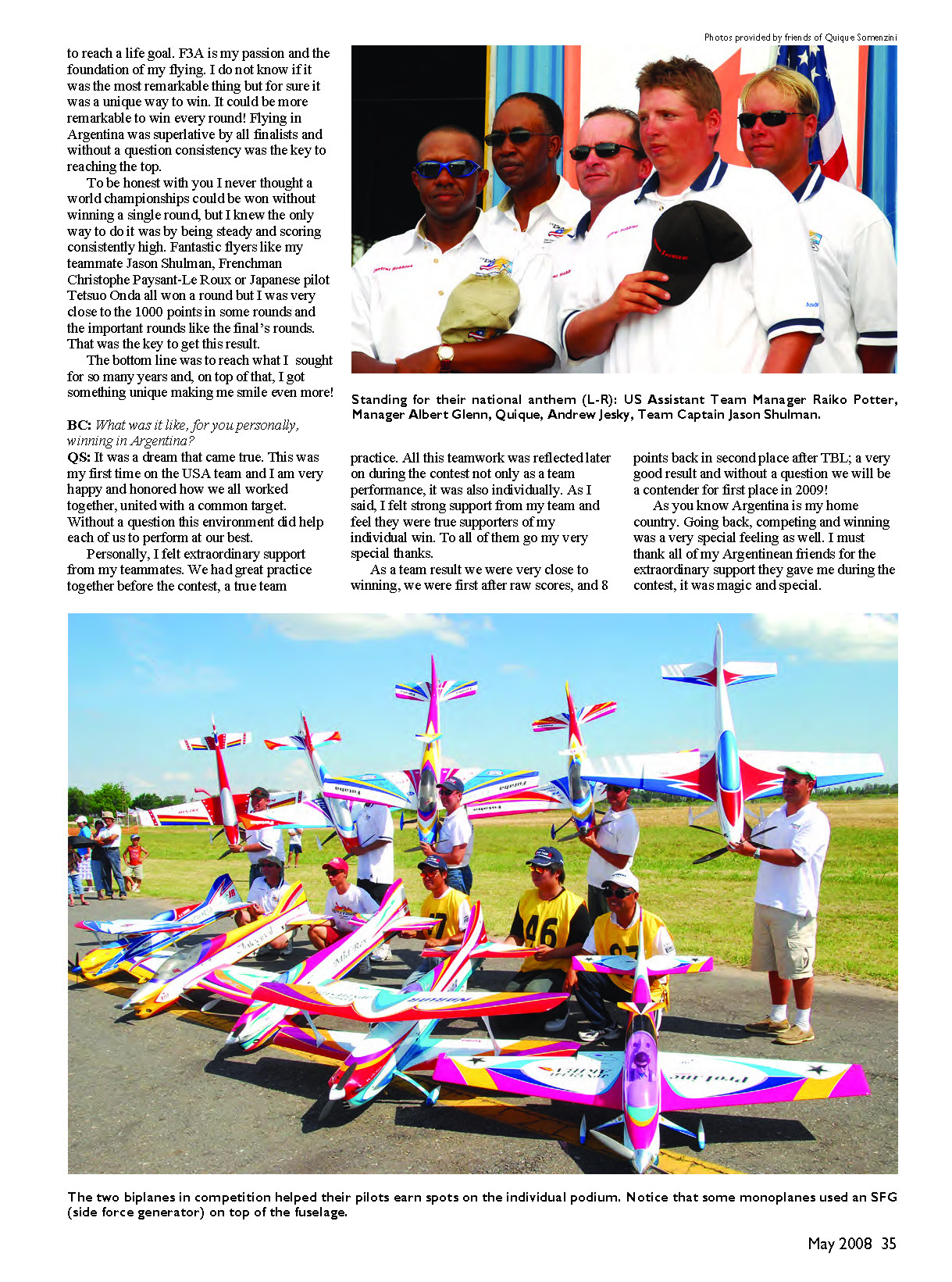
QS: The Euphoria was designed for me and manufactured by Oxai models. Wayne Ulery helped make the nose plug and detailed my drawings. I truly believe a properly designed biplane has advantages over monoplanes based on my years of experience flying both.
It took me a while to come up with the proper biplane, and the Euphoria is close to what I've always been looking for. There's always room to improve designs, but the Euphoria's concept is what I really like — a winning concept.
Biplanes are known for great, unique, attractive presentations and at the same time are known for being a challenge to set up. Both of these things are true. I see another strong point: presentation. A well-designed biplane can give you an edge in style and presentation if you can get it set up and tuned right.
This was my first time representing the USA and it was an enormous experience for me. I felt part of a real and very strong team. I enjoyed the contest and equally enjoyed the practice. Every day we practiced together before the WC, which was truly exciting and an incredible opportunity to learn and improve my flying. At home I usually practice with Wayne or by myself, but in Argentina we practiced together as a team with Jason or Andrew flying and the whole team watching. To me that was one of the nicest challenges I went through.
I truly believe that if our team in the future works united and with the same goals, we could set the standards of world F3A competition. Young fliers are already showing incredible talent and achievement. One of them is Andrew Jesky, who did a remarkable job and is probably one of the best world F3A pilots. Brett Wickiser is another young and very talented pilot who also showed his talent at the last Nats. I am excited to see young fliers like them and I will keep supporting younger pilots as much as I can. I will return to the World Championships in Portugal in 2009 as an individual competitor to give the opportunity for a fourth person from the US to be part of the US team, and I will continue flying and competing in F3A as long as I enjoy it.
BC: The F3A World Championships is, in essence, the top honor conferred on any powered, fixed-wing RC pilot in the world. Bearing in mind your involvement with many other disciplines of RC, such as IMAC and E-flight, what is your personal favorite type of model aircraft? What do you fly for fun? Does your son fly yet?
QS: My passion is precision aerobatics. No matter what airplane type I fly, I like to fly aerobatics — aerobatics with control. To me that has a direct relationship with precision. Precision is the foundation of all types of aerobatics. Whether it's 3D, F3A, IMAC, or E-flight, they share the same feeling and foundation. F3A, in my opinion, is the purest expression of precision, finesse, and style.
My son does not fly yet, but if he chooses to fly pattern I will be a happy dad!
BC: You are now the undisputed top precision aerobatics pilot in the world. What can you tell us about your practice schedule in the year leading up to the World Championships in Argentina?
QS: 2007 was an intensive F3A year — more so than the previous five or six years. I got my new Euphoria flying early in 2007, learned the airplane, and found the best setup. We had the Nationals/Team Trials and then the World Championships.
My preparation was mainly working on the airplanes. I took three airplanes to Argentina and spent a great amount of time trying to get all of them flying as similarly as possible. Wayne and I spent many hours together working on props. We learned some things at the Nationals and used that experience to get better tuned up for the Worlds.
After the Nationals I took a break from flying and worked in the shop building my fourth Euphoria. By mid-September I started flying again and kept working on setting up and matching the airplanes. I flew about five to six flights every day except weekends and flew most of the day. The wind did not stop me because I knew the conditions waiting for us in Argentina. I flew the P programs, F programs, and Unknown maneuvers every day. With Wayne calling and coaching, we flew until I left for Argentina.
In Argentina we were able to practice at outstanding facilities in a small town called Camilo Aldao, where the US team practiced hard for five days. That team practice was very important for both the team and my individual result.
BC: You mentioned a specially modified APC propeller; what were the modifications, and how many other propeller setups were you prepared to use in Argentina? What conditions were the other propellers designed to perform under?
QS: Wayne based his prop on an APC 15.5x12 four-blade and increased it to about 16.2x13 using fiberglass and carbon fiber. We tested many props, but the four-blade outflew all the two- and three-blade props.
We took four props to Argentina, all the same kind, and that tells you how happy I was with that prop.
BC: What advice can you give younger pilots aspiring to make the United States F3A team in the future, to help them prepare for the world stage?
QS: Practice and practice, but practice smart. Managing your time well is key to solid practice. Practice in all kinds of weather conditions and practice all kinds of maneuvers to be ready for the Unknowns. Practice the known P and F programs to eliminate every little mistake. Try different setups.
Like any other sport, desire and determination will take you where you want to go, along with discipline, being open to criticism, having an open mind about setups, perseverance, and being a good sportsman.
BC: With this goal achieved, what are your next goals as a Pattern pilot?
QS: Keep flying and enjoying F3A. Reaching my goal won't change how I feel about flying precision aerobatics. Designing airplanes is another passion and something I want to keep doing in F3A. Every season brings something new to try, and that's what I enjoy about the sport.
Another goal is supporting young talent coming up and helping them to one day be in the position I am today. If I can be part of a project like that I will be very proud.
Quique, thank you for sharing your thoughts. I am excited and proud of your win here in the US, and I look forward to your leadership for Team USA in the future.
Ron Chidgey's 1987 Advice
In Ron Chidgey's 1987 article he outlined five points he felt F3A needed in the US to be competitive:
- Get yourself a coach and do your serious practicing with him or her.
- Read the rule book. Better still, study the rule book.
- Don't let yourself get into the habit of just grinding out flight after flight.
- Be humble when you win and graceful when you don't.
- Fly your own design, or at least one you can be closely identified with.
The 2007 US F3A team did a great job following Ron's advice from 20 years earlier. His intent was to guide the US back to preeminence in world Pattern competition — which has largely been achieved.
This past year the National Society of Radio Controlled Aerobatics (NSRCA) adopted the US F3A team for fund-raising purposes, establishing a year-round program currently chaired by Rusty Dose. Visit the NSRCA website for information. The NSRCA is the AMA's SIG for RC Aerobatics, runs the Pattern Nats, and hosts the Team Selection Finals (usually in conjunction with the Nats). For now the organization's focus is Portugal in 2009, where Quique and the next three F3A team members will compete in the World Championships.
Congratulations to the 2007 team, and best wishes to those pilots hoping to win a place on the team in 2008.
Brian Clemmons [email protected]
Sources:
- NSRCA — http://nsrca.us/
- Oxai — (480) 664-1560, www.oxai-rc.com
Transcribed from original scans by AI. Minor OCR errors may remain.

