
INtheAIR — 2011/05
Joe Beshar Receives Prestigious McEntee Award
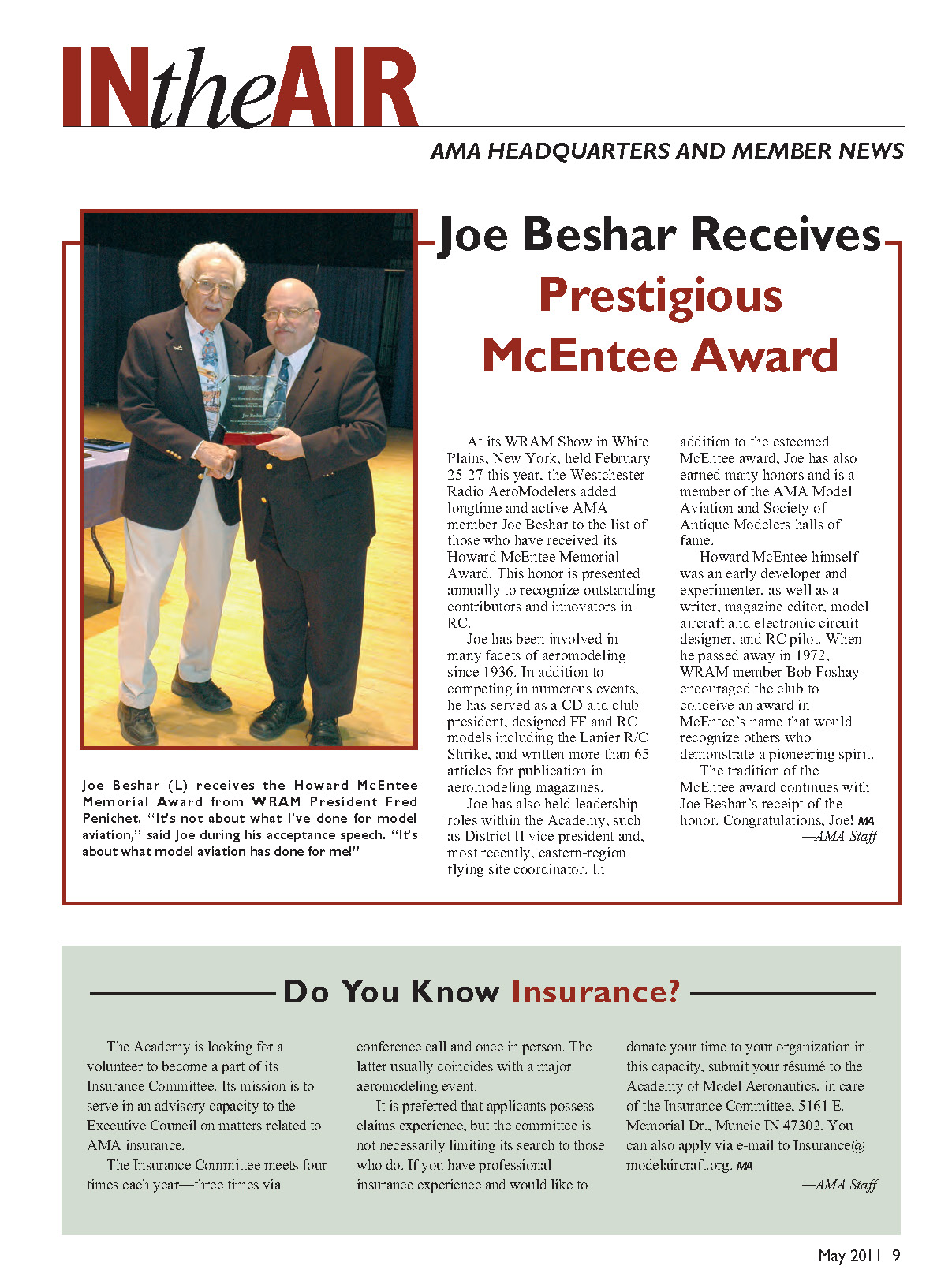
At its WRAM Show in White Plains, New York, held February 25–27 this year, the Westchester Radio AeroModelers added longtime and active AMA member Joe Beshar to the list of those who have received its Howard McEntee Memorial Award. This honor is presented annually to recognize outstanding contributors and innovators in RC.
Joe has been involved in many facets of aeromodeling since 1936. In addition to competing in numerous events, he has served as a contest director (CD) and club president, designed free-flight (FF) and RC models including the Lanier R/C Shrike, and written more than 65 articles for publication in aeromodeling magazines.
Joe has also held leadership roles within the Academy, such as District II vice president and, most recently, eastern-region flying site coordinator. In addition to the esteemed McEntee award, Joe has earned many honors and is a member of the AMA Model Aviation and Society of Antique Modelers halls of fame.
Howard McEntee himself was an early developer and experimenter, as well as a writer, magazine editor, model aircraft and electronic circuit designer, and RC pilot. When he passed away in 1972, WRAM member Bob Foshay encouraged the club to create an award in McEntee’s name that would recognize others who demonstrate a pioneering spirit.
The tradition of the McEntee award continues with Joe Beshar’s receipt of the honor. Congratulations, Joe! — AMA Staff
Large Models—Redefined
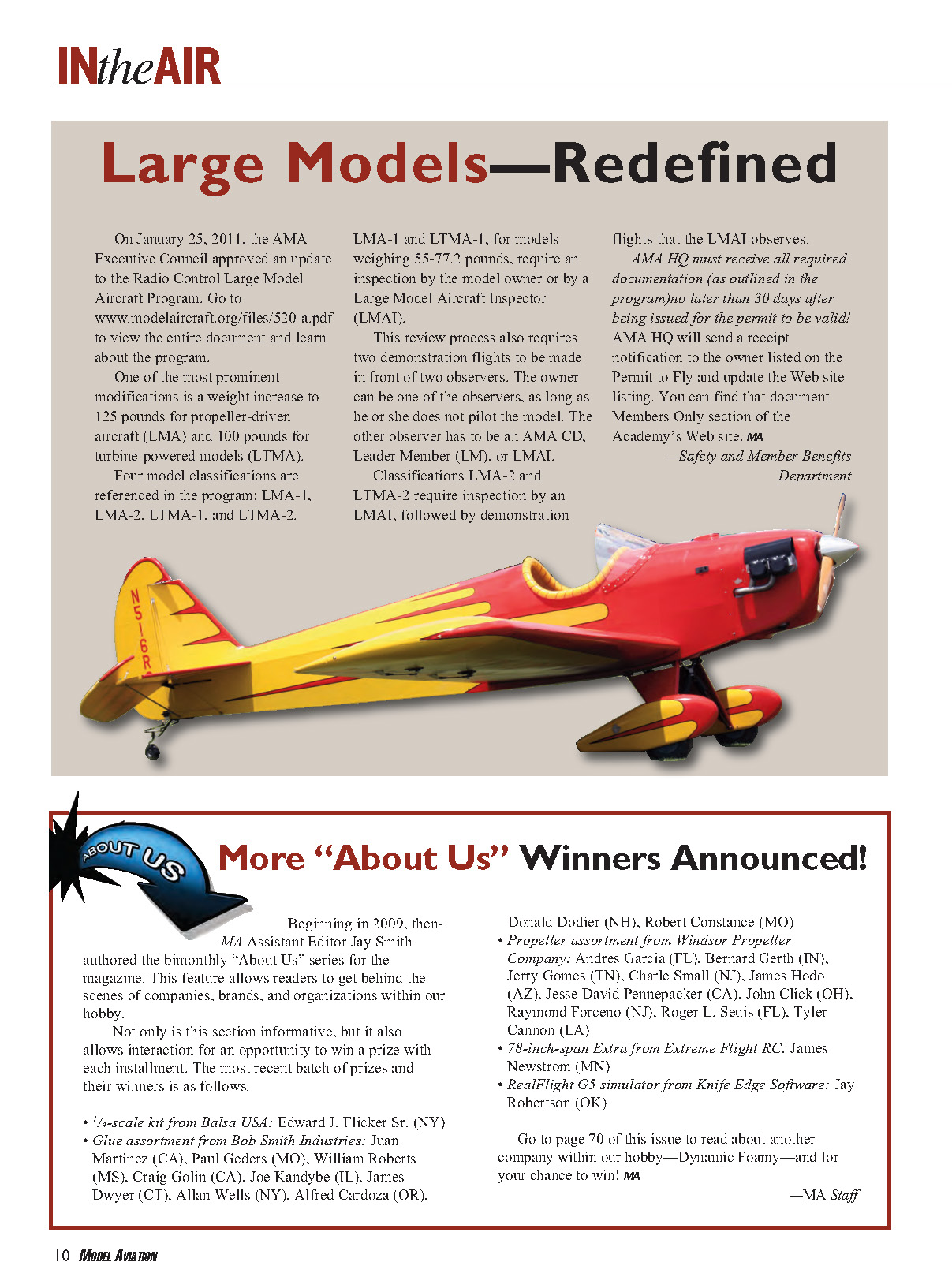
On January 25, 2011, the AMA Executive Council approved an update to the Radio Control Large Model Aircraft Program. Go to www.modelaircraft.org/files/520-a.pdf to view the entire document and learn about the program.
One of the most prominent modifications is a weight increase to 125 pounds for propeller-driven aircraft (LMA) and 100 pounds for turbine-powered models (LTMA).
The program references four model classifications:
- LMA-1
- LMA-2
- LTMA-1
- LTMA-2
Inspection and demonstration requirements:
- LMA-1 and LTMA-1 (models weighing 55–77.2 pounds) require an inspection by the model owner or by a Large Model Aircraft Inspector (LMAI). This review process also requires two demonstration flights to be made in front of two observers. The owner can be one of the observers, as long as they do not pilot the model. The other observer must be an AMA CD, Leader Member (LM), or LMAI.
- LMA-2 and LTMA-2 require inspection by an LMAI, followed by demonstration flights observed by the LMAI.
AMA HQ must receive all required documentation (as outlined in the program) no later than 30 days after the permit is issued for the permit to be valid. AMA HQ will send a receipt notification to the owner listed on the Permit to Fly and update the website listing. You can find that document in the Members Only section of the Academy’s website. — MA, Safety and Member Benefits Department
Michigan Modelers Spread Holiday Cheer
The Southeastern Michigan aeromodeling community kept busy during the last holiday season.
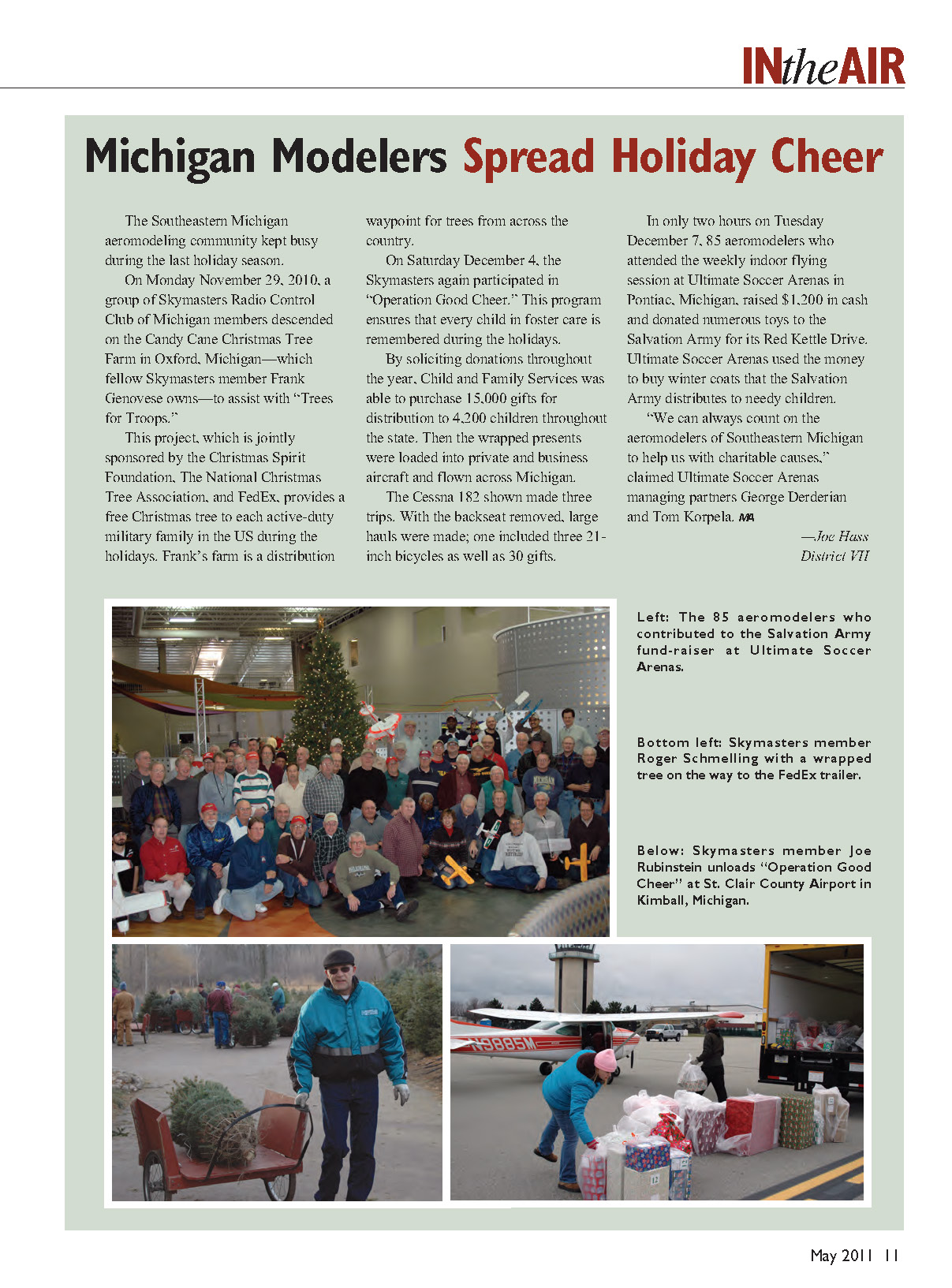
On Monday, November 29, 2010, a group of Skymasters Radio Control Club of Michigan members descended on the Candy Cane Christmas Tree Farm in Oxford, Michigan—which fellow Skymasters member Frank Genovese owns—to assist with "Trees for Troops."
This project, jointly sponsored by the Christmas Spirit Foundation, the National Christmas Tree Association, and FedEx, provides a free Christmas tree to each active-duty military family in the U.S. during the holidays. Frank’s farm is a distribution waypoint for trees from across the country.
On Saturday, December 4, the Skymasters again participated in "Operation Good Cheer." This program ensures that every child in foster care is remembered during the holidays. By soliciting donations throughout the year, Child and Family Services was able to purchase 15,000 gifts for distribution to 4,200 children throughout the state. The wrapped presents were then loaded into private and business aircraft and flown across Michigan.
The Cessna 182 shown made three trips. With the backseat removed, large hauls were made; one included three 21-inch bicycles as well as 30 gifts.
In only two hours on Tuesday, December 7, 85 aeromodelers who attended the weekly indoor flying session at Ultimate Soccer Arenas in Pontiac, Michigan, raised $1,200 in cash and donated numerous toys to the Salvation Army for its Red Kettle Drive. Ultimate Soccer Arenas used the money to buy winter coats that the Salvation Army distributes to needy children.
"We can always count on the aeromodelers of Southeastern Michigan to help us with charitable causes," said Ultimate Soccer Arenas managing partners George Derderian and Tom Korpela. — Joe Haas, District VII
History Preserved:
The Collection of the National Model Aviation Museum
Engine mounts are a vital part of aircraft design and construction. In his "Engine Technique" column in the March 1978 MA, Don Jehlik explained that "the engine vibrates, produces heat and power. It needs to be mounted in such a way that it will do the job you intend for it."
He went on to explain how to determine whether or not the mount is true. If the mounting lugs aren't properly mated with a true engine mount, extra stresses on the power plant and mount as they move during flight can impair engine performance.
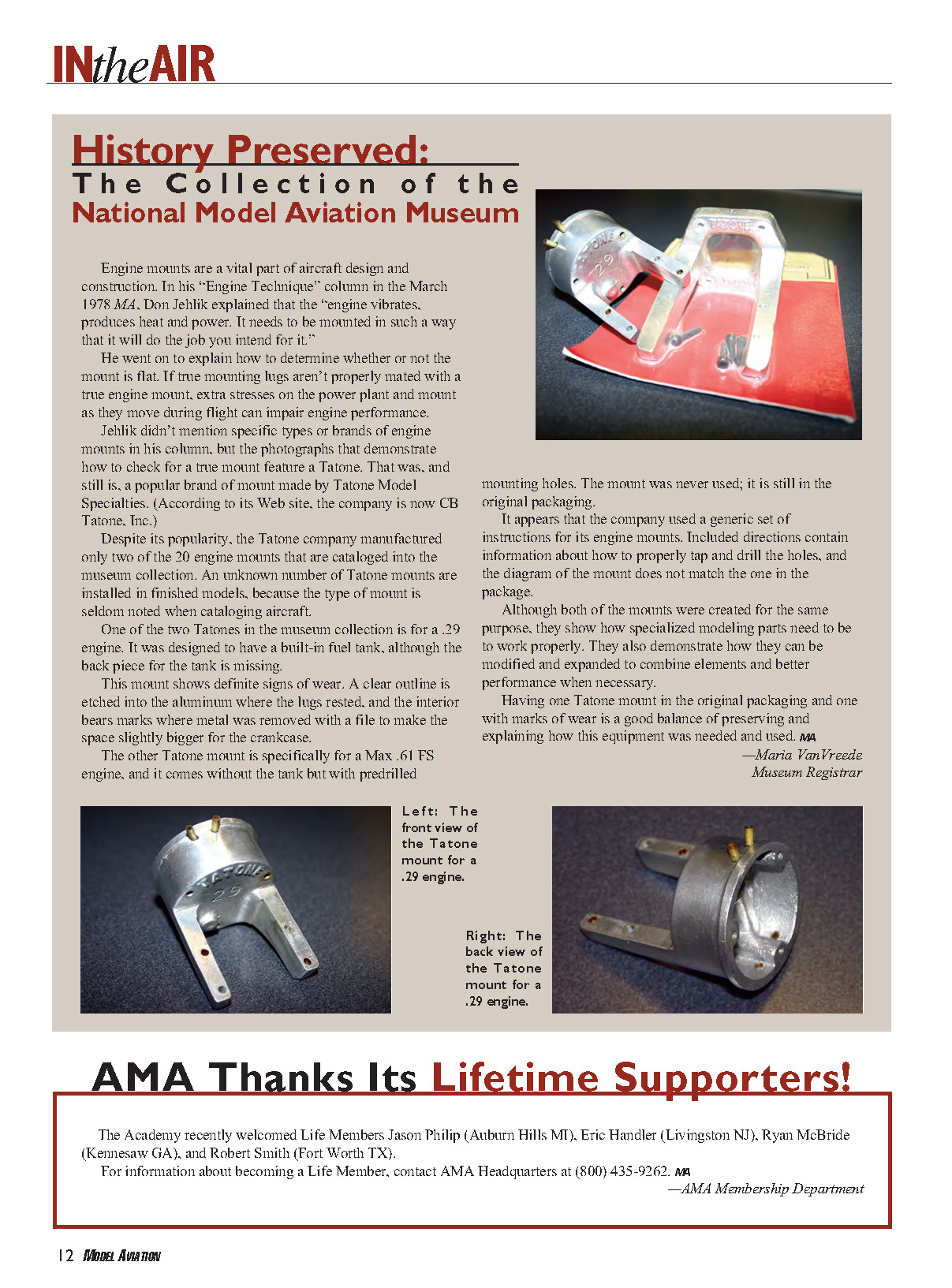
Jehlik didn't mention specific types or brands of engine mounts in his column, but the photographs that demonstrate how to check for a true mount feature a Tatone. That was, and still is, a popular brand of mount made by Tatone Model Specialties. (According to its website, the company is now CB Tatone, Inc.)
Despite its popularity, the Tatone company manufactured only two of the 20 engine mounts that are cataloged in the museum collection. An unknown number of Tatone mounts are installed in finished models, because the type of mount is seldom noted when cataloging aircraft.
One of the two Tatones in the museum collection is for a .29 engine. It was designed to have a built-in fuel tank, although the back piece for the tank is missing. This mount shows definite signs of wear. A clear outline is etched into the aluminum where the lugs rested, and the interior bears marks where metal was removed with a file to make the space slightly bigger for the crankcase.
The other Tatone mount is specifically for a Max .61 FS engine; it comes without the tank but with predrilled mounting holes. The mount was never used and is still in the original packaging.
It appears that the company used a generic set of instructions for its engine mounts. Included directions contain information about how to properly tap and drill the holes, and the diagram of the mount does not match the one in the package.
Although both mounts were created for the same purpose, they show how specialized modeling parts need to be to work properly. They also demonstrate how they can be modified and expanded to combine elements for better performance when necessary.
Having one Tatone mount in the original packaging and one with marks of wear is a good balance of preserving and explaining how this equipment was needed and used. — Maria VanVreede, Museum Registrar
Transcribed from original scans by AI. Minor OCR errors may remain.

