
Introduction to Lithium-Polymer Batteries - 2004/05
by Bob Aberle
SEVERAL YEARS AGO we first heard of model-aviation enthusiasts using lithium-ion batteries to power electric motors in RC model aircraft. The lithium-ion cells came from the cell-phone industry, which meant the supply was abundant. But early on, modelers began to realize that lithium-ion cells weren't so adaptable for hobby use. Along came the lithium-polymer cells, or Li-Poly, and the rest is history.
These new Li-Poly cells have proven to be a boon to the electric-power enthusiast. They offer substantial weight savings and considerably more capacity. Under proper care, these new cells are much safer to use than lithium-ion cells. The bottom line is that your electric-powered model can weigh less and fly for a longer period of time.
That's the good news, but using these new battery cells has become a problem for many modelers and has caused serious safety concerns. The Li-Poly cell characteristics are completely different from Ni-Cd and NiMH cells. The chargers and charging techniques are completely different. There are also safety issues associated with the use of these cells about which the user must know.
Li-Poly cells are currently more expensive than the traditional Ni-Cd and NiMH cells. First-generation Li-Poly cells were more limited in load current capability, but that aspect has improved greatly in recent years. In this article I describe the Li-Poly cell itself, go into charging and discharging, and provide application suggestions for using this new form of electric power. I also revisit my Scratch-One RC electric sailplane design (presented in November 2003 and January 2004 installments) and show exactly how I replaced a NiMH battery pack with one of Li-Poly cells so you can easily relate to the weight reduction and increased capacity.
Li-Poly Cell Characteristics
- Ni-Cd and NiMH cells reach approximately 1.4 volts at full charge and are usually stated as having a nominal or average voltage of 1.2 volts per cell.
- Lithium-ion and Li-Poly cells (which have the same basic electrical characteristics) are considered fully charged at 4.2 volts, and most experts consider the nominal or average working voltage to be 3.7 volts per cell.
This difference can make life more difficult for the electric flier. With Ni-Cd or NiMH, adding or removing a single cell changes total pack voltage by only ~1.2 volts. With Li-Poly cells, increments are larger: one cell = 3.7 V, two cells = 7.4 V, three cells = 11.1 V, etc. Tailoring your motor and prop/gear-reduction to these discrete voltage options can be a challenge. You often must change gear reduction or prop size to maintain allowable power (wattage) and motor current.
Cell Weight
Consider some weight comparisons:
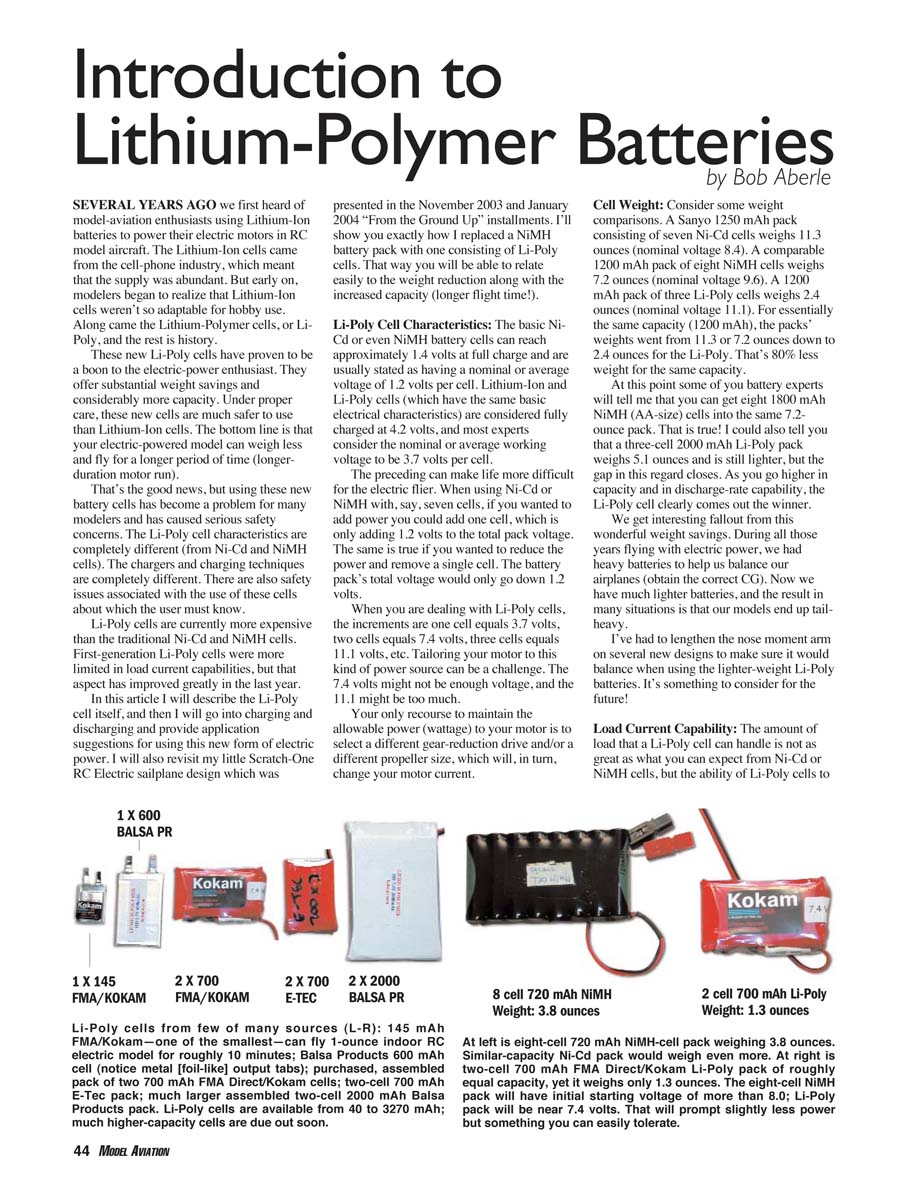
- A Sanyo 1250 mAh pack of seven Ni-Cd cells weighs 11.3 oz (nominal voltage 8.4 V).
- A comparable 1200 mAh pack of eight NiMH cells weighs 7.2 oz (nominal voltage 9.6 V).
- A 1200 mAh pack of three Li-Poly cells weighs 2.4 oz (nominal voltage 11.1 V).
For essentially the same capacity (1200 mAh), pack weights went from 11.3 or 7.2 oz down to 2.4 oz for the Li-Poly — roughly 80% less weight for the same capacity.
You can get higher-capacity NiMH packs that narrow the gap (for example, eight 1800 mAh NiMH AA cells), and a three-cell 2000 mAh Li-Poly pack (5.1 oz) is still lighter but the advantage shrinks. As you go higher in capacity and discharge-rate capability, Li-Poly cells increasingly become the winner.
A practical consequence of this weight savings: many models end up tail-heavy because batteries no longer provide the previous ballast. I've lengthened the nose moment arm on several designs to ensure balance when using lighter Li-Poly batteries.
Load Current Capability
- Early Li-Poly cells (circa 2002) could only supply 2–3C loads — insufficient for many models.
- Ni-Cd and NiMH cells often handle 20–25C. For example, a 3000 mAh NiMH pack powering a motor at 50 A is a 50 ÷ 3.0 = 17C load.
- Li-Poly cells have progressed: 4C, 6C, 8C, and now some manufacturers (e.g., FMA Direct/Kokam) offer cells rated at 20C, putting them on par with older Ni-Cd and NiMH cells.
Load capability is improving rapidly as the technology matures.
Series/Parallel Connections
With Ni-Cd or NiMH you typically place cells in series to increase voltage while capacity remains that of a single cell. Li-Poly cells follow the same principle, except available cell voltages are larger (3.7 V nominal per cell) and single-cell capacities currently peak around 3270 mAh (and rising).
To achieve both higher voltage and higher capacity with Li-Poly cells, modelers combine series and parallel configurations:
- Place cells in series to increase voltage (3.7 V per cell).
- Place identical series strings in parallel to increase capacity.
Example:
- Make two identical series strings of three 1000 mAh Li-Poly cells (3 × 3.7 V = 11.1 V each).
- Connect the two 3S strings in parallel → result: 11.1 V at 2000 mAh (3S2P), totaling six cells.
I will cover series/parallel pack assembly in more depth in a subsequent article.
Charge Retention
Li-Poly cells have excellent charge retention: they lose only about 1–2% of their charge over six months, far better than Ni-Cd and NiMH which drop from peak charge in a couple of weeks. Because of this, do not use trickle-charging on Li-Poly batteries — prolonged trickle charging or overcharging can damage them. Use chargers specifically designed for Li-Poly cells and avoid leaving packs on indefinite charge. Li-Poly cells can easily be overcharged in a trickle mode, so don't do it.
Expected Life
Li-Poly cell lifespan is roughly 600 cycles under proper use, at which point usable capacity might be down to around 80% of the original. Proper charging and discharging discipline is essential to realize this life.
Appearance and Identification
- Li-Poly batteries are flat, aluminum-foil pouches (rectangular and thin) and are easy to identify compared to cylindrical Ni-Cd or NiMH cells.
- Output tabs are mounted on one end of each cell. Each cell or pack is usually labeled with voltage and capacity; some manufacturers also provide charging instructions (number of cells and recommended charge current).
- A common convention: 1S = single cell, 2S = two cells in series, 3S = three cells in series. For series/parallel packs you’ll see notations like 3S4P (three-in-series, four parallel strings).
Assembling Cells Into Packs
- Early Li-Poly cell tabs were aluminum and difficult to solder. Manufacturers began welding nickel-plated strips to tabs to ease soldering, but accidental shorting during soldering remained a risk.
- FMA Direct/Kokam introduced a printed circuit board (PCB) material attached to battery tabs so the builder only connects wiring to pads on the PCB — simplifying pack assembly.
- FMA Direct also supplies connector strips to link packs in parallel without soldering and offers ready-made packs with thin foam separators between cells and a final heat-shrink wrap.
- Important assembly practice: make sure all cells are at the same potential before construction. Individually charge all cells fully before assembly. Assembling cells with different states of charge (e.g., two fully charged and one discharged) can result in a cell that never charges properly.
Cost of Cells
- Early Li-Poly cells were expensive: small 145 mAh cells cost around $10 each.
- Two 700 mAh Li-Poly cells for parking-lot flyers might cost around $30 — comparable to an equivalent NiMH pack.
- A three-cell 1900 mAh pack for a Speed 400 motor could cost $60–$70, significantly more than an eight-cell NiMH pack.
- Costs rise quickly when using parallel strings for higher capacity. For example, an expert modeler assembled a 36-cell series/parallel pack producing 37.8 V at 7800 mAh (for a 50-size brushless motor at up to 50 A) and paid close to $600. Prices have been dropping and are expected to continue to decline.
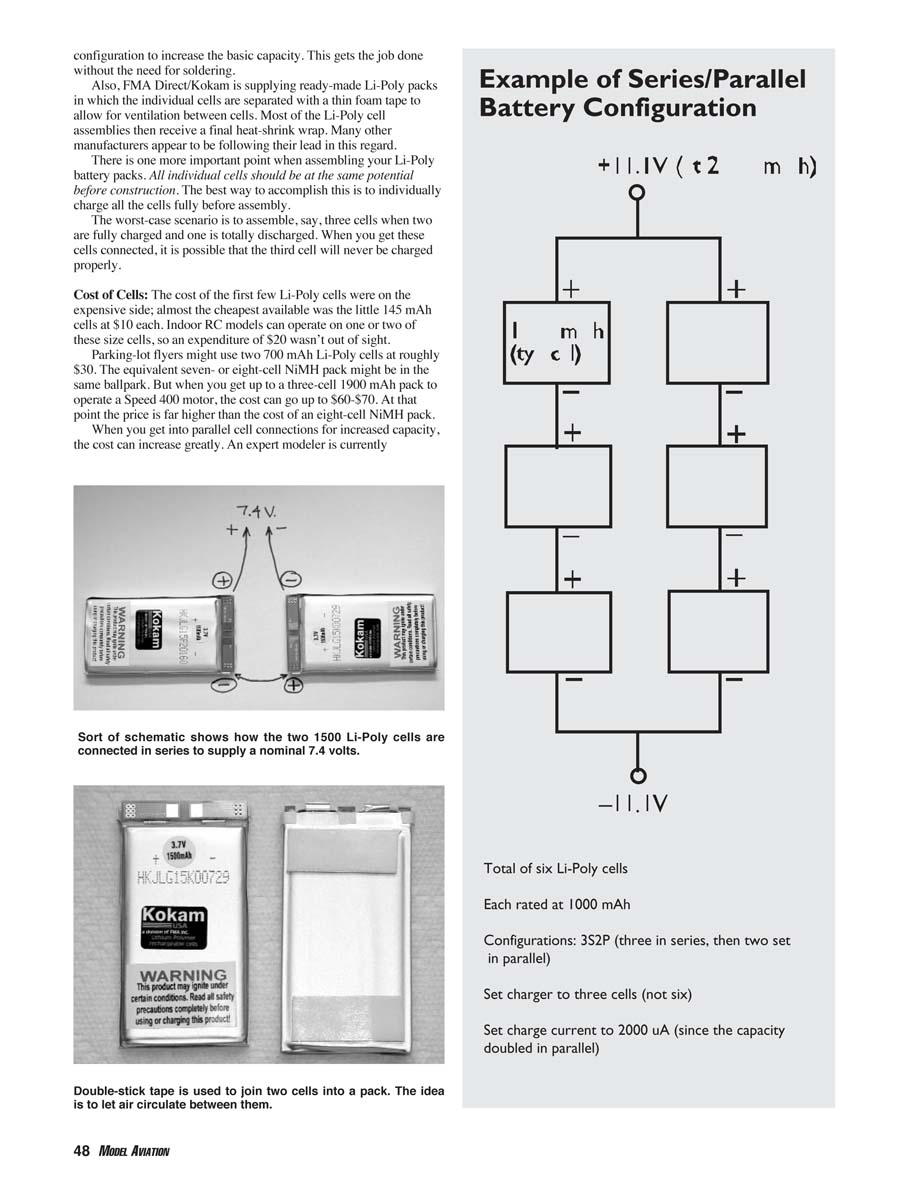
Example of Series/Parallel Battery Configuration
- Total cells: 6 Li-Poly cells
- Each rated: 1000 mAh
- Configuration: 3S2P (three in series, two identical 3S strings in parallel)
- Charger settings:
- Set charger for three cells in series (3S), not six.
- Set charge current to 2000 mA (since the capacity doubled in parallel to 2000 mAh).
Notes:
- When assembling packs, cells can be joined with double-stick foam tape; leave a small air gap between cells for ventilation.
- Example weight comparison: an original 5.9 oz eight-cell 1100 mAh NiMH pack vs. a 2.7 oz two-cell 1500 mAh Li-Poly pack — roughly half the weight with more capacity.
- Cautionary example: a two-cell 145 mAh Li-Poly pack should be charged at 1C (~145 mA). If charged at a much higher current (e.g., 750 mA), cells can swell ("swollen sausage") and be ruined. Accidental misuse generally ruins cells but may not cause explosion or fire — still, avoid careless setups.
Charging
- Always use a charger designed for Li-Poly batteries. Do not use peak-detect chargers meant for Ni-Cd/NiMH on Li-Poly packs.
- Li-Poly charging method: charger starts at constant current; as cell voltage approaches 4.2 V per cell, the charger switches to constant-voltage mode and reduces current (often pulsing) until full. Voltage is never allowed to exceed 4.2 V per cell. Using an improper charger can exceed cell voltage, permanently damage the cell, or cause fire.
Common chargers and features:
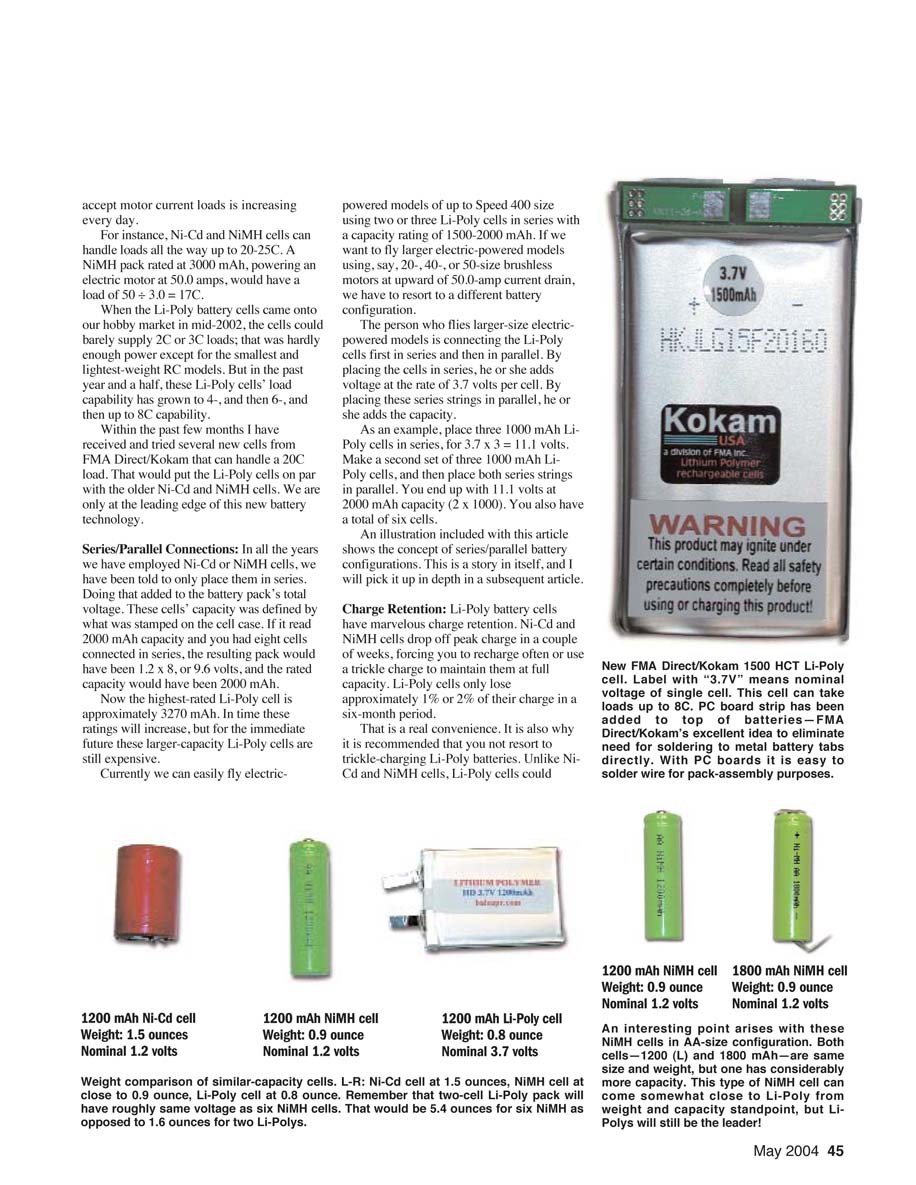
- Peak Electronics Sirius Charger: good for smaller models (up to 3 cells, up to 1500 mA). LCD displays charging parameters. Manual setting of cell count and charge current is required.
- AstroFlight Model 109 Lithium Charger: handles up to 9 cells and up to 7.5 A; includes discharge capability and automatically detects the number of cells. It requires a separate 12 V supply. Provides detailed LCD parameters during charge/discharge.
- Great Planes Triton: multifunction charger handling Ni-Cd/NiMH peak-detect and Li-Poly charging (up to 4 cells at 2.5 A). Has discharge capability and an LCD. Must set the correct battery type.
- FMA Direct/Kokam Lipo-402: handles up to 4 cells at discrete charge levels up to 1500 mA, uses small shorting plugs to select current, and includes an optional Auto Detection mode to set cell count automatically.
Power supplies:
- Many chargers operate from a 12 V supply, which must be purchased separately or can be powered from a car battery.
Charging practice and rates:
- Recommended charge rate: 1C (battery capacity in mAh = charge current in mA). Example: a 1500 mAh pack charges at 1500 mA.
- At 1C, a Li-Poly pack typically reaches ~90% capacity in about 1 hour; the remaining 10% takes longer due to current tapering to maintain 4.2 V per cell. Many users accept ~90% charge for practical purposes.
- On chargers like the Peak, select the number of cells in series and set the charge current to 1C before starting. Some chargers auto-detect cell count (e.g., AstroFlight 109), but you still set the current.
- When using series/parallel packs, set the charger to the number of cells in series. For example: two 3S packs in parallel = set charger for 3 cells; set current to combined capacity (e.g., 1000 mAh in parallel → 2000 mA).
- Remove batteries from the model before charging. If settings are wrong or a cell fails, you don't want a fire inside your balsa model.
- Never leave a Li-Poly battery unattended while charging. Typical full-charge times are 1–2 hours; stay in the workshop during that period.
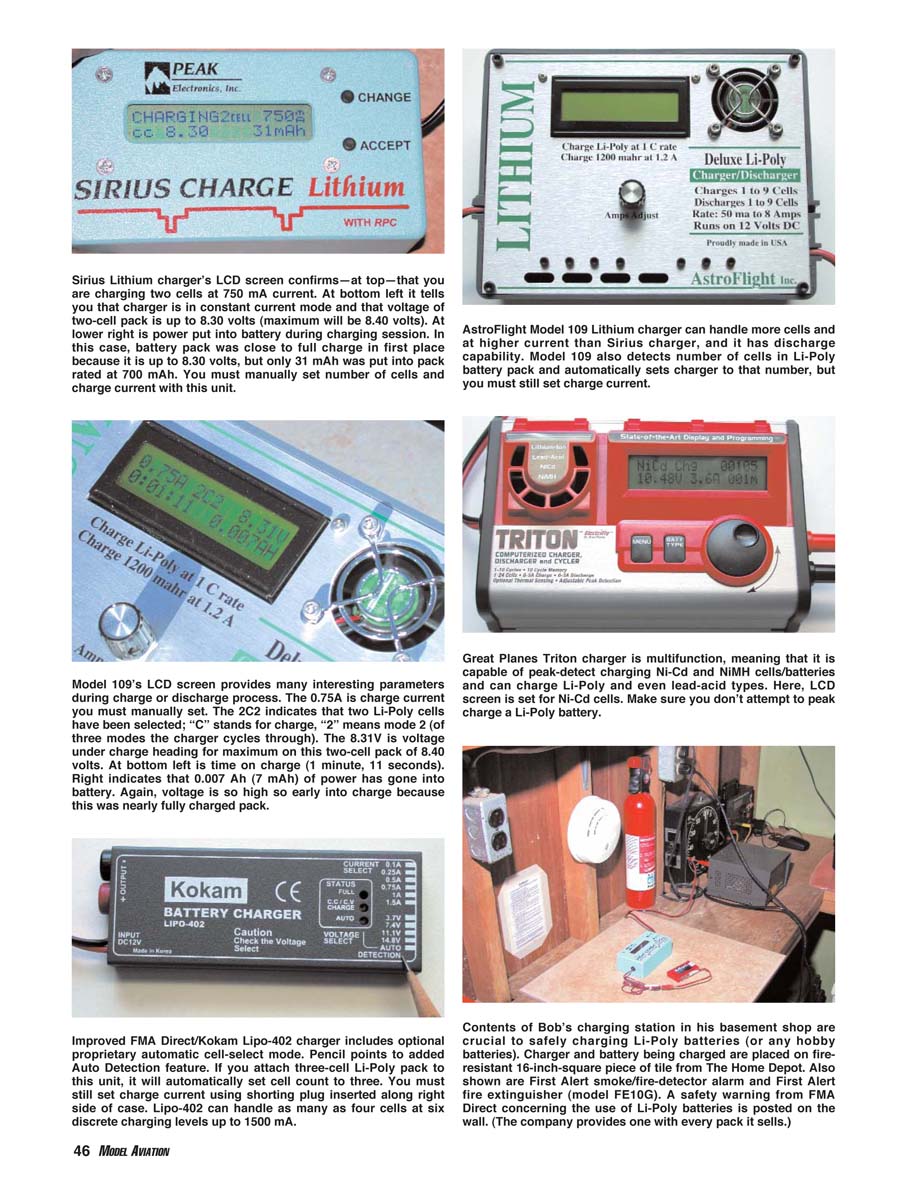
- Set up a safe charging station: a large ceramic tile (e.g., 16 × 16 in) or Corningware surface, a nearby fire extinguisher (with pressure gauge), and a smoke/fire detector. Replace detector batteries annually.
Field charging:
- Many modelers avoid field charging because Li-Poly packs provide more capacity; bring multiple charged packs instead.
- If you do charge at the field, remove the battery from the model and place charger and battery on a stable surface (e.g., folding table); avoid car fenders or engine compartments.
Discharging
- Do not discharge Li-Poly cells below 2.5 V per cell. Most modelers use a conservative minimum of 3.0 V per cell.
- Many modern ESCs include low-voltage cutoff set for Li-Poly: 3.0 V × number of cells (e.g., 6.0 V for 2S, 9.0 V for 3S).
- Some aftermarket warning devices provide audible alerts when the pack voltage drops to a preset level and can be small enough to mount in the cockpit. Other devices will cut the motor when minimum battery voltage is reached.
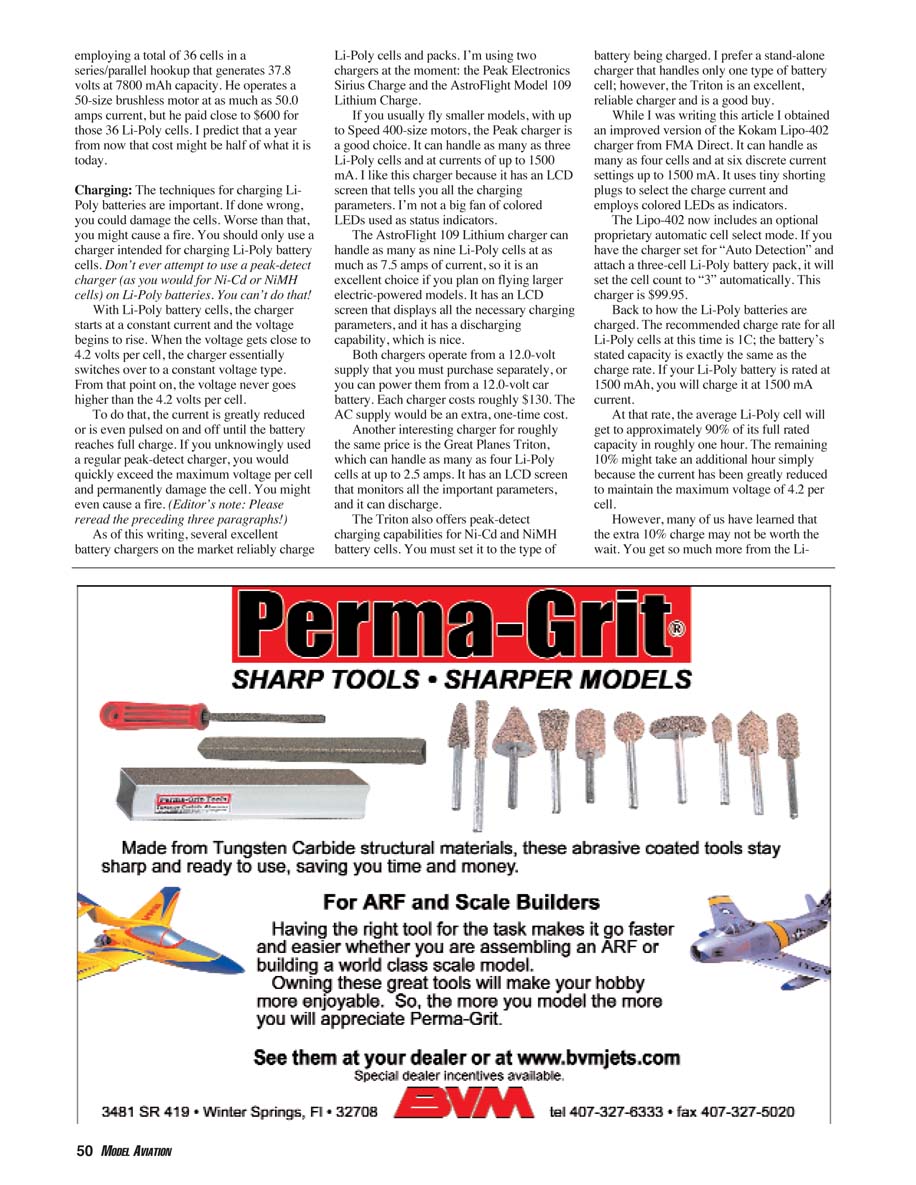
- You can monitor voltage during flight with a wattmeter/voltmeter and record the voltage at landing. If you want to check under load, apply a short motor run on the ground with a current/voltage meter inserted to see how low the voltage goes.
- Chargers with discharge capability typically discharge to the 2.5–3.0 V per cell range to maintain safety.
Safety Issues
- There have been incidents of Li-Poly cell/pack fires. Most are due to inappropriate charger settings or charger failures; only a few accidents have been due to cells failing on their own.
- Li-Poly cells are pouch-type and can expand during misuse; they are more likely to catch fire than to explode. Remove packs from models before charging; keep charging on non-flammable surfaces or in fireproof containers.
- If a model crashes and the battery is damaged, store the pack in a fireproof, insulated box (e.g., a small security box) — do not leave it loose in a car trunk.
- Protective Circuit Modules (PCMs) are used in many lithium-ion packs to sense excess heat, voltage, or current and open the circuit. In some cases, a PCM activating in flight could cut power and cause a crash, so the trade-offs must be considered.
- New external safety devices (e.g., FMA Direct’s Safety Guard) can be placed in series between the charger and battery pack. These open the circuit if a charging problem is detected, and because they are used during charging rather than in flight, they mitigate the risk of in-flight power loss.
- Understand your charger and follow manufacturer instructions carefully to eliminate most problems.
Applications
- Replacing Ni-Cd and NiMH batteries with Li-Poly is not a simple one-for-one swap because of voltage and discharge characteristics.
- Example: a GWS Lite Stik that typically uses a six-cell Ni-Cd or seven-cell NiMH pack with ~2 A motor current could be replaced with two Li-Poly cells (2S) of 700–1200 mAh capacity. Two Li-Poly cells provide much lighter weight and more capacity, but three Li-Poly cells (3S) would raise the voltage to >11 V and could increase motor current enough to damage a small motor.
- Many Li-Poly suppliers publish application guides recommending which packs work with specific motor types and model sizes (e.g., Parking Lot, E-3D Vertical, Speed 280/400).
- Useful references:
- FMA Direct’s "The Kokam USA Lithium Battery System" (AN000002) — comprehensive Li-Poly reference.
- Dave Radford (E-Tec) Li-Poly application data online.
Scratch-One Li-Poly Retrofit
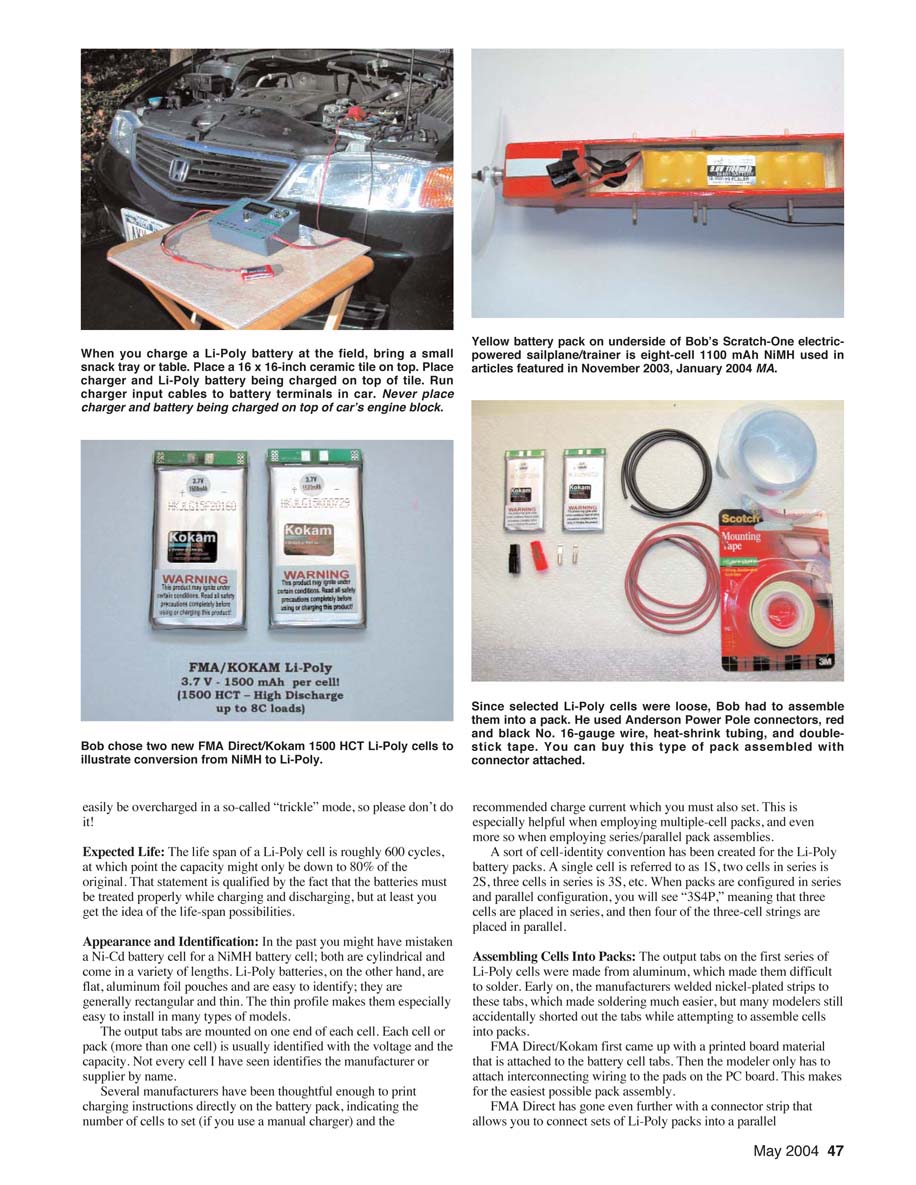
- The Scratch-One is a simple electric RC sailplane/trainer I presented in the "From the Ground Up" series. Originally it used an eight-cell NiMH pack (1100 mAh) with a Speed 400 motor running direct drive. The starting current was about 12 A, dropping during flight to ~8–10 A. The all-up weight was 16.9 oz.
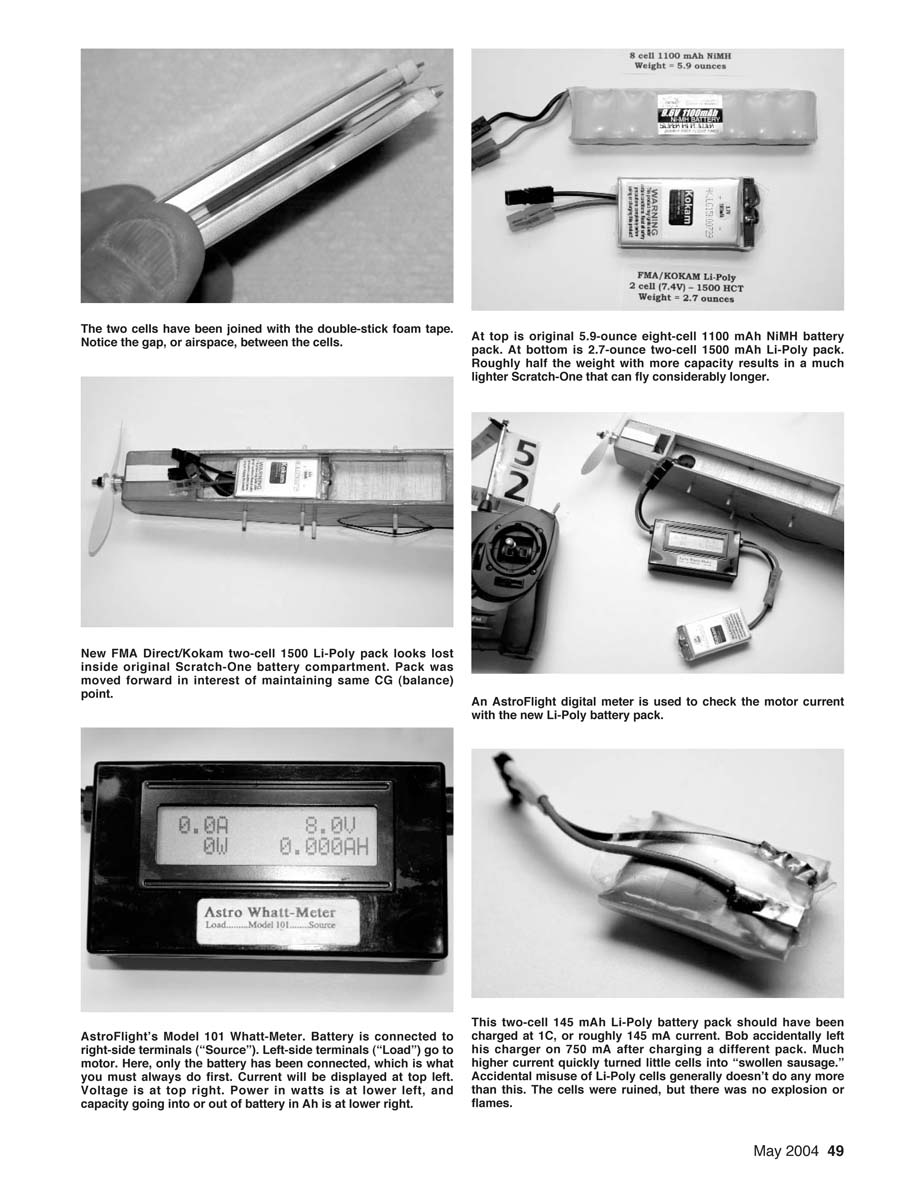
- I swapped in a two-cell Li-Poly pack (2S) to keep voltage reasonable (7.4 V nominal instead of >11 V for 3S). I selected FMA/Kokam 1500 HCT cells rated for 8C (8 × 1500 = 12,000 mA = 12 A) — adequate for the motor's upper limit.
- Results:
- Weight: eight-cell 1100 mAh NiMH = 5.9 oz; two-cell 1500 mAh Li-Poly = 2.7 oz. Weight savings = 3.2 oz. New all-up weight: 13.7 oz.
- Performance: motor current dropped somewhat because of the lower voltage, but not enough to materially affect flight. Combined with greater capacity, motor run time almost doubled; typical cruise currents of 5–7 A produced flight times around 20 minutes or more.
- Cost: NiMH pack $32.95 vs. Li-Poly pack $41.75 — the extra cost was worth the performance and weight benefits.
- With centrally located battery position, the lighter pack had little effect on CG; reduced wing loading improved thermalling and flight time.
Conclusion
Li-Poly battery technology is shaping the future of electric-powered RC modeling. While there are important differences from Ni-Cd and NiMH (voltage per cell, charging method, safety concerns), the advantages in weight, capacity, and charge retention make them compelling. Treat these batteries with respect, use proper chargers and safe charging practices, and they will reward you with cleaner, quieter, longer flights.
Bob Aberle [email protected]
Manufacturers/suppliers
- Advanced Energy Technology (Thunder Power Li-Poly batteries) (702) 228-8883
- Air Craft Inc. (E-Tec chargers, Li-Poly batteries) 00-81-948-21-1045 (Japan) www.aircraft-world.com
- AstroFlight Inc. (Model 109 Lithium charger) (310) 821-6242 www.astroflight.com
- Balsa Products (chargers, Li-Poly batteries) (732) 634-6131 www.balsapr.com
- Batteries America (Li-Poly batteries) (800) 308-4805 www.batteriesamerica.com
- Bishop Power Products (Chargers, FMA/Kokam Li-Poly batteries) www.b-p-p.com
- FMA Direct (Chargers, Kokam Li-Poly Batteries, Safety Guard) (800) 343-2934 www.fmadirect.com
- Hobby Lobby International (chargers, FMA/Kokam Li-Poly batteries) (615) 373-1444 www.hobby-lobby.com
- Horizon Hobby Inc. (Chargers, FMA/Kokam Li-Poly batteries) (217) 403-3279 www.horizonhobby.com
- New Creations R/C (chargers, Li-Poly batteries) (936) 856-4630 www.newcreations-rc.com
- Peak Electronics Inc. (Sirius Lithium charger, Li-Poly batteries) (858) 679-4952 www.SiriusElectronics.com
- Radical R/C (chargers, Li-Poly batteries) (937) 256-7727 www.radicalrc.com
- Tower Hobbies (Triton charger, FMA/Kokam Li-Poly batteries, Great Planes/Hobbico items) (800) 637-6050 www.towerhobbies.com
Transcribed from original scans by AI. Minor OCR errors may remain.

