
Introduction to RC Aerotowing
by Andrew Griffith
This form of flying IS A TEAM SPORT
I can still clearly recall my first ride in a full-scale airplane. It was in a Schweitzer 2-33 two-place glider and I remember the loud noise from the wind during the tow. When the pilot told me to pull the release there was a big “clunk,” then everything went completely quiet. That was the moment when I officially became hooked on Soaring.
I wanted to take full-scale lessons, but unfortunately my budget at the time wasn't on par with my aspirations. After a lot of lawn mowing and car washing though, I had my first RC airplane, a Craft Air Drifter 2 glider with a Cox two-channel radio and a hi-start.
Throughout the years, I have collaborated with a few friends and engaged in several half-hearted attempts to aerotow various gliders. At the time, there was little information available about the subject and the magazine Soaring columns tended to cover either conventional (winch or hi-start) launching or Slope Soaring. The only results that I would call spectacular during those early attempts were the crashes, so I took the notion and filed it away for future reference.
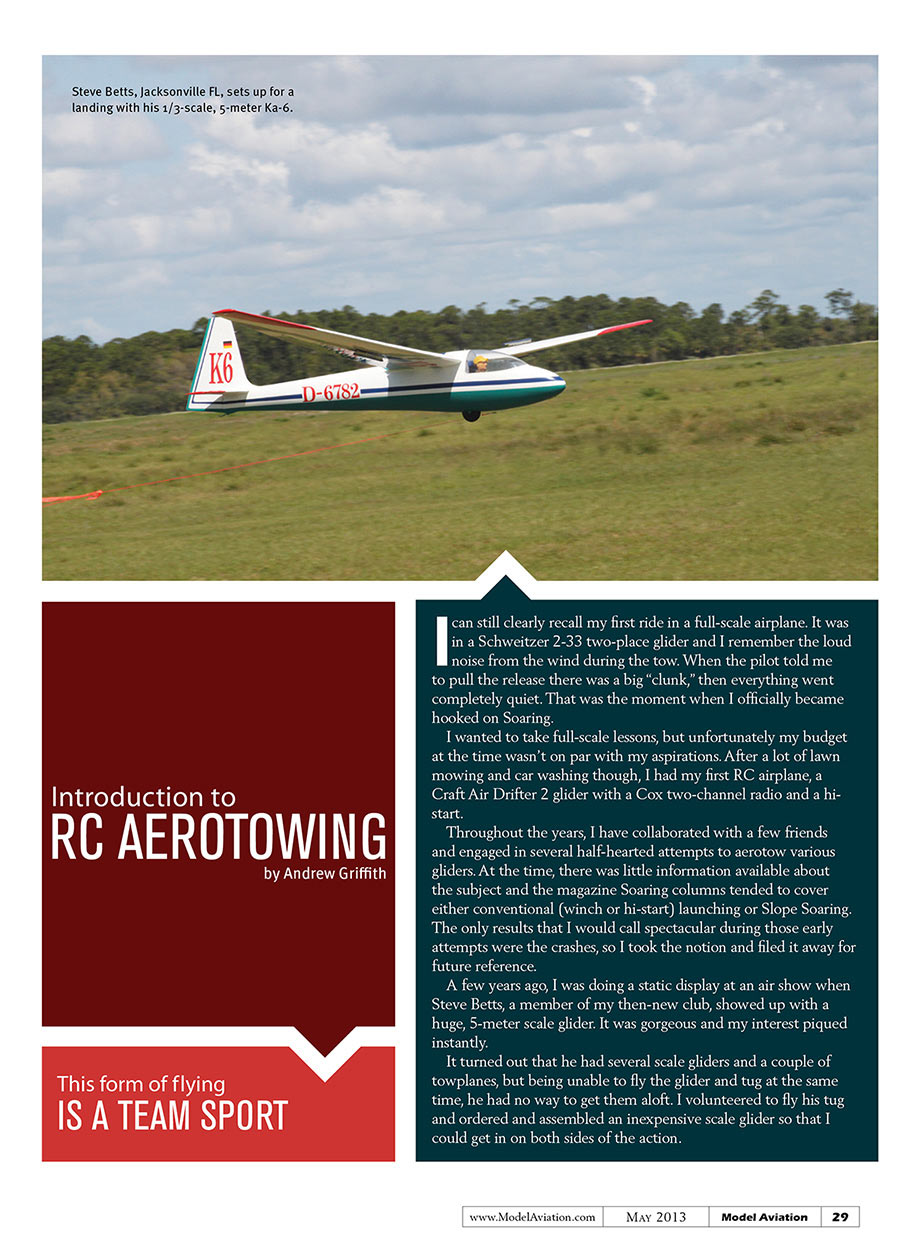
A few years ago, I was doing a static display at an air show when Steve Betts, a member of my then-new club, showed up with a huge, 5-meter scale glider. It was gorgeous and my interest piqued instantly.
It turned out that he had several scale gliders and a couple of towplanes, but being unable to fly the glider and tug at the same time, he had no way to get them aloft. I volunteered to fly his tug and ordered and assembled an inexpensive scale glider so that I could get in on both sides of the action. His tug was a 106-inch Lanier Husky (similar to a Piper J-3 Cub) with a 40cc gas engine and servo-operated tow release. We have been towing successfully for the last several years with this and other airplanes, so I'm going to pass along some of what we have learned along the way.
What Do You Need to Get Started? The obvious answer is a towplane, towline, and a glider. Let's start by discussing the characteristics that are desirable for a towplane:
- A reliable engine or electric motor system with plenty of power.
- Enough fuel and/or battery capacity for several tows.
- Capable of slow, stable flight.
- Transmitter-operated tow release.
You can tow with nearly anything that has a motor, but some airframes are better suited to aerotowing than others. A good towplane will generally be a high-wing tail-dragger that is capable of remaining stable in slow-speed flight.
If possible it should be equipped with flaps so that it can make steep descents to the field without building up too much speed after the glider releases. I wrote “generally” because my Hangar 9 Piper Pawnee is an outstanding towplane, although it features a low wing.
You need an airplane with plenty of power for the task at hand. If you’re towing small gliders such as 2-meter and smaller, a Telemaster or something similar might be all you need. We tow lightweight 2-meter and even 3-meter gliders with the versatile 3D Hobby Shop EBT trainer that features a shoulder-mount wing and a homemade tow release. If you're going to be towing large 4-, 5-, or even 6-meter airplanes, then a larger towplane such as a big Pilatus Porter, a Pawnee, or another larger gas-powered airplane will be necessary.
Hand-in-hand with the proper engine or motor for your airplane is the propeller selection. You want to choose the propeller for torque and not speed. Most engines have a range of propellers that will allow the engine or motor to run properly. Choose one with a larger diameter and slightly less pitch. This is comparable to using a lower gear in a car on a hill. A large-diameter propeller will also help with braking on the descent.
On the nitro-powered side of the house, four-stroke engines with their large propellers make better tow engines than a screaming two-stroke power plant.
A high-capacity power system and large fuel tank will allow for plenty of towing before having to stop and refuel or recharge the receiver and/or ignition battery packs. This is one area where fuel-powered airplanes have an edge. We tow with a 106-inch electric-powered Lanier Husky, but even with a 10S 5000 mAh battery setup, we only get three good tows per charge—and batteries that large aren't exactly inexpensive.
Many vintage scale gliders don't do well with excessive speed during the tow, so your tug should be capable of stable flight at slower speeds. Sleek modern sailplanes prefer a faster tow speed to keep their narrow wings from stalling, so a good speed range is essential.
A transmitter-activated tow release on the towplane is highly recommended. There are a number of commercial tow releases available or you can fashion your own. My Pawnee has a gorgeous, machined, two-step tow release from iFlyTailies.
You don't need anything that fancy, though. If you're handy in the shop, one can be fashioned from hardwood or aluminum stock and steel music wire. The servo connected to the steel release pin should be of sufficient strength to positively release the towline under load.
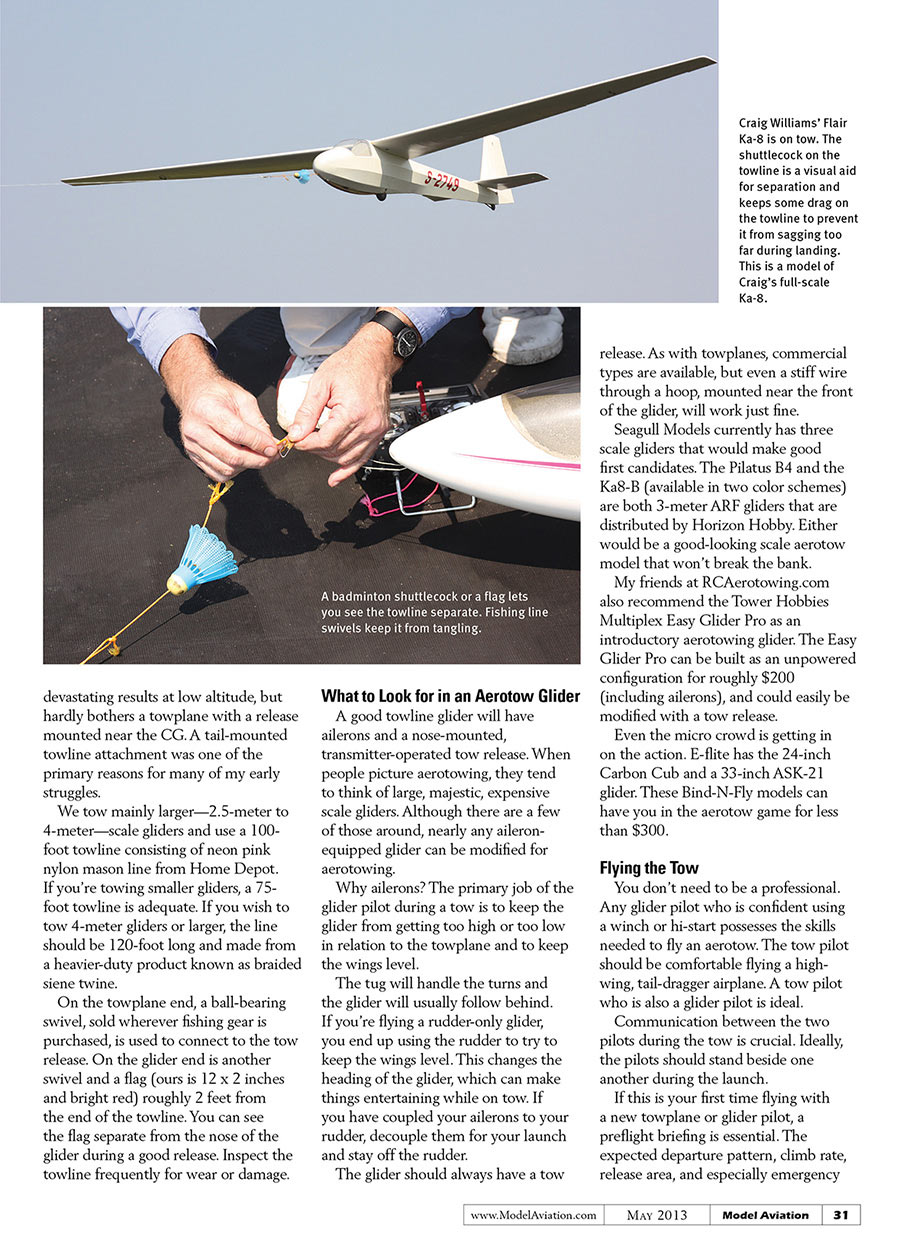
The tow release should be mounted at or near the CG or at the wing's TE. The reason for this departure from full-scale towing is simple: perspective. It is much easier for a full-scale glider pilot to maintain proper attitude behind a towplane than for an RC pilot who is standing on the ground.
If we were to mount the tow attachment on the tail as full-scale pilots do, and the glider balloons up unexpectedly, it would pull the tail of the towplane with it. This could have devastating results at low altitude, but hardly bothers a towplane with a release mounted near the CG. A tail-mounted towline attachment was one of the primary reasons for many of my early struggles.
We tow mainly larger—2.5-meter to 4-meter—scale gliders and use a 100-foot towline consisting of neon pink nylon mason line from Home Depot. If you’re towing smaller gliders, a 75-foot towline is adequate. If you wish to tow 4-meter gliders or larger, the line should be 120-foot long and made from a heavier-duty product known as braided sienne twine.
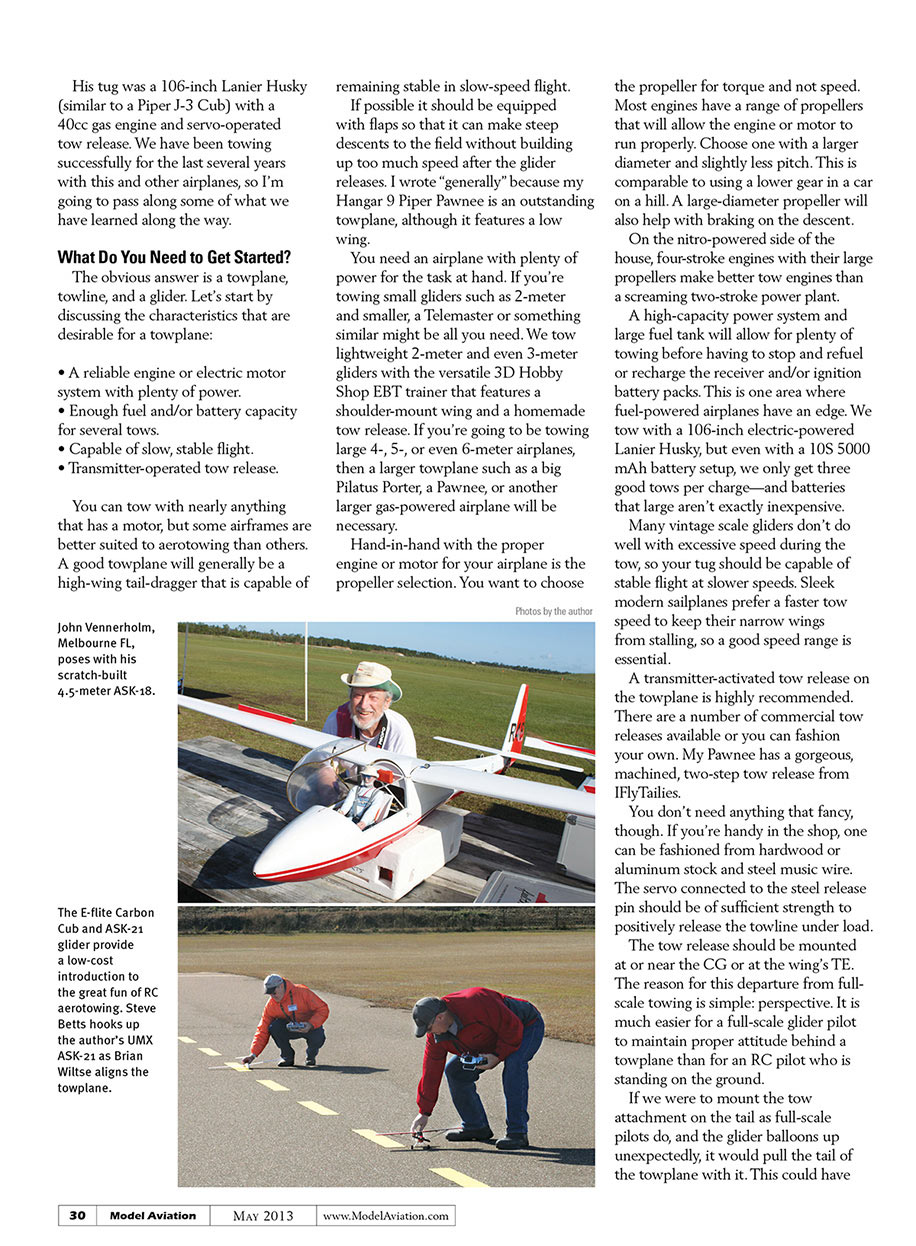
On the towplane end, a ball-bearing swivel, sold wherever fishing gear is purchased, is used to connect to the tow release. On the glider end is another swivel and a flag (ours is 12 x 2 inches and bright red) roughly 2 feet from the end of the towline. You can see the flag separate from the nose of the glider during a good release. Inspect the towline frequently for wear or damage.
What to Look for in an Aerotow Glider
A good towline glider will have ailerons and a nose-mounted, transmitter-operated tow release. When people picture aerotowing, they tend to think of large, majestic, expensive scale gliders. Although there are a few of those around, nearly any aileron-equipped glider can be modified for aerotowing.
Why ailerons? The primary job of the glider pilot during a tow is to keep the glider from getting too high or too low in relation to the towplane and to keep the wings level.
The tug will handle the turns and the glider will usually follow behind. If you’re flying a rudder-only glider, you end up using the rudder to try to keep the wings level. This changes the heading of the glider, which can make things entertaining while on tow. If you have coupled your ailerons to your rudder, decouple them for your launch and stay off the rudder.
The glider should always have a tow release. As with towplanes, commercial types are available, but even a stiff wire through a hoop, mounted near the front of the glider, will work just fine.
Seagull Models currently has three scale gliders that would make good first candidates. The Pilatus B4 and the Ka8-B (available in two color schemes) are both 3-meter ARF gliders that are distributed by Horizon Hobby. Either would be a good-looking scale aerotow model that won’t break the bank.
My friends at RCAerotowing.com also recommend the Tower Hobbies Multiplex Easy Glider Pro as an introductory aerotowing glider. The Easy Glider Pro can be built as an unpowered configuration for roughly $200 (including ailerons), and could easily be modified with a tow release.
Even the micro crowd is getting in on the action. E-flite has the 24-inch Carbon Cub and a 33-inch ASK-21 glider. These Bind-N-Fly models can have you in the aerotow game for less than $300.
Flying the Tow
You don’t need to be a professional. Any glider pilot who is confident using a winch or hi-start possesses the skills needed to fly an aerotow. The tow pilot should be comfortable flying a high-wing, tail-dragger airplane. A tow pilot who is also a glider pilot is ideal.
Communication between the two pilots during the tow is crucial. Ideally, the pilots should stand beside one another during the launch.
If this is your first time flying with a new towplane or glider pilot, a preflight briefing is essential. The expected departure pattern, climb rate, release area, and especially emergency procedures, should be discussed. Agree on terminology and/or hand signals before you take off.
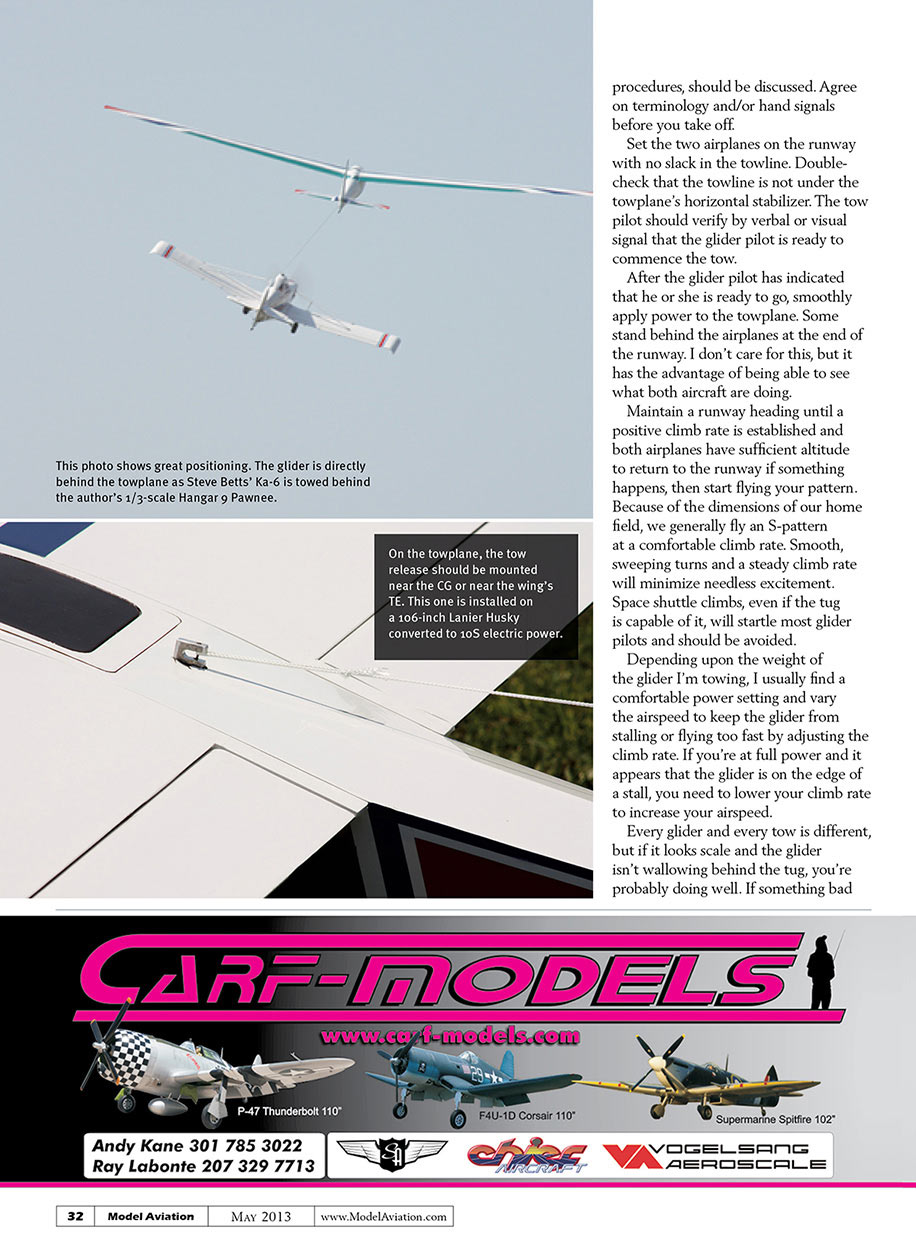
Set the two airplanes on the runway with no slack in the towline. Double-check that the towline is not under the towplane’s horizontal stabilizer. The tow pilot should verify by verbal or visual signal that the glider pilot is ready to commence the tow.
After the glider pilot has indicated that he or she is ready to go, smoothly apply power to the towplane. Some stand behind the airplanes at the end of the runway. I don’t care for this, but it has the advantage of being able to see what both aircraft are doing.
Maintain a runway heading until a positive climb rate is established and both airplanes have sufficient altitude to return to the runway if something happens, then start flying your pattern. Because of the dimensions of our home field, we generally fly an S-pattern at a comfortable climb rate. Smooth, sweeping turns and a steady climb rate will minimize needless excitement. Space shuttle climbs, even if the tug is capable of it, will startle most glider pilots and should be avoided.
Depending upon the weight of the glider I’m towing, I usually find a comfortable power setting and vary the airspeed to keep the glider from stalling or flying too fast by adjusting the climb rate. If you’re at full power and it appears that the glider is on the edge of a stall, you need to lower your climb rate to increase your airspeed.
Every glider and every tow is different, but if it looks scale and the glider isn’t wallowing behind the tug, you’re probably doing well. If something bad happens during the tow, saving the tug is your primary responsibility. If that means cutting the glider loose to save the towplane, don’t be afraid to flip the switch.
Flying the glider is relatively easy. The glider will usually follow nicely behind the tug, although you may need some down-elevator because of the increased lift generated at higher speeds. Use the ailerons to keep the wings level, and adjust the elevator to keep the glider at the same altitude or slightly above the towplane.
It’s easy to get carried away with the beauty of the whole thing, so don’t forget to release while you can still see your airplane. The objective of the tow is to get the glider aloft where you can search for lift, not to tow the glider into the clouds. Talk to the tow pilot if you feel your glider needs more or less airspeed during the tow.
Give the tow pilot a heads up when you’re about to release, and confirm that you have a positive separation. During the critical early stages of the departure, the tow pilot can’t watch both the glider and the towplane. Have a bailout plan in mind for emergencies at various points during the tow. You should have a feel of the altitude where you have room to turn and land versus where you will have to go straight and possibly take your licks.
Glider towing is unique and great fun. It will add a new dimension to your flying, whether you are flying the towplane or the glider, and spectators love it. It’s best if you can find an experienced pilot in your area, but don’t be afraid to give it a try if you have the equipment and a couple of pilots with sufficient experience.
If I have grabbed your interest and you want to learn more, plenty of information can be found in the online forum at RCAeroTowing.com.
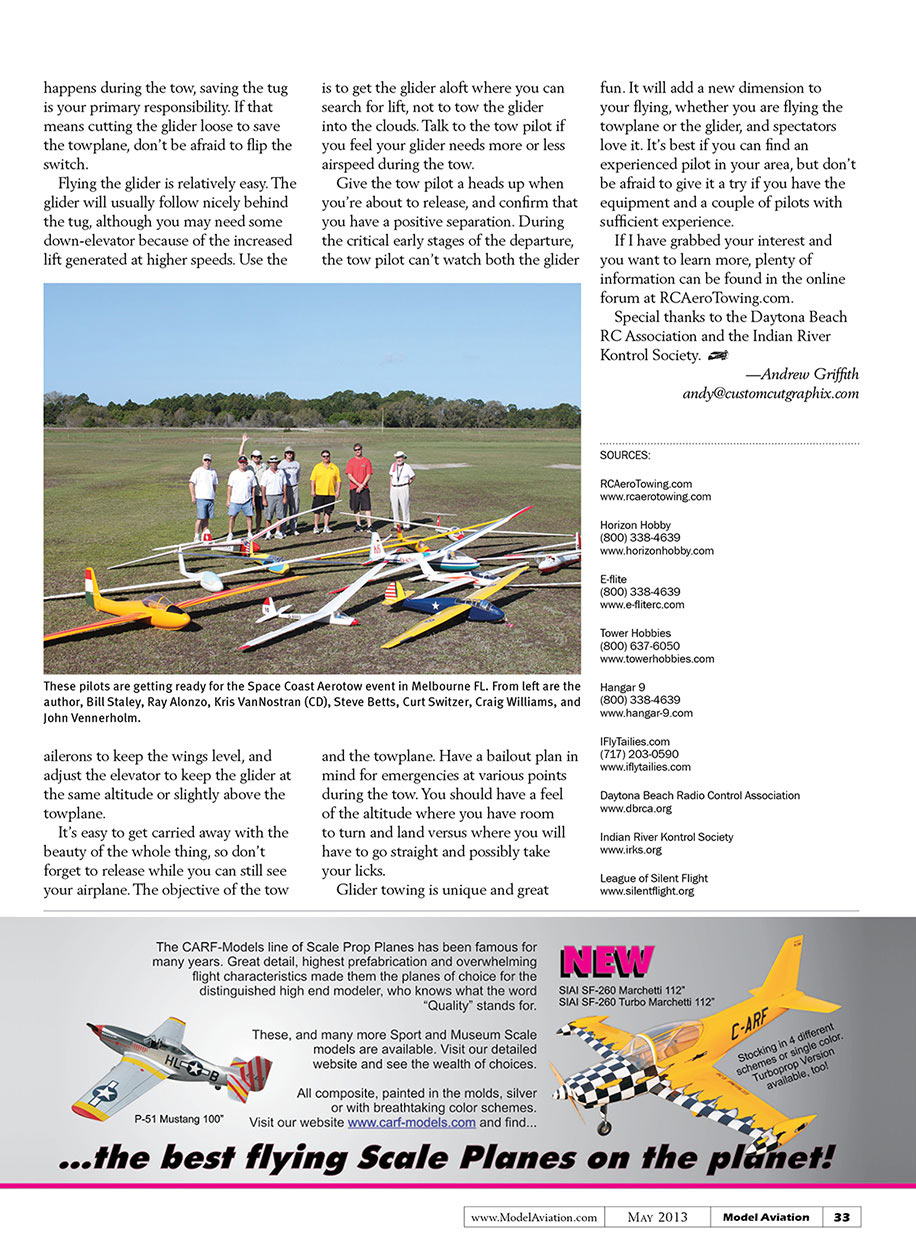
Special thanks to the Daytona Beach RC Association and the Indian River Kontrol Society.
—Andrew Griffith <REDACTED>
SOURCES:
RCAeroTowing.com www.rceaerotowing.com
Horizon Hobby (800) 338-4639 www.horizonhobby.com
E-flite (800) 338-4639 www.e-fliterc.com
Tower Hobbies (800) 637-6050 www.towerhobbies.com
Hangar 9 (800) 338-4639 www.hangar-9.com
iFlyTailies.com (717) 203-0590 www.iflytailies.com
Daytona Beach Radio Control Association www.dbrca.org
Indian River Kontrol Society www.irks.org
League of Silent Flight www.silentflight.org
Transcribed from original scans by AI. Minor OCR errors may remain.

