
It Flew for Almost Three Hours!
By Bob Noll
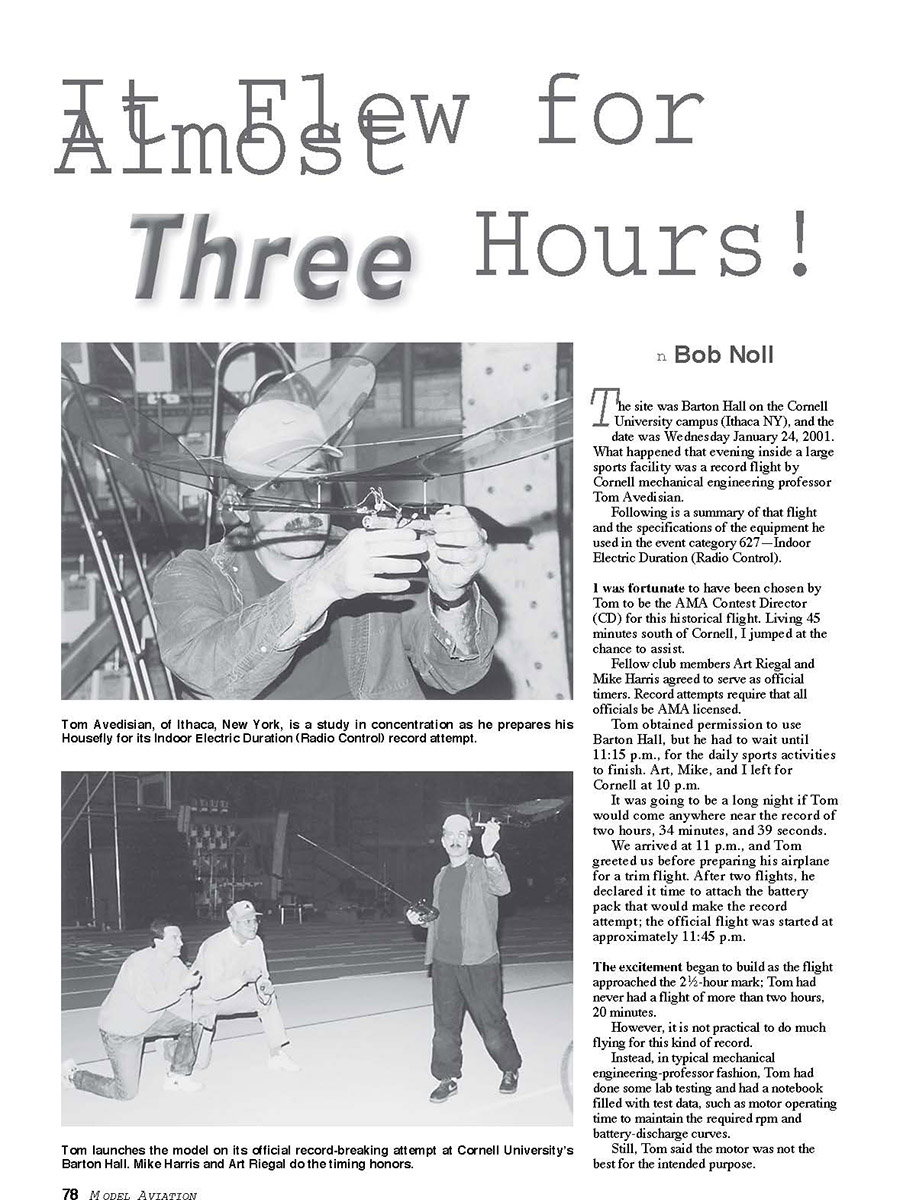
The site was Barton Hall on the Cornell University campus (Ithaca, NY), and the date was Wednesday, January 24, 2001. What happened that evening inside a large sports facility was a record flight by Cornell mechanical engineering professor Tom Avedisian.
Following is a summary of that flight and the specifications of the equipment he used in the event category 627—Indoor Electric Duration (Radio Control).
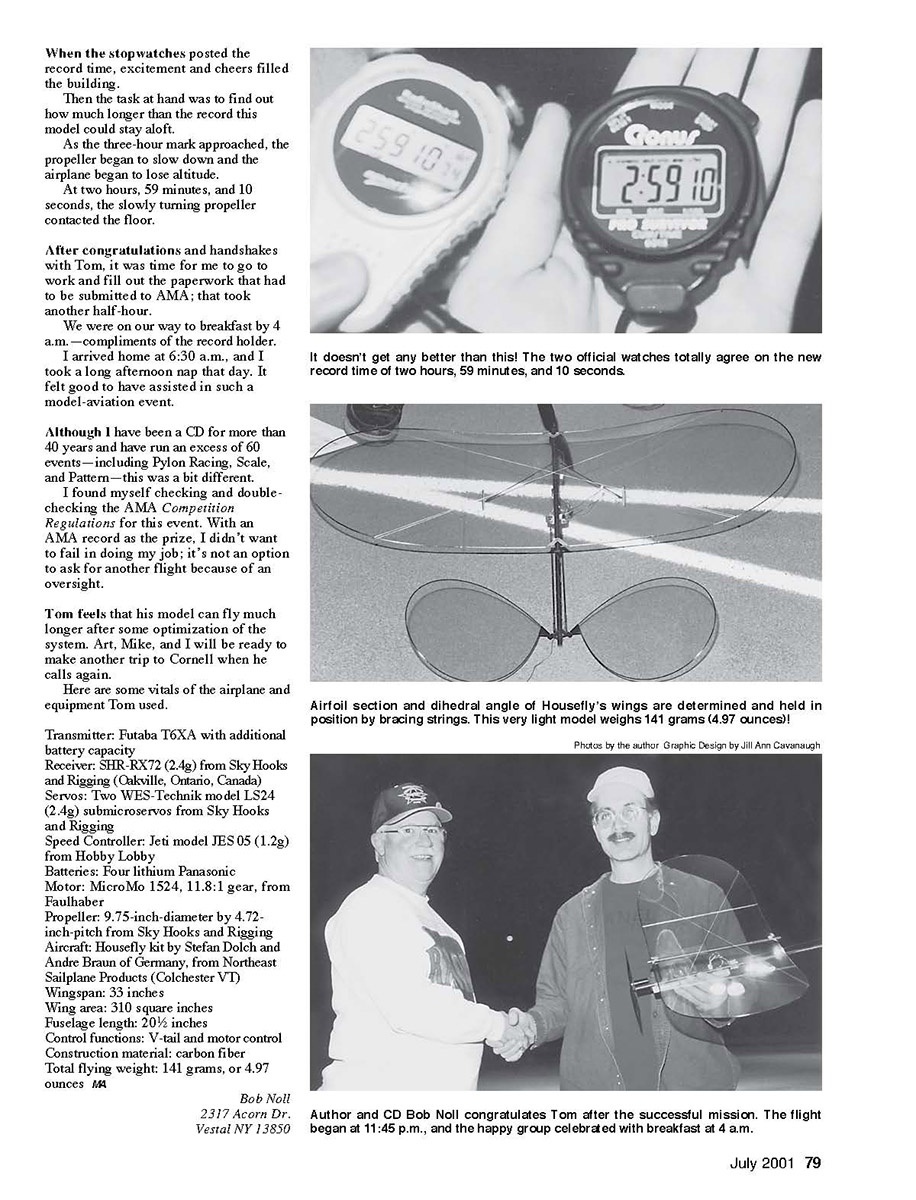
I was fortunate to have been chosen by Tom to be the AMA Contest Director (CD) for this historical flight. Living 45 minutes south of Cornell, I jumped at the chance to assist. Fellow club members Art Riegal and Mike Harris agreed to serve as official timers. Record attempts require that all officials be AMA-licensed.
Tom obtained permission to use Barton Hall, but he had to wait until 11:15 p.m. for the daily sports activities to finish. Art, Mike, and I left for Cornell at 10 p.m.
It was going to be a long night if Tom would come anywhere near the record of two hours, 34 minutes, and 39 seconds.
We arrived at 11 p.m., and Tom greeted us before preparing his airplane for a trim flight. After two flights, he declared it time to attach the battery pack that would make the record attempt; the official flight was started at approximately 11:45 p.m.
The excitement began to build as the flight approached the 2½-hour mark; Tom had never had a flight of more than two hours, 20 minutes.
However, it is not practical to do much flying for this kind of record. Instead, in typical mechanical-engineering–professor fashion, Tom had done some lab testing and had a notebook filled with test data, such as motor operating time to maintain the required rpm and battery-discharge curves. Still, Tom said the motor was not the best for the intended purpose.
When the stopwatches posted the record time, excitement and cheers filled the building. Then the task at hand was to find out how much longer than the record this model could stay aloft.
As the three-hour mark approached, the propeller began to slow down and the airplane began to lose altitude. At two hours, 59 minutes, and 10 seconds, the slowly turning propeller contacted the floor.
After congratulations and handshakes with Tom, it was time for me to go to work and fill out the paperwork that had to be submitted to AMA; that took another half-hour. We were on our way to breakfast by 4 a.m.—compliments of the record holder.
I arrived home at 6:30 a.m., and I took a long afternoon nap that day. It felt good to have assisted in such a model-aviation event.
Although I have been a CD for more than 40 years and have run an excess of 60 events—including Pylon Racing, Scale, and Pattern—this was a bit different. I found myself checking and double-checking the AMA Competition Regulations for this event. With an AMA record as the prize, I didn't want to fail in doing my job; it's not an option to ask for another flight because of an oversight.
Tom feels that his model can fly much longer after some optimization of the system. Art, Mike, and I will be ready to make another trip to Cornell when he calls again.
Aircraft and Equipment
- Transmitter: Futaba T6XA with additional battery capacity
- Receiver: SHR-RX72 (2.4 g) from Sky Hooks and Rigging (Oakville, Ontario, Canada)
- Servos: Two WES-Technik model LS24 (2.4 g) submicro servos from Sky Hooks and Rigging
- Speed Controller: Jeti model JES 05 (1.2 g) from Hobby Lobby
- Batteries: Four lithium Panasonic cells
- Motor: MicroMo 1524, 11.8:1 gear, from Faulhaber
- Propeller: 9.75-inch diameter by 4.72-inch pitch from Sky Hooks and Rigging
- Aircraft: Housefly kit by Stefan Dolch and Andre Braun of Germany, from Northeast Sailplane Products (Colchester, VT)
Aircraft Specifications
- Wingspan: 33 inches
- Wing area: 310 square inches
- Fuselage length: 20½ inches
- Control functions: V-tail and motor control
- Construction material: carbon fiber
- Total flying weight: 141 grams (4.97 ounces)
Bob Noll <REDACTED>
Transcribed from original scans by AI. Minor OCR errors may remain.

