
IT'S CALLED CONTROL LINE
Bill Netzeband
Of the three major categories of model aircraft recognized by AMA, Control Line (CL) fits neatly between Free Flight (FF) and Radio Control (RC).
FF models are launched by the flier, and are required to fly themselves automatically and land safely. RC models are launched by the flier, then are controlled by a radio-linked aerodynamic control system that the flier operates.
The flier controls CL models through one or more metal wires that provide aerodynamic control while the aircraft rotates around the flier at the end of these wires. The CL flier is directly involved in controlling the aircraft, and joins the action in real time.
The RC flier must imagine him- or herself in the cockpit of the aircraft, and provide aerodynamic control inputs through the transmitter unit while remaining on the ground.
The FF flier builds in the aerodynamic stability features required by the aircraft to control itself, and relinquishes active control to the elements.
My task is to describe the wonderful things you will achieve by building and flying CL model aircraft.
The history of CL is colorful and varied. For a comprehensive description of the turbulent beginnings, obtain a copy of Pioneers of Control Line Flying by Charles A. Mackey. It is available from PAMPA Products (address at the end of this article).
National CL competition events have been celebrated continually starting with the 1946 National Model Airplane Championships (Nats), in which the events were Speed, Precision, and Novelty Stunt.
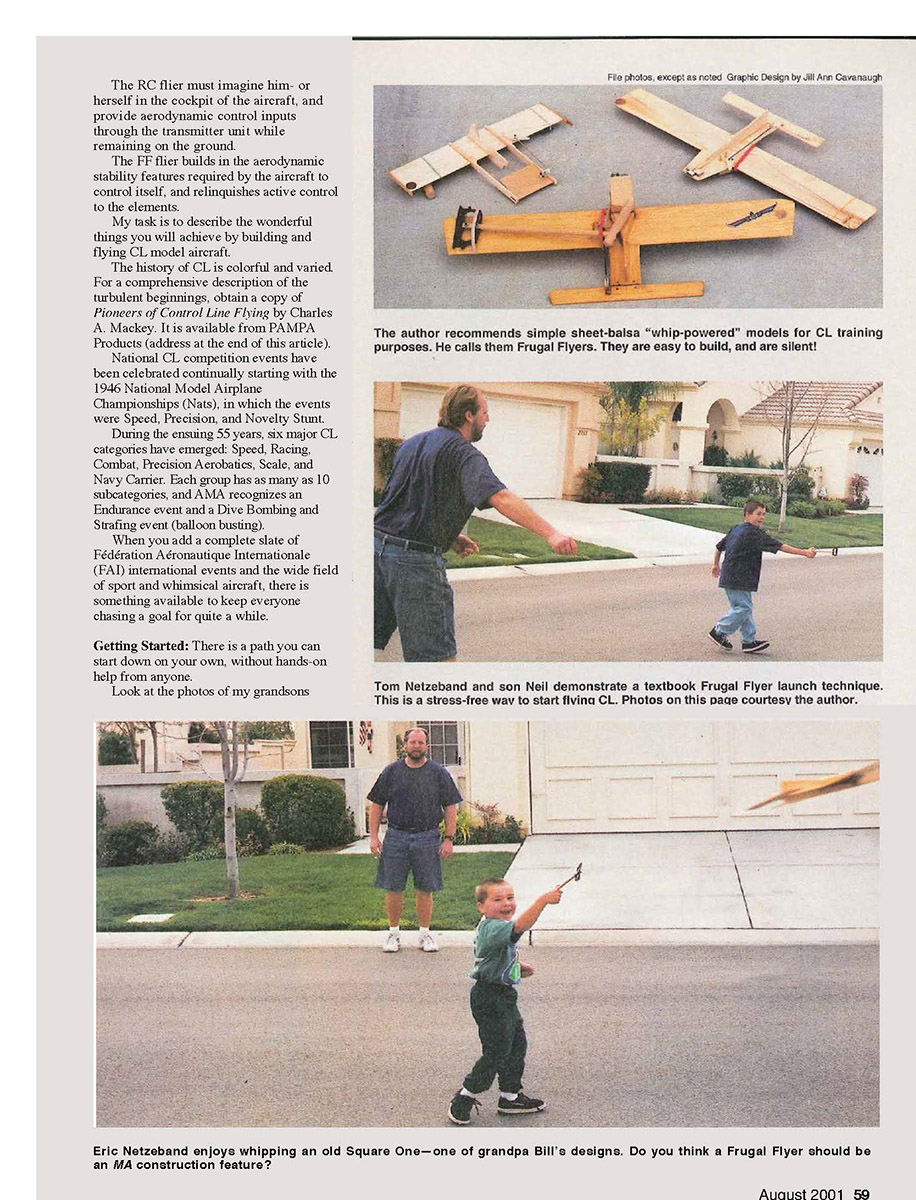
During the ensuing 55 years, six major CL categories have emerged: Speed, Racing, Combat, Precision Aerobatics, Scale, and Navy Carrier. Each group has as many as 10 subcategories, and AMA recognizes an Endurance event and a Dive Bombing and Strafing event (balloon busting).
When you add a complete slate of Fédération Aéronautique Internationale (FAI) international events and the wide field of sport and whimsical aircraft, there is something available to keep everyone chasing a goal for quite a while.
Getting Started
There is a path you can start down on your own, without hands-on help from anyone.
Look at the photos of my grandsons flying in the street. The aircraft have no onboard power units; they are powered by the pilots "whipping" the models.
The basic design produces an airplane from one sheet of 1/8 x 3 x 36 balsa wood, some scrap wood, and a purchased control system.
I started the low-cost concept in the mid-1970s, with an aircraft designed for a 1/2A engine. Rich Porter picked up my design and improved it into the Ultimate Frugal Flyer.
Rich is dedicated to teaching newcomers the CL art, and he has a high success rate with these little introductory aircraft. Flown over grass, they can survive crash landings that would require repairs if they were flown over a hard surface.
Rich has also spent many hours testing the latest high-tech fishing lines for use with the small-field CL aircraft.
In the interest of pushing education, Rich prefers that you contact him by E-mail at [email protected]. Mention the Ultimate Frugal Flyer, and he'll provide you with information to obtain plans for the aircraft. They are a blast.
Ideally, the path to success in solo flight is to contact a person or club that can guide you through the initial building and flying phase. The person or club probably has a training airplane; this will save you from making time-consuming mistakes until you start pushing the envelope on your own.
Before entering active competition, you will need to be highly proficient in the basic procedures for successful CL flying. That involves building and flying simple aircraft that you can repair easily, and advancing only when you feel comfortable enough with an aircraft to fly it continuously without staring at it.
It also involves learning the etiquette required in the pit areas and in the flight circle, so you don't get yelled at.
You'll need to gain a basic knowledge of how engines work, how they must sound before you launch them, and become familiar with propellers. That includes how the propeller does its job and what it can do when fingers or body parts get in its path.
You won't have to learn about aerodynamics, but it is an exciting part of the activity. You will be able to design your own creations by simply following the proportions of successful aircraft.
I have been steadily designing, building, and flying for more than 67 years, and I have not run out of things I want to create.
Join a club or a group. Flying with a friend or a group of friends will allow you to progress faster. The social aspect of any hobby is a large portion of the enjoyment. You will not be able to spend all your time with an aircraft in the air, and your friends have many neat things to talk about.
Although there are national rules for events, individual clubs and regional groups constantly invent and experiment with categories of their own. This makes the pot of things to do really spicy.
At the end of this article are some CL Special Interest Groups (SIGs) recognized by AMA. They will be happy to talk with you about their favorite competition events and can help you obtain the special materials and equipment required by the currently high level of technology.
Some of the SIGs have active Web pages for rapid response. All are available by regular mail. Many of the organizations have individuals who are willing to communicate by telephone. Put them to work.
AMA Competition Categories
Earlier I mentioned the categories of aircraft flown in competition. They are all based on the CL principle, but they vary widely in their specific requirements for equipment and piloting expertise.
The detailed rules are carefully documented in the Competition Regulations rule book supplied by AMA.
During a two-year period, these rules are open for discussion and changes are governed by official boards in response to AMA members' desires. A new rule book will be issued in 2002.
I'm going to take you on a brief tour of each event, to improve your chances of finding something that will make you passionate enough to get involved. I'll present the list in alphabetical order.
Combat
Take two aerobatic airplanes, pull them at more than 100 mph with powerful engines, and tie streamers to their tails. Stir vigorously!
The winner of each elimination match is determined by the number of times he or she cuts the opponent's streamer, including the ability to snatch all of it safely (a "kill"). If none of that happens, you can win by staying in the air longer than your opponent.
Midair collisions are deemed accidents. You will be well-served to find a good pit person and fly regularly.
The basic engine sizes used are the 1/4 A (.049 cubic-inch displacement [cid]), the FAI (.15 cid), and the .36 cid, used at various power-output levels in several events.
Modern Fast Combat aircraft will run at more than 130 mph without a streamer. The frenetic action requires a pilot to be highly experienced and in excellent physical condition.
A Slow Combat event uses design and engine restrictions to drop the speed to roughly 100 mph.
Some local events require that the aircraft not exceed 80 mph, which is checked before combat is allowed to start. That speed is the level at which Combat stayed for quite a few years after its introduction in the 1950s.
Now that equipment has been so refined, local groups are holding Vintage events for the many interesting designs using the older engines that led up to the modern equipment. This is a low-key event.
The fast action and lightning-quick maneuvers make Combat the most exciting event for spectators.
Navy Carrier
This event was introduced in 1953 while the US Navy sponsored the Nats on its airfields. It involves Scale models of Navy Carrier-based airplanes using a throttle to control speed, and a flight schedule that resembles a carrier combat mission.
Aircraft are awarded 100 Scale points on a go or no-go basis.
The flight phase consists of taking off from a scaled carrier deck, flying the first seven laps (1/2 mile on 60-foot lines) at high speed, then slowing to a minimum speed and being timed for seven laps.
Following the slow flight, the aircraft is landed on the scale deck with an arresting-line system.
The points for Scale, high speed, difference between high and low speed, and quality of the landing make up the total score.
The Scale and high-speed challenge involve clever design, building, and engine techniques. Flying skill determines the slow speed and the landing.
Technical progress has led to increased speed and slower flight using flaps, spoilers, and other aerodynamics tricks.
The event is flown by a group of dedicated individuals, and is interesting to watch. The participants are also experimenting with Vintage events.
Precision Aerobatics
The first two things to become competition with CL aircraft were going fast and performing maneuvers and stunts.
For a short period there was a Novelty Stunt event, in which pilots flew two airplanes at once and did daring acrobatic stunts with their bodies, as well as trick stuff such as picking up gliders, rolling the models' wheels and burning smoke bombs, towing gliders, picking up handkerchiefs from the ground, etc. The circus part disappeared and the Precision Aerobatics event survived.
The first flight patterns were designed to suit the limited ability of early aircraft.
Appearance requirements were added when aircraft designs started to become functional—large, lightweight, and square.
The introduction of the glow-plug ignition system by Ray Arden in 1947 doomed the ignition engines and opened the doors for higher performances.
The appearance requirements quickly improved the workmanship and finishing, and the excess weight led the flight pattern away from the tight performance dimensions listed in the rule book. The name was eventually changed to Aerobatics, to protect the ambiance.
Overall, the Precision Aerobatics event has been the most popular in terms of participation, because of the appeal of drawing pretty flight paths in the sky, the high level of workmanship, the exotic shapes, and the shiny finishes.
Present-day aircraft are large packages, and the surfaces are sculpted into artistic shapes to create a pleasing package of eye candy.
The surface finishes are of the highest gloss available to the automobile industry, and the designers create wonderfully configured graphic designs to enhance the shape of the aircraft.
Not to worry, newcomers. The Precision Aerobatics Model Pilot Association (PAMPA) has created a skill-level classification system recognizing Beginner, Intermediate, Advanced, and Expert categories.
These classes are based on your individual ability, and that allows you to move up through the ranks before you have to take on the big dogs!
The formula for winning involves several skills. You need a good, straight aircraft; a power-plant package that matches your aircraft; a great deal of practice to be able to cruise through a pattern, and make quick and accurate corrections for varying wind conditions; and a positive attitude to help you make an effective "presentation" each time you fly.
The judges have a book full of dimensions they expect to see your aircraft adhere to, but they are depending on their individual skill and integrity, and call them like they see them.
Unlike those events that judge your performance with a stopwatch, nothing is cut-and-dried here!
The Precision Aerobatics events have been enhanced by the creation of two special classes. Old-Time Stunt is flown with replicas of aircraft designed and published before 1953, and includes the spark-ignition engines.
Classic Stunt is flown with aircraft designed and published before 1970. These include most of the varying designs flown during the developmental period, before design features settled into the most favorable configurations.
These events have sufficient attendance that two- to four-day contests are held just for them.
Racing
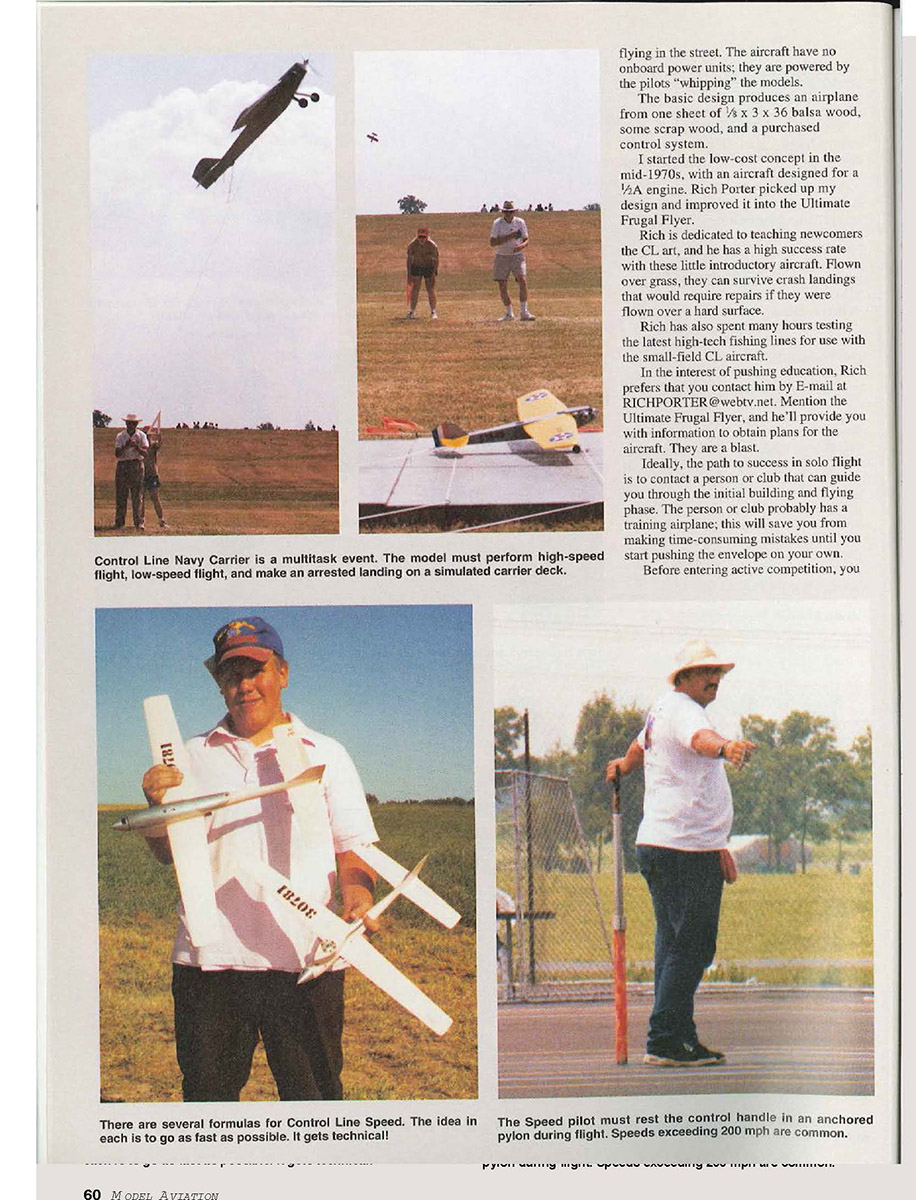
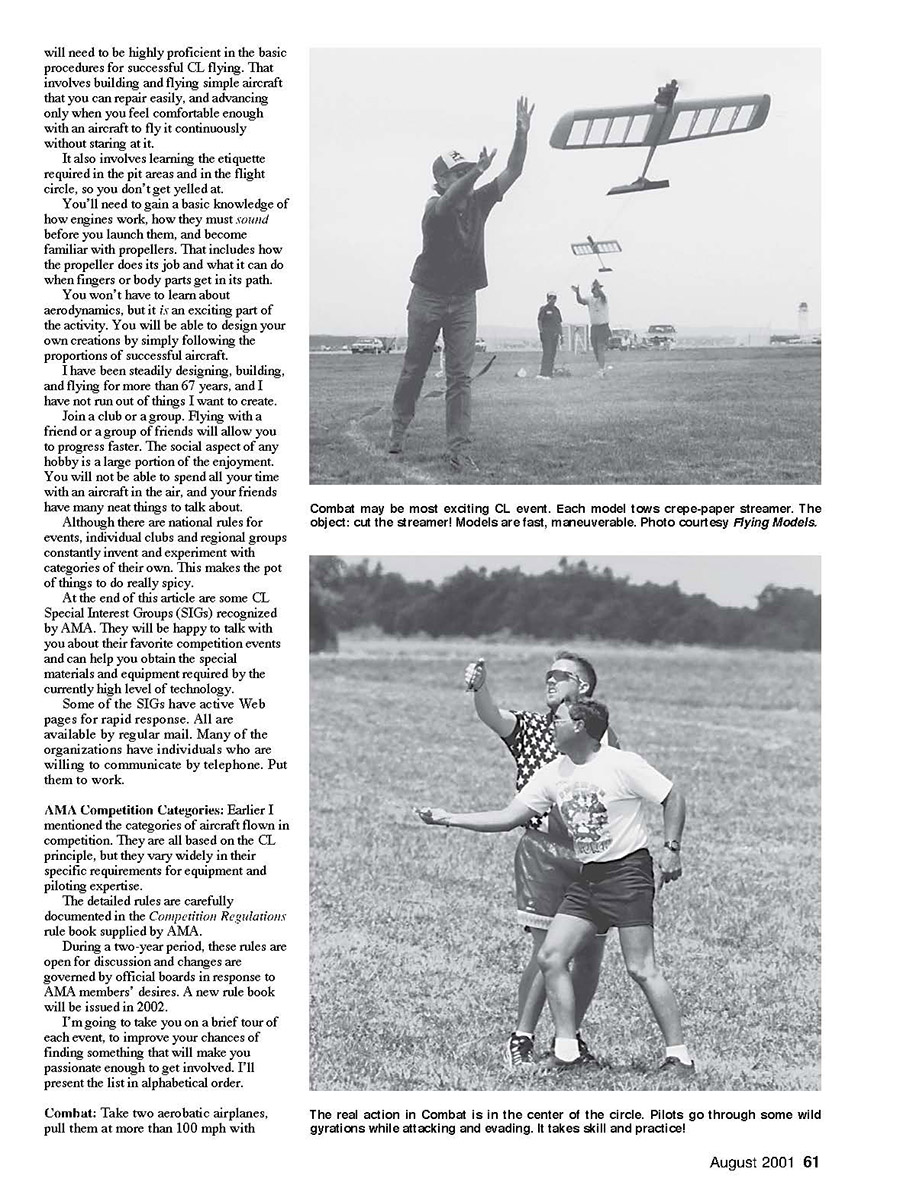
There are eight official events in which two or more aircraft start at the same time and try to complete a prescribed number of laps before their opponents.
Most event rules specify limited fuel supplies and require pitstops during the race. This category really gets the juices flowing.
I would be remiss if I indicated that my Racing events was hid-back; that's not the name of the game.
You will need a partner in these events, to either fly the aircraft or do the pitcrew chores. The best strategy wins the races, and is generally out in front of the competition by only a few seconds.
To save you your time, I'll skip details of the wide variety of aircraft, engines, and race distance/procedures.
There is plenty of variety in the official rule books to suit everyone, and there are numerous local events to fill in the narrow gaps between these rules. (Actually, some local races may be labeled hi-back.)
Scale
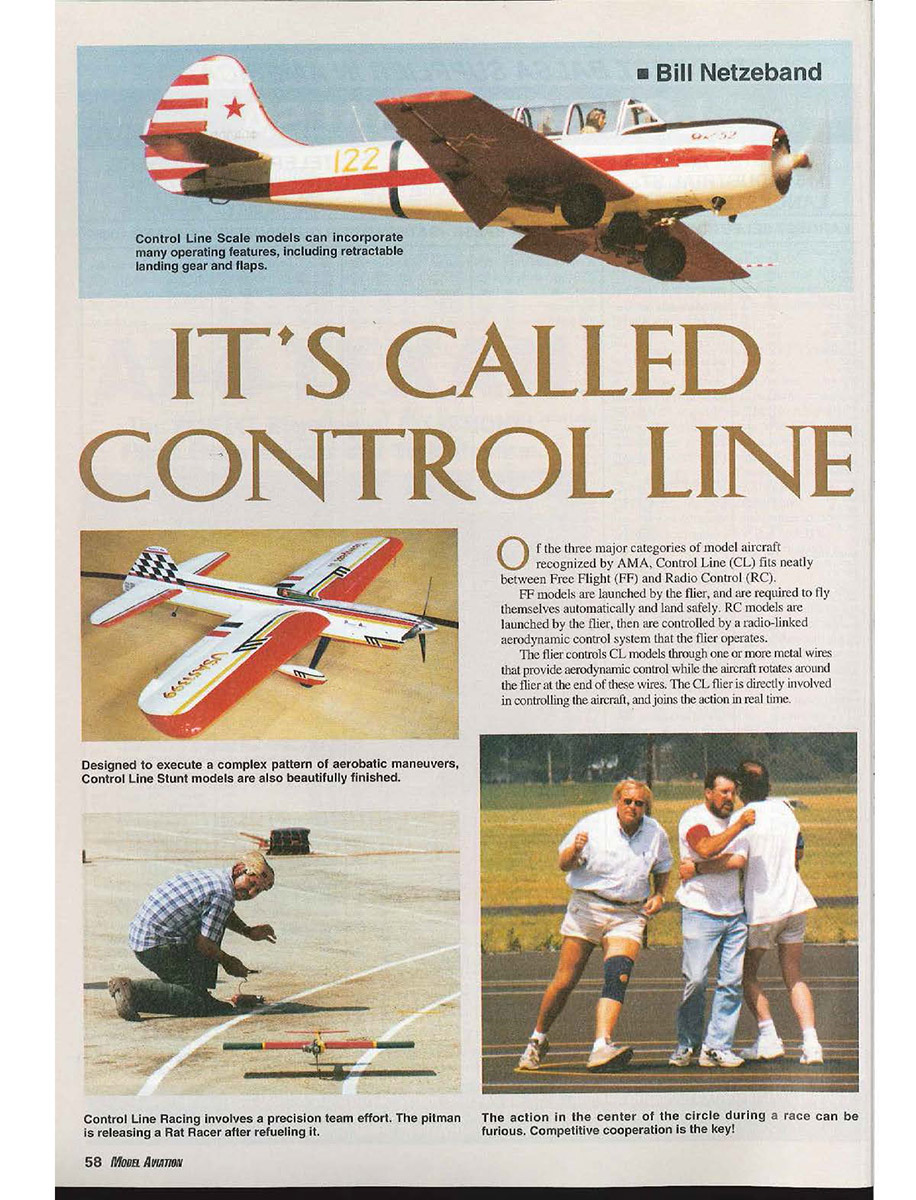
CL Scale requires accurately researched and constructed models of man-carrying aircraft to be judged by the accuracy, workmanship, details, flying ability, and demonstration of flight features, such as retractable landing gear, flaps, aerodynamic functions, and things the aircraft would do in full-scale.
This is the premier contest for builders and researchers to show their talents. CL Scale also requires that the model conform to the natural laws that govern the way the smaller aircraft perform. The flying requirement tends to some nail-biting, and not every flight is a success. (Keep in mind the desire to maintain a regular number of takeoffs and landings.)
Take any chance you get to observe a Scale competition!
There is also a Sport Scale event, in which the level of accuracy is lowered in order to provide competition for those who are more interested in flying than in building.
The ability to obtain modern electronic and various forms of remote-control equipment has allowed the Scale event to move upward levels from the earlier period, in which added controls meant adding control wires to the system.
Speed
In the beginning of CL activity, being the fastest dog was the goal of everyone—after they learned how to land safely. A safe landing is one after which you can use the aircraft again—without repairs!
In the beginning it was clear that engine size was important, and engines were classified by their displacement.
The event is rather simple to judge. A single aircraft flies a fixed distance and is timed by judges using stopwatches, and the fastest speed in a class wins.
Most of the rule changes throughout the years have been made to increase safety and/or slow the class down by restricting items that control top speed, such as fuel additives, intake areas, exhaust enhancements, etc.
Some Speed events judge the average speed from a standing start through the end of a set number of laps. This presents a different set of problems from simple flat-out speed with a flying start.
Those who develop engines and aircraft have raised the level of performance to a high peak. There are a few entry level classes, but you must be prepared to work hard to get into the upper crust.
If you are hooked now, my job is done. The people in the following groups are waiting to help you over the speed bumps of learning, and are the sources of special equipment.
We are having fun in CL—please join us.
Sources
- Precision Aerobatic Model Pilots Association (PAMPA)
- Sharon Fischer
- 158 Flying Cloud Isle
- Foster City CA 94404
- www.zianet.com/pampaeditor/ham/pam.htm
- PAMPA Products
- 100 Park Ave.
- Carmichael, PA 18520
- Miniature Aircraft Combat Association (MACA)
- Larry Driskill
- 6806 Third St
- Lubbock TX 79416
- National Association of Scale Modelers (NASA)
- Stan Alexander
- 3709 Valley Ridge Dr.
- Nashville TN 37211-8931
- National Control Line Racing Association (NCLRA)
- Dave McDonald
- P.O. Box 584
- Delaville IN 47334
- Navy Carrier Society (NCS)
- Frank Garzon
- 425 Storey Ave.
- Central Islip NY 11722
- North American Speed Society (NASS)
- Box 62224
- North Barnaby
- BC Canada V5C 2K7
Transcribed from original scans by AI. Minor OCR errors may remain.

