
JC23 Evo Gas Engine
Steve Cline
In the past few years, I have noticed many people switching from glow to gasoline-powered engines for their models. Gasoline engines have many strong points over average glow-powered engines.
Gasoline engines require a much lighter field box, they are cheaper to run, easier to start, have less cleanup after flying, and they tend to keep running. That means fewer unexpected dead-stick landings.
What about electrics? Electric power has its place in the RC world, but for larger aircraft and scale setups, electrics don't have the same presence that a combustion engine does. Larger electric setups are expensive, require expensive batteries, and flight times tend to be less.
So the quest began for a good first gasser. For my lightweight 3D Hobby Shop Velox, the new JC23 Evo 23cc gasoline engine from Heinen Aerowerks was a good match.
I have flown the airplane with other 20cc-class and 30cc-class engines, so this is a perfect platform with which to test. I will focus on the engine side of things.
First Look
From the moment the engine arrived from Heinen Aerowerks, I was impressed. The packaging was professional and boxed well, not simply bubble wrapped and thrown in a box of Styrofoam peanuts.
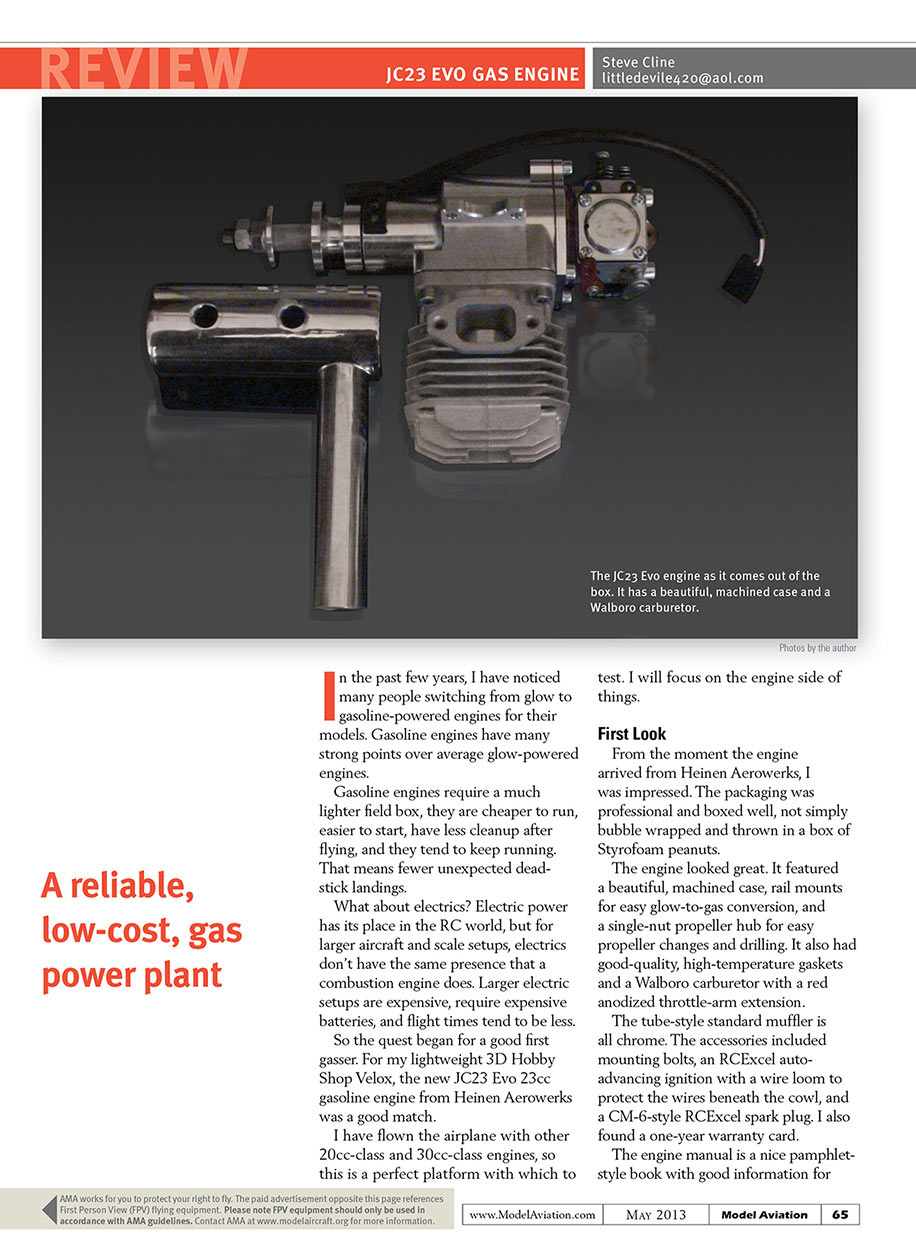
The engine looked great. It featured a beautiful, machined case, rail mounts for easy glow-to-gas conversion, and a single-nut propeller hub for easy propeller changes and drilling. It also had good-quality, high-temperature gaskets and a Walboro carburetor with a red anodized throttle-arm extension.
The tube-style standard muffler is all chrome. The accessories included mounting bolts, an RCExcel auto-advancing ignition with a wire loom to protect the wires beneath the cowl, and a CM-6-style RCExcel spark plug. I also found a one-year warranty card.
The engine manual is a nice pamphlet-style book with good information for installing the engine and getting it properly running. It was one of the better manuals I’ve read. This engine stands out from the rest.
Mounting
I typically like to mount the engine on my test stand to fuel it and do the initial tuning before mounting it on my model, but not this one. The manual said it was unnecessary, so I began installing it.
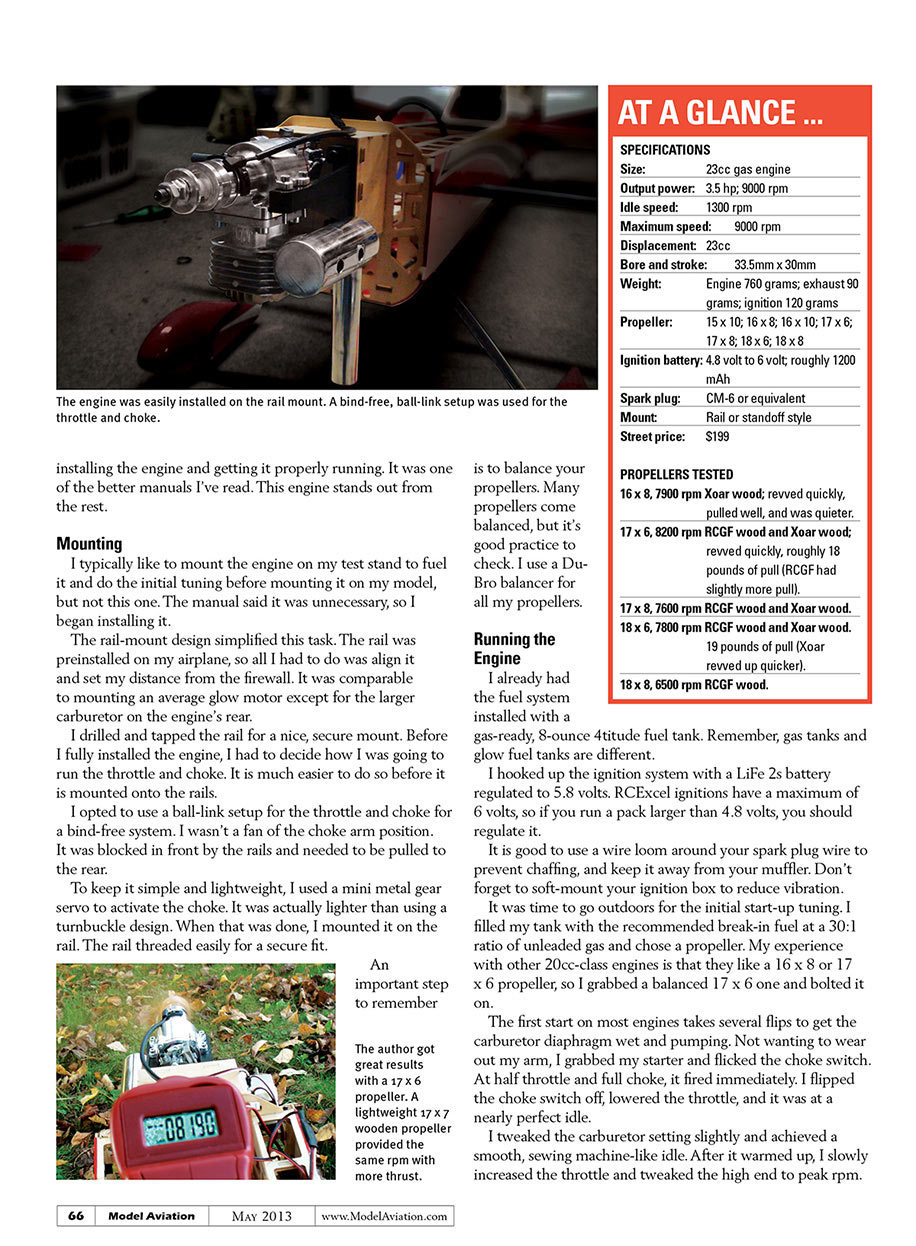
The rail-mount design simplified this task. The rail was preinstalled on my airplane, so all I had to do was align it and set my distance from the firewall. It was comparable to mounting an average glow motor except for the larger carburetor on the engine’s rear.
I drilled and tapped the rail for a nice, secure mount. Before I fully installed the engine, I had to decide how I was going to run the throttle and choke. It is much easier to do so before it is mounted onto the rails.
I opted to use a ball-link setup for the throttle and choke for a bind-free system. I wasn’t a fan of the choke arm position. It was blocked in front by the rails and needed to be pulled to the rear.
To keep it simple and lightweight, I used a mini metal gear servo to activate the choke. It was actually lighter than using a turnbuckle design. When that was done, I mounted it on the rail. The rail threaded easily for a secure fit.
An important step to remember is to balance your propellers. Many propellers come balanced, but it’s good practice to check. I use a Du-Bro balancer for all my propellers.
Running the Engine
I already had the fuel system installed with a gas-ready, 8-ounce 4titude fuel tank. Remember, gas tanks and glow fuel tanks are different.
I hooked up the ignition system with a LiFe 2s battery regulated to 5.8 volts. RCExcel ignitions have a maximum of 6 volts, so if you run a pack larger than 4.8 volts, you should regulate it.
It is good to use a wire loom around your spark plug wire to prevent chaffing, and keep it away from your muffler. Don’t forget to soft-mount your ignition box to reduce vibration.
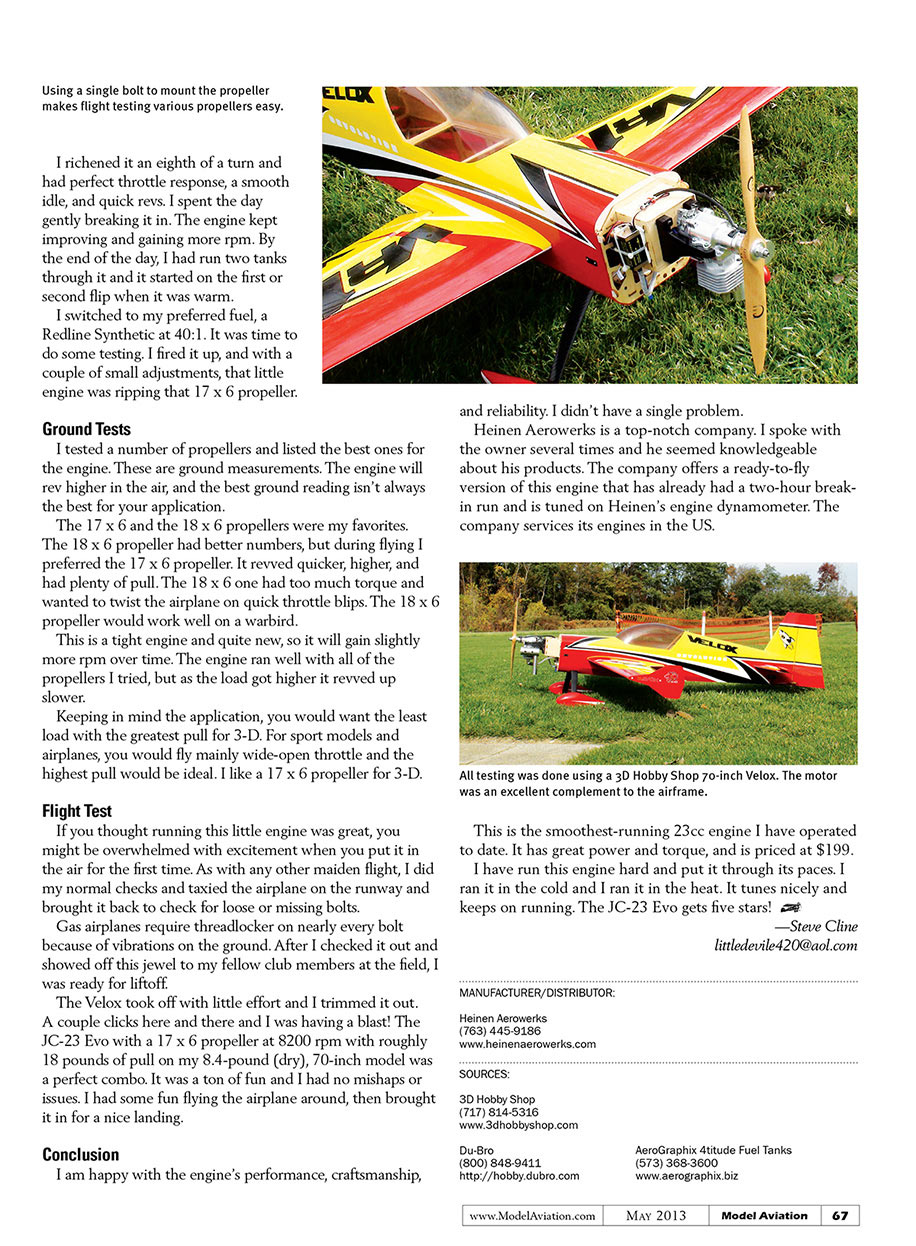
It was time to go outdoors for the initial start-up tuning. I filled my tank with the recommended break-in fuel at a 30:1 ratio of unleaded gas and chose a propeller. My experience with other 20cc-class engines is that they like a 16 x 8 or 17 x 6 propeller, so I grabbed a balanced 17 x 6 one and bolted it on.
The first start on most engines takes several flips to get the carburetor diaphragm wet and pumping. Not wanting to wear out my arm, I grabbed my starter and flicked the choke switch. At half throttle and full choke, it fired immediately. I flipped the choke switch off, lowered the throttle, and it was at a nearly perfect idle.
I tweaked the carburetor setting slightly and achieved a smooth, sewing machine-like idle. After it warmed up, I slowly increased the throttle and tweaked the high end to peak rpm. I richened it an eighth of a turn and had perfect throttle response, a smooth idle, and quick revs. I spent the day gently breaking it in. The engine kept improving and gaining more rpm. By the end of the day, I had run two tanks through it and it started on the first or second flip when it was warm.
I switched to my preferred fuel, a Redline Synthetic at 40:1. It was time to do some testing. I fired it up, and with a couple of small adjustments, that little engine was ripping that 17 x 6 propeller.
Ground Tests
I tested a number of propellers and listed the best ones for the engine. These are ground measurements. The engine will rev higher in the air, and the best ground reading isn’t always the best for your application.
The 17 x 6 and the 18 x 6 propellers were my favorites. The 18 x 6 propeller had better numbers, but during flying I preferred the 17 x 6 propeller. It revved quicker, higher, and had plenty of pull. The 18 x 6 one had too much torque and wanted to twist the airplane on quick throttle blips. The 18 x 6 propeller would work well on a warbird.
This is a tight engine and quite new, so it will gain slightly more rpm over time. The engine ran well with all of the propellers I tried, but as the load got higher it revved up slower.
Keeping in mind the application, you would want the least load with the greatest pull for 3-D. For sport models and airplanes, you would fly mainly wide-open throttle and the highest pull would be ideal. I like a 17 x 6 propeller for 3-D.
Flight Test
If you thought running this little engine was great, you might be overwhelmed with excitement when you put it in the air for the first time. As with any other maiden flight, I did my normal checks and taxied the airplane on the runway and brought it back to check for loose or missing bolts.
Gas airplanes require threadlocker on nearly every bolt because of vibrations on the ground. After I checked it out and showed off this jewel to my fellow club members at the field, I was ready for liftoff.
The Velox took off with little effort and I trimmed it out. A couple clicks here and there and I was having a blast! The JC-23 Evo with a 17 x 6 propeller at 8200 rpm with roughly 18 pounds of pull on my 8.4-pound (dry), 70-inch model was a perfect combo. It was a ton of fun and I had no mishaps or issues. I had some fun flying the airplane around, then brought it in for a nice landing.
Conclusion
I am happy with the engine’s performance, craftsmanship, and reliability. I didn’t have a single problem.
Heinen Aerowerks is a top-notch company. I spoke with the owner several times and he seemed knowledgeable about his products. The company offers a ready-to-fly version of this engine that has already had a two-hour break-in run and is tuned on Heinen’s engine dynamometer. The company services its engines in the US.
This is the smoothest-running 23cc engine I have operated to date. It has great power and torque, and is priced at $199.
I have run this engine hard and put it through its paces. I ran it in the cold and I ran it in the heat. It tunes nicely and keeps on running. The JC-23 Evo gets five stars!
—Steve Cline <REDACTED>
MANUFACTURER/DISTRIBUTOR: Heinen Aerowerks (763) 445-9186 www.heinenaerowerks.com
SOURCES: 3D Hobby Shop (717) 814-5316 www.3dhobbyshop.com
Du-Bro (800) 848-9411 http://hobby.dubro.com
AeroGraphic Altitude Fuel Tanks (573) 368-3600 www.aerographic.biz
Transcribed from original scans by AI. Minor OCR errors may remain.

